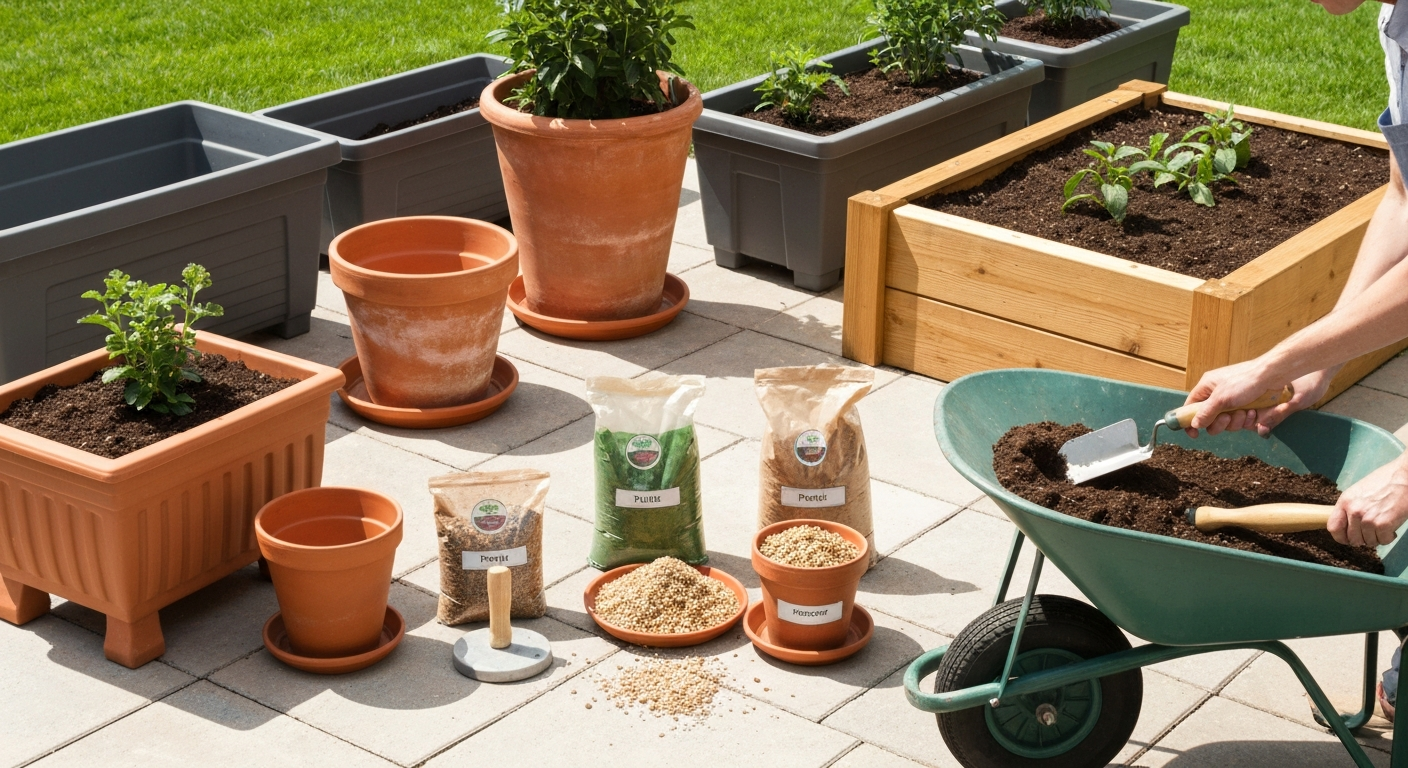
For most patio containers and raised beds, a high-quality commercial potting mix amended with 10–20% extra perlite is the best starting point. It drains freely, stays light enough for decks and raised planters, and gives roots the air and moisture balance they need. Plain topsoil, garden soil, or anything dug straight from the ground will compact, drain poorly, and stress or kill plants in a confined patio setting. The exact mix you need depends on what you're growing, what type of planter you're using, and whether your patio has weight limits or drainage restrictions that rule certain materials out entirely.
Best Soil for Patio Garden: Mixes, Materials & Climate Tips
Nolan Ellison
21 Jul 2026
Why soil choice matters more on a patio than in an open garden
In an open garden bed, roots can travel to find water, nutrients, and air. In a patio planter, they're locked into whatever you put in the pot. That confinement makes every soil property matter more. Get the mix wrong and you'll deal with waterlogged roots, compaction after one season, plants that starve despite regular feeding, or containers so heavy they crack a deck board or shift a paver. Soil choice also has a direct relationship with your patio surface. Heavy, dense soil in large planters sitting on porcelain tile, flagstone, or composite decking creates freeze-thaw stress in cold climates, stains light-colored pavers with tannins and iron, and can hold moisture under pots long enough to encourage surface rot or mold. If you're placing containers directly on your patio surface rather than on feet or stands, the drainage behavior of your mix matters almost as much as the drainage behavior of the paving material itself.
Drainage problems compound fast on patios. A mix that holds too much water will saturate, and that excess has to go somewhere. On gravel patios it disperses easily. On porcelain tile or sealed stone it puddles, stains, and sits. On a rooftop or elevated deck, poor drainage can exceed structural load limits if a planter becomes a vessel of waterlogged, saturated growing media. Weight is the factor most homeowners underestimate. Moist topsoil runs 81–96 lb per cubic foot; saturated topsoil can hit 96–111 lb per cubic foot. A single 24-inch square raised planter filled with 12 inches of topsoil can weigh several hundred pounds when soaked. Lightweight mixes built around perlite, pumice, or expanded clay aggregate cut that number dramatically, which matters on any deck, elevated patio, or rooftop garden.
What makes a soil mix actually good for patio planters
A well-performing patio growing medium balances seven properties at once. Most cheap bagged products optimize for only two or three, which is why even experienced gardeners get frustrated results.
| Property | What to aim for | Why it matters on a patio |
|---|---|---|
| Texture / particle size | Most particles 0.5–4 mm; under 20% below 0.5 mm | Fine particles compact and reduce drainage in containers |
| Total porosity | 60–75% by volume | Roots need air as much as water; low porosity suffocates them |
| Air-filled porosity (after drainage) | 10–20% by volume | Ensures gas exchange after watering; prevents anaerobic root zone |
| Available water | Over 30% by volume after drainage | Sufficient moisture reserve between waterings |
| Drainage / permeability | Fast enough to prevent perched water table | Critical for container health and protecting patio surfaces |
| Weight / bulk density | As low as practical for the application | Deck and rooftop load safety; ease of moving containers |
| pH | 6.0–7.0 for most vegetables and flowers; 5.5–6.5 for acid-lovers | Controls nutrient availability; peat-heavy mixes often need lime added |
| Fertility / CEC | Moderate; supplement with slow-release fertilizer | Containers leach nutrients faster than open beds |
One thing worth calling out specifically: do not add a layer of gravel at the bottom of a pot thinking it will improve drainage. Multiple university extension programs have documented this mistake. A coarse gravel layer below finer potting mix creates a perched water table, meaning water stops moving down at the interface between the two materials and saturates the bottom of the root zone. If your pot has functional drainage holes and a well-textured mix, that's all the drainage system you need.
Containers, raised beds, and in-ground patio planters are not the same thing
These three planting formats look similar but have different soil requirements that trip up a lot of homeowners.
Standard containers and pots
Containers have the smallest soil volume, the most restricted root space, and the most limited drainage (entirely dependent on holes in the base). They heat up and dry out fast in summer, especially on hot patios. They need the lightest, most porous mix you can build, with a strong aeration component like perlite or coarse pumice. Because water and nutrients flush through quickly, regular liquid feeding is essential. Peat-based or coconut coir-based mixes work well here. Never fill a container with straight garden soil or topsoil.
Raised patio beds
Raised beds sitting on a patio surface are larger, deeper (typically 8–24 inches), and heavier. They hold more moisture and temperature buffer than pots, but they're still isolated from the native soil below. A purely peat-and-perlite mix won't hold nutrients through a full growing season in a raised bed. The right approach is a blended mix: compost for fertility and water retention, a coarse aeration component like perlite, and a small percentage of high-quality topsoil (no more than 20–25%) to add mineral content and microbial life. Weight is a bigger concern here than in small pots, especially on decking. Calculate saturated weight before you commit to a fill recipe.
In-ground patio planters (built-in planting pockets)
Built-in planters, meaning planting areas cut into or framed within the patio hardscape, connect to the subsoil below if they have a permeable base. If you're on a patio with clay subsoil underneath (a common concern for homeowners building patios in regions where clay soil is prevalent), that subsoil will wick moisture back up into the planting area and restrict drainage. For guidance on choosing paving and drainage solutions that work well over clay subsoil, see our guide on the best patio material for clay soil. In those cases you need an engineered drainage layer below your growing medium: at minimum 2–4 inches of coarse crushed stone or clean gravel, ideally with a geotextile layer to prevent migration. If the planter is over an impermeable surface like a concrete slab, treat it like an extra-large container and install drainage holes or a perforated drain pipe at the base.
Comparing the main soil types and commercial mixes
| Soil / Mix Type | Best use on patios | Key strengths | Key weaknesses | Rough cost |
|---|---|---|---|---|
| Premium potting mix (bagged) | Containers, small raised beds | Ready to use, good drainage, lightweight | Breaks down in 1–2 seasons; variable quality between brands | $8–$18 per 1–2 cu ft bag |
| Topsoil / screened loam | Large in-ground beds with drainage amendment | Mineral content, microbial life, affordable in bulk | Heavy (80–100+ lb/ft³ wet), compacts badly in containers | $20–$45 per cubic yard bulk |
| Garden soil (bagged) | Raised beds with good mixing | Better structure than topsoil, often pre-amended | Too dense for containers alone; variable drainage | $5–$12 per bag |
| Soilless peat-lite mix (DIY or commercial) | Containers, trays, seedlings | Very light, sterile, excellent drainage and air porosity | No fertility; needs lime + fertilizer; breaks down over time | $10–$20 per cu ft peat; $15–$25 perlite |
| Coconut coir-based mix | Peat-free containers, moisture-sensitive plants | Renewable, neutral pH, good moisture retention | Low natural fertility; needs amendment; variable water-holding | $8–$20 per brick or bag |
| Cactus / succulent blend | Succulents, Mediterranean herbs, drought-tolerant plants | Fast-draining, gritty, prevents rot | Too dry for most vegetables and annuals | $5–$12 per bag |
| Compost alone | Amendment only, not a standalone mix | Excellent fertility and biology | Compacts quickly; holds too much water on its own | $25–$50 per cubic yard bulk |
| Expanded clay / LECA / pumice | Rooftop mixes, hydroponic-adjacent planters | Very lightweight (30–70 lb/ft³ dry), excellent drainage | Expensive; low fertility; needs full nutrient program | $30–$80 per cubic foot specialty |
Commercial potting mixes are convenient but not all equal. Budget brands often skimp on perlite content and rely heavily on bark fines that break down within a season, reducing drainage and causing compaction. If you squeeze a handful of dry mix and it clumps rather than crumbles, or if you see very few white perlite specks, add your own perlite at about 20% by volume before using it. For vegetables and large planters, look for mixes that include compost rather than bark alone. The label should specify components, not just a brand name.
DIY soil mix recipes with actual proportions
I've mixed all of these by hand and at batch scale. All proportions are by volume, not weight, which makes them practical to measure with buckets or a wheelbarrow.
Fast-draining mix for succulents, Mediterranean herbs, and terracotta pots
This mix is built for plants that want to dry out between waterings and hate sitting in moist soil. It works well for lavender, thyme, rosemary, sedums, echeverias, and most cacti on sunny patios.
- 50% coarse perlite or coarse pumice (aim for 3–6 mm particle size; not fine horticultural grade)
- 25% commercial cactus/succulent mix or all-purpose potting mix
- 25% coarse horticultural sand (not play sand or builder's sand, which are too fine)
- Optional: a small handful of dolomitic lime per 5-gallon bucket of mix if using peat-based commercial mix, to raise pH toward 6.5
This formula produces a very fast-draining medium with excellent air porosity. It will dry out quickly in summer, which is exactly what these plants want, but it means you'll need to water more frequently in extreme heat. For pots on dark or heat-absorbing patio surfaces (black composite, dark porcelain, dark stone), add an extra 10% perlite to give roots more air buffer during heat spikes.
Lightweight mix for rooftop patios and weight-sensitive decks
This is the most important recipe to get right structurally. If you're gardening on an elevated deck, balcony, or rooftop, you need to know your surface's live load limit before filling any large planter. blank" rel="noopener noreferrer">The IBC sets a baseline of 20 psf for unoccupied vegetated roof areas, but occupiable roof gardens are held to higher standards, and your jurisdiction may differ. Always check with your structural engineer or building department. Once you know your limit, use saturated unit weight for design, and base that on ASTM E2397 test data from your substrate supplier if you're doing a serious installation.
For a peat-free lightweight mix suitable for rooftop and deck containers:
- 50% expanded clay aggregate (LECA) or pumice, 10–20 mm grade (dry bulk density roughly 480–800 kg/m³ depending on product; verify with manufacturer datasheet)
- 30% coconut coir (peat-free moisture retention component; pH near neutral, avoids the liming step)
- 20% compost (mature, fine-screened; adds fertility and microbial activity)
- Add slow-release granular fertilizer per manufacturer's rate; coir and LECA provide no natural fertility
- Add a wetting agent if using coir blocks that have been dried out, as dry coir can initially repel water
Rooftop and elevated-deck installations also require a full membrane protection stack below any planting area. A proper assembly runs: roofing membrane (EPDM or TPO, minimum specified thickness with fully sealed seams), then a membrane protection board, then a root barrier that complies with ANSI/SPRI VR-1 testing, then a filter fabric, then a drainage/retention layer, and finally your growing substrate. Do not skip the root barrier. Fine root tips will find gaps in roofing seams over time and cause expensive damage. Green-roof system suppliers and membrane manufacturers publish their own required assembly specs; follow the one that matches your membrane.
For extensive rooftop substrates (shallow, 3–6 inch depth, low-growing plants), the general design guideline is 80–90% lightweight mineral aggregate and 10–20% organic matter by volume. This minimizes weight while maintaining enough moisture retention for sedums, grasses, and herbs. Intensive systems with deeper substrate, trees, or vegetables need more organic content and must be engineer-reviewed.
Moisture-retentive mix for vegetables, large planters, and raised beds
Vegetables and large flowering plants need more water-holding capacity and fertility than a fast-draining or lightweight mix provides. This recipe is based on the Cornell/USU compost-based transplant formula adapted for patio raised beds and large containers:
- 1 part mature compost (fine-screened; this is the fertility and moisture-retention anchor)
- 1 part sphagnum peat moss or coconut coir (peat holds 15–30x its weight in water; coir is a peat-free alternative with similar properties)
- 1 part coarse perlite or vermiculite (vermiculite holds slightly more water than perlite; both work)
- If using peat: add approximately 1.5 tablespoons dolomitic lime per gallon of peat in the mix (roughly equivalent to 20 lb per cubic yard of peat) to raise pH; most vegetables want 6.0–7.0
- Top-dress or incorporate a balanced slow-release fertilizer at label rate; compost alone won't sustain heavy feeders like tomatoes or squash through the season
For large raised beds where you're filling significant volume, you can push the compost fraction to 40% and add 10–15% screened topsoil to bring in mineral particles and soil biology. Keep the perlite or vermiculite component at 20–25% minimum to prevent compaction over time. A purely compost-and-topsoil fill without an aeration component will compress by the end of the first season.
Amendable base mix for large raised beds
If you're filling a large raised bed (4 feet wide, 24 inches deep or more) entirely with premium potting ingredients, costs add up fast. This base mix gives you solid structure at a lower per-yard cost that you can amend seasonally:
- 40% bulk compost (bought by the yard; much cheaper than bagged)
- 40% screened topsoil or sandy loam (adds mineral base, reduces cost)
- 20% coarse perlite or horticultural grit (maintains drainage and prevents full compaction)
- Each spring: topdress with 2–3 inches of fresh compost and fork lightly into the top 4–6 inches to restore organic matter and fertility
This mix runs heavier than the pure potting-mix recipes, so it's suitable for ground-level raised beds and built-in patio planters, not for elevated decks or rooftop applications where weight is a constraint.
How patio materials affect your soil and planting choices
The surface your planters sit on matters more than most gardening guides acknowledge. For details on how different paving materials affect drainage and staining, see our patio material comparison. For guidance on picking the best patio material for drainage, see our guide to the best patio material for drainage. For guidance on choosing durable, nonstaining paving and decking, see our guide to the best patio materials. Porcelain tile and polished stone are vulnerable to iron-rich water leaching from soil: the tannin and iron staining from some organic mixes can permanently discolor light-colored pavers. If your patio surface is pale flagstone, white or light porcelain, or light-colored concrete, always use pot feet or drainage saucers, and consider a coir-based mix over a peat-heavy one (peat tends to produce darker, more tannic drainage water). Gravel patios are the most forgiving surface for container gardening: drainage disperses naturally, staining is a non-issue, and you can place planters directly on the surface. Brick and natural stone are moderately tolerant but should be kept dry under pots to prevent moss and biological staining in humid climates. Composite decking is sensitive to pooled water and anything that inhibits the surface from drying: always use pot feet and a saucer that drains, not one that holds standing water.
For built-in planters adjacent to any paved surface, install a physical separation between the growing medium and any paver edge: a strip of root barrier fabric, plastic liner, or treated timber prevents soil and moisture from migrating under adjacent pavers. Frost heave is a particular concern in cold climates, including New England: saturated soil in built-in planters freezes and expands, and if that expansion is adjacent to flagstone, brick, or mortared joints, it will gradually work the paving loose. Designing for drainage and leaving an expansion gap between planter walls and adjacent paving solves this.
Soil for specific site conditions
Clay subsoil under your patio
If your patio sits over clay subsoil, any built-in or open-bottomed planter will drain slowly because clay's permeability is extremely low. The solution is to create a physical drainage break: install a 3–4 inch layer of crushed stone or coarse gravel directly on the clay, then a geotextile filter fabric on top, then your growing medium. This prevents the clay from wicking back up into the planting zone and gives water somewhere to temporarily collect before it slowly percolates. For containers on clay-subsoil patios, the subsoil itself isn't the problem since the pot is isolated, but the patio drainage around the pot may be sluggish, which keeps the area under pots wet and encourages surface mold. Elevating pots on feet is even more important in these situations.
Hot climates
In hot, dry climates, patio containers can lose moisture so fast that even a well-watered pot is bone dry by the following afternoon. For guidance on selecting durable, heat-reflective paving and surface materials that reduce soil and container heat stress, see our guide to the best patio material for hot climate. In this situation, moisture retention matters more than drainage. Lean toward the 1:1:1 compost-coir-perlite recipe over the fast-draining mix, add a tablespoon of water-retaining polymer crystals per 5-gallon pot (use sparingly; too much causes anaerobic conditions), and consider adding 10% vermiculite instead of all perlite since vermiculite holds slightly more water. Light-colored containers and mulching the soil surface with coarse bark or gravel reduces evaporation significantly. Also consider whether your patio surface radiates extra heat: dark composite, dark porcelain, or dark stone can raise soil temperatures significantly in direct sun, stressing roots.
Cold climates and New England winters
Freezing temperatures present two specific problems for patio soil: water expansion in saturated containers cracks pots and damages planter walls, and freeze-thaw cycling degrades organic matter faster and destabilizes soil structure. For cold climates, aim for a mix that drains quickly and doesn't hold excess water going into winter. For guidance on choosing the best patio material for cold climate, including freeze‑thaw resistance, drainage behavior, and compatibility with planter drains, see our guide to the best patio material for cold climate. The fast-draining perlite-heavy mix is a better choice than a moisture-retentive one if you're leaving containers outdoors over winter. Unglazed terracotta cracks in freeze-thaw cycles; move vulnerable pots indoors or switch to fiberglass, metal, or thick-walled polyethylene planters that flex slightly. For built-in planters, ensure they drain completely from the bottom and that there's an air gap or compressible material between the planter walls and adjacent paving to absorb frost expansion without displacing the hardscape. New England soils are often acidic, so if you're incorporating any local topsoil or compost made from local leaf litter, test pH and add lime if needed. For recommendations on the best patio material for New England, see best patio material for New England.
Pet-safe patio gardens
Dogs and cats that access the patio will dig in, chew, or roll in planters given the chance. For guidance on choosing pet-friendly paving and surfaces that are durable and easy to clean, see best patio material for dogs. The soil-specific concerns are cocoa shell mulch (toxic to dogs), certain slow-release fertilizer granules that dogs find attractive and may eat, and sharp grit or perlite at the surface that can irritate paws or eyes. Stick to plain compost-based mixes without added fertilizer granules on the surface; incorporate fertilizers below the soil line or use liquid feeding. Avoid any mulch or amendment that contains cocoa hulls. Large perlite (coarse grade) is safer than fine grades if dogs or cats are digging in the soil. Raised beds with walls at least 18 inches tall also simply keep curious dogs out of the planting area.
Testing and amending what you already have
Before you buy bags of new mix for a built-in planter or decide to amend existing bed soil, it's worth taking a proper sample. University extension programs recommend collecting 10–20 subsamples from across the planting area, slicing to the relevant rooting depth (4–6 inches for containers, 6–8 inches for beds), mixing them together thoroughly in a clean bucket, then sending about 1 cup (250 mL) to a university or commercial soil lab with the lab's submission form. A standard soil test costs $15–$30 and tells you pH, macro and micronutrient levels, organic matter percentage, and often gives amendment recommendations specific to what you want to grow. I've run soil tests on newly filled raised beds and found pH as low as 4.8 in peat-heavy mixes with no lime added, which would have locked out phosphorus and calcium for the whole season. The test paid for itself immediately.
Common amendments and what they fix: dolomitic lime raises pH and adds calcium and magnesium (mix in at roughly 20 lb per cubic yard of peat-heavy medium to get to neutral); sulfur lowers pH for blueberries and acid-loving plants; compost improves structure, drainage, and fertility across nearly all scenarios; coarse perlite or pumice improves drainage and aeration in compacted or clay-heavy mixes; wetting agents help hydrophobic peat that has dried out and started repelling water.
How to calculate how much soil you need
Volume calculations save you from either running short or buying three times what you need. Measure your planter's length, width, and depth in feet, then multiply to get cubic feet. Divide by 27 to convert to cubic yards. For round containers, use the formula: pi (3.14) times radius squared times depth. Bags of potting mix typically state their volume on the label (common sizes are 1 cu ft and 2 cu ft). Bulk compost and topsoil are sold by the cubic yard. A useful rule of thumb: a 4x8 foot raised bed filled 12 inches deep needs about 32 cubic feet, or roughly 1.2 cubic yards of growing medium. That's around 16 bags of 2-cu-ft potting mix, or a little over one scoop from a bulk supplier.
For weight planning on decks and rooftops: multiply the volume of medium (in cubic feet) by its saturated bulk density to get worst-case weight. Premium potting mix saturates at roughly 50–65 lb per cubic foot. Pure perlite or expanded clay aggregate saturates at 30–50 lb per cubic foot depending on grade. Expanded perlite dry density is roughly 6–12 lb/ft3 (100–200 kg/m3) and exfoliated vermiculite ≈4–10 lb/ft3 (64–160 kg/m3); use manufacturer grade data for precise design (Perlite Institute, Perlite properties and densities) Perlite Institute — Perlite properties and densities. Topsoil saturates at 96–111 lb per cubic foot. A 4x4 foot planter filled 12 inches deep with saturated topsoil would weigh over 1,500 pounds, easily exceeding standard residential deck loads. The same planter filled with a lightweight expanded clay and coir mix would weigh under 600 pounds, which is still significant and should be checked against your deck's rated capacity.
Seasonal maintenance and soil longevity
Patio growing media degrades faster than open garden soil. Organic components break down, perlite can settle or wash out over time, and nutrients deplete through watering and plant uptake. Plan for a yearly refresh cycle. In spring, pull the top 2–3 inches of old media from containers, check drainage holes (clear blockages), and refill with fresh potting mix. Scratch in a balanced slow-release fertilizer appropriate for your plants. Every two to three years, consider a full container refresh: empty the pot entirely, check it for root rot or pests, and refill with new mix. For raised beds, the annual topdress with 2–3 inches of compost and a light turn into the top few inches is usually sufficient to keep structure and fertility going without a full replacement.
In winter, protect soil in exposed containers from freeze-thaw damage by wrapping containers in burlap or bubble wrap insulation, moving them against a sheltered wall, or bringing them inside if the container material is fragile. Allowing containers to drain fully before the first hard freeze prevents the cracking caused by water expanding in a full, saturated pot. For raised beds, a layer of straw or shredded leaf mulch applied in late fall insulates the soil, slows temperature swings, and protects soil structure and biology through the winter.
Where to buy soil and what to spend
For small quantities (under 20 cubic feet), bagged products from a garden center or home improvement store are practical. Look for mixes that list their components specifically rather than vague descriptors. For large raised beds, buying compost and topsoil in bulk from a local landscape supplier is significantly cheaper per cubic yard than bagged products: bulk compost runs roughly $25–$50 per cubic yard versus $150–$250 worth of bags for the same volume. Perlite is also significantly cheaper in 4-cubic-foot bags from horticultural wholesalers or agricultural supply stores than in the small bags at garden centers. Expanded clay aggregate (LECA) and pumice for rooftop mixes are most economically sourced from green-roof system suppliers or specialty horticultural distributors; retail prices at garden centers can be three to four times higher for the same material.
One practical note: if your patio is at the end of a long or narrow access path, consider the logistics of moving bulk material. A cubic yard of compost delivered loose takes up the bed of a full-size pickup truck or occupies about the footprint of a washing machine in a pile. If you can't get a wheelbarrow to your patio directly, order in bags even if the cost is higher. It's not a corner worth cutting if it means damaging pavers, fencing, or the patio surface itself moving heavy material through tight spaces.
FAQ
What are simple, reliable soil recipes for patio containers, raised beds, and lightweight rooftop planters (by volume)?
Containers (general flowers/vegetables): 1 part compost : 2 parts sphagnum peat moss (or coir) : 1 part perlite/vermiculite. Seedling/transplant mix (finer, faster draining): 1 part compost : 1 part peat/coir : 1 part perlite. Lightweight rooftop/weight‑sensitive intensive planters: 2–4 parts lightweight aggregate (expanded clay/LECA/pumice) : 1 part compost : 0.25–0.5 part peat/coir (increase aggregate for lower weight). For extensive green roofs (very shallow), follow industry guidance ~80–90% lightweight mineral aggregate + 10–20% organic matter and use professional specs.
How do I convert these volumetric recipes to weights for structural/load checks?
Estimate dry bulk densities from supplier datasheets or use typical ranges: peat/coir (dry) ~6–12 lb/ft3; perlite/vermiculite ~4–12 lb/ft3; screened topsoil/loam ~56–81 lb/ft3 dry and 81–111 lb/ft3 saturated. Lightweight aggregates vary widely (30–70 lb/ft3). Compute component weight = volume (ft3) × component bulk density (lb/ft3); sum components. For rooftop/deck safety, use saturated weight (assume high end for topsoil) and compare to design live/dead load. When in doubt, ask structural engineer and use ASTM/IBC/ASTM E2397 guidance.
What particle‑size and porosity targets make a good container mix?
Aim for most particles between ~0.5–4 mm, with <20% under 0.5 mm. Target total porosity 60–75% by volume, air‑filled porosity 10–20% after drainage, and available water >30% (volume % after drainage). These ranges keep roots oxygenated while retaining usable moisture.
How should I adjust mixes for heavy clay subsoils or poor drainage on the patio?
Do not use native clay as a container or planter fill without heavy amendment. For in‑ground patio planters or beds over clay: excavate and replace with a well‑drained loam/raised mix (1 part screened topsoil/loam : 1 part compost : 1 part coarse sand/perlite) or build raised beds with the container recipes above. Improve site drainage (slope, French drains) and avoid placing planters where water ponds. For containers, include more coarse aggregate/perlite (up to 1.5 parts) to prevent saturation.
What are lightweight aggregate options for rooftop or weight‑sensitive patios and how much do they weigh?
Common options: expanded clay (LECA), expanded shale, pumice, and perlite. Typical dry bulk densities vary by product—roughly 30–70 lb/ft3 (480–1120 kg/m3) depending on material and grade. Always use manufacturer saturated unit weight for design; if unavailable, get a test sample for saturated unit weight. For green‑roof engineering, follow ASTM E2788 and ASTM E2397 when specifying substrate and loads.
What is the building‑code/engineering rule of thumb for rooftop garden loading?
IBC guidance commonly uses a minimum uniform live load for unoccupied vegetated roof areas around 20 psf, but the critical value for planting is the saturated dead load of the media. Use ASTM E2397 to determine saturated substrate weight and confirm the roof structure can handle that plus live loads. Always get structural approval before adding saturated soil loads.