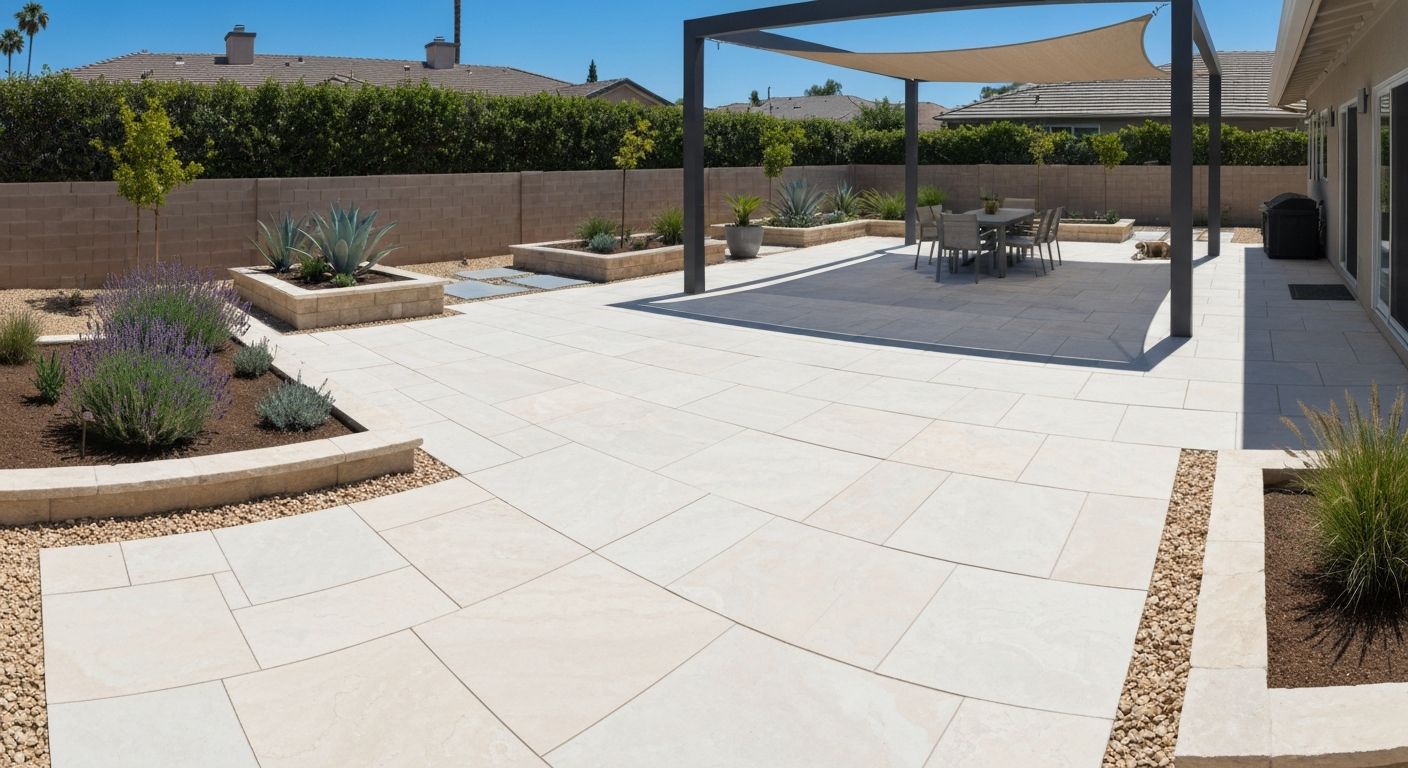
In a hot climate, the best patio materials are light-colored flagstone, porcelain tile with a textured matte finish, and decomposed granite or gravel, because they either reflect heat, drain quickly, or store relatively little thermal energy compared with dark concrete or dense brick. Which one is actually right for your yard depends on how you use the space, your soil type, whether you have pets or a patio garden, and what you're willing to spend. This guide walks through every relevant factor and gives you a clear recommendation for each use case.
Best Patio Material for Hot Climate: Top Picks & Buying Guide
Nolan Ellison
16 Jul 2026
How heat changes the patio-material decision
A patio in Phoenix or Austin behaves completely differently from one in Boston or Portland, and that isn't just about comfort. The surface physics are different. Dense, dark materials absorb solar radiation all day and release it as radiant heat into the evening, a phenomenon that turns a backyard into an oven well after the sun goes down. That same thermal mass that makes brick or dark concrete so effective at moderating temperatures in cold climates (see the contrast with freeze-thaw concerns in New England patios) becomes a liability when ambient temperatures are already in the 90s or higher.
Here are the six factors I look at first on any hot-climate patio project, in order of how much they drive the material decision.
- Surface temperature: how hot the material gets underfoot at peak sun. Light-colored or high-albedo surfaces run 10–20°F cooler than dark surfaces under the same conditions. Reflective pavement field trials in Phoenix showed surface-temperature reductions of roughly 6–12°F at midday, with some afternoon readings averaging about 10.5°F cooler than untreated dark pavement.
- Thermal mass: how much heat the material stores and for how long. Granite has a thermal conductivity of roughly 1.2–4.2 W/m·K and stores heat effectively — which can be good or bad depending on finish and color. Concrete stores moderate heat (volumetric heat capacity around 2.0 MJ/m³·K) but holds it longer than gravel or loose aggregate.
- Slip risk: wet or sweaty feet on a sun-baked smooth tile surface can be dangerous. Slip resistance isn't captured by a single metric — the pendulum wet test (BS 7976), DIN 51130 ramp ratings, and dynamic COF methods all measure different conditions, so always ask suppliers for the specific test method and wet-footing result.
- Drainage: hot climates often produce intense, short-duration thunderstorms. Water needs somewhere to go fast, especially on clay soils that don't absorb quickly. Permeable pavements reduce runoff and provide evaporative cooling that measurably lowers peak surface temperatures.
- Pets: paw pads can burn on surfaces exceeding about 125°F, which dark concrete and brick can easily reach in direct midday sun. Texture and color both matter here.
- Plants and garden compatibility: if you want a patio garden, the material needs to accommodate planters, root intrusion (for mortared joints), and irrigation runoff without staining or degrading.
Top picks by use case and budget
Before the material-by-material deep dives, here are my straight recommendations. If you want the full reasoning, read the sections below, but if you just need a quick steer, this is where to start. For a side-by-side overview of pros and cons, see the patio material comparison.
| Use Case | Top Pick | Runner-Up | Why |
|---|---|---|---|
| Entertaining / barefoot comfort | Light porcelain tile (matte finish, R11 rated) | Buff or cream flagstone | Lowest surface temps, safest wet grip, cleanest look |
| Low maintenance | Porcelain tile | Gravel / decomposed granite | Porcelain needs only occasional sweeping and hosing; gravel needs periodic re-leveling but no sealing |
| Pet-friendly | Decomposed granite or pea gravel | Textured flagstone (unsealed) | Stays coolest underfoot, gentle on paws, drains immediately |
| Budget | Decomposed granite | Gravel | Material costs as low as $1–3/sq ft installed; no mortar or concrete substrate needed |
| Premium / long lifespan | Large-format porcelain pavers (20mm+) | Quartzite or granite flagstone | 50+ year lifespan, near-zero maintenance, premium aesthetic |
| Patio garden setup | Flagstone with open joints / ground cover | Permeable gravel with defined planting pockets | Open joints support low-growing plants; irrigation drains freely; no chemical sealers needed near edibles |
Quick comparison: all materials side by side
| Material | Heat Performance | Slip Risk (wet) | Drainage | Pet-Friendly | Clay Soil Suitability | Garden Compatible | Maintenance | Cost Band (installed, per sq ft) |
|---|---|---|---|---|---|---|---|---|
| Flagstone (light-colored) | Good — reflects well if light; quartzite/buff tones best | Medium — textured surface helps; avoid polished | Good with open joints; needs base prep on clay | Good — rough texture protects paws; stays moderate temp | Moderate — needs compacted base or mortar bed over clay | Excellent — open joints allow planting | Low–Medium (sealing optional) | $15–30+ |
| Porcelain tile (outdoor grade) | Excellent — light finishes reflect heat; matte beats polished | Low–Medium — get R10/R11 rated tile specifically | Poor if solid-set; good with permeable bedding or open joints | Fair — smooth surface can get hot; matte/textured better | Requires rigid concrete substrate (careful curing in heat) | Fair — planters only; joints sealed | Very Low | $20–40+ |
| Brick / clay pavers | Poor–Fair — dark brick absorbs and holds heat; lighter tones help | Low–Medium — tumbled/textured surfaces safer | Good with permeable base; good joint spacing | Fair — can get very hot; lighter brick better | Moderate — flexible laying works on clay if base is right | Good — open joints possible | Medium (sealing, joint sand) | $10–25 |
| Gravel / pea gravel | Excellent — loose aggregate stays coolest overall | Very Low — soft material | Excellent — fully permeable by nature | Excellent — gentle on paws, drains instantly | Excellent — needs minimal base prep | Excellent — planters integrate naturally | Low (raking, top-up) | $2–8 |
| Decomposed granite (DG) | Excellent — light color, permeable, evaporative cooling | Very Low | Excellent | Excellent | Excellent — flexible base | Excellent | Low (re-compaction annually) | $1–5 |
| Concrete (standard) | Poor — stores and releases significant heat; light color+sealer helps | Medium — depends heavily on finish (broom, exposed aggregate) | Poor (solid slab); permeable concrete better | Poor–Fair — can burn paws; broom finish or light color improves | Requires careful hot-weather pour (ACI 305R practices) | Fair | Medium–High (sealing, crack repair) | $8–18 |
Flagstone in hot climates
Flagstone is my personal favorite for hot-climate patios where a garden or natural aesthetic is the goal. The key is choosing the right stone. Quartzite, buff sandstone, and light limestone stay noticeably cooler than dark slate or bluestone in direct sun, granite has a wide thermal conductivity range (roughly 1.2–4.2 W/m·K depending on mineral composition), so a light-colored granite slab and a dark one can behave quite differently. On a project in central Texas, I swapped out the original dark-gray flagstone spec for a cream-colored quartzite and the midday surface temperature dropped enough that the homeowner could walk barefoot on it again by late afternoon.
Pros and cons for hot climates
- Pro: naturally textured surface provides decent slip resistance without special coatings
- Pro: open joints allow full permeability, excellent drainage on clay soils, and planting of low groundcovers like thyme or dymondia
- Pro: high thermal mass means slower heat uptake in the morning and cooler stones earlier in the day compared to concrete slab
- Pro: lifespan of 30–80+ years with minimal intervention
- Con: dark or dense varieties (dark slate, black basalt) get extremely hot — surface temperatures above 140°F in direct sun are possible
- Con: irregular thickness requires more skilled labor and a flexible sand/gravel base or a mortar bed
- Con: porous stones like sandstone can stain from food, oils, or pet accidents if left unsealed
- Con: cost is $15–30+ per square foot installed, higher for large irregular pieces
Safety: slip and surface temperature
Avoid polished or honed flagstone finishes outdoors in any climate, but especially in hot climates where you're more likely to be barefoot, wet, or using misters and water features. A natural cleft or rough-sawn finish is sufficient. If you're installing near a pool or spa, ask your supplier for the pendulum wet-test result or a DIN 51130 R-rating, you want at minimum R10, ideally R11. Unsealed natural cleft flagstone typically meets this. Adding a penetrating silane/siloxane sealer (not a topical film sealer) maintains grip while reducing staining without making the surface slippery.
Pet and garden friendliness
Flagstone with open joints is one of the better options for patio gardens because low-growing groundcovers fill the gaps, reduce the overall hard-surface temperature through transpiration, and give the space a softer look. For dogs, the main issue is surface temperature, stick to light-colored stones, keep joints open for drainage, and provide a shaded area. For a deeper comparison of options optimized for pets, see our guide to the best patio material for dogs. Cats and small dogs with sensitive paws will do better on flagstone than on dark brick or smooth concrete, provided you avoid dark stone varieties.
Drainage and clay soil tips
Clay soil is the enemy of any paved surface because it swells when wet and shrinks when dry, causing heaving and cracking. On clay, I recommend a minimum 6-inch compacted crushed-stone base before laying flagstone. If the clay is highly expansive, consider lime stabilization of the top 6–8 inches of subgrade before adding the stone base, but get the soil tested for sulfates first, because lime treatment in sulfate-bearing soils can cause severe heaving through ettringite formation. Open-joint flagstone laid on a compacted gravel base handles drainage far better than a mortar-set solid installation on clay. For a concise comparison of options and my top picks specifically for clay subgrades, see my guide to the best patio material for clay soil.
Finishes, cooling options, and installation notes
For hot climates, a light reflective sealer or simply choosing inherently light stone colors is the most effective cooling strategy, no special coating needed. Spacing joints at 1–2 inches and filling with decomposed granite, coarse sand, or groundcover plants boosts drainage and reduces radiant heat from the surface. For DIY installation, a dry-laid flagstone patio on a compacted 4–6 inch crushed-stone base is very achievable; mortar-set work requires more experience, particularly managing thermal expansion. In extreme heat, follow the same precautions as hot-weather concreting if using a mortar or concrete bed, work early in the day, dampen the substrate, and keep mortar covered.
Porcelain tile in hot climates
Outdoor porcelain pavers have become my go-to recommendation for homeowners who want the cleanest-looking patio with the least ongoing maintenance. The material is manufactured to near-zero water absorption (≤0.5% per ASTM C373), which means it won't absorb pet urine, cooking oils, or fertilizer, and it won't crack from moisture infiltration the way porous stone can. In freeze-thaw climates that's important for frost resistance, but in hot climates the benefit is stain resistance and thermal stability.
How porcelain tile behaves in heat
Smooth, glossy porcelain in dark colors will get extremely hot in direct sun, I've measured surfaces above 150°F on dark-charcoal tiles. The solution is simple: specify light colors (white, cream, light gray, buff) and a matte or textured finish. Matte-finish light porcelain tiles in the 24x24 or 24x48 format stay surprisingly comfortable underfoot and look excellent. The low emissivity of smooth porcelain (approximately 0.92 by typical field thermography values) means it radiates heat back relatively efficiently, which helps it cool faster in the evening than some denser natural stones.
Pros and cons for hot climates
- Pro: near-zero water absorption — no sealing required, no staining from spills or pets
- Pro: light-colored matte tiles can be among the coolest surfaces available for a formal patio
- Pro: extremely low maintenance — sweep and hose down, that's essentially it
- Pro: consistent thickness simplifies installation versus irregular flagstone
- Pro: 30–50+ year lifespan in a hot climate (no freeze-thaw stress)
- Con: requires a rigid concrete substrate for structural stability — problematic on expansive clay soils
- Con: solid installation is completely impermeable unless you use open joints with permeable bedding
- Con: smooth finishes get dangerously slippery when wet — you must specify R10/R11 or higher slip-rated tile for outdoor use
- Con: large format tiles need expansion/movement joints per TCNA guidelines to handle thermal cycling
- Con: higher installed cost — $20–40+ per square foot depending on tile size and labor market
Slip and footing safety
This is the most common mistake I see with porcelain tile on outdoor patios: people buy a beautiful large-format tile without checking the slip rating, then wonder why the patio feels like an ice rink when wet. Always ask for the specific test method and result, not just a general 'outdoor grade' claim. The DIN 51130 ramp test R-rating and the pendulum wet test (BS 7976) measure different things. For a general patio, R10 wet-rated tile is a reasonable minimum. For a pool deck or area with regular water exposure, R11 or above, with a genuinely textured surface rather than a microscopically etched one.
Substrate, drainage, and expansion in hot climates
On clay soils, the rigid concrete substrate required for porcelain tile is both a challenge and a risk. The concrete slab must be properly engineered for expansive clay, which may mean a thickened-edge slab, a post-tensioned design, or significant subgrade preparation including possible lime or cement stabilization (test for sulfates first). Once the slab is down, hot-weather concreting practices from ACI 305R apply: precool materials, use retarding admixtures if needed, cure aggressively with moisture or curing compound to prevent plastic shrinkage cracking. Expansion joints in the tile system should follow TCNA recommendations for hot climates, typically every 8–12 feet in each direction minimum, and always at structural joints in the slab.
Pet and plant compatibility
Porcelain is easy to clean, which is a genuine advantage for pet owners, but the smooth hard surface isn't great for dogs that pace or run. Lighter-colored matte textured tiles are acceptable for dog-friendly areas as long as the sun exposure is managed with shade structures. For patio gardens, porcelain tile doesn't integrate with planting the way open-joint flagstone or gravel does, you'll be working with raised planters and contained beds rather than any in-ground or joint planting.
Brick and clay pavers in hot climates
I'll be direct about brick: it's a more difficult call in a hot climate than most sources admit. Traditional dark-red clay brick absorbs a tremendous amount of solar radiation and holds it. The thermal properties of fired clay vary significantly by clay mix and porosity, but the practical result on a hot afternoon is a surface that stays uncomfortably warm well into the evening. That said, brick isn't disqualified from hot-climate use, you just need to be deliberate about color, finish, and installation method.
Heat retention and safety
Light-colored brick (buff, cream, pale gray) performs meaningfully better thermally than standard red brick or charcoal pavers. Tumbled or wire-cut brick surfaces provide better wet slip resistance than smooth or glazed faces. For pet owners, the critical test is the midday surface temperature, on a 100°F day, dark brick can reach 150°F or more in full sun. Light buff brick in the same conditions might be 20–25°F cooler, which is the difference between safe and unsafe for paw contact.
Pros and cons for hot climates
- Pro: permeable installation (sand-set with open joints) provides excellent drainage and some evaporative cooling
- Pro: classic aesthetic that suits many home styles and blends well with garden plantings
- Pro: flexible sand-set installation tolerates minor clay-soil movement without cracking
- Pro: repairable — individual units can be lifted and reset if heaving occurs
- Pro: moderate cost — $10–25 per square foot installed
- Con: dark colors absorb and retain significantly more heat than lighter materials
- Con: porous clay brick can stain from oil, food, fertilizer, and pet urine
- Con: joint sand degrades over time and requires periodic replenishment
- Con: weeds can establish in joints, increasing maintenance in warm climates with long growing seasons
- Con: lifespan can be 30–50 years, but grout and joint maintenance is needed throughout
Dealing with clay soils
Brick's biggest hot-climate advantage on clay soil is that sand-set (flexible) installation tolerates subgrade movement far better than a mortar-set or concrete-substrate system. A properly built flexible base, typically 4–6 inches of compacted crushed stone followed by 1 inch of coarse bedding sand, allows minor clay movement without cracking the surface. On highly expansive clay (Plasticity Index above 35), subgrade stabilization is worth considering. Lime treatment at 3–8% by dry weight is a standard approach, but again, sulfate-bearing soils require testing before any calcium-based stabilizer is applied.
Finishes, installation, and cooling for high temps
Polymeric joint sand with antimicrobial additives reduces weed growth and maintains joint stability better than plain sand in hot climates. For cooling, the best options are choosing the lightest available brick color, applying a light-colored reflective sealer, providing overhead shade, or using a permeable installation that supports evaporative cooling. Permeable interlocking concrete pavers (a close cousin of brick) are worth considering specifically for drainage and cooling performance, the engineered open-graded aggregate reservoir beneath permeable interlocking pavers allows rapid infiltration and supports a degree of evaporative cooling that measurably reduces surface temperatures compared with impermeable dense pavement.
Gravel and decomposed granite in hot climates
If your priorities are budget, drainage, and keeping the surface cool for pets and barefoot use, nothing beats gravel or decomposed granite. These materials are fully permeable by nature, which gives them two cooling advantages: water from rain or misters drains away immediately rather than pooling, and wet aggregate provides evaporative cooling that genuinely lowers surface temperatures. Four-year field experiments on permeable sidewalks confirm that permeable surfaces release stored heat faster than impermeable ones, leading to cooler peak daytime temperatures.
Heat performance and comfort
Decomposed granite and light-colored pea gravel or crushed stone stay noticeably cooler than any paved surface in direct sun, for two reasons: light color reflects solar radiation, and the loose aggregate has air gaps that reduce heat storage. On a 105°F afternoon in the Southwest, I've walked comfortably on buff-colored DG while the adjacent concrete patio was unbearable. The material won't burn paws. The main comfort tradeoff is texture underfoot, bare feet on angular crushed gravel can be uncomfortable, while DG compacted with a stabilizer, or rounded pea gravel, is much gentler.
Pros and cons
- Pro: lowest installed cost of any option — DG runs $1–5/sq ft, pea gravel $2–8/sq ft including delivery and labor
- Pro: fully permeable — manages stormwater, supports evaporative cooling, requires no drainage engineering
- Pro: coolest surface temperatures in hot climates
- Pro: gentlest on pet paws of any patio surface
- Pro: easy DIY installation — no concrete, mortar, or substrate needed
- Pro: integrates naturally with garden plantings and raised beds
- Con: not suitable for dining or entertaining furniture (chairs sink in, tables wobble) without stepping stones or pavers
- Con: tracked into the house on feet and paws
- Con: requires periodic raking, re-leveling, and top-up — not zero-maintenance
- Con: DG compacted with stabilizer can become hard and less permeable over time
- Con: can become habitat for ants, wasps, or other insects in warm climates
- Con: weeds can establish if landscape fabric or base prep is insufficient
- Con: not ADA-accessible for wheelchairs or mobility aids unless stabilized
Best base prep for clay soil
Gravel and DG are more forgiving on clay soil than any paved surface, but without basic preparation the material will mix into the clay and disappear over a season or two. The right approach: excavate 4–6 inches, compact the clay subgrade, lay a non-woven geotextile landscape fabric to separate the aggregate from the clay (this preserves permeability over time), then add 3–4 inches of crushed stone base topped with 2–3 inches of DG or gravel surface. For recommendations on selecting the best soil for a patio garden, see our guide to best soil for patio garden. For a concise comparison of options focusing on permeability and runoff, see best patio material for drainage. The FHWA guidance on permeable pavement systems recommends exactly this kind of geotextile separator for aggregate-based drainage sections on low-permeability subgrades.
Edging, compaction, and maintenance
Edging is critical, without a physical boundary, gravel migrates onto lawn and garden beds within a few weeks. Use steel, aluminum, or concrete edging staked firmly at 12-inch intervals. For DG, a plate compactor run over the surface after initial spreading and after top-up applications produces a firmer, more stable surface; stabilized DG (mixed with a polymer binder at the factory) compacts to a firm, walkable surface that holds up well underfoot and under lightweight furniture. Plan to top up gravel or DG every 1–2 years as material compacts or disperses, and vacuum or blow off the surface to remove organic debris that would otherwise feed weeds.
Cooling and long-term expectations
Gravel and DG don't have a traditional lifespan the way a tile or stone installation does, the material itself doesn't degrade, but the system needs refreshing periodically. Expect to add 0.5–1 inch of fresh material every 2–3 years in a high-traffic area, and replace the geotextile separator every 10–15 years if clogging reduces drainage. Cooling performance stays consistent as long as the surface remains light-colored and permeable. If you add misting systems or shade sails over a gravel patio, the combination is genuinely one of the most comfortable outdoor setups available in a hot climate, and among the cheapest to build.
Hot climate vs. cold climate: where the priorities flip
It's worth pausing on how different the material calculus is between hot and cold climates. In a cold-climate patio context, thermal mass is actually desirable, you want a surface that absorbs afternoon sun and radiates it back in the evening. For a detailed comparison of the best patio material for cold climate, see our dedicated guide on cold-climate patio materials. Frost resistance is paramount, so porcelain tile's ≤0.5% water absorption (verified against ASTM C1026 freeze-thaw testing) becomes a critical spec, not just a nice-to-have. See Tile specifications glossary, Tile Shop (explains ASTM/ISO tile tests and thresholds) for the ASTM C1026/ISO 10545‑12 freeze‑thaw test details and acceptance thresholds, porcelain with water absorption ≤0.5% that passes these tests is considered frost‑resistant blank" rel="noopener noreferrer">Tile specifications glossary — Tile Shop (explains ASTM/ISO tile tests and thresholds). Gravel and DG are durable in freeze-thaw but can heave and become uneven. Flagstone in cold climates needs mortar joints or tight fitting to prevent frost-heave displacement. If you're building in a transitional climate that gets both hot summers and cold winters, porcelain tile or quartzite flagstone on a properly engineered base is the safest crossover choice. For guidance specific to cold New England conditions, see best patio material for New England.
Your hot-climate patio decision checklist
Use this checklist before committing to a material. It takes about five minutes and will eliminate at least half the options before you even start getting quotes.
- What is your soil type? If clay (especially high-plasticity or expansive), mark porcelain tile as high-risk unless you can engineer the slab, and favor flagstone on gravel base, brick on sand, or gravel/DG.
- Do you have pets, especially dogs? If yes, prioritize light-colored materials and avoid dark brick or concrete in full-sun areas. DG and gravel are the safest paw-friendly choices.
- Do you want a patio garden with in-ground or joint planting? Flag stone with open joints or gravel with planting pockets are your best fits.
- Is this a formal entertaining space or a relaxed backyard? Formal: porcelain or flagstone. Relaxed/family: brick, gravel, or DG.
- What is your budget per square foot installed? Under $5: gravel or DG. $10–25: brick. $15–30: flagstone. $20–40+: porcelain.
- Are you near a pool or water feature? Specify minimum R10/R11 wet-rated tile or use naturally textured stone — no polished or honed surfaces.
- Are you DIY or hiring a contractor? DG and gravel are genuinely DIY-friendly. Sand-set brick is achievable for a careful DIYer. Mortar-set flagstone and porcelain tile on a concrete substrate are better left to experienced installers.
- Does your climate also get cold winters? If yes, move toward quartzite flagstone or frost-rated porcelain tile and away from porous sandstone or unsealed brick.
FAQ
What are the top patio materials for hot climates by use‑case and budget?
Budget: stamped or broom‑finish concrete (durable, moderate heat retention). Mid‑range: brick pavers or gravel (good drainage; brick varies by mix). Premium: natural flagstone or granite (cooler if light color, high thermal mass) and exterior‑grade porcelain pavers (low water absorption, wide color/finish options). Best for low‑maintenance pet areas: loose gravel or permeable pavers with infill. Best for patio gardens: permeable stone or gravel and raised composite decking. Best for coolest surfaces (daytime peak): light, high‑albedo finishes and permeable systems that allow evaporative cooling.
How does heat retention differ between common materials (concrete, stone, brick, porcelain)?
Concrete: moderate thermal conductivity (~1.3–2.0 W/m·K) and relatively high volumetric heat capacity so it stores heat into the evening. Granite/natural stone: thermal conductivity varies (typical granite ~1.2–4.2 W/m·K) and can store substantial heat depending on density and color. Brick: thermal properties vary widely with porosity and composition; dense fired bricks can store heat, while porous bricks are cooler. Porcelain: thin pavers absorb less heat by mass and porcelain's surface temperature depends strongly on color and emissivity; also porcelain is nearly impervious (≤0.5% absorption) so it behaves differently from porous stone.
Which materials stay coolest in direct sun and what strategies reduce surface temperature?
Coolest choices combine light color/high albedo and permeability: light‑colored flagstone, light porcelain pavers, and reflective/conservative finishes can lower surface temps. Field studies of reflective pavements show daytime surface reductions ≈3–7°C (≈6–12°F). Permeable pavements also run cooler via evaporative cooling and release stored heat faster than dense pavements. Additional strategies: choose lighter colors, high‑albedo coatings or finishes, add permeable joints or aggregate, increase shading (trees, pergolas), and use textured matte finishes to lower radiant heat.
Are porcelain pavers safe and durable in hot climates?
Yes—exterior‑grade porcelain is manufactured to be effectively impervious (water absorption ≤0.5%), resisting staining and thermal cycling. For heat performance, choose porcelain rated for exterior use and verify slip resistance (manufacturer test data). Proper substrate, movement joints, and TCNA/ANSI installation methods are required to accommodate thermal expansion in hot climates.
Which materials are best for pet‑friendly patios in hot weather?
Pet‑friendly options favor lower surface temperatures, soft underfoot, and good drainage: light‑colored flagstone with wide joints filled with decomposed granite or pea gravel; loose gravel (rounded, <1/2" for drainage); artificial turf with cool infill; and permeable pavers. Avoid dark, dense materials that retain heat (dark concrete, dark slate). Provide shaded zones and water access where pets rest.
How should I prepare and build a patio on clay or poorly drained soils in a hot climate?
Address drainage and swelling risk before surface selection: regrade to shed water, install sub‑surface drains where needed, and use an engineered base (open‑graded aggregate reservoir for permeable pavements). For high‑plasticity clays consider lime or cement stabilization (typical lime rates ~3–8% by dry weight) after lab testing. Always test soils for sulfates first—if sulfates are present, calcium stabilizers can produce ettringite and heave; follow geotechnical recommendations or remove/replace troublesome soil.