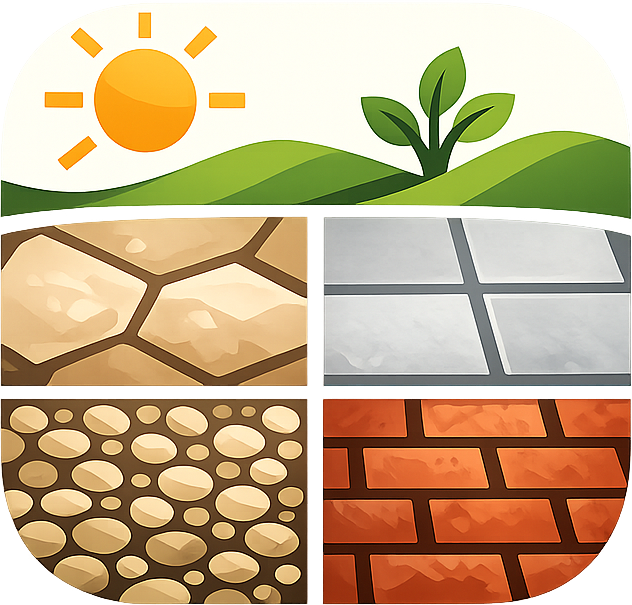
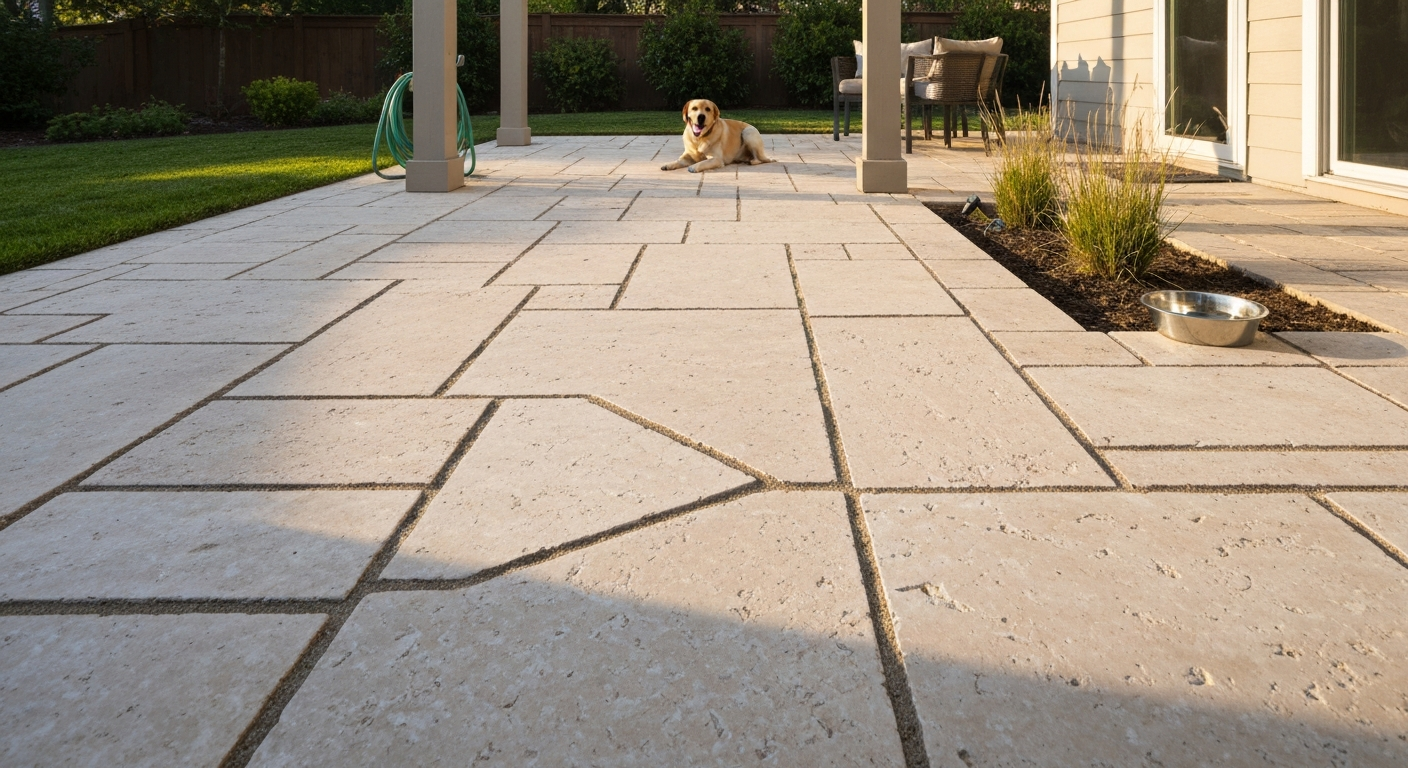
For most homeowners with dogs, textured concrete pavers or tumbled natural stone give you the best all-around result: they stay cooler than solid concrete slabs, drain well when set on a proper gravel base, and their slightly rough surface gives paws enough grip to stop a running Lab in its tracks. If budget is tight, brick pavers are a close second. If you want zero-maintenance joints and a very clean look, matte-finish porcelain tile (DCOF ≥ 0.42) works well in mild climates. The 'right' answer does shift depending on your climate, soil type, and how your dog actually uses the space, which is exactly what this guide walks through. For a deeper comparison of the best patio materials for dog owners, see our guide on best patio materials.
Best Patio Material for Dogs: Durable, Cool, Pet-Safe Guide
Nolan Ellison
28 Jul 2026
What this guide covers
This is a practical, material-by-material breakdown written for homeowners who have at least one dog sharing the patio. Dogs add specific demands that a standard patio buyer's guide glosses over: heat retention that can burn paw pads, slick surfaces that cause joint injuries, porous materials that trap urine odor, and jointing materials that get dug up. I've also factored in climate and soil considerations, because the best material for a Boston backyard on clay subgrade is not the same as the best choice for a Phoenix homeowner dealing with 110°F summers. Where relevant, I'll note how each material holds up in hot climates, cold and freeze-thaw regions like New England, and on clay soil, since those topics come up constantly alongside this one.
Quick top pick by homeowner profile
Rather than one single 'winner,' here is the fastest path to a decision based on common homeowner situations. For a quick patio material comparison, see the side-by-side summary to match materials to your climate, soil, and dog-usage needs.
| Your situation | Top pick | Runner-up |
|---|---|---|
| Hot climate, dogs outside midday | Tumbled flagstone or travertine (light color) | Brick pavers (buff or tan) |
| Cold climate / New England, freeze-thaw cycles | Concrete interlocking pavers (ASTM C1645-rated) | Tumbled brick pavers |
| Clay soil subgrade, drainage concern | Permeable concrete pavers on deep gravel base | Flagstone on 8–12 in. compacted aggregate |
| Budget under $8/sq ft installed | Concrete pavers or brick | Decomposed granite (edged and stabilized) |
| Low maintenance, modern look | Matte porcelain tile (DCOF ≥ 0.42, large format) | Brushed concrete pavers |
| Dog that digs or chews joints | Flagstone set in mortar or polymeric-sand pavers | Solid poured concrete (sealed) |
| Active dogs, wet conditions year-round | Textured concrete pavers or tumbled bluestone | Brick on proper drainage base |
How to choose a patio surface for dogs: the criteria that actually matter
When I evaluate a patio surface for a household with dogs, I run through six questions before anything else. These are not abstract concerns: every one of them has a real consequence for the dog's health or your ongoing workload.
Paw comfort and heat retention
The American Animal Hospital Association notes that pavement surfaces can run 40 to 60°F (roughly 22 to 33°C) hotter than air temperature, and a surface at around 125°F (52°C) can cause a burn in about 60 seconds. That matters enormously in summer. Dark, dense, low-porosity surfaces (polished black granite, dark asphalt, even standard concrete in full sun) hold heat the longest. Lighter-colored, slightly porous, or textured surfaces cool faster. Research published in BMJ Public Health found that modified permeable pavements reduce surface temperature by an average of about 5.5°C compared to conventional asphalt, which is meaningful. In practice: choose light-colored materials, add shade, and if you live somewhere hot, avoid dark solid surfaces entirely for a dog-heavy patio. For a deeper look at choosing the best patio material for hot climates, see our guide on the best patio material for hot climate.
Slip resistance
Dogs, especially older ones or breeds prone to joint problems, need traction. The U.S. standard for wet slip resistance on floor surfaces is ANSI A326.3 (DCOF AcuTest), which sets a minimum wet dynamic coefficient of friction (DCOF) of 0.42 for level surfaces walked on when wet. DCOF AcuTest®, Daltile (explains ANSI A326.3 and the 0.42 benchmark) states that ANSI A326.3 is the U.S. dynamic coefficient-of-friction test method and cites a wet DCOF ≥0.42 as the threshold for level walking surfaces when wet DCOF AcuTest® — Daltile (explains ANSI A326.3 and the 0.42 benchmark). Any tile or paver product you consider should meet or exceed this threshold; manufacturers are required to declare compliance. Natural split-face stone, tumbled pavers, and textured brick all tend to exceed this comfortably. Polished marble and high-gloss porcelain do not.
Drainage
Standing water is a hygiene problem on any patio, and doubly so with dogs. Water pools in paw prints, gets tracked inside, and keeps the surface wet long enough to encourage bacteria and algae. The standard practice is to grade the patio at roughly 1/4 inch per foot (a 2% slope) toward a drain or the yard edge. Permeable systems, like interlocking pavers on a gravel base, also let water move down through the surface rather than just across it. If you're on clay soil, drainage is even more critical: clay doesn't absorb runoff well, so a non-draining surface design leads to pooling and, in cold climates, frost heave. For help choosing the best patio material for drainage, see our dedicated comparison of permeable and well-draining surfaces.
Durability under dog traffic
Nails on a hard surface exert concentrated point loads, especially from larger breeds running and turning. The bigger durability risk is usually at joints and edges: sand-filled joints get excavated by bored dogs, soft sandstone edges chip, and unsealed porous stone absorbs urine and etches over time. Dense, hard materials with strong jointing hold up best under active dogs.
Stain and odor resistance
Dog urine contains uric acid, which crystallizes inside porous materials. Once uric acid crystals are embedded in something like unfinished concrete or sandstone, simple pressure washing will not remove the odor because you're only cleaning the surface, not the crystals deeper in the pores. Enzymatic cleaners work by using enzymes like uricase to chemically convert uric acid into more soluble compounds that can be rinsed out. The review 'Immobilized Enzymes in Biosensor Applications' (PMC) documents uricase's ability to oxidize uric acid to more soluble products, supporting enzymatic cleaner mechanisms Immobilized Enzymes in Biosensor Applications — review mentioning uricase (PMC). Low-porosity materials (dense porcelain, sealed pavers) prevent the urine from penetrating far in the first place, which is a much easier problem to solve.
Ease of cleaning
Weekly routines matter. Smooth, sealed surfaces can be hosed down in minutes. Rough, open-jointed gravel or decomposed granite traps organic debris and dog hair. Ask yourself honestly how much time you'll spend maintaining the surface, and choose accordingly.
Full material comparison at a glance
| Material | Installed cost (approx.) | Durability | Maintenance | Drainage | Heat retention | Slip resistance (wet) | Dog-specific notes |
|---|---|---|---|---|---|---|---|
| Concrete pavers (interlocking) | $8–$18/sq ft | Excellent (30+ yrs) | Low–moderate | Good (permeable option available) | Moderate (lighter colors help) | Good (textured surface) | Best freeze-thaw option; polymeric sand discourages digging |
| Flagstone (irregular) | $15–$30/sq ft | Very good | Moderate | Good (open joints drain well) | Moderate–low (porous, light colors) | Good (natural split face) | Light-colored limestone or travertine stays coolest; seal against urine |
| Porcelain tile (large format) | $12–$25/sq ft | Excellent | Very low | Poor–moderate (slope-dependent) | High if dark/smooth | Poor–good (depends on finish) | Must specify matte/textured, DCOF ≥ 0.42; grout lines need sealing |
| Brick / clay pavers | $8–$15/sq ft | Good–very good | Moderate | Good (permeable base) | Moderate | Good (tumbled or textured) | Buff/tan colors stay cooler; resistant to digging when well-set; absorbs urine if unsealed |
| Gravel / decomposed granite | $2–$6/sq ft | Moderate (replenish needed) | Low–high | Excellent | Low | Moderate (uneven surface) | Cheap; good drainage; dogs may track material; DG stabilized with resin performs better |
| Natural stone: bluestone | $18–$35/sq ft | Excellent | Moderate | Good (split face/joints) | Moderate | Very good (thermal finish) | Thermal or flamed finish critical; smooth bluestone is slick when wet |
| Natural stone: limestone | $12–$25/sq ft | Moderate–good | Moderate–high | Good | Low–moderate (light color) | Good (honed or split) | Very porous; seal essential for urine; one of the coolest surfaces in summer |
| Natural stone: slate | $15–$28/sq ft | Good (varies by origin) | Moderate | Good | Low–moderate | Good (cleft face) | Cleft face is slip-resistant; layered structure can delaminate in hard freeze-thaw |
Flagstone
Flagstone is a broad category covering any flat, naturally split stone used for paving, most commonly sandstone, limestone, bluestone, or travertine cut or broken into irregular slabs. It's one of the most dog-friendly options on paper because the natural texture provides good grip, the open joints drain well, and light-colored varieties like travertine or limestone stay dramatically cooler underfoot than concrete or dark stone.
Pros
- Natural split or tumbled texture gives excellent wet grip, generally well above the DCOF 0.42 threshold
- Open joints drain quickly, reducing standing water and bacterial buildup
- Light-colored varieties (travertine, light limestone) are among the coolest paving options in summer sun
- Relatively forgiving for large irregular dogs running and turning
- Can be reset individually if a slab settles or cracks
Cons
- Cost is higher than brick or concrete pavers, typically $15–$30 per square foot installed
- Sandstone and limestone are porous and absorb urine readily if not sealed
- Irregular joints can be challenging to clean around and accumulate debris
- Some flagstone varieties (especially softer sandstones) chip under concentrated nail traffic over time
- In freeze-thaw climates, porous varieties like sandstone can spall if saturated before freezing
Dog-specific considerations
Seal limestone and travertine flagstone with a penetrating silane/siloxane sealer to reduce urine absorption. Research on penetrating sealers for concrete (which behaves similarly) shows measurable protection lasting roughly 5 to 8 years in field conditions. Plan to reseal every 3 to 5 years for flagstone in a high-use dog area. Fill joints with polymeric sand rather than regular jointing sand to prevent dogs from digging the material out. Avoid polished or honed flagstone in dog areas: the smooth surface becomes dangerously slick when wet.
Climate and soil suitability
In hot climates, travertine and light limestone flagstone are genuinely excellent choices. In New England and other freeze-thaw regions, stick to dense, low-absorption varieties like bluestone or granite-based flagstone rather than sandstone or soft limestone, which can spall from freeze-thaw cycling. For a deeper comparison focused on freeze-thaw durability and local recommendations, see our guide to the best patio material for New England. On clay subgrade, use a deep compacted aggregate base of 8 to 12 inches with a non-woven geotextile separation layer below the stone to limit frost heave and settlement, which is standard geotechnical practice for frost-susceptible soils.
Porcelain tile
Outdoor porcelain tile has improved enormously in the last decade. Modern large-format tiles (24x24 in. or larger) are dense, very low porosity, and some products are specifically rated for outdoor freeze-thaw use. For dogs, the finish is everything: a high-gloss tile is genuinely dangerous when wet, while a matte or structured-surface tile meeting DCOF ≥ 0.42 per ANSI A326.3 can be perfectly safe and extremely easy to clean.
Pros
- Extremely low porosity means urine sits on the surface rather than penetrating, making cleanup simple
- Grout joints can be minimized with large-format tiles and sealed grout
- Very durable surface; resistant to staining, scratching from nails, and chemical cleaning agents
- Wide range of color and texture options, including wood-look and stone-look finishes
- Easy to hose down and disinfect thoroughly
Cons
- Wrong finish choice is a serious safety risk for dogs: polished or even 'satin' tiles can be extremely slippery when wet
- Surface temperature in full sun can be very high, particularly with dark colors and smooth faces
- Requires a rigid, crack-free substrate; movement cracks and frost heave in cold climates can crack tiles
- Professional installation is essentially mandatory for proper results; this is not a good DIY-first project
- Grout lines, even when narrow, need periodic resealing to prevent urine and bacteria infiltration
Dog-specific considerations
Always confirm the manufacturer's declared DCOF per ANSI A326.3 before purchasing. A wet DCOF of 0.42 is the minimum acceptable for a level exterior surface walked on when wet; aim for 0.50 or higher in a dog-heavy space where the tile will be regularly wet from hosing down. Choose light grey, beige, or buff tones in warm climates to keep surface temps manageable. In covered patio areas where direct sun isn't an issue and the surface stays dry, a wider finish choice is acceptable.
Climate and soil suitability
Porcelain tile is best suited to mild climates or covered patios in cold regions. In true freeze-thaw climates like New England, frost heave under the substrate causes tiles to crack and debond unless you have an exceptionally well-drained, frost-stable base, which is expensive to build correctly. On clay subgrade, the movement risk is higher; this combination requires extra investment in base preparation and is generally not the first choice. For hot climates, it works well if you pick the right color and finish.
Gravel and decomposed granite
Gravel and decomposed granite (DG) are the most affordable paving options and have genuinely excellent drainage properties. They're worth considering for a dog yard or secondary patio area, but they come with real trade-offs that matter specifically for dogs.
Pros
- Lowest material cost, typically $2–$6 per square foot installed
- Outstanding drainage: water moves through gravel essentially immediately
- Stays relatively cool because the surface is not a solid heat sink
- Easy to add or replenish; no complex installation for basic applications
- Urine drains straight through, eliminating surface pooling
Cons
- Dogs track loose gravel and DG into the house constantly, and this is not a minor inconvenience
- Loose gravel can irritate paw pads and become embedded between toes, especially angular crushed stone
- Regular dogs will dig in gravel enthusiastically, scattering material and creating holes
- DG without polymer stabilizer turns to mud when wet and powdery dust when dry
- Very difficult to clean hair and debris out of loose gravel
- Edge restraints are mandatory to prevent migration
Dog-specific considerations
If you use DG, always choose the polymer-stabilized version rather than raw DG. Stabilized DG compacts into a firm surface that behaves much more like a hard paving material, dramatically reducing tracking and digging. For gravel, pea gravel (smooth, 3/8 in. rounded) is far more paw-friendly than crushed angular stone. Keep gravel areas separated from the primary entertaining patio with a clear physical edge. I'd honestly use either material in a designated dog run or side yard rather than a main patio where you're also sitting with guests.
Climate and soil suitability
Gravel and DG are excellent in hot, dry climates where drainage and heat are the primary concerns. In wet climates, loose DG degrades faster and requires more frequent replenishment. In freeze-thaw climates, gravel itself handles cold fine, but the surface becomes very uneven after freeze-thaw cycles if not properly edged and maintained. On clay soil, gravel over a geotextile liner is actually a smart drainage solution: the liner prevents clay fines from migrating up into the gravel layer while letting water pass down.
Brick and clay pavers
Traditional clay brick pavers remain one of the most dog-friendly options I recommend regularly. They're firm, slightly textured, available in cooler buff and tan tones, and when laid on a proper base with polymeric sand joints, they're durable and easy to maintain. They also look great in almost any backyard setting.
Pros
- Natural texture provides reliable traction; tumbled brick especially so
- Lighter colors (buff, tan, cream) stay noticeably cooler than dark or concrete-grey surfaces
- Individual bricks can be reset if they settle, heave, or crack
- When set on a permeable gravel base, drainage is excellent
- Very long lifespan when properly installed; some historic brick patios have lasted over a century
Cons
- Clay brick is porous; absorption varies significantly by product. Without sealing, urine can penetrate and cause persistent odor
- Red brick can stain permanently from iron oxidation when repeatedly exposed to organic acids in urine
- In high-rainfall or shaded areas, brick can develop moss and algae that make the surface slippery
- Quality varies widely; low-density brick is unsuitable for outdoor paving in freeze-thaw climates
Dog-specific considerations
Use a penetrating masonry sealer on brick in dog areas. Brick water absorption is measured by Initial Rate of Absorption (IRA) and 24-hour absorption per ASTM C67, and it varies substantially by product: a high-IRA brick will soak up urine fast. Sealing slows that considerably. Reapply sealer every 2 to 4 years depending on traffic. Polymeric sand joints resist dog digging and also inhibit weed growth between joints.
Climate and soil suitability, including clay subgrade
For cold-climate and New England installations, specify pavers rated for freeze-thaw and de-icer exposure. For more on choosing the best patio material for cold climate, see our dedicated guide that compares freeze-thaw durability and suitability by material. The equivalent for concrete pavers is ASTM C1645 testing; for brick, look for products meeting ASTM C67 severe weathering requirements. On clay subgrade, the base preparation matters more than the surface material. FHWA geotechnical guidance recommends undercutting frost-susceptible clay and installing 8 to 12 inches of compacted free-draining aggregate with a non-woven geotextile separator between the clay and the aggregate to prevent fines migration. This is not optional: skipping it on clay is the single most common reason brick patios heave and settle within a few years. A well-built brick patio on properly prepped clay will outperform an improperly installed premium stone patio.
Natural stone: limestone, bluestone, and slate
Natural stone covers a wide range of performance characteristics. The three most commonly used on residential patios, after flagstone generically, are limestone, bluestone, and slate. Each behaves quite differently, and the dog-friendliness of each depends heavily on which specific finish and variety you choose.
Limestone
Limestone is one of the coolest patio surfaces available in summer sun, particularly in light cream and buff tones that reflect rather than absorb heat. It's a genuinely paw-friendly surface temperature-wise. The downside is porosity: limestone and travertine (a variety of limestone) show water absorption rates in the single-digit to mid-range percentages, which is high compared to granite, and urine penetrates quickly into unsealed stone. Sealing is non-negotiable in any dog-heavy installation. Soft limestones are also vulnerable in freeze-thaw climates; stick to dense, hard varieties for New England and similar regions, or use it for a covered patio.
Bluestone
Bluestone is a dense, hard sandstone/graywacke that performs very well in cold climates and is one of the most popular choices in the Northeast. For dogs, the critical distinction is finish: a thermal (flame-textured) or natural cleft bluestone surface provides excellent grip and consistently exceeds DCOF 0.42 when wet. Smooth or honed bluestone is a different story: it becomes genuinely slippery when wet and is not appropriate for dog-heavy patios. Dense bluestone has low absorption rates comparable to granite in some varieties, so urine penetration is less of a concern than with limestone, though sealing is still worthwhile. It handles freeze-thaw cycling very well.
Slate
Slate's natural cleft face is one of the better slip-resistant finishes in any natural stone category, and it tends to stay cooler than darker dense stones. The concern with slate is its layered mineral structure: some slate varieties, particularly softer domestic slates, can delaminate (the layers separate) after repeated freeze-thaw cycles. In mild climates, slate is a durable and attractive choice. In climates with harsh winters, test the specific product's freeze-thaw durability before committing. On clay subgrade, the same deep aggregate base requirements apply as with all other stone materials.
Dog-specific considerations across natural stone
Across all natural stone types, the practical rules for dogs are: choose a cleft, split, thermal, or otherwise textured finish rather than honed or polished; seal porous varieties (limestone, travertine, softer sandstones) with a penetrating silane/siloxane sealer and maintain it every 3 to 5 years; use polymeric sand or mortar-set joints to deter digging; and apply enzymatic cleaner rather than acid-based stone cleaner when dealing with urine stains, since acid cleaners will etch limestone and travertine.
Installation and dog-proofing: what actually matters at build time
The surface material gets all the attention, but the base and drainage setup determine whether your patio survives the first few winters and stays flat and functional over time. I've seen beautiful stone patios fail in two years because the base was wrong, and I've seen modest brick patios still level and stable after fifteen years because the base was built correctly.
- Excavate to depth: for most climates and paver/stone surfaces, 8 to 12 inches of compacted aggregate base is the starting point. In clay or frost-susceptible subgrade, lean toward 12 inches or deeper.
- Lay a non-woven geotextile separator between native soil and aggregate base wherever the subgrade is clay or fine silt, to prevent fines migration into the drainage layer.
- Compact the base in 3 to 4 inch lifts using a plate compactor rather than all at once.
- Grade the base and the finished surface at 1/4 inch per foot (2%) away from the house toward a drain or the yard. This single step eliminates most standing water problems.
- Use polymeric sand for paver joints in dog areas: it resists digging, inhibits weeds, and is available in stabilized formulas that stay in place under rain and hose-down pressure.
- Install edge restraints on all permeable paver and gravel areas to prevent migration.
- For porcelain tile, ensure the substrate is rigid and crack-free; tile is not tolerant of movement.
- Seal porous stone and brick before first use, especially in a dog-heavy patio.
Keeping it clean: the dog-owner maintenance routine
A dog patio needs a different maintenance approach than a standard outdoor surface. The main issues are urine, hair, organic staining, and de-icer damage in winter.
Urine and odor
For surface urine on sealed or low-porosity materials, a diluted enzymatic cleaner followed by a thorough rinse handles routine cleanup. For unsealed porous surfaces (concrete, unfinished brick, limestone) where uric acid crystals have penetrated, enzymatic saturation is essential: apply the cleaner, let it dwell 15 to 30 minutes, scrub, and rinse. For serious penetration in concrete specifically, professional remediation protocols recommend enzymatic saturation plus extraction, followed by a penetrating sealer to lock in remaining residue and block future absorption. A surface pressure wash alone will not eliminate deeply embedded uric acid.
Hair, debris, and general cleaning
Blow or sweep hair off hard surfaces weekly; it mats down and becomes significantly harder to remove when wet. A stiff deck brush and hose handles most routine cleaning on pavers, stone, and brick. For tile, a soft-bristle brush protects the grout. Avoid wire brushes on any natural stone.
De-icing in cold climates
Rock salt (sodium chloride) and calcium chloride de-icers are hard on pavers, stone, and the dog's paws. For dog-safe de-icing, use sand for traction and calcium magnesium acetate (CMA) or urea-based products if melting is necessary. Note that de-icing salts accelerate freeze-thaw spalling on concrete and masonry surfaces not rated for de-icer exposure per ASTM C1645. Research from USGS suggests permeable pavements can maintain warmer subsurface temperatures in winter, which can reduce the need for de-icing salts in some conditions.
Sealer maintenance
Field data on penetrating silane/siloxane sealers shows meaningful protection lasting roughly 5 to 8 years, though in high-traffic dog areas I budget for reapplication every 3 to 5 years. Test with a water drop: if water beads, the sealer is still active. If it absorbs, it's time to reseal.
Budget and sourcing guide
Here are realistic installed cost ranges, including materials, base preparation, and basic labor for a professional installation in most U.S. markets as of mid-2026. DIY installation reduces cost by roughly 30 to 50% on labor, but proper base prep equipment (plate compactor, skid steer for excavation) is not optional and will affect DIY cost calculations.
| Material | DIY material cost | Installed (pro) cost | Best purchased from | DIY-friendly? |
|---|---|---|---|---|
| Concrete interlocking pavers | $3–$8/sq ft | $8–$18/sq ft | Local masonry supplier, big-box stores | Yes, with proper tools |
| Flagstone (irregular) | $4–$12/sq ft | $15–$30/sq ft | Local stone yard or quarry direct | Moderate; heavy and irregular |
| Porcelain tile (outdoor rated) | $4–$10/sq ft | $12–$25/sq ft | Tile specialty retailer | Not recommended without tile experience |
| Brick / clay pavers | $2–$6/sq ft | $8–$15/sq ft | Masonry supplier, salvage yards | Yes |
| Gravel / pea gravel | $0.50–$2/sq ft | $2–$6/sq ft | Landscape supply, bulk delivery | Very easy |
| Decomposed granite (stabilized) | $1–$3/sq ft | $3–$6/sq ft | Landscape supply | Easy |
| Bluestone | $8–$15/sq ft | $18–$35/sq ft | Northeast stone yards | Moderate; requires cuts |
| Limestone / travertine | $5–$12/sq ft | $12–$25/sq ft | Stone specialty supplier | Moderate |
Buying direct from a local stone yard or masonry supplier almost always gives you better pricing and more variety than a big-box store for flagstone and natural stone. For concrete and brick pavers, the big-box options are fine for standard sizes and colors, but specialty masonry suppliers carry freeze-thaw rated and permeable options that are harder to find at home improvement stores.
Decision checklist before you commit
Run through these questions before finalizing your material choice. If you've been thinking through the comparisons above, most of these should already have clear answers.
- What is my climate zone? Freeze-thaw climates (New England, Midwest, mountain regions) eliminate polished porcelain and porous flagstone as primary options.
- What is my subgrade soil? Clay soil requires deep aggregate base (8–12 in.) plus geotextile and possibly underdrains regardless of what surface material I choose.
- How much direct sun does the patio get? Dark surfaces and low-porosity solids in full sun require shade structures or light-colored material choices to protect paw pads.
- How many dogs, and what size? Large active breeds put more demand on joints, edges, and traction than small or older dogs.
- Am I willing to seal and reseal? If not, choose porcelain or concrete pavers rather than porous stone or brick.
- What is my actual installed budget? Don't confuse material cost with installed cost; base prep, labor, and edging add substantially.
- Do I have adjacent planting areas or a patio garden? If so, plan the grading and drainage so runoff from the patio doesn't pool at plant roots, and verify the soil in planters is appropriate for the plants, not just the structural base under the hardscape.
- Is moss or algae a likely issue (shaded, wet climate)? If yes, avoid smooth surfaces and plan for annual anti-algae treatment or choose a textured surface that drains fast.
A note on patio garden areas adjacent to dog patios
Many dog-friendly patios include raised planters or border garden beds. The soil in those planting areas is a separate consideration from the structural aggregate base under your hardscape. For planters, use quality loam or a blended planting mix appropriate for what you're growing; the compacted aggregate base material under your pavers is not suitable planting soil. For guidance on selecting the best soil for patio garden beds, see our guide on best soil for patio garden. Grade the hardscape surface so it doesn't channel runoff directly into planter beds, which can waterlog roots, and be aware that urine from dogs routinely using the adjacent patio will eventually reach bed soil through drainage. High-nitrogen input from dog urine can burn or over-fertilize nearby plants; border plantings near active dog zones should be hardy, nitrogen-tolerant species.
FAQ
What is the best patio material for dogs?
There’s no single best material for every dog/homeowner. For most suburban homeowners with mixed needs (walkability, cleaning, moderate climate), textured porcelain tile or dense natural stone (e.g., granite/limestone with a textured finish) and properly installed concrete pavers rank highest overall. They combine low porosity, good slip resistance when textured, easy cleaning, and durability. If drainage and cooling are top priorities (e.g., active dogs, lots of outdoor bathrooming), permeable gravel or permeable pavers are better. For hot climates prioritize lighter, permeable, or modified surfaces to reduce surface temperature; for cold/New England choose frost‑rated pavers or dense stones with proper base and drainage.
How do I compare materials specifically for dogs?
Compare by: paw comfort (smooth vs textured), slip resistance (wet DCOF/pendulum score), heat retention (darker/concrete/asphalt get hotter), porosity (stain/odor risk from urine), durability (freeze–thaw resistance if you live in cold areas), and ease of cleaning. Texture helps grip but must be balanced with cleanability (very rough stone traps dirt/urine). Permeable systems reduce pooling and subsurface freeze issues but need maintenance to avoid clogging.
Are porous/permeable patios good for dogs?
Yes for drainage and reducing pooling and odors—permeable concrete, permeable pavers, or compacted gravel let urine drain into the base where it’s diluted and flushed away, and they reduce ice formation and some heat buildup. Long‑term infiltration drops with clogging, so design conservatively, use a proper aggregate base, and plan maintenance (vacuuming/blowing and occasional power‑rinsing or surface rejuvenation).
Which surfaces are safest for dog paws in hot weather?
Light‑colored, permeable, or modified pavements that stay closer to air temperature are safest. Avoid dark asphalt and dark smooth concrete/pavers on exposed patios. Provide shade, water, and cooling mats. Remember surfaces can be 40–60°F hotter than air; paw burns can occur at ~125°F in around a minute.
What about cold climates and New England—what should I use?
In freeze–thaw climates choose frost‑resistant materials (factory‑rated concrete pavers, dense granites, or frost‑rated brick) and follow best base practices: undercut frost‑susceptible soils, install 8–12+ inches of compacted, free‑draining aggregate, use non‑woven geotextile where needed, slope the patio ~1/4 in/ft to drains, and consider underdrains/edge drains for clayey sites. Avoid high‑absorption stones and unsealed porous concrete unless properly detailed and sealed.
How do I handle clay soils under a dog patio?
Don’t build directly on undisturbed clay. Undercut poor clay to frost depth or at least 4–8 in., install a geotextile separator, and replace with a compacted free‑draining gravel base (8–12+ in.). Use edge restraints and consider underdrains if runoff collects. These steps limit settlement and frost heave and keep the patio stable for dogs.