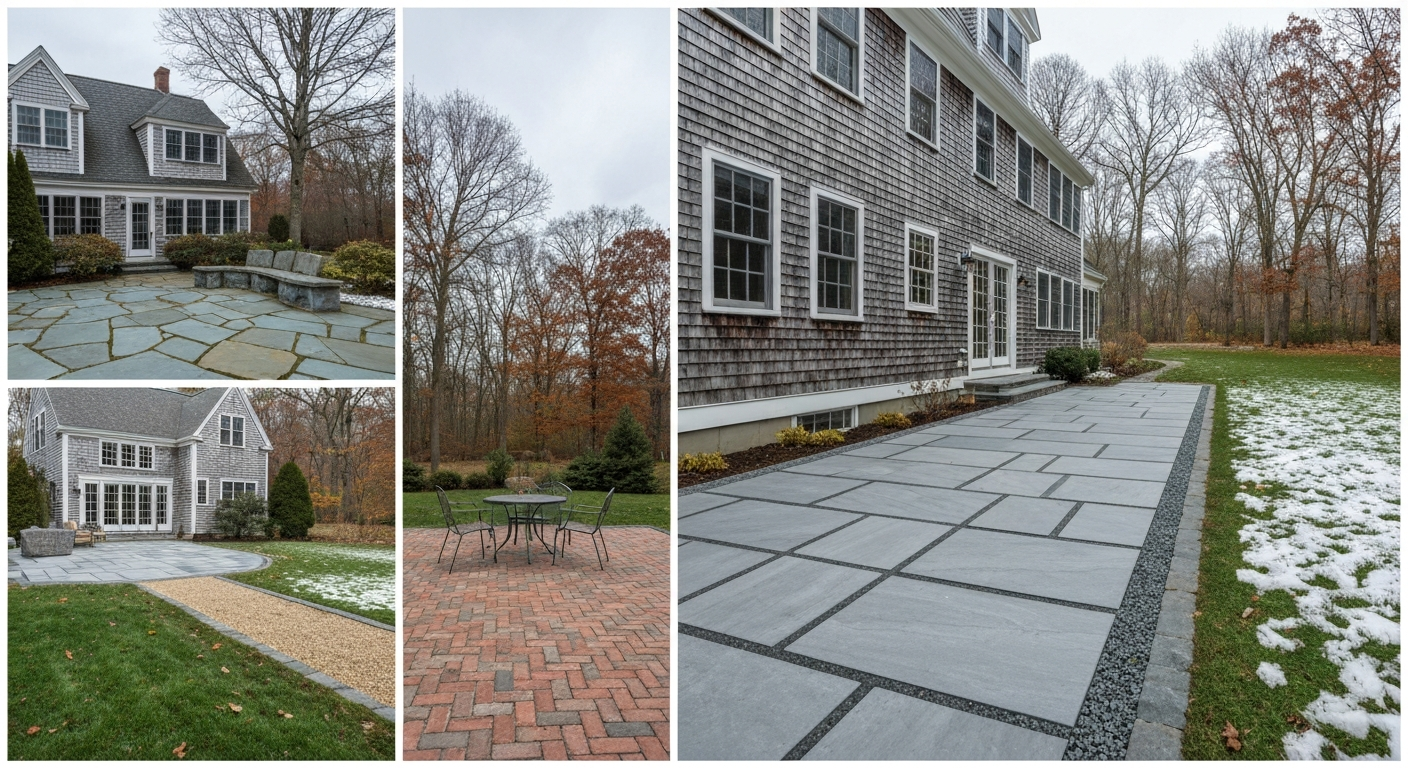
For most New England homeowners, bluestone flagstone or concrete brick pavers set on a properly drained, compacted crushed-stone base are the most reliable all-around patio materials. Both handle freeze-thaw cycling well when installed correctly, are widely available from local quarries and suppliers, and hold up to snow shoveling and de-icing salt with reasonable care. That said, the 'best' material really depends on your site: how well your soil drains, whether you have clay underneath, how much maintenance you want to do, and what you're willing to spend upfront versus over the long haul. For a side-by-side comparison of performance, cost, and maintenance, see our guide to the best patio materials.
Best Patio Material for New England: Compare Flagstone, Brick, Porcelain
Nolan Ellison
18 Jul 2026
Quick recommendations for common New England scenarios
Before diving into the details, here's a fast-reference guide based on the most common situations I see New England homeowners in. These are starting points, not final answers, and the sections below explain the reasoning behind each one.
| Your Situation | Best Material Choice | Why It Works Here |
|---|---|---|
| Heavy freeze-thaw, exposed site, northern Maine or NH mountains | Dense bluestone or granite on compacted base | Low absorption, high frost durability, proven performance in extreme cold |
| Clay-heavy soil with poor drainage | Brick or concrete pavers on open-graded base with geotextile | Flexible system moves with soil, base isolates paver layer from clay movement |
| Low-maintenance priority, moderate budget | Concrete brick pavers | Repairable, widely available, ICPI-spec base handles frost movement |
| High-end look, low maintenance, modern aesthetic | Porcelain pavers (frost-rated, ≤0.5% absorption) | Near-zero water uptake eliminates freeze-thaw scaling risk |
| Tight budget, informal garden area | Compacted gravel or crushed stone | Lowest upfront cost, naturally draining, easy to add to or reset |
| Pet owners or households with kids | Tumbled brick or textured flagstone | Non-slip when wet, no sharp edges, forgiving surface for falls |
| Patio adjacent to garden beds | Flagstone with open joints or gravel | Allows water infiltration, integrates naturally with planted borders |
| Renovation over existing concrete slab | Porcelain pavers or bluestone set in mortar or on pedestals | Avoids full demolition, works on stable existing base |
Key factors to weigh before you choose a material
Every patio project starts with the same basic questions, and skipping any of them usually costs money later. I've seen homeowners fall in love with a material, buy it, and then realize halfway through installation that their site simply doesn't suit it. Here's what to think through before you commit.
Climate and frost depth
New England has some of the most demanding paving conditions in the country. Frost penetration depths vary dramatically by location: many New Hampshire municipalities list a minimum frost line of 48 inches, while exposed or high-elevation sites in Maine can see computed frost depths of 72 inches or more based on design freezing index calculations used by state transportation departments. That means any rigid, mortared patio surface needs either an extremely deep frost-protected footing (impractical for most residential patios) or a flexible sand-set system that can move slightly with the soil and return to level without cracking. Most residential patios go the flexible route, which is why base preparation matters more than material choice in many cases.
Your site: drainage and soil type
Poorly draining clay soil is the single biggest installation risk factor in New England. Clay holds water, which expands when it freezes and can heave a patio surface dramatically over a single winter. The USDA's Web Soil Survey (available free online) lets you look up your property's soil type by county before you dig. For more on choosing and amending the best soil for patio garden sites, see our detailed guide on selecting and improving soil for patio gardens. If you see terms like 'poorly drained,' 'hydric,' or references to a clay layer or fragipan in the description, plan on a thicker base, a geotextile separation layer between subgrade and stone, and possibly perforated drain pipe at the base perimeter. Skipping these steps on clay soil is the most common mistake I've seen on DIY and contractor-built patios alike.
Intended use and foot traffic
A dining patio that sees a few adults in the evening has very different demands than a poolside deck used by wet kids and dogs all summer. Heavier use calls for harder, more abrasion-resistant surfaces like granite or dense porcelain. Light-use garden sitting areas can get away with softer flagstone or gravel. If you're planning outdoor furniture with heavy legs, thin or irregularly shaped flagstone can crack under concentrated point loads, so thickness matters: aim for at least 1.5 inches for flagstone in high-use zones.
Pets
Dogs can be tough on patios. Claws scratch softer stones like slate and some sandstones over time. Gravel can get lodged between paw pads. Smooth polished surfaces like certain porcelain tiles get very slippery when wet. Tumbled or textured surfaces, such as tumbled brick and rough-sawn or sandblasted bluestone, give dogs better traction and resist claw marks better than polished alternatives. For more on pet-friendly choices and traction, see our guide to the best patio material for dogs.
Budget: upfront vs. lifecycle
Material cost is just one part of the equation. A gravel patio might cost $3 to $7 per square foot installed, while premium porcelain or granite can run $25 to $45 per square foot or more depending on your location and the contractor. But that cheap gravel patio needs periodic raking, top-dressing, and edging to stay neat, while a properly installed granite patio essentially takes care of itself for decades. Think in terms of 10- to 20-year total cost, including expected repairs, sealing, and replacement of damaged units, not just what you're spending this summer.
Maintenance tolerance
Be honest with yourself here. Some materials need annual sealing, careful choice of de-icing products, and prompt attention to joint sand washout. Others are nearly maintenance-free. If you're not going to seal a stone patio every two years, choose a material that doesn't need it rather than one that deteriorates without it.
How New England's climate and site conditions affect patio performance
New England's climate puts patios through a stress test that most other regions simply don't experience. Understanding the mechanisms of damage helps you make smarter decisions about material choice, base design, and winter care. For guidance tailored to hot, low-freeze regions, see our coverage on the best patio material for hot climate.
Freeze-thaw cycling
The most damaging thing that happens to a patio in New England isn't a single cold snap, it's repeated cycling between freezing and thawing. Water expands roughly 9% when it freezes. Any water that has absorbed into a porous paving material or pooled in its joints and base can exert tremendous internal pressure as it freezes, causing scaling, spalling, and cracking. This is why water absorption is the most critical material specification for cold-climate patios. Porcelain with ASTM C373-tested absorption of 0.5% or less is essentially immune to this mechanism. Dense granite and some bluestone performs well too. Softer, more porous materials like certain sandstones and lower-grade limestone are vulnerable.
Snow, ice, and de-icing salt damage
Rock salt (sodium chloride), calcium chloride, and magnesium chloride are all effective at melting ice but accelerate surface scaling in cementitious and porous stone materials. Peer-reviewed research confirms that chloride-based de-icers increase internal salt crystallization pressure and surface scaling beyond what freeze-thaw alone causes. If you use any of these products on natural stone or brick, sealing is not optional, it's a maintenance requirement. Safer alternatives for stone surfaces include sand for traction or acetate-based de-icers, though those come with their own cost and availability trade-offs. Porcelain and dense granite are the most salt-tolerant materials you can use.
Snow removal mechanics
A steel snow shovel blade can chip the edges of pavers and tiles, especially at joints. Industry guidance recommends using plastic-edged shovels or rubber-bladed snow equipment for patio surfaces. Snow blowers with skid shoes are fine on most paver surfaces if the shoes are adjusted so the auger doesn't contact the surface. For high-use areas like entries and steps, in-slab electric or hydronic snowmelt systems are worth the investment since they eliminate manual removal and greatly reduce the need for de-icing chemicals.
Drainage and clay soil
Even the best patio material will heave and shift if water is allowed to saturate the subgrade. For guidance on selecting the best patio material for drainage, consult our detailed guide. The standard best practice for frost-resistant patios on any soil, but especially on clay, is: excavate to stable soil, install a geotextile separation fabric, place 4 to 8 inches of compacted crushed stone in lifts (compacted to at least 95% Standard Proctor density for the subgrade and 98% for the aggregate base), add 1 inch of screeded bedding sand, then set your pavers with continuous edge restraints anchored into the base. On persistently wet sites, a perforated drain pipe at the base perimeter directs water away before it can saturate and freeze under your patio. The ICPI (Interlocking Concrete Pavement Institute) publishes detailed technical specs on this, and they're freely available online if you want the full engineering detail. See the Paver & Patio Calculator + ICPI/CMHA Tech Spec references summary (includes PICP guidance and base thicknesses), industry guide / calculator for ICPI/CMHA Tech Spec 18 recommendations on open‑graded reservoir subbase stone, geotextile separation, and underdrains and for guidance on permeable interlocking concrete pavement design and base thicknesses blank" rel="noopener noreferrer">Paver & Patio Calculator + ICPI/CMHA Tech Spec references summary (includes PICP guidance and base thicknesses) — industry guide / calculator.
Flagstone: classic look with some important caveats
Flagstone is one of the most popular patio choices in New England, and for good reason. It looks right at home on a colonial or craftsman property, it's available from local quarries throughout the region, and it gives that irregular, handcrafted appearance that many homeowners want. But 'flagstone' covers a wide range of rock types, and not all of them perform equally well in cold climates.
Pros
- Regionally sourced: New England quarries supply Pennsylvania bluestone, Connecticut bluestone, and local granite-derived flagstone, which keeps costs lower and supports shorter supply chains
- Natural appearance integrates well with traditional New England architecture and garden styles
- Dense, low-absorption types (true bluestone, quartzite) have excellent freeze-thaw durability
- Thickness of 1.5 to 2 inches handles typical residential foot traffic well
- Can be set with open joints for drainage, which helps reduce freeze-thaw pressure at the base
- Relatively forgiving to DIY installation in informal patterns
Cons
- Quality varies significantly by source: some 'flagstone' sold at big-box stores is softer sandstone or low-grade limestone that does not belong in a New England patio
- Irregular thickness makes screeding a consistent bedding layer more difficult, and thin spots crack under furniture or point loads
- Porous types absorb water and salt, leading to spalling and surface flaking within a few winters if not sealed
- Moss and algae growth in shaded areas can make surfaces slippery, especially when wet
- Mortared flagstone joints crack with frost heave and require periodic repointing
- Harder to source in consistent dimensions for a formal, geometric layout
Frost performance and maintenance
Dense bluestone and quartzite flagstone perform very well in New England winters when properly installed on a crushed-stone base with good drainage. The key is always the base, not just the stone. A beautiful piece of bluestone set on an inadequate base will heave and tip. For flagstone specifically, I recommend sand-set installation over mortared joints in most residential applications because the flexible system accommodates minor frost movement without cracking. If you want mortared joints for a more formal look, build on a reinforced concrete slab and accept that you'll be repointing joints every few years. Seal porous flagstone annually with a penetrating siloxane or silane sealer, especially if you're in a zone where calcium chloride or rock salt gets used. Avoid pressure washing in fall since it drives moisture deeper into the stone before freezing temperatures arrive.
Porcelain pavers: the low-maintenance frontrunner for harsh winters
Porcelain pavers have become my go-to recommendation for homeowners who want the lowest possible maintenance in a New England climate. For a side-by-side patio material comparison, see patio material comparison to weigh porcelain against natural stone, brick, and gravel for New England conditions. For a deeper comparison of options, see our guide to the best patio material for cold climates. The material science is straightforward: porcelain is classified by ASTM C373 as having water absorption of 0.5% or less by mass, which means there's almost no water entering the material to freeze, expand, and cause damage. When you also have ASTM C1026 freeze-thaw test data from the manufacturer, you can specify porcelain pavers with genuine confidence that they'll survive northern winters without scaling. ASTM C373 specifies porcelain tile as having water absorption ≤0.5% by mass, and ASTM C1026 outlines standardized freeze‑thaw test methods for ceramic tiles blank" rel="noopener noreferrer">ASTM C373 (porcelain absorption ≤0.5%) and ASTM C1026 (freeze‑thaw test).
Pros
- Extremely low water absorption (≤0.5% per ASTM C373) makes them the most frost-resistant paver material available
- ASTM C1026 freeze-thaw test data available from manufacturers for specification
- Salt-resistant: de-icing chemicals don't cause the scaling that affects natural stone and brick
- Virtually no sealing required
- Available in large formats (24x24 and 24x48 inches) for a contemporary look
- Consistent dimensions simplify installation compared to irregular flagstone
- Can be installed over existing concrete slabs on pedestals, avoiding full excavation
Cons
- Higher material cost than brick or gravel, typically $12 to $25 per square foot for quality frost-rated product
- Polished or smooth finishes are slippery when wet or icy; specify textured or R11-rated slip-resistant surfaces for outdoor use
- Chips and cracks are difficult to repair invisibly since porcelain doesn't age the way natural stone does
- Large-format tiles require a very flat, stable base: any settling becomes immediately visible
- Fewer local suppliers in rural New England compared to natural stone; shipping from distant distributors adds cost
- Not sourced regionally, which matters for homeowners prioritizing local materials
Frost performance and maintenance
Properly specified frost-rated porcelain pavers with documented ASTM test data are as close to maintenance-free as a New England patio gets in terms of freeze-thaw durability. The main maintenance tasks are keeping joints filled with polymeric sand to prevent weed intrusion and water infiltration, occasional cleaning with a pH-neutral cleaner, and prompt removal of standing water in fall. Unlike natural stone, you don't need to apply sealers annually. For snow removal, use a plastic-edged shovel and avoid steel blades that can chip corners and edges, particularly on large-format tiles where edge chipping is the most visible damage mode.
Brick pavers: proven, repairable, and deeply at home in New England
Brick has been used for hardscape in New England for centuries, and there's a reason it's still one of the most popular choices. Genuine clay brick pavers (not concrete brick) have a warm, traditional appearance that suits colonial, federal, and craftsman architecture especially well. Concrete brick pavers are more dimensionally consistent and slightly less expensive but don't have quite the same look. Both can perform well in cold climates when properly installed.
Pros
- Classic New England aesthetic suits the region's architectural heritage
- Individual pavers can be removed and reset when frost heave displaces them, making repairs simple and low-cost
- Tumbled brick gives excellent traction when wet, suitable for pet-friendly and family patios
- Widely available from regional suppliers and masonry yards
- Reclaimed brick from demolition projects is abundant in New England and adds character at lower material cost
- ICPI-spec sand-set installation on a proper compacted base handles frost movement with minimal long-term damage
Cons
- Clay brick is more porous than porcelain or dense granite: sealing is recommended to reduce salt and water absorption
- Lower-grade brick not rated for exterior paving (SW grade or SX grade required) will spall and flake within a few winters
- De-icing salts accelerate surface scaling, especially on unsealed brick near driveways or walkways where heavy salt use is common
- Joint sand can wash out over time, allowing weed growth and destabilizing the surface if not maintained
- Concrete brick may fade over years; clay brick retains color better
- Requires precise grading and a good base to stay level: settling in any one area creates trip hazards
Frost performance and maintenance
The key specification for clay brick pavers in New England is the ASTM C902 or C936 designation: look for SX (severe weathering) or SW rating, which indicates the brick has been tested for severe freeze-thaw conditions. Never use interior or 'building' brick for a patio in New England regardless of how good a deal it seems. For concrete brick pavers, look for products that meet ASTM C936 with documented freeze-thaw test compliance. Annual or biennial sealing with a penetrating sealer is worth doing, especially if de-icing products contact the surface. Polymeric sand in the joints helps prevent washout and weed intrusion. Individual units that heave or crack can simply be pulled up, the base re-leveled, and the unit reset or replaced, which is a significant practical advantage over monolithic surfaces like poured concrete.
Gravel and compacted stone: the honest workhorse
A well-built gravel patio is one of the most underrated options in New England, particularly for informal gardens, side yards, or homeowners on a tighter budget who want a functional outdoor space without a large capital outlay. It's also one of the most drainage-friendly surfaces you can build, which matters a great deal on clay-heavy sites where runoff and standing water are a concern.
Pros
- Lowest installed cost of any patio option, typically $3 to $8 per square foot depending on material and edging
- Naturally permeable: water drains through the surface rather than pooling, reducing runoff and freeze-thaw base saturation
- Easy to install as a DIY project; no specialized tools or skills required for basic compacted gravel
- Regionally abundant: crushed granite, trap rock, and pea gravel are all widely available in New England
- Simple to modify, extend, or change grade if needed
- Works well as a base layer under stepping stones or flagstone in a hybrid design
Cons
- Requires periodic raking and top-dressing as material migrates or compacts over time
- Not comfortable for bare feet, unstable in sandals or heels
- Can scatter onto lawn or garden beds if edge restraints are inadequate
- Not a good surface for outdoor furniture: legs sink in and tip on loose stone
- Dogs can kick it out of the patio area and may track it inside; some dogs develop a preference for using it as a bathroom, which complicates odor management
- Weeds can establish in the gravel over time even with landscape fabric underneath
Frost performance and maintenance
Gravel is essentially immune to freeze-thaw damage as a material, since individual stone pieces simply cannot crack under frost heave the way a monolithic surface can. The real risk on gravel patios is edge erosion and base migration. Use rigid steel or aluminum edging anchored with spikes to contain the material. On clay soil, install a geotextile weed barrier and separation fabric over the subgrade before adding stone. For a more stable surface, compacted crushed stone (angular, not round pea gravel) compacts into a firm surface when properly installed at 4 inches or more depth. Angular crushed granite or trap rock interlocks under compaction far better than smooth river stone. Annual top-dressing with a quarter-inch of fresh material and a quick rake keeps the surface looking clean.
Natural stone options: bluestone, granite, and slate
Natural stone is where New England truly shines as a region. The geology of the Northeast produces some of the finest building and paving stone in North America, including true bluestone (a dense sandstone/siltstone found in the Hudson Valley and Connecticut), granite in virtually every county, and slate from Vermont and Maine. These materials are not interchangeable, and their freeze-thaw performance varies significantly.
Bluestone
True bluestone is the workhorse of New England patios. Dense, with relatively low absorption for a sedimentary stone, it splits naturally into flat slabs that are ideal for paving. It performs well in freeze-thaw conditions when properly sealed and installed on a good base. The main risk is buying 'bluestone' that is actually a softer, more porous material from a different quarry region. Always ask for quarry certification or an absorption test result, and buy from a reputable local stone yard that can tell you where the material came from. Connecticut bluestone from the Hartford Basin and Pennsylvania bluestone from the Delaware River Valley are both well-regarded. A natural thermal finish (rough-sawn) provides better traction than a smooth sawn face.
Granite
Granite is the most durable natural paving material available in New England, full stop. As an igneous rock with very low porosity, it is highly resistant to freeze-thaw cycling, abrasion, salt, and staining. New Hampshire and Maine both have active granite quarries producing paving-grade material. Cobbles, setts, and cut slabs are all available. The downsides are weight (granite is dense and heavy to handle), cost (premium material, premium fabrication), and slip resistance on polished or wet surfaces. For patios, specify a flamed or bush-hammered finish rather than polished; it provides a rougher surface that's dramatically safer when wet or icy. Granite is also excellent for coping, steps, and edging on patios built with other field materials.
Slate
Vermont and Maine slate is beautiful, and it's tempting to use locally quarried material for a patio in those states. However, slate requires more care in New England outdoor applications than either bluestone or granite. Slate is a metamorphic rock that splits along distinct cleavage planes, and thin-gauge slate (less than 1 inch) can delaminate and flake when water infiltrates between layers and freezes. Thicker Vermont slate (1.5 inches or more) performs better, but the surface is still more vulnerable to salt than granite. If you want slate, use it in protected or semi-covered areas, seal it every one to two years, and keep de-icing products off it entirely. In fully exposed locations with heavy snow and ice management, granite or bluestone is a safer long-term investment.
Natural stone: frost performance and maintenance summary
For all natural stone patios in New England, the maintenance routine is: seal with a penetrating siloxane or silane-based product at installation and repeat every one to two years depending on product and exposure. Keep chloride-based de-icers off the surface; use sand for traction or a calcium magnesium acetate product if you must chemically treat. Clean with a pH-neutral stone cleaner rather than acidic or bleach-based products. Check joint sand annually and refill as needed. Inspect for cracked or chipped units after the first winter and reset or replace before the second freeze cycle works them looser.
Material comparison: how the options stack up
| Material | Freeze-Thaw Durability | Salt Resistance | Slip Resistance (wet) | DIY-Friendly | Typical Installed Cost/sq ft | Sealing Required | Repairability |
|---|---|---|---|---|---|---|---|
| Bluestone flagstone | Good (dense types) | Moderate (seal required) | Good (thermal finish) | Moderate | $15–$28 | Yes, every 1–2 yrs | Moderate: individual stones can be reset |
| Porcelain pavers (frost-rated) | Excellent | Excellent | Good (textured grade) | Moderate | $18–$35 | No | Difficult: chips visible, hard to match |
| Brick pavers (SX/SW grade) | Good | Moderate (seal recommended) | Good (tumbled) | Yes | $12–$22 | Yes, every 2 yrs | Excellent: individual units replaceable |
| Compacted gravel/crushed stone | Excellent (material) | N/A | Fair | Yes | $3–$8 | No | Excellent: add material as needed |
| Granite | Excellent | Excellent | Good (flamed/textured) | No (heavy) | $22–$45+ | Minimal | Moderate: matching slabs available |
| Slate | Fair–Good (thick gauge) | Poor–Moderate | Good (natural cleft) | No | $18–$32 | Yes, every 1–2 yrs | Difficult: matching color/texture |
Installation essentials for frost-resistant patios
No matter which surface material you choose, the base system underneath it determines whether your patio survives New England winters intact. I'd rather see a homeowner install a modest material on an excellent base than a premium stone on an inadequate one. Here's the installation sequence that works.
- Excavate to firm, undisturbed subgrade, removing all organic material and soft spots. Depth depends on your finish thickness plus base depth, typically 10 to 14 inches total on well-drained soil, more on clay
- On clay or poorly drained soil, lay a non-woven geotextile fabric over the subgrade before adding any base stone to prevent clay migration into the aggregate
- Install 4 to 8 inches of compacted crushed stone (angular, not round) in 2- to 3-inch lifts, compacting each lift with a plate compactor to at least 95% Standard Proctor density at subgrade and 98% for the aggregate base
- On wet sites or those with high clay content, consider an open-graded (gap-graded) aggregate subbase or install a perforated drain pipe around the perimeter before backfilling with compacted stone
- Add 1 inch of coarse bedding sand (concrete sand or stone dust), screed flat, and do not compact it at this stage
- Set pavers or stones in the bedding sand, maintaining consistent joint spacing
- Install continuous rigid edge restraints (plastic or aluminum paver edging, or stone-on-edge or concrete curbing) anchored with spikes driven into the compacted base
- Sweep joint sand (polymeric sand for best weed and erosion resistance) into joints, then compact the surface with a plate compactor over a protective pad
- Ensure positive surface drainage: slope the patio a minimum of 1/8 to 1/4 inch per foot away from the house foundation
One thing I'll add from personal experience: the step most DIYers skip is adequate compaction of the subgrade and base layers. Renting a plate compactor is not optional on a frost-susceptible site. A tamper and your body weight simply cannot achieve the density you need to resist freeze-thaw movement. If you're hiring a contractor, ask specifically how they're handling base compaction and what depth of base they're proposing, since this is the most common place cost-cutting happens invisibly.
Winter care and snow removal
A patio that's built right still needs sensible winter management. Here's the practical routine I recommend for New England homeowners regardless of their surface material.
- Use a plastic-edged shovel or push plow with a rubber blade for snow removal; steel edges chip paver corners and tile edges
- Avoid piling snow on the same area repeatedly since concentrated melt-refreeze cycles in snow piles are especially damaging to surface and joints
- If you use de-icing chemicals, use sand mixed with a small amount of calcium magnesium acetate (CMA) rather than rock salt on natural stone, brick, and concrete pavers; reserve full-strength calcium chloride for emergencies only on entry steps and keep it off the main patio field
- For high-use areas like steps, entries, and transitions, consider an electric snowmelt mat or hydronic system embedded in the base: these eliminate manual snow removal and de-icing chemical use entirely
- In fall, refill any joint sand that has washed out before the ground freezes; empty joints collect water that freezes and widens joints over winter
- Apply or reapply penetrating sealer to natural stone and brick patios in early fall, before temperatures drop below 40°F
Budgeting and sourcing in New England
New England is one of the best regions in the country for sourcing natural patio stone locally. Maine, New Hampshire, and Vermont have active granite quarries; Connecticut and the Hudson Valley (accessible to western New England) have bluestone; Vermont and Maine have slate. Buying directly from a regional quarry or a masonry yard that sources regionally typically gets you better quality and lower cost than big-box stores, where stone provenance is often vague and quality control is inconsistent. Ask where the stone was quarried, not just what it's called.
Reclaimed brick is abundant in New England given the region's inventory of older industrial and commercial buildings that are regularly demolished or renovated. Reclaimed SX-grade brick from a reputable salvage yard is often an excellent value, especially for traditional or historic properties. Inspect individual pieces for spalling, fractures, and soft spots before buying; reclaimed brick quality varies widely within a single lot.
When budgeting for contractor installation, get itemized quotes that separate material, excavation, base work, installation, and edging costs. Base work (excavation, geotextile, aggregate, compaction) typically represents 30 to 50% of total project cost on a residential patio. If a quote seems suspiciously low, base depth and compaction are almost always where corners are being cut. A properly built patio base is not something you'll be able to see after the project is done, which makes it an easy place for an unscrupulous contractor to skimp. Ask for photos of the base at different stages or schedule a site visit during installation.
A quick decision checklist
Use this checklist before finalizing your material and installation plan. If you can answer all of these confidently, you're ready to move forward.
- Have I checked my local frost line depth? (Call your building department or check local municipal building criteria.)
- Have I identified my soil type using the USDA Web Soil Survey or a simple soil test? Do I have clay or poor drainage to address?
- Have I specified a freeze-thaw rated material? (SX brick, ASTM C1026-tested porcelain, dense bluestone or granite with absorption data.)
- Is my base plan at least 4 to 6 inches of compacted crushed stone, with geotextile on clay or wet sites?
- Do I have a drainage plan that directs surface water away from the patio and the house foundation?
- Have I planned for continuous rigid edge restraints?
- Do I have a winter maintenance plan that avoids steel snow shovels and heavy chloride de-icers on natural stone or brick?
- Have I factored in the cost of sealing and joint sand maintenance over a 5- to 10-year horizon?
- If I have pets, is my surface choice textured and non-slip when wet?
- Have I gotten itemized quotes that show base work and compaction as separate line items, not lumped into a flat installation fee?
FAQ
Which patio material holds up best to New England freeze–thaw cycles?
Porcelain pavers with documented low water absorption (≤0.5% per ASTM C373) and dense natural stones (granite, dense quartzite/gneiss) perform best because low porosity reduces internal ice‑expansion damage. Well‑installed concrete pavers with proper base and drainage also perform well. Softer, porous stones (some sandstones/bluestone/limestones) and untreated cast concrete can be vulnerable unless tested, sealed and installed with frost‑resistant details.
How do freeze–thaw and de‑icing salts affect each material?
Freeze–thaw damages porous materials by water absorption and internal ice pressure; salts accelerate surface scaling and internal crystallization. Porcelain and dense granites resist this best. Concrete and softer natural stone can scale with repeated freeze‑thaw plus chlorides unless kept dry, sealed, or protected. Gravel and some permeable systems avoid surface scaling but can be impacted by salt runoff and sediment clogging.
How important is drainage and subgrade preparation in New England?
Critical. Because frost penetration and groundwater vary across New England, good positive surface drainage, a well‑graded, compacted crushed‑stone base (typ. 4–8 in. for patios; deeper or open‑graded reservoir for permeable systems), geotextile separation over clay, and underdrains where needed are far more effective than relying on 'frost depth' alone. Proper base and compaction control frost heave and preserve the paving surface.
Which materials are best for clay or poorly drained soils?
If the site has clay or high water table, use an engineered subbase: geotextile, open‑graded reservoir stone or thicker compacted crushed stone, and underdrains to move water away. Porcelain and pavers set on a proper aggregate base work well. Avoid simple loose gravel placed directly on clay without separation or drainage — it will rut and migrate. Permeable paver systems can work if designed to avoid clogging.
What patio material is most pet‑friendly?
Smooth, low‑porosity surfaces are easiest for pets: porcelain pavers or well‑finished concrete pavers provide solid footing and are simple to clean. Avoid very rough, jagged flagstone that can abrade paws. For dogs that run, choose non‑slip, textured finishes rather than glossy surfaces that become slick when wet or icy. Consider heat (dark surfaces heat in sun) and whether you need easy waste cleanup.
How do installation best practices differ by material?
Common essentials: establish positive drainage, prepare/compact subgrade, install geotextile separation over weak/clayey soils, build an appropriate aggregate base compacted in lifts to spec, use a screeded bedding layer for pavers/flagstone or mortar/setting bed for some natural stone, and install continuous edge restraints. Porcelain requires frost‑rated installation methods (pedestal, mortar, or sand bed per manufacturer) and anchoring; brick and interlocking pavers follow ICPI specs (edge restraints, 4–8 in. base). Gravel needs confinement (edging) and a good subbase to avoid migration.