For most homeowners, concrete pavers or brick pavers are the best all-around patio surface: they handle freeze-thaw cycles well when installed on a proper compacted base, cost $10–$30 per square foot installed, are repairable without tearing out the whole patio, and come in enough styles to suit almost any aesthetic. That said, the "best" surface really does depend on your climate, how the space gets used, and what you're willing to spend and maintain. Flagstone wins for rustic natural beauty. Porcelain tile wins for modern, low-maintenance slabs. Gravel wins for tight budgets. Natural travertine wins poolside in hot climates. This article walks through every major option with real cost ranges, honest trade-offs, and scenario-based picks so you can make a confident decision. For a quick comparison of top picks by scenario, see our guide to the best patio surface. For a quick comparison of materials and pros and cons, see our guide to the best patio flooring (ff79ec40-4f2c-4b26-81ef-942d80a8f1f5).
What Is the Best Surface for a Patio: Materials, Costs, Uses
Best patio surface by use-case: quick recommendations
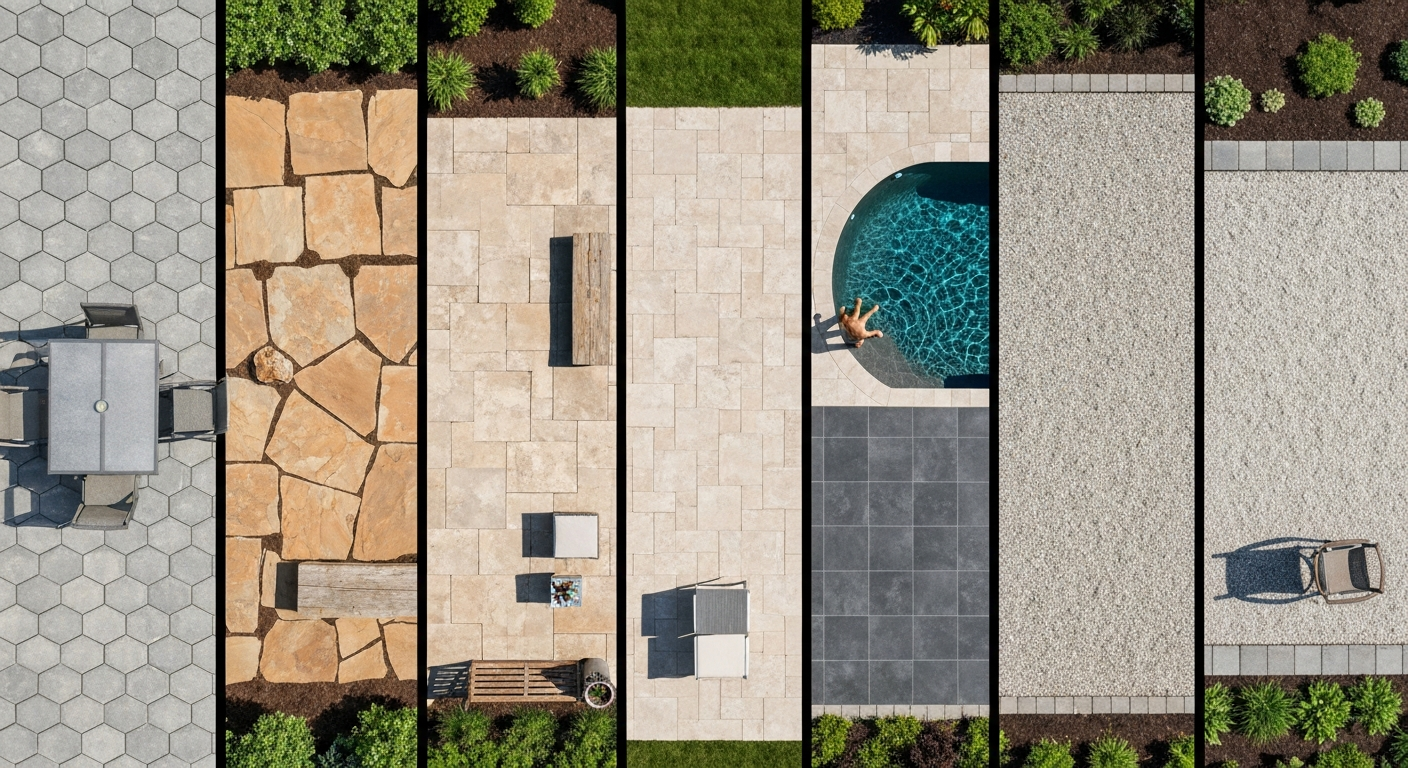
Before diving into each material in detail, here are the scenario-based picks I'd make for the most common homeowner situations. For a deeper comparison of the best patio floor material for different climates, uses, and budgets, see our detailed guide on best patio floor material. These are based on a combination of performance data, installed cost ranges, and the kinds of problems I've seen come up repeatedly on real projects.
| Use-case / scenario | Top pick | Runner-up | Why |
|---|---|---|---|
| Poolside / wet barefoot area | Travertine (tumbled or cleft) | Textured porcelain tile (wet DCOF ≥0.55) | Travertine stays 15–30°F cooler than gray concrete in sun; textured porcelain is the low-maintenance modern alternative |
| High-traffic family patio | Concrete pavers (60 mm) | Brick pavers | Durable, repairable unit by unit, ASTM C936-rated for strength and freeze-thaw resistance |
| Freeze-thaw climate (Zones 5–7) | Concrete pavers | Porcelain tile (≤0.5% water absorption per ASTM C373) | Pavers flex and are re-leveled easily; frost-proof porcelain resists spalling if bedded correctly |
| Hot climate / desert | Light limestone or travertine | Light-colored concrete pavers | High albedo and low thermal mass keep surfaces cooler underfoot |
| Small budget | Compacted gravel or decomposed granite | DIY concrete pavers on sand base | Gravel installed ~$3–$8/ft²; DIY pavers ~$10–$15/ft² materials + your labor |
| Pet-friendly / paw-safe surface | Concrete pavers (brushed) | Flagstone (dry-set, wide joints with groundcover) | Textured surface, no sharp grout seams, easy hose-down; flagstone with planted joints is gentle on paws |
| Modern / minimalist aesthetic | Large-format porcelain tile (20 mm) | Smooth concrete pavers in grey or charcoal | Clean lines, consistent color, tight joints |
| Rustic / cottage aesthetic | Flagstone (random irregular) | Tumbled brick pavers | Natural variation and warm color tones; no two slabs look the same |
| Sloped or drainage-critical site | Permeable concrete pavers (open-graded base) | Gravel with grid stabilizer | Water drains through joints rather than running off; reduces puddling |
How to choose a patio surface: the factors that actually matter
It's tempting to choose a patio surface based on a photo you liked on a home design site. I've done it. But what looks great in a California garden can be a liability in Minnesota after two winters. Here are the factors worth thinking through before you settle on a material.
Climate and freeze-thaw exposure
Water absorption is the single most important physical property for any surface in a cold climate. When water trapped in a porous material freezes, it expands about 9% and cracks the material from inside. ASTM C373 is the standard test method for water absorption, and the key threshold to know is 0.5%: porcelain tile at or below 0.5% absorption is classified as impervious and is safe for exterior frost-prone installations. Dense natural stones like granite are also low-absorption. Softer limestones, travertine, and some sandstones have higher absorption and need sealing or careful specification in cold, wet climates. Gravel and permeable pavers actually sidestep the freeze-thaw problem by letting water drain away before it can freeze in or under the surface.
How you'll actually use the space
A patio that hosts weekend barbecues for a dozen people needs a different surface than a quiet meditation corner. Think about furniture loads (heavy planters and fire pits concentrate weight), whether kids will be running on it barefoot, whether you'll park a vehicle on it, and whether it connects to a pool or hot tub. ICPI recommends 60 mm (about 2.36 inches) thick concrete pavers for pedestrian patios and 80 mm for occasional vehicle use, a detail that surprises most homeowners who assume all pavers are interchangeable.
Budget: installed cost vs. lifecycle cost
The cheapest upfront option, gravel at $3–$8 per square foot installed, often costs more over 10 years once you factor in annual weed control, top-ups, and eventual edging replacement. Concrete pavers at $10–$30 per square foot installed have a much longer service life with minimal maintenance. Premium flagstone or porcelain at $20–$60-plus per square foot installed has a high upfront cost but can last decades with minimal repair. I always recommend pricing the 10-year scenario, not just the Day 1 invoice.
Slip resistance
ANSI A137.1 and the TCNA's DCOF AcuTest set a minimum wet Dynamic Coefficient of Friction (DCOF) of 0.42 for level interior floors walked on when wet. For pool decks and exterior wet barefoot areas, industry guidance commonly recommends a wet DCOF of 0.55 to 0.60 or higher. If you're specifying tile or smooth stone for a poolside or rainy-climate patio, always ask the supplier for the product's wet DCOF data sheet and verify it meets these thresholds for your specific application. A honed limestone tile that looks beautiful on a showroom floor can become dangerously slick when wet outside.
Maintenance commitment
Porcelain tile and concrete pavers need relatively little maintenance, periodic cleaning, joint sand top-ups, and a sealer reapplication every 3–5 years if you use one. Natural stone, especially porous types like travertine, limestone, and slate, needs sealing on installation and re-sealing regularly (annually in high-traffic or wet areas, every 2–3 years otherwise). Gravel needs weed suppression fabric, top-up material, and edging maintenance. Brick tends to grow moss in shaded, wet climates and needs occasional scrubbing or a mild biocide.
Aesthetics and design context
Be honest about your home's architectural style and the garden's character before choosing a surface. Large-format porcelain tiles look sharp with a contemporary house but can look clinical against a heritage cottage. Random flagstone looks organic and warm but requires a skilled setter to lay well. Brick and tumbled pavers are forgiving of both styles. Think about color at noon in direct sun, not just how the material photograph in shade, light travertine and buff limestone read much lighter outside than in a showroom.
Installation: DIY vs. hiring a pro
Gravel and decomposed granite are genuinely DIY-accessible for someone with a weekend and a plate compactor rental. Interlocking concrete pavers on a sand-set base are doable for a confident DIYer who follows ICPI base specifications. Flagstone in mortar and large-format porcelain tile both require professional skill: mortar-setting flagstone incorrectly causes cracking and frost heave; large porcelain tiles are brittle and unforgiving of an uneven sub-base. A botched porcelain installation is expensive to redo. When in doubt, get the sub-base installed professionally and DIY the surface units if you want to save money.
At-a-glance comparison: all major patio surfaces
| Material | Typical installed cost (per sq ft) | Durability / lifespan | Maintenance level | Slip resistance (untreated) | Freeze-thaw suitability | DIY-friendliness |
|---|---|---|---|---|---|---|
| Concrete pavers (60 mm) | $10–$30 | 50+ years | Low | Good (textured) | Excellent with proper base | Moderate |
| Brick pavers | $10–$25 | 50+ years | Low–Medium | Good | Good (quality units) | Moderate |
| Flagstone (dry-set) | $15–$30 | 30–50 years | Medium | Good (cleft face) | Good if dense stone used | Difficult |
| Flagstone (mortar-set) | $20–$40 | 30–50 years | Medium | Good (cleft face) | Good with correct mortar | Not recommended DIY |
| Natural stone: bluestone | $20–$45 | 40–60 years | Medium | Good (thermal finish) | Good (dense) | Difficult |
| Natural stone: slate | $15–$35 | 30–50 years | Medium | Good (cleft) | Fair–Good (varies by type) | Difficult |
| Natural stone: limestone | $15–$40 | 30–50 years | Medium–High | Fair–Good (depends on finish) | Fair (seal required in cold climates) | Difficult |
| Porcelain tile (20 mm outdoor) | $20–$40 | 30–50+ years | Very low | Good–Excellent (textured) | Excellent (≤0.5% absorption) | Not recommended DIY |
| Gravel / crushed stone | $3–$8 | Indefinite (replenish) | High | Fair | Excellent (drains water) | Easy |
| Decomposed granite (compacted) | $3–$7 | 3–7 years before refresh | Medium–High | Fair | Good (drains) | Easy–Moderate |
| Composite decking | $20–$45 | 25–50 years (warranty) | Low | Good (grooved boards) | Good | Moderate |
Flagstone: natural character with a price to match
Flagstone is any flat natural stone split or sawn into paving slabs, typically from sandstone, bluestone, limestone, slate, or quartzite. It's the material that gives a garden patio that organic, settled-in look that no manufactured product quite replicates. The irregular shapes and natural color variation are the whole point, but they're also what makes a good installation expensive.
Durability and lifespan
Dense flagstones, quartzite, bluestone, hard sandstone, are genuinely tough and will outlast most homeowners. Softer stones like certain sandstones and some limestones show wear and pitting over decades, especially in high-traffic areas or under outdoor furniture. The enemy of flagstone longevity is moisture in the sub-base: a properly compacted gravel base with good drainage keeps slabs stable for 30–50 years; a thin or clay-heavy base allows movement, cracking, and frost heave within 5 years.
Cost range
Expect to pay roughly $15–$30 per square foot for dry-set flagstone (slabs set on a compacted sand or gravel bed without mortar) and $20–$40 per square foot for mortar-set, where slabs are bedded in mortar and joints are grouted. The high end of that range reflects complex patterns, heavy or thick pieces, and highly skilled labor in expensive markets. Material costs alone for flagstone typically run $2–$8 per square foot depending on stone type and source.
Slip resistance and finish
Cleft-face (split) flagstone has a naturally rough texture that provides good slip resistance in wet conditions. Sawn-face flagstone is smoother and can become slippery when wet, so it's worth applying a penetrating sealer and considering an anti-slip additive treatment for poolside or rainy-climate applications. For any wet-area flagstone, ask the supplier for available wet friction data or request a sample and test it with water before committing.
Maintenance
Flagstone in an open garden setting with dry-set joints (filled with gravel, decomposed granite, or low groundcovers) needs very little maintenance beyond occasional weeding and re-leveling any slabs that shift. Mortar-set flagstone needs grout joint inspection every few years and re-pointing where joints have cracked or eroded. Porous flagstone types should be sealed with a penetrating impregnator on installation and re-sealed every 2–3 years.
Best uses
Flagstone works best for: informal garden patios, cottage or farmhouse aesthetics, low-to-moderate traffic areas, and any space where a naturalistic feel is the priority. It's not ideal for high-traffic areas with furniture that gets dragged across it regularly (irregular surfaces trap furniture feet), and I wouldn't use sawn-face limestone poolside without an anti-slip treatment.
Natural stone variants: bluestone, slate, and limestone
"Natural stone" covers a huge range of materials with very different performance profiles. The three most commonly used for patios are bluestone, slate, and limestone. Understanding their differences saves a lot of regret.
Bluestone
Bluestone (typically a dense sandstone or basalt depending on regional sourcing) is one of the most durable natural paving stones available. Its low porosity gives it solid freeze-thaw resistance, the Natural Stone Institute notes that dense stones with low water absorption have high freeze-thaw resistance, and most commercial bluestone falls into this category. Thermally finished (flame-textured) bluestone has excellent wet slip resistance and is a genuine go-to for cold-climate patios in the Northeast US and Canada. Expect to pay $20–$45 per square foot installed, with thermal-finish pieces toward the higher end.
Slate
Slate's cleft surface gives it naturally good slip resistance, and its layered structure makes it easy to split into thin, flat pieces. The downside is that slate quality varies enormously by quarry origin: good Brazilian and Welsh slate are dense and durable, while some lower-grade imported slate delaminates and flakes within a few winters. I've pulled up slate patios after 8 years that looked like they'd been through a shredder, and replaced others that were 40 years old and still perfect. Always ask about origin and get a density/absorption spec sheet from the supplier. Installed cost typically runs $15–$35 per square foot. In wet, freeze-prone climates, specify only dense, low-absorption slate and seal it.
Limestone
Limestone is beautiful, warm, creamy tones that photograph wonderfully, but it's the most maintenance-intensive of the three in cold or wet climates. It's a sedimentary stone with higher porosity than bluestone or granite, and the Natural Stone Institute is explicit that some limestones and travertines need sealing or careful specification in cold/wet environments. Polished or honed limestone is dangerously slick when wet and is not suitable for exterior paving without either a textured finish or an anti-slip treatment. For warm, dry climates (think southern California, Arizona, Texas), limestone is a gorgeous choice. For Zone 5 and colder, use it carefully and seal religiously. Installed cost runs $15–$40 per square foot.
Travertine: the poolside standout
Travertine deserves a specific mention here because it comes up repeatedly in poolside context. Practical temperature comparisons show light travertine running roughly 15–30°F cooler in direct sun than medium-gray concrete, driven by its high albedo (reflectivity) and lower thermal mass. Tumbled travertine has a rough enough surface for safe barefoot use. The trade-off: travertine is porous and needs annual sealing in wet or freeze-thaw climates. In warm, dry climates (the environments it was originally sourced for in Italy), it's nearly perfect. In a Minnesota winter, it needs very careful installation and consistent maintenance.
Porcelain tile for patios: modern, low-maintenance, and unforgiving of bad installs
Outdoor porcelain, particularly the 20 mm thick format engineered specifically for exterior use, has become one of the most popular premium patio surfaces in the last decade, and for good reason. ASTM C373 defines porcelain as having water absorption of 0.5% or less, which makes it effectively impervious. That means no sealing, no staining, no freeze-thaw spalling when correctly installed. A properly installed porcelain patio looks the same on year 20 as it did on year 1, which is something almost no natural stone can claim.
Slip resistance: verify before you buy
This is the one area where porcelain tile demands careful attention. The DCOF AcuTest under ANSI A137.1 sets a minimum wet DCOF of 0.42 for level wet floors, but industry guidance and the TCNA recommend 0.55–0.60 or higher for pool decks and exterior barefoot areas. Not all porcelain tiles meet those higher thresholds. A polished or semi-polished finish often doesn't. Textured, matt, or structured-surface porcelain tiles do. Always request the product's wet DCOF data sheet before purchasing any porcelain tile for an outdoor application. Manufacturers and tile distributors can usually provide this on request, and it should also appear on the product specification sheet.
Installation: this is where most problems start
Outdoor porcelain, especially the large-format 20 mm (2 cm) pavers, is notoriously unforgiving of an uneven sub-base. Any flex in the substrate causes cracking in large thin tiles. A typical exterior porcelain installation requires a concrete slab or very well-consolidated compacted base, flexible polymer-modified tile adhesive (not standard cementitious mortar), and correct joint spacing with appropriate exterior grout or joint compound. I've seen beautiful large-format porcelain installations fail within a year because someone laid them on a sand bed like concrete pavers. Hire a tile installer with specific outdoor porcelain experience and ask to see a previous project. The installed cost of $20–$40 per square foot is higher partly because skilled labor is included.
Pros and cons at a glance
- No sealing required: water absorption ≤0.5% means porcelain resists staining and frost damage without treatment
- Consistent appearance: color and texture are controlled in manufacturing, unlike natural stone
- Low ongoing maintenance: sweep, occasional wash, done
- Freeze-thaw rated when correctly installed: the tile body itself won't spall in frost conditions
- Large format options: 24x24 in, 24x48 in and larger formats give clean, contemporary aesthetics
- Brittle and unforgiving of sub-base movement: cracking risk if substrate is inadequate
- High installation skill requirement: not a DIY project for large-format tiles
- Can get hot in direct sun with dark colors: specify light-colored tiles for hot climates and poolside areas
- Grout joints require maintenance over time: use quality exterior grout and inspect annually
Brick and concrete pavers: the reliable workhorse
If I had to choose one surface that performs well across the widest range of climates, uses, and budgets, it would be concrete or brick pavers on a properly prepared interlocking base. They're not the flashiest option, but they're the most consistently reliable.
Concrete pavers: performance specifications
ASTM C936 governs solid interlocking concrete paving units and sets minimum compressive strength and freeze-thaw resistance requirements for durable products. ICPI (Interlocking Concrete Pavement Institute) recommends 60 mm (approximately 2.36 inch) thick units for pedestrian-only patios and 80 mm for areas where vehicles may drive or park. The base specification matters as much as the paver: a 4-inch compacted aggregate base is a common starting point for pedestrian patios in stable soils, but ICPI guidance requires deeper bases toward local frost depth in freeze-thaw regions to prevent heaving. Getting the base wrong is the single most common cause of paver patio failure.
Brick pavers
Traditional clay brick pavers are dense, durable, and have a warmth that concrete pavers don't fully replicate. Good quality clay brick pavers resist freeze-thaw damage well (look for SX/Severe Weathering rated units per ASTM C902 or C1272). They're slightly more expensive than mid-range concrete pavers at $10–$25 per square foot installed, but they're also essentially permanent if the base is right. Brick tends to grow moss and algae in shaded, damp conditions, a quick annual scrub with a stiff brush and mild biocide handles this. Patterns like herringbone, running bond, and basket weave all affect both aesthetics and structural stability (herringbone resists spreading and shifting better under load).
Maintenance: what ICPI actually recommends
ICPI and CMHA maintenance guidance for interlocking concrete pavement is straightforward: sweep or clean the patio each spring and fall, top up joint sand when any joint has lost more than half an inch (12 mm) of fill, use polymeric sand or joint stabilizers for better long-term joint integrity, and re-apply breathable sealers on a 3–5 year cycle if you use a sealer for stain protection. Following this routine, a well-installed paver patio should perform for 50-plus years, I've walked paver driveways from the 1970s that, with basic maintenance, look better than a concrete slab installed 15 years ago.
Repair advantage
One under-appreciated benefit of interlocking pavers is repairability. If a utility crew needs to dig up part of your patio, or if a section settles, you lift the affected pavers, correct the base, and relay the same pavers. With a poured concrete slab or mortar-set tile, you're looking at saw-cutting, breaking out sections, and patching, which almost never matches the original surface exactly. With pavers, it's genuinely seamless.
Design and pattern options
- Running bond: simple, classic, easy to cut and lay — good for DIY
- Herringbone (45° or 90°): best structural stability, resists lateral spreading under load
- Basket weave: traditional look, works well with square pavers
- Pinwheel / fan patterns: more complex, requires more cuts, best left to experienced installers
- Mixed-size or random ashlar: modern look using 2–3 paver sizes; plan your layout carefully to minimize cuts
- Edge restraints: always use a manufactured plastic or concrete edge restraint anchored with spikes — without it, the field pavers will slowly spread and the pattern will distort over time
Gravel and decomposed granite: the budget-friendly options explained honestly
Gravel and decomposed granite (DG) are the cheapest viable patio surfaces at $3–$8 per square foot installed. I want to be genuinely honest about what "viable" means here: they work, they drain beautifully (which is actually a real structural advantage), and they have a casual, naturalistic look that suits the right space. But they come with trade-offs that many homeowners don't think through before committing.
The real trade-offs
- Migration: loose gravel tracks onto lawn and into the house; requires regular raking and edging maintenance
- Weed pressure: even with suppression fabric underneath, weeds establish in the surface layer within 2–3 seasons
- Comfort: loose gravel is uncomfortable in bare feet and awkward for furniture; table and chair legs sink and tilt
- No hard surface for furniture: a dining table on gravel is frustrating to use
- Annual maintenance: plan on weed treatment, top-up material, and edging repair every year — these costs add up
- Accessibility: loose gravel is difficult to navigate with strollers, wheelchairs, or for anyone with mobility challenges
Stabilization options: grids and resin
Two technologies meaningfully improve loose gravel patios. Plastic grid stabilizers (honeycomb or cellular confinement systems) are installed on the compacted base before gravel is spread into the cells. They prevent migration, support furniture, and dramatically reduce weed emergence from below. Resin-bound gravel is a higher-end option where aggregate is mixed with a clear polyurethane resin and applied as a continuous porous surface: it looks like gravel but is stable, walkable, and drains through its body. Resin-bound gravel installed by a specialist costs $25–$55 per square foot, no longer a budget option, but it solves almost every complaint about loose gravel.
Decomposed granite specifics
Compacted decomposed granite (DG) is a finer material than gravel, it compacts into a relatively firm surface that's better for walking on and more suitable for outdoor furniture than loose pea gravel. It's popular in dry, Western US climates where it looks at home and doesn't get churned into mud by rain. In wetter climates, DG erodes, washes, and turns muddy in heavy rain. Stabilized DG (mixed with a binder at installation) performs significantly better in moderate rainfall but still needs refreshing every 3–7 years as the surface breaks down. It's a genuinely good low-cost choice for the right climate: hot, dry, and low-rainfall.
Drainage: the one area where gravel genuinely wins
For sites with drainage challenges, low spots, clay soils, areas near foundation walls, a permeable gravel surface is structurally superior to any impermeable paving. Water moves through rather than pooling on top or running off the edge. If you're choosing between gravel and pavers on a site with poor drainage, seriously consider permeable concrete pavers on an open-graded base, which gives you the structural and aesthetic benefits of pavers with close to the drainage performance of gravel.
Composite decking as a patio surface: worth considering in the right situation
Composite decking isn't a traditional patio surface in the ground-level sense, but it's increasingly used as a raised patio or ground-level deck surface where a wood-look finish is desired without the maintenance of real timber. Manufacturers like Trex publish residential limited warranties of 25–50 years covering fading and staining, which is a real performance guarantee. The installation involves a structural frame, which adds complexity and cost ($20–$45 per square foot installed depending on frame design and board grade).
The critical caveat that manufacturers themselves flag: composite boards get hot in direct sun. Dark-colored boards in full summer sun can reach temperatures uncomfortable or damaging for bare feet. Trex and similar manufacturers explicitly note this in their product FAQs. For a shaded patio or one used primarily when the sun isn't direct, this isn't a problem. For a sun-exposed poolside surface where people walk barefoot, it's a serious consideration, light-colored composite boards help, but they're still typically warmer than travertine or light limestone.
Slip resistance in practice: how to choose safe surfaces
Slip resistance is the most underestimated patio design factor, especially around pools, hot tubs, and in rainy climates. For a concise guide to the best non slip patio flooring, see our recommendations. The ANSI/TCNA DCOF AcuTest minimum of 0.42 wet DCOF is a floor, not a target. For pool decks and exterior surfaces walked barefoot when wet, aim for 0.55–0.60 or higher. Here's how the major surface categories compare:
| Surface type | Finish / treatment | Wet slip resistance | Notes |
|---|---|---|---|
| Porcelain tile | Polished or semi-polished | Poor–Fair (often <0.42 wet DCOF) | Not suitable for wet exterior areas without anti-slip treatment |
| Porcelain tile | Textured / structured / matt | Good–Excellent (≥0.55 achievable) | Verify wet DCOF on product data sheet; many outdoor-spec tiles meet ≥0.55 |
| Flagstone | Cleft / split face | Good | Natural texture; effective even when wet |
| Flagstone | Sawn / honed | Fair–Poor (when wet) | Treat with anti-slip coating or avoid in wet areas |
| Limestone / travertine | Tumbled or sandblasted | Good | Better than honed; seal to reduce absorption |
| Limestone / travertine | Honed or polished | Poor when wet | Not suitable for pool decks or rainy climates without treatment |
| Bluestone | Thermal (flamed) finish | Excellent | Industry standard for safe exterior paving in wet climates |
| Concrete pavers | Standard brushed surface | Good | Typical paver texture is safe for exterior use |
| Brick pavers | Standard clay face | Good | Gets mossy in shade — clean regularly |
| Composite decking | Grooved or embossed surface | Good | Check product data for wet DCOF; grooved boards perform well |
| Gravel / DG | Loose aggregate | Fair | Low formal slip risk but uneven and ankle-twist risk for loose gravel |
If you've already installed a surface that isn't slip-resistant enough, options include: applying a penetrating anti-slip treatment (silica or aluminium oxide particles bonded into the surface), adhering anti-slip strips in high-risk zones, or applying an anti-slip topcoat. These are stopgap measures compared to specifying the right surface finish from the start, but they're effective and readily available from tile and stone suppliers.
Installation essentials: sub-base, drainage, and joints
No matter what surface you choose, the sub-base is the most important part of the installation. A perfect surface on a bad base will fail. A simple surface on a good base will last decades. Here are the core principles.
- Excavate to the required depth: for pedestrian paver patios, this typically means 4–6 inches of compacted aggregate base plus 1 inch of bedding sand plus the paver thickness. In freeze-thaw climates, consult local frost depth and increase base thickness accordingly.
- Compact the sub-grade: native soil should be compacted to at least 95% Proctor density before any base material goes in. Soft spots and clay pockets need to be excavated and replaced with compactable aggregate.
- Install geotextile fabric at the sub-grade level: this separates the native soil from the aggregate base, preventing clay migration upward and aggregate migration downward over time.
- Build up the aggregate base in lifts: compact in 3–4 inch layers, not all at once. Each lift should be compacted with a plate compactor before the next goes on. Skipping this step is the most common DIY mistake.
- Plan for drainage: slope all hard surfaces a minimum of 1/8 to 1/4 inch per foot away from the house. Never allow water to pond against a foundation.
- Install edge restraints before the surface layer: for pavers, manufactured plastic restraints held with 10-inch spikes prevent the field from spreading. For tile, the concrete slab edge and perimeter grouting contain the field.
- Use the right joint fill: polymeric sand for pavers (activated with water, it resists weed germination and ant excavation), exterior sanded grout or flexible joint compound for tile, crushed stone or groundcover for dry-set flagstone.
- Allow for thermal expansion with tile: large-format tile installations need perimeter expansion joints and field movement joints every 8–10 feet. Omitting these causes buckling in summer heat.
Maintenance schedules by surface type
| Surface | Annually | Every 2–3 years | Every 5+ years or as needed |
|---|---|---|---|
| Concrete / brick pavers | Sweep, wash, inspect joints; top up sand where >12mm loss | Re-apply sealer if used | Re-level any settled sections; replace damaged units |
| Flagstone (dry-set) | Weed joints, re-level shifted slabs, check drainage | Seal porous stone types | Replace cracked slabs; re-compact base under persistent settled areas |
| Flagstone (mortar-set) | Inspect grout joints; patch any cracked grout promptly | Seal porous stone; re-point cracked or missing mortar joints | Full re-grout of deteriorated sections |
| Bluestone / slate / limestone | Clean and inspect; treat moss/algae in shaded areas | Re-seal (annually in wet climates for limestone/travertine) | Repair any flaking or delaminating pieces (especially lower-grade slate) |
| Outdoor porcelain | Sweep and wash; inspect joint compound | Re-grout any cracked exterior joints with flexible compound | No sealing required; check for edge restraint integrity |
| Gravel / DG | Weed, rake, add top-up material as needed, check edging | Replace suppression fabric if weeds break through heavily | Refresh or re-stabilize DG surface when worn to compacted subgrade |
| Composite decking | Sweep debris from board gaps, wash with mild detergent | Inspect fasteners, frame members and any exposed cut ends for moisture entry | Inspect and treat structural frame members; replace any boards showing mechanical damage |
Design and finish ideas: patterns, joints, and edging
The surface material is only part of how a patio looks and functions. For further inspiration and layout options, see our guide to the best ideas for patio flooring which walks through material looks, patterns, and finish treatments to match any design style. How you finish the joints, edges, and transitions has a significant effect on both aesthetics and longevity.
Joint choices
For pavers, polymeric sand in a color that complements the paver is the industry-standard recommendation. Light sand with medium-colored pavers creates a defined grid look; matching sand colors to pavers gives a more monolithic, stone-like appearance. For tile, narrow joints (3–6 mm) with matching-tone exterior grout look contemporary and reduce the amount of joint to maintain. For dry-set flagstone, the joint can be filled with fine gravel, decomposed granite, or planted with low groundcovers like creeping thyme or Corsican mint, this is one of my favorite design moves because it makes a flagstone patio feel like part of the garden rather than a separate hard element.
Edging options
Edge treatment defines the patio's boundary and transitions to lawn, planting beds, or gravel paths. Options include: soldier course (pavers set vertically end-on), header course (full pavers laid flat at the perimeter in a contrasting color), steel or aluminum landscape edging (invisible, architectural look), cut stone edging (expensive but beautiful), or simply allowing the patio to meet a gravel border without a formal edge. The choice should be consistent with the surface material: random flagstone suits a natural stone or metal edge; clean contemporary pavers suit a crisp steel or aluminum profile.
Mixing surfaces
Combining two surface materials in one patio is one of the most effective design moves: a primary field of concrete pavers with a natural stone or porcelain tile section under a dining table, or a gravel surround framing a central flagstone area. The structural requirement is that both materials sit at the same finished height, plan the sub-base depths carefully to account for different material thicknesses.
Sourcing your materials: what to ask, where to buy, and how to estimate
Where to buy
For concrete and brick pavers, hardscape supply yards and masonry suppliers typically offer a much wider range of products than big-box stores, and their staff know the products well. For natural stone (flagstone, bluestone, slate, limestone), specialist stone yards are far better than general landscaping suppliers, the quality range is enormous and you need to be able to inspect pieces before buying. For outdoor porcelain tile, tile showrooms and dedicated tile distributors carry the largest format and textured ranges; big-box stores usually only carry a limited selection without the technical specs you need. For gravel and DG, landscape supply yards sell by the cubic yard or ton and deliver, which is almost always cheaper than bagged product.
Questions to ask your supplier
- What is the water absorption rate (ASTM C373 or equivalent) for this product? Is it rated for exterior freeze-thaw use?
- What is the wet DCOF test result for this tile or stone finish? Do you have the test certificate?
- Is this stone or paver suitable for the specific application I'm describing (pool deck, patio, vehicle use)?
- What is the recommended base specification for this material in my climate zone?
- Do you recommend sealing this product, and if so, what sealer and at what interval?
- What is the lead time for this product, especially large-format tiles or special-order stone?
- Can I get a sample piece to take home and test in my actual site conditions?
- What is the coverage per pallet/unit, and what overage percentage do you recommend I order?
Estimating quantities
Measure your patio area in square feet (length x width for simple rectangles; break up complex shapes into rectangles and add them). Add a waste factor: 5% for square or rectangular pavers in a straight pattern, 10% for diagonal or herringbone patterns (more cuts at edges), 10–15% for irregular flagstone (natural wastage in selecting and cutting to fit). For gravel, calculate cubic yards needed: (area in sq ft x depth in inches) divided by 324. One ton of gravel typically covers 80–100 sq ft at 2 inches deep, but this varies by aggregate size and density. Always confirm coverage rates with your specific supplier.
Final decision checklist: pick the right surface for your specific situation
Run through these questions before you commit to a material. They cover the factors that most often get overlooked until after the patio is built.
- Climate: does my area experience freeze-thaw cycles? If yes, specify low-absorption materials (≤0.5% for tile, dense stone, or concrete pavers on a proper frost base).
- Drainage: does my site drain well, or do I need a permeable surface (gravel, open-graded pavers) to manage water?
- Slip risk: will the surface get wet regularly, be used barefoot, or be near a pool or hot tub? If yes, verify wet DCOF ≥0.55 for the actual product and finish you're specifying.
- Heat: in full summer sun, will people walk on this surface barefoot? If yes, choose light-colored, high-albedo materials (travertine, light limestone, light concrete pavers); avoid dark porcelain and dark composites.
- Traffic and load: will heavy furniture, a grill, planters, or vehicles ever be on this surface? Specify 60 mm+ concrete pavers or mortar-set stone for anything beyond light foot traffic.
- Maintenance time and budget: are you willing to seal, weed, and replenish annually? If no, avoid gravel and high-porosity natural stone; choose concrete pavers or outdoor porcelain.
- DIY or professional install? Be honest about your skill level. Concrete pavers on sand are DIY-manageable. Large-format porcelain and mortar-set flagstone are professional jobs.
- Aesthetic: is your design style rustic/organic (flagstone, tumbled brick, gravel), transitional (concrete pavers, tumbled stone), or contemporary/minimal (large-format porcelain, smooth concrete pavers in consistent colors)?
- Budget ceiling: can you afford the installed cost, or are you working with a tight budget? If tight, start with gravel or basic concrete pavers and upgrade sections over time rather than compromising on the base — a good base is the one thing you can't retrofit cheaply.
- Repairability: is it important that individual damaged units can be replaced without a full tearout? If yes, interlocking pavers (concrete or brick) are the clear winner.
FAQ
What is the best surface for a patio overall?
There is no single "best" surface—best depends on use, climate, budget and style. Quick guidance: porcelain pavers or dense natural stone (granite, some bluestones) for durability and freeze–thaw resistance; interlocking concrete pavers or brick for high‑traffic, easy repairs and moderate cost; flagstone or natural stone for rustic aesthetics; gravel/decomposed granite for the lowest upfront cost and casual look; composite decking where a raised, wood‑like surface is wanted. Choose by matching the material strengths to your primary needs (poolside, budget, pets, freeze‑thaw, barefoot comfort, maintenance tolerance).
Which patio surface is best for poolside and wet areas?
Best choices: textured porcelain pavers (20 mm outdoor grade with a high wet‑DCOF), certain travertine and light dense natural stones (cooler in sun and naturally slip‑friendly when cleft or honed), and broom‑finished concrete if budget is primary. Avoid smooth glazed tiles and dark non‑textured surfaces. For barefoot pool decks, target products with wet‑DCOF recommended for pool decks (many authorities suggest ≥0.55–0.60) and specify textured finishes or anti‑slip treatments.
Which material is best for high‑traffic patios and heavy use?
Interlocking concrete pavers (60–80 mm thickness) and porcelain pavers are best for high pedestrian use. They resist wear, are easy to repair (replace a unit), and perform well with correct base construction. Dense natural stone (granite) also performs well but is more costly. Avoid loose surfaces like pea gravel for high‑traffic entertaining areas.
What is the cheapest viable patio flooring and what are the trade‑offs?
Cheapest durable options: compacted crushed stone, pea gravel, and decomposed granite (material+basic install ≈ $2–$8/ft²). Trade‑offs: higher ongoing maintenance (weed control, periodic top‑up), less comfort underfoot, migration without good edging, and lower suitability for furniture with narrow legs. Broom‑finished poured concrete is also low‑cost installed ($6–$15/ft² typical) and more solid but less decorative.
What surface performs best in freeze–thaw climates?
Porcelain (impervious, ASTM/ANSI water absorption ≤0.5%) and dense, low‑porosity natural stones (certain granites) perform best. Concrete pavers installed to ICPI frost‑depth/base guidelines also do well. Avoid porous natural stones (some limestones, sandstones) and improperly installed mortar‑set pavers that can trap water. Proper base, drainage, and through‑joints are critical to prevent frost heave.
Which patio surfaces are best for hot, sunny climates and barefoot comfort?
Light‑colored materials with higher albedo stay cooler: light travertine, certain limestones, light porcelain finishes, or lighter concrete finishes. Composite decking can get hot—manufacturers warn about surface heat. Dark pavers and darker concrete absorb more heat and will be noticeably hotter to bare feet.