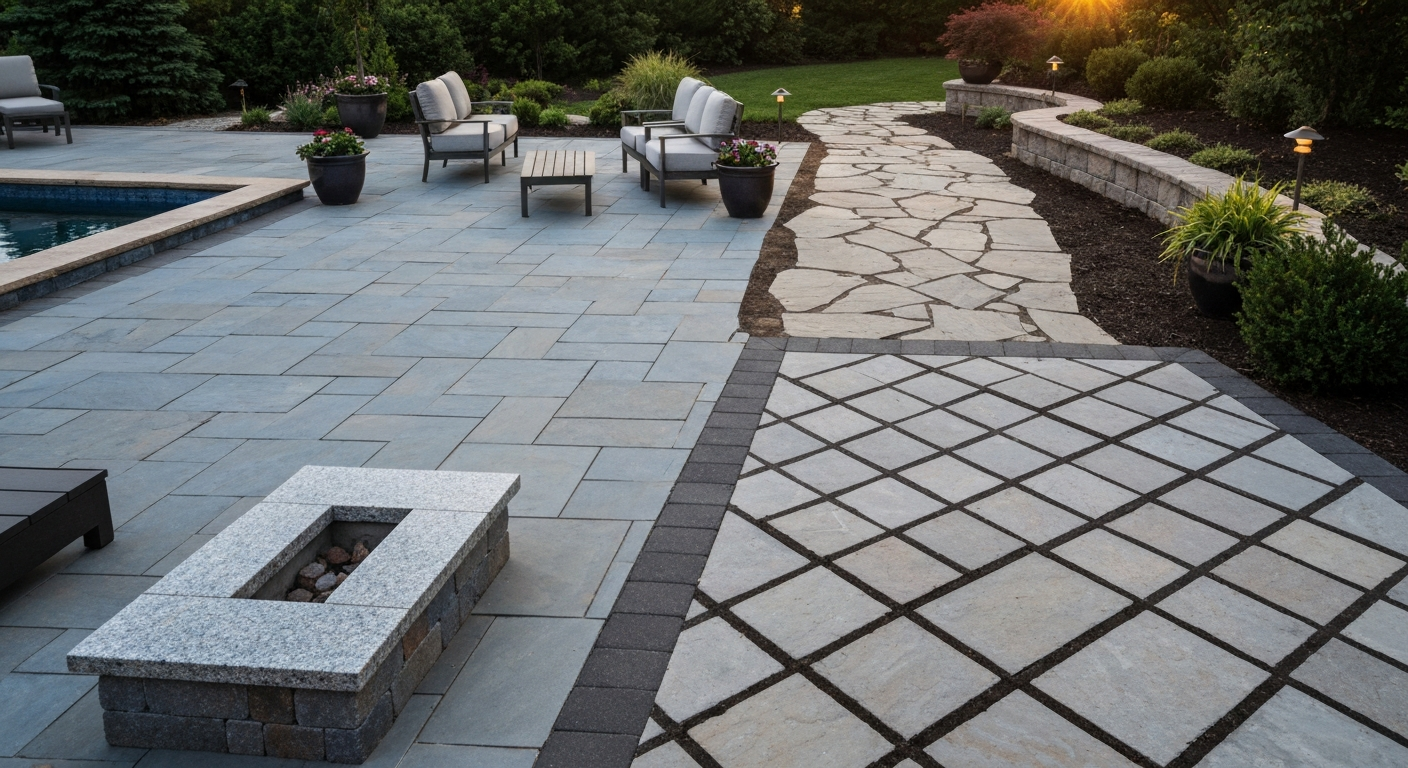
For most homeowners, bluestone or flagstone hits the best all-around sweet spot: both look great, handle freeze-thaw cycles reasonably well, and come in a range of budgets from about $15 to $55 per square foot installed. If you want near-zero maintenance and a modern look, 2-cm porcelain pavers are hard to beat. If budget is the priority, concrete interlocking pavers deliver solid performance at $10 to $25 per square foot. And if you want the most durable stone money can buy and cost is secondary, granite wins. The right answer depends on four things: your climate, your budget, how much maintenance you're willing to do, and the look you're after. This guide walks you through all of it. For design inspiration and layout examples, see our guide to the best stone patio ideas.
Which Patio Stone Is Best: Pick-by-Priority Guide for Homeowners
What this guide covers and how to use it
I've put this guide together as a complete decision resource, not a product showcase. It covers every realistic patio surface option: natural stones (flagstone, bluestone, slate, granite, sandstone, travertine), man-made alternatives (porcelain pavers, concrete pavers, composites), loose surfaces like gravel and decomposed granite, and brick. Each section gives you honest pros, cons, lifespan expectations, and cost ranges based on 2026 U.S. pricing. Whether you're replacing a crumbling old patio or building one from scratch, start with the Quick Recommendation Matrix to zero in on two or three candidates, then read those material deep dives. If you're already committed to natural stone, the sections on flagstone, bluestone, slate, and granite will give you the detail you need on finishes, slab sizes, and edge options.
Quick recommendation matrix: pick by your top priority
Use this matrix to find your best starting candidates based on what matters most to you. Most patios have two or three competing priorities, so look at which material shows up strongest across your top criteria.
| Priority | Top Pick | Runner-Up | Why |
|---|---|---|---|
| Best overall look | Bluestone (cut) | Flagstone (irregular) | Bluestone's uniform blue-gray tone and clean lines photograph beautifully; flagstone gives a more rustic, organic feel |
| Maximum durability | Granite | Bluestone (thermal finish) | Granite is among the hardest natural stones available; resists chips, stains, and heavy loads better than any other option |
| Lowest budget | Gravel / DG | Concrete interlocking pavers | Gravel installs for $3–$6/ft²; concrete pavers for $10–$25/ft² installed with excellent lifespan |
| Freeze-thaw climates | Porcelain pavers (frost-rated) | Bluestone or granite | Frost-rated porcelain absorbs ≤0.5% water; virtually immune to spalling in hard freeze cycles |
| Hot/coastal climates | Travertine or porcelain | Sandstone | Travertine stays cooler underfoot; porcelain resists salt and UV fade; both handle heat without cracking |
| Best slip resistance | Sandblasted/brushed granite | Textured porcelain (DCOF ≥0.42) | Rough-finish granite and ANSI A326.3-rated porcelain both deliver safe wet-surface traction |
| Lowest maintenance | Porcelain pavers | Concrete pavers | Porcelain needs no sealing and resists staining; concrete needs occasional sealing but no annual stone-care routine |
| DIY-friendliest install | Concrete interlocking pavers | Composite/plastic grid | Uniform size and weight make concrete pavers the most forgiving for homeowner installation over compacted gravel base |
| Best value over 20+ years | Bluestone or granite | Concrete pavers | Natural stone appreciates in curb appeal and rarely needs replacement; concrete pavers last 30+ years with minimal upkeep |
Step-by-step checklist: how to choose the right patio stone for you
Work through these steps in order. By the end, you'll have narrowed your choice to one or two materials and know roughly what to budget.
- Identify your climate zone. Do you get hard freezes (below 20°F regularly)? Coastal salt exposure? Extreme heat above 110°F? Freeze-thaw rules out porous stones like unsealed sandstone and some slate grades unless they're properly sealed and maintained. Coastal salt exposure argues strongly for granite or porcelain.
- Set a realistic total budget. Get a per-square-foot target before falling in love with a material. Gravel: $3–$6/ft² installed. Concrete pavers: $10–$25/ft². Natural flagstone, bluestone, sandstone: $15–$55/ft². Slate: $15–$30/ft² basic, up to $60/ft² cut and mortared. Granite: $25–$70+/ft². Large stone slabs on full mortar bed: $35–$150+/ft².
- Measure your patio footprint accurately. Add 10–15% for cuts and waste on irregular flagstone; 5–8% for cut stone and pavers. This affects material quantity and final cost.
- Decide on your installation method. Sand-set (dry-lay over compacted aggregate base) is DIY-friendly and forgiving of frost heave. Full mortar-bed (wet-set) is more permanent but cracks require professional repair. Pedestal systems work for roof decks and over existing concrete.
- Assess your slip-resistance needs. Pool surrounds, north-facing shaded patios, and areas used by older adults or children should prioritize finishes with a wet DCOF of at least 0.42 per ANSI A326.3 testing. Ask suppliers for DCOF data on any tile or paver you're considering.
- Think honestly about maintenance. Can you commit to sealing natural stone every 1–3 years? Hand-weeding or applying polymeric sand joints annually? If not, lean toward porcelain pavers or concrete pavers with sealed joints.
- Nail down your aesthetic. Rustic/cottage: irregular flagstone or reclaimed brick. Modern/minimalist: large-format cut bluestone or porcelain. Traditional/formal: cut bluestone, granite, or brick. Relaxed/natural: sandstone or travertine.
- Get samples before ordering. Order at least one piece per stone type you're considering and view it wet and dry, in sun and shade, next to your house exterior. Color shifts dramatically between quarry photos and your actual light conditions.
- Check local sourcing. Locally quarried stone cuts freight costs significantly. Bluestone is regionally sourced in the Northeast U.S.; flagstone in the Southwest and Mid-Atlantic; granite and slate from various domestic and imported sources. Ask your supplier about origin and check for consistency across batches.
- Decide DIY or professional install. Sand-set concrete pavers or simple flagstone stepping areas are genuinely DIY-friendly with an ICPI-standard 4-inch compacted aggregate base for pedestrian use. Mortared natural stone, large granite slabs, and anything over 150 lbs per piece requires professional handling.
Side-by-side comparison: all major patio surfaces
This table covers the full range of patio surface options so you can compare them at a glance. Costs are 2026 U.S. installed estimates for typical residential patio projects.
| Material | Installed Cost ($/ft²) | Lifespan (years) | Wet Slip Resistance | Maintenance Level | Freeze-Thaw Suitability | Best Climate Match |
|---|---|---|---|---|---|---|
| Flagstone (natural irregular) | $15–$55 | 30–75+ | Good (rough natural surface) | Medium (seal every 2–3 yrs) | Moderate (depends on stone density) | Most climates; avoid porous grades in hard-freeze zones |
| Bluestone (cut or irregular) | $16–$70 | 50–100+ | Good–Excellent (thermal/brushed finish) | Medium (seal every 2–3 yrs) | Good (dense stone handles freeze well) | Excellent in Northeast/Mid-Atlantic; good most regions |
| Slate | $15–$60 | 30–75 | Good (cleft surface) | Medium-High (seal annually in wet climates) | Fair–Good (varies by grade/density) | Mild to moderate climates; avoid soft grades in hard freezes |
| Granite | $25–$70+ | 75–100+ | Excellent (sandblast/bush-hammer finish) | Low (seal every 3–5 yrs) | Excellent (very low absorption) | All climates including harsh freeze and coastal |
| Sandstone | $15–$40 | 25–50 | Good (natural texture) | Medium-High (seal every 1–2 yrs) | Fair (porous; requires sealing in freeze zones) | Mild/dry climates; warm regions |
| Travertine | $12–$40 | 25–50+ | Good (tumbled/brushed finish) | Medium (fill and seal regularly) | Fair (voids can trap water; must be filled) | Hot/dry, pool areas; not ideal for hard-freeze zones |
| Porcelain pavers (2-cm) | $12–$40 | 30–50+ | Excellent (rated DCOF ≥0.42) | Very Low (no sealing needed) | Excellent (≤0.5% absorption, frost-rated) | All climates; ideal for freeze-thaw and coastal |
| Concrete interlocking pavers | $10–$30 | 30–50+ | Good (textured surface) | Low-Medium (seal every 2–3 yrs, re-sand joints) | Good–Excellent (frost-rated grades) | All climates; workhorse option |
| Brick (clay pavers) | $10–$30 | 25–50+ | Good (tumbled or textured) | Low-Medium (re-sand joints, occasional seal) | Good if ASTM C902 SX-rated | Most climates with proper SX-grade selection |
| Gravel / Decomposed Granite | $3–$6 | Ongoing (replenish 1–3 yrs) | Poor–Fair (unstable surface) | Low-Medium (re-grade, edge maintenance) | Excellent (drains freely) | Dry, low-traffic areas; warm climates |
| Composite/plastic grid | $3–$10 | 10–25 | Fair (depends on infill) | Low | Good (flexible, drains freely) | Light-use areas, temporary patios |
| Large stone slabs (full mortar bed) | $35–$150+ | 50–100+ | Depends on finish | Medium (joint maintenance, occasional reseal) | Good–Excellent (depends on stone type) | All climates with proper stone selection |
A note on slip resistance: what the numbers actually mean
Slip resistance is often glossed over in patio guides, but it matters, especially around pools, on shaded north-facing patios, and anywhere elderly family members or kids are walking on wet surfaces. The U.S. industry standard is ANSI A326.3, which measures Dynamic Coefficient of Friction (DCOF) on wet surfaces. A DCOF score of at least 0.42 is the minimum threshold for level wet areas like exterior patio surfaces. Dynamic Coefficient of Friction, Frequently Asked Questions | TCNA cites ANSI A326.3 and documents the historical ≥0.42 wet DCOF threshold for level wet areas and offers guidance on exterior use and product classification Dynamic Coefficient of Friction — Frequently Asked Questions | TCNA. For porcelain and manufactured pavers, you can ask your supplier for the product's DCOF test data directly. For natural stone, finish matters more than the stone type itself: a polished granite is slippery when wet, while a sandblasted or bush-hammered granite surface on the same stone is safe. Always specify the finish when ordering any natural stone for exterior use.
Installation basics: base depth, method, and what you can DIY
The base under your patio matters as much as the stone on top. A well-built base prevents settling, cracking, and frost heave. For sand-set pedestrian patios, the ICPI framework calls for a 4-inch compacted aggregate base (crushed stone or compacted gravel, compacted in 2-inch lifts to at least 95% Standard Proctor density), topped by a 1-inch bedding sand layer. Driveways or areas that see vehicle loads need 6 inches minimum. If you're in a hard freeze zone, depth may need to go deeper based on local frost depth recommendations from your building department.
Full mortar-bed (wet-set) installations bond the stone to a concrete slab and give a more rigid, permanent result. They're required for large or heavy stone slabs where movement would crack joints, and for any patio over an existing concrete slab. The trade-off is that repairs are harder: a cracked mortared slab requires cutting and re-bedding, not just lifting and releveling a sand-set paver. For most homeowners doing a first patio, sand-set concrete interlocking pavers or irregular flagstone over a properly compacted base is the most forgiving and repairable system.
Material deep dive: Flagstone
Flagstone is a category name, not a single stone. It refers to flat, irregularly shaped natural stone pieces used for patios, walkways, and stepping stones. The most common types sold as flagstone in the U.S. are sandstone, quartzite, bluestone, limestone, and slate, each with its own performance profile. What they share is a naturally flat-splitting character that makes them suitable for outdoor paving without heavy cutting.
Flagstone: pros
- Natural, organic appearance that blends well with garden and landscape settings
- Wide range of colors and textures available depending on stone species and region
- Irregular shapes allow creative random-pattern layouts that are forgiving of DIY cutting skill
- Dense flagstone varieties (quartzite, bluestone-grade flagstone) are extremely durable
- Sand-set flagstone is DIY-accessible and relatively easy to repair or relay
- Locally sourced options exist in many U.S. regions, reducing material cost
Flagstone: cons
- Irregular shapes mean more material waste (plan for 10–15% overage) and more cutting labor
- Quality varies significantly: softer sandstone flagstone can flake, stain, or crack in freeze-thaw cycles if not properly sealed
- Joints in irregular flagstone are wider and less uniform, creating more weed and moss infiltration opportunities
- Thickness varies piece to piece, requiring more careful base preparation and leveling during installation
- Cost range is wide ($15–$55/ft² installed) and hard to predict without a site assessment
- Polished or very smooth flagstone can be slippery when wet; specify rough or cleft-face finish for patios
Flagstone: lifespan, finishes, slab sizes, and edge options
Well-laid flagstone over a proper base lasts 30 to 75-plus years depending on stone type and climate. Dense quartzite flagstone can exceed 100 years with minimal care. Softer sandstone flagstone in a wet or freeze-thaw climate may need re-sealing every one to two years and can show surface wear within 20 years without maintenance.
Finishes on flagstone are largely dictated by how the stone is split. A natural cleft surface (the split face of the stone) is the most common finish: it's textured, slightly irregular, and provides good traction when wet. Some suppliers offer sawn flagstone with one smooth face, which gives a flatter, more uniform look but can be slippery when wet unless it has a brushed or sandblasted treatment applied. Tumbled flagstone has softened, rounded edges from mechanical tumbling, giving an aged, rustic look that suits cottage-style gardens.
Slab sizes for irregular flagstone typically range from about 1 to 6 square feet per piece, with thicknesses from 1 inch to 2.5 inches. Thicker pieces (1.5 inches-plus) are more durable and less prone to cracking under foot traffic or point loads. For mortar-set installations, thicker stone is strongly preferred. Edge options for cut flagstone include natural rough/broken edges (most common for irregular flagstone), sawn straight edges (for a cleaner joint), and chiseled or rockface edges for decorative borders. When mixing irregular pieces with some cut pieces for a more structured look, budget for additional cutting labor.
Material deep dive: Bluestone
Bluestone is probably the most popular natural stone patio material in the Northeastern United States, and for good reason. It's a dense, fine-grained sandstone or argillaceous sandstone (depending on quarry and region) that splits cleanly, takes a smooth or textured finish well, and ages gracefully. The characteristic blue-gray color with subtle brown and purple undertones works with everything from Colonial-style homes to modern architecture. I've seen bluestone patios that were laid 60 years ago looking nearly perfect with just periodic cleaning and occasional resealing.
Bluestone: pros
- Dense, low-absorption stone that handles freeze-thaw cycles well compared to most other natural flagstone options
- Available in both irregular (natural cleft) and cut/sawn formats, giving design flexibility from rustic to refined
- Ages beautifully; develops a patina over time without structural degradation
- Excellent for mortar-set large-slab installations where permanence is desired
- Widely stocked by Northeast U.S. suppliers, with competitive regional pricing
- Natural cleft surface provides good wet traction without additional finishing treatment
- Thermal finish (see below) dramatically improves slip resistance for pool or shaded-area use
Bluestone: cons
- More expensive than concrete pavers and many other stone options: $16–$70/ft² installed, depending on cut vs. irregular and mortar vs. sand-set
- Heavy: large bluestone slabs (24 inches by 36 inches at 1.5-inch thickness) can weigh 100–200 lbs per piece, making DIY handling difficult and sometimes requiring equipment
- Requires sealing (typically every 2–3 years) to resist staining from organic material like leaves and berries
- Smooth (sawn) bluestone surfaces are slippery when wet; always specify thermal or brushed finish for exterior use
- Color and thickness can vary between quarry batches; order all material from the same lot when possible
- Less widely available outside the Northeast U.S., which increases freight costs for other regions
Bluestone: lifespan, finishes, slab sizes, and edge options
Properly installed bluestone has a functional lifespan of 50 to 100-plus years. The stone itself rarely fails; problems come from inadequate base preparation causing settling and cracking, or from neglected joints that allow water infiltration and freeze-thaw spalling at edges. With a solid base and proper sealing, a bluestone patio can genuinely outlast the house.
The most important finish decision with bluestone is between natural cleft and thermal (or sawn). Natural cleft is the split surface of the stone: slightly uneven, good traction, and the traditional look for irregular bluestone patios. Thermal finish (also called flamed finish) is created by passing a high-heat flame across the sawn surface, causing the top layer to micro-fracture and produce a rough, non-slip texture. Thermal finish gives excellent wet slip resistance and is the standard recommendation for any bluestone used around pools or on shaded patios that stay damp. Sawn/smooth bluestone has a more polished, contemporary look but is genuinely slippery when wet and should not be used as a walkable outdoor surface without a secondary texture treatment.
Cut bluestone is typically available in standard modular sizes: 12x12, 16x16, 18x18, 24x24, 24x36, and 36x36 inches are common stock sizes from most suppliers. Irregular bluestone (natural cleft flagging) comes in random sizes from about 1 to 8 square feet per piece. Thickness runs from 1 inch (for sand-set paver-style) to 1.5 inches and 2 inches for full-slab installations. Edge options for cut bluestone include sawn straight (clean, modern look for tight-jointed patterns), snapped or broken edge (rustic, natural look that complements irregular stone settings), and chiseled or hand-split edge for a more artisan finish. For a large formal patio, sawn edges with 3/8-inch to 1/2-inch joints and polymeric sand give a clean, low-weed result.
Material deep dive: Slate
Slate is a metamorphic rock that splits into thin, flat sheets along natural cleavage planes, making it one of the most naturally paving-ready stones available. It comes in a wider range of colors than most stones: deep charcoal gray, rusty red, purple-black, sea green, and multicolor blends depending on origin. Brazilian and Indian slates dominate the import market; Vermont slate is the premium domestic option and is considerably denser and more durable than most imported grades.
Slate: pros
- Unique color range unavailable in other natural stones, especially multicolor and green-toned varieties
- Natural cleft surface provides excellent wet traction without any secondary finishing
- Splits thin, which makes it lighter than bluestone or granite at equivalent area coverage
- Vermont slate in particular is exceptionally durable and frost-resistant
- Relatively affordable compared to granite and cut bluestone: $15–$30/ft² installed for standard grades
- Works well for both traditional and contemporary patio designs depending on color and cut
Slate: cons
- Quality is wildly inconsistent: cheap imported slate (often from India or China) can be soft, flaky, and prone to delamination within a few years, especially in freeze-thaw conditions
- Thin slates (under 3/4 inch) crack easily under point loads and furniture legs; specify at least 1-inch thickness for patio use
- Slate exfoliates (surface layers peel) if water infiltrates and freezes; lower-density grades must be sealed and maintained in cold climates
- Color fades over time, especially on softer imported grades exposed to UV; high-quality domestic slate retains color far better
- Harder to source domestically in premium grades; premium Vermont slate can be expensive and may need to be special-ordered
- Higher-maintenance sealing schedule required in wet or freeze-thaw climates: annually for soft grades, every 2–3 years for dense domestic grades
Slate: lifespan, finishes, slab sizes, and edge options
This is where slate has the biggest spread of any stone: Vermont slate roofs last 150-plus years, while cheap imported patio slate can look rough within 5 to 10 years in a cold climate. For patio use, realistic lifespan with good-quality domestic or premium imported slate is 30 to 75 years. Budget slate in a freeze-thaw climate without diligent sealing may need replacement in 15 to 25 years.
Slate's natural cleft surface is its standard and best finish for exterior use. The cleft texture provides traction and the characteristic layered appearance that makes slate distinctive. Some suppliers offer gauged slate (ground to a uniform thickness on the back, with natural cleft on the face), which makes installation much easier since piece-to-piece thickness variation is eliminated. For a cleaner, more contemporary look, sawn slate is available but is slippery when wet and not recommended for patio surfaces without a sandblasted or honed matte finish applied.
Standard patio slate pavers are typically available in 12x12, 16x16, and 24x24 inch formats, with random irregular flagging also common. Thickness for patio use should be 3/4 inch minimum; 1 inch to 1.5 inches is preferable for durability and resistance to cracking. Edge options are generally limited to natural broken edge (common in irregular pieces) and sawn edge for cut formats. Chiseled edges are available from some premium suppliers and suit rustic or cottage-style installations. One practical note: because slate splits naturally, you can trim pieces with a cold chisel and hammer without a saw for irregular adjustments, which is genuinely useful for DIY layouts.
Material deep dive: Granite
If you want the most durable patio stone available without compromise, granite is the answer. It's an igneous rock, meaning it formed from cooled magma, and its interlocking crystal structure makes it harder, denser, and more stain-resistant than any sedimentary or metamorphic stone. I've seen granite cobble patios in European cities that have been walked on for 200 years and show only the most graceful wear. For residential use, granite is genuinely a once-in-a-lifetime installation if it's done right.
Granite: pros
- Hardest and most durable natural patio stone: resists chipping, cracking, staining, and heavy loads better than any alternative
- Very low water absorption means excellent freeze-thaw resistance without demanding a rigorous sealing schedule
- Available in a broad range of colors and patterns: charcoal black, silver-gray, pink, multicolor, and more depending on quarry origin
- Bush-hammered and sandblasted finishes provide excellent wet slip resistance, appropriate for pool decks and all exterior use
- Virtually permanent installation: a well-built granite patio can last 75 to 100-plus years with minimal intervention
- Highly resistant to coastal salt and UV fade, making it one of the few stones that performs well in both cold and tropical climates
- Strong curb appeal and perceived quality; adds measurable property value in many markets
Granite: cons
- Expensive: $25–$70+ per square foot installed for standard granite paver formats; custom-cut large slabs can push $70–$150+/ft² with full mortar-bed installation
- Heavy: granite pavers are dense and thick; large slab formats may require equipment to handle and place safely
- Polished granite surfaces are extremely slippery when wet; never use a polished finish for exterior patio applications
- Hardness makes cutting difficult; requires diamond-blade saws and professional cutting for custom shapes
- Color and pattern variation between quarry batches can be significant; order full quantity from the same production lot
- Thermal expansion can cause cracking in full mortar-bed installations if movement joints are not properly designed
- Higher upfront cost means longer payback period compared to concrete pavers or other budget options
Granite: lifespan, finishes, slab sizes, and edge options
Granite's lifespan in a well-built patio installation is effectively the life of the structure: 75 to 100-plus years is a realistic expectation, and historical examples show granite pavement lasting centuries. The base underneath will almost certainly need attention before the stone itself does. Sealing is recommended every 3 to 5 years (compared to annually for softer stones) primarily to resist organic staining from leaves and garden runoff rather than for protection against moisture damage.
Finish selection is critical with granite because the stone's hardness creates a wide range of surface textures depending on how it's processed. Polished granite (high-gloss mirror surface) is for indoor countertops only; it is dangerously slippery on exterior wet surfaces and should never be specified for a patio. Honed granite (matte, smooth but not shiny) is somewhat better but still marginal for wet exterior use. Thermal/flamed finish (same process as described for bluestone: high heat causing micro-fracturing) produces a rough, textured surface with very good wet traction. Bush-hammered finish uses a multi-point tool to create a pitted, highly textured surface that provides excellent slip resistance and a distinctive, almost cobblestone-like appearance. Sandblasted finish gives a fine, even texture with good traction and a uniform visual appearance. For any patio use, specify thermal, bush-hammered, or sandblasted finish.
Granite pavers are commonly available in cube/cobble format (4x4x4 inches, used for European-style cobblestone patios), standard paver formats (12x12, 12x24, 16x16, 18x18, 24x24 inches at 1.25 to 2 inches thick), and custom slab formats for large-slab installations (up to 48x96 inches or larger from specialty suppliers, at 1.25 to 3 inches thick). Thicker slabs (2 inches-plus) are necessary for large-format pieces to prevent cracking during handling and installation. Edge options include sawn straight edge (clean, minimal joint for modern layouts), natural broken/split edge (rustic, traditional), chiseled edge (hand-finished, artisan look), and bullnose (rounded) edge for steps or coping applications. For large-slab patios, sawn edges with tight joints (1/4 to 3/8 inch) and epoxy or polymer grout give the cleanest contemporary finish.
Other materials worth knowing about
Sandstone
Sandstone is a warm-toned sedimentary stone available in buff, tan, rust, and pink tones that works beautifully in Southwest and Mediterranean-style settings. It's softer and more porous than bluestone or granite, which means it requires more frequent sealing (every 1 to 2 years) and is not the best choice for hard-freeze climates unless a dense, low-absorption grade is specified and carefully sealed. Installed cost runs $15 to $40 per square foot. Lifespan is 25 to 50 years with proper maintenance; in dry climates with minimal freeze-thaw stress, sandstone ages gracefully for decades.
Travertine
Travertine is a limestone-family stone with a characteristic pitted, porous surface formed by gas bubbles during formation. For exterior use, the voids must be filled (typically with grout or epoxy filler) to prevent water infiltration and freeze-thaw damage. Travertine stays noticeably cooler underfoot than dark stones or concrete in hot sun, which is why it's so popular for pool decks in Florida, Arizona, and other warm climates. In freeze-thaw climates, improperly filled or maintained travertine will spall and deteriorate relatively quickly. Installed cost ranges from $12 to $40 per square foot; tumbled travertine at the lower end, filled and cut premium grades at the higher end. See Travertine Pool Deck Problems and How to Prevent Them, Citadel Stone (industry guide) for more on travertine pool-deck performance and typical installed pricing Travertine Pool Deck Problems and How to Prevent Them — Citadel Stone (industry guide).
Porcelain pavers (2-cm outdoor)
Porcelain pavers have moved from a niche product to a mainstream patio option over the past decade, and the performance case for them is genuinely strong. At 2 cm (roughly 3/4 inch) thickness, purpose-made outdoor porcelain has water absorption of 0.5 percent or less, making it effectively immune to freeze-thaw damage when properly installed. Manufacturers test to ANSI A326.3 standards and provide DCOF data, so you can verify slip resistance before purchasing. The visual range now includes convincing stone, wood, and concrete looks in large formats up to 24x48 inches and larger. The main trade-off is that porcelain can chip at edges if struck by a heavy object, and repairs require matching a specific product that may be discontinued. Installed cost runs $12 to $40 per square foot.
Concrete interlocking pavers and brick
Concrete interlocking pavers are the value leader in the patio market for good reason. At $10 to $25 per square foot installed, they deliver 30 to 50-plus years of service life, tolerate freeze-thaw well in frost-rated grades, and are the most DIY-friendly option of any hard surface. The interlocking joint system means that if one paver settles or cracks, you lift it, re-level, and replace it without disturbing the rest of the patio. Clay brick pavers offer a warmer, more traditional look at similar cost but require ASTM C902 SX-rated bricks in freeze-thaw climates; MX-rated bricks are for mild climates only. Both are good choices for homeowners who prioritize repairability and manageable upfront cost.
Gravel and decomposed granite
Gravel and decomposed granite (DG) are the lowest-cost patio surface options at $3 to $6 per square foot installed for standard installations. They drain freely, require no sealing, and are easy to top up or re-grade. The obvious trade-offs: they're not a stable, comfortable walking surface for formal entertaining or furniture placement, they migrate into adjacent lawn and garden areas, and they need re-grading and top-dressing every one to three years. Stabilized resin-bound or binder-stabilized DG (at $6 to $15 per square foot installed) gives a firmer surface that resists tracking. Both options work best as accent areas, garden paths, or low-use secondary spaces rather than primary patio surfaces.
Maintenance: what each material actually needs from you
The biggest mistake I see homeowners make is choosing a beautiful stone and then doing nothing to maintain it. Here's a realistic maintenance schedule by material type.
| Material | Sealing Frequency | Joint Maintenance | Cleaning | Watch Out For |
|---|---|---|---|---|
| Flagstone (sandstone/limestone base) | Every 1–2 years | Re-apply polymeric sand or re-grout every 3–5 years; hand-weed as needed | Annual wash with stone-safe cleaner | Freeze-thaw spalling on unsealed porous stone |
| Bluestone | Every 2–3 years | Re-sand or re-grout every 3–5 years | Annual wash; remove organic stains promptly | Leaf tannin staining; joint weed growth |
| Slate | Annually (soft imported grades); every 2–3 yrs (dense domestic) | Re-grout or re-sand every 3–5 years | Annual wash with pH-neutral cleaner | Delamination on thin or soft grades; fade on imported varieties |
| Granite | Every 3–5 years | Re-grout or re-sand every 5–7 years | Annual wash; pressure washing safe on rough finishes | Edge chipping on thin pavers; polished finish slip hazard |
| Travertine | Every 1–2 years | Inspect and refill voids annually; re-grout every 3–4 years | Gentle pH-neutral cleaner; avoid acidic cleaners | Void deterioration; freeze-thaw if voids not maintained |
| Porcelain pavers | None required | Re-apply polymeric sand every 3–5 years | Wash as needed; very stain-resistant | Edge chipping from impact; grout/joint growth |
| Concrete pavers | Every 2–3 years (optional but extends life) | Re-apply polymeric sand every 3–5 years; may need re-leveling after freeze cycles | Annual wash; pressure washing fine | Surface fading on colored pavers; joint settling |
| Brick (clay) | Optional every 3–5 years | Re-apply polymeric sand every 3–5 years | Annual wash; pressure washing at low setting | Spalling in freeze zones with non-SX-rated bricks |
| Gravel/DG | N/A | Edge restraint inspection annually | Re-grade and top-dress every 1–3 years | Migration into lawn; compaction under furniture |
Cost realities and sourcing tips
The installed cost ranges in this guide reflect real 2026 U.S. pricing, but your actual quote will depend on access (how hard is it to get a pallet into your backyard?), site prep complexity (existing concrete to demo? Significant grading needed?), and regional labor rates. In high-cost metros like New York, San Francisco, and Boston, expect to be at the high end of every range or above it. In lower-cost regions, mid-range estimates are more typical.
A few sourcing tips that genuinely save money and headaches. First, buy all stone for a project from the same quarry batch or production lot. Stone color, thickness, and surface texture vary between batches, and mismatched lots are a common source of frustration. Second, ask suppliers whether reclaimed stone is available for your project. Reclaimed bluestone, granite cobbles, and brick can offer character and sometimes cost savings, though you'll need more time for selection and may need to have pieces cleaned or reworked. Third, always order physical samples and view them in your actual site conditions, wet and dry, before committing to a full order. What looks gray-blue in a supplier's showroom may read brown or purple in your backyard's afternoon light.
When evaluating contractor quotes, make sure each quote specifies the same scope: base depth and compaction method, bedding layer type (sand vs. mortar), joint treatment, any demo of existing surfaces, sealing (if included), and edge restraint type. A quote that's $5 per square foot cheaper because it skips proper base preparation is not a deal; it's a future repair bill.
Climate-specific advice in brief
Cold/freeze-thaw climates (Zones 3–6): Prioritize dense, low-absorption stone (granite, dense bluestone, frost-rated porcelain pavers, or ASTM C902 SX-rated brick). Avoid unsealed porous sandstone, unfilled travertine, and thin or soft-grade imported slate. Ensure base depth meets local frost depth requirements and use proper drainage to prevent water pooling under pavers.
Hot and dry climates (Desert Southwest, Zones 9–11): Light-colored stones (travertine, buff sandstone, light granite) stay cooler underfoot and are more comfortable barefoot. Avoid very dark stone in high-sun areas; dark granite and slate can reach scorching surface temperatures in direct summer sun. Porcelain in light tones performs very well in heat and resists UV fade better than natural stone.
Coastal and salt-air environments: Granite and porcelain pavers are the clear leaders. Both resist salt-driven surface deterioration and efflorescence far better than limestone-family stones (travertine, sandstone, some flagstone types). Stainless or galvanized edge restraints and fasteners are necessary to prevent rust staining. Bluestone performs reasonably well if sealed consistently; softer stones deteriorate faster in marine environments.
Final recommendation: which patio stone is actually best
There is no single best patio stone for every situation, but there is a best answer for your situation. If I had to pick one all-around recommendation for a homeowner who wants great looks, solid durability, and a manageable budget, I'd say cut bluestone in a thermal or brushed finish, sand-set on a proper 4-inch compacted aggregate base with polymeric sand joints. For a focused comparison of slab types, sizes, and finishes, see our guide to the best stone slabs for patio. For a side-by-side comparison of top options and to help decide which is the best outdoor patio stone for your needs, see the guide’s recommendation matrix and material deep dives. See a detailed guide to the best natural stone for outdoor patio to compare bluestone with other top stone choices. For an expanded list and examples, see our guide to best stone patios. It checks nearly every box, it's widely available in the Northeast and increasingly available elsewhere, and a patio built this way will still look excellent in 40 years.
For homeowners in freeze-thaw climates who want zero maintenance, frost-rated 2-cm porcelain pavers are the most technically sound choice available today. For those chasing the absolute pinnacle of durability and longevity, granite in a bush-hammered or thermal finish is unbeatable. And for homeowners working with a tight budget who still want a durable, attractive result, concrete interlocking pavers done right deliver far more value per dollar than any natural stone option. Start with your climate and your budget, work through the checklist in this guide, and the right material will become clear.
FAQ
Which patio stone or surface is best if my top priority is appearance and a natural look?
Choose natural flagstone (bluestone, sandstone, or irregular flagstone) for a rustic, varied look; bluestone gives a more uniform blue/gray palette and tighter joints, while sandstone offers warm tones. Slate provides dramatic color and veining but can be slippery when wet if polished. For a sleek, modern natural appearance, consider large cut slabs of bluestone or granite. Note: natural stone often costs more to source and install than man-made options.
What's best if durability and low long‑term maintenance are my main concerns?
Granite and dense bluestone rank highest for long life and wear resistance. Porcelain pavers (proper exterior grade) are also extremely durable, resist staining and freeze‑thaw, and require minimal upkeep. Concrete pavers are durable and relatively low‑maintenance when properly installed. Avoid softer sandstones and certain travertines in high‑traffic or abrasive conditions unless sealed and maintained.
Which option is most budget‑friendly?
Gravel or decomposed granite is the lowest upfront cost. Basic concrete pavers and brick pavers are typically the next most affordable installed options. Natural stone (flagstone, bluestone, slate, granite) and porcelain or premium slab systems are higher cost. Keep in mind lifecycle costs—cheaper surfaces may need more frequent maintenance or replacement.
How should climate influence my choice?
In freeze‑thaw climates choose low‑absorption materials: dense bluestone, granite, frost‑rated porcelain, frost‑rated clay brick, or properly installed concrete pavers. Avoid highly porous soft sandstone or non‑frost‑rated travertine unless sealed and installed on an appropriate base. For coastal salt exposure, prefer dense stones (granite) and avoid materials susceptible to salt scaling. In very hot climates pick lighter colors to reduce heat absorption and materials resistant to thermal expansion (porcelain, certain sand‑set stone).
Which materials are safest for slip resistance around wet areas like pools?
Unpolished, textured surfaces provide the best slip resistance: cleft or natural finish bluestone/flagstone, textured travertine pavers designed for pool decks, textured porcelain pavers with appropriate wet DCOF ratings, and concrete pavers with sanded textures. Check manufacturers’ wet DCOF data (ANSI/TCNA A326.3 is the industry test method) and aim for products specified for exterior/wet use rather than relying only on indoor thresholds.
How long should I expect each material to last (lifespan expectations)?
Typical lifespans when properly installed: granite and dense bluestone: 25–100+ years; high‑quality porcelain and concrete pavers: 20–50+ years; brick pavers: 30–75 years; flagstone/irregular natural stone: 20–50+ years depending on stone type; slate: 20–50 years; travertine and softer sandstones: 15–40 years; gravel/DG: 5–20 years depending on stabilization; composite grid systems: 10–30 years depending on product and load.