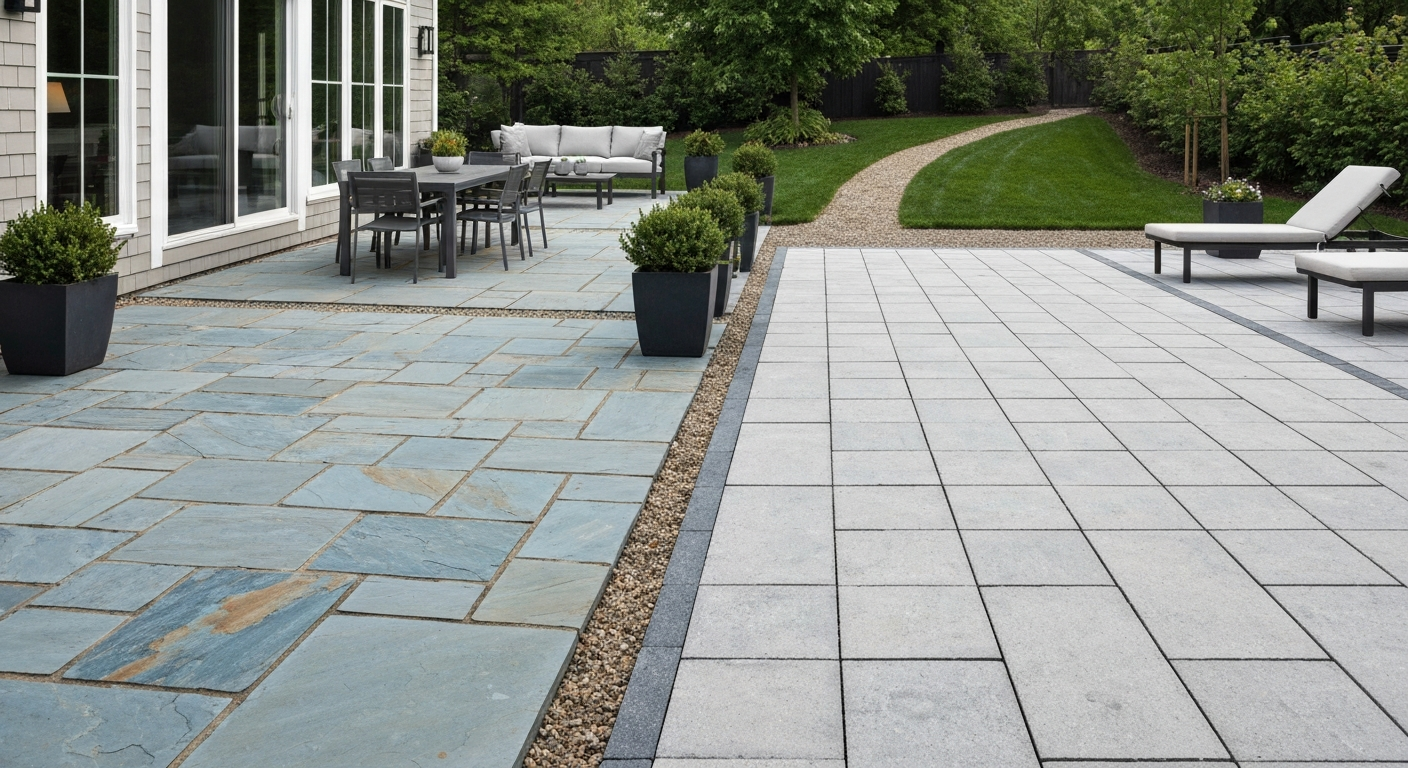
For most residential patios, bluestone, granite, and quartzite are the strongest all-around choices in natural stone, while 20 mm porcelain pavers are the top pick if you want zero-maintenance performance in freeze-thaw climates. TCNA meeting log (ANSI A326.3 discussion), U.S. Consumer Product Safety Commission filing notes that ANSI/TCNA A326.3 (DCOF AcuTest) is the U.S. consensus test for wet dynamic coefficient of friction; the industry benchmark for level interior wet-walk areas is DCOF ≥ 0.42 (wet) TCNA meeting log (ANSI A326.3 discussion) — U.S. Consumer Product Safety Commission filing. Flagstone (usually Pennsylvania bluestone or irregular fieldstone) gives you the most natural look at a mid-range price. Limestone and sandstone are affordable and beautiful but need more care in wet or cold regions. Slate works well in mild climates but chips under heavy furniture and sharp freeze cycles. Granite and quartzite cost more upfront and last essentially forever. This guide walks you through every option, including engineered stone, so you can match the right slab to your climate, budget, load needs, and design style.
Best Stone Slabs for Patio: Picks, Costs, Care & Install
What this guide covers and how to use it
This is a decision-first resource, not a sales pitch. Whether you are still choosing a material, planning installation, or trying to figure out why your existing patio is heaving or staining, there is a section here for you. Start with the Top Picks at a Glance section if you need a fast answer. Work through the Stone Options Explained section if you want the full material breakdown. Jump to the Climate and Use Recommendations section if your situation is specific, such as a pool surround, a freeze-thaw zone, or a spot that takes heavy furniture and a gas grill. The Comparison Table gives you everything side by side. The later sections cover installation prep, laying methods, maintenance, design patterns, sourcing, and budgeting in practical detail. Related in-depth guides on this site cover natural stone selection, patio design ideas, and outdoor stone options at a deeper level, so use this article as your starting map and follow the threads that matter most for your project.
Top picks at a glance
These are my top recommendations by category, based on material properties, real-world performance, and cost-benefit trade-offs. Every pick is explained in full further down.
| Category | Top Pick | Runner-Up | Why |
|---|---|---|---|
| Best for budget | Flagstone (irregular) | Sandstone | Lowest material cost; cut-your-own sizing possible |
| Best for wet/freeze climates | Granite slab | 20 mm porcelain paver | Very low absorption (~0.1–0.4%); freeze-thaw stable |
| Best for heat/hot-dry climates | Limestone (buff/cream) | Sandstone | Light color reflects heat; comfortable barefoot |
| Best modern look | 20 mm porcelain paver | Quartzite | Large format, consistent color, minimal jointing |
| Best traditional look | Pennsylvania bluestone (thermal finish) | Irregular flagstone | Classic, widely loved, ages gracefully |
| Best longevity | Granite or quartzite | Porcelain paver | Granite and quartzite rated 50+ years with minimal care |
Stone options explained
Each stone family behaves differently in the field. Understanding the key properties, especially absorption, hardness, and finish availability, is what separates a patio that looks great in year one from one that still looks great in year twenty.
Flagstone
Flagstone is a catch-all term for flat-splitting sedimentary or metamorphic stone sold in irregular shapes. Common sources include Pennsylvania bluestone, Arkansas sandstone, Tennessee crab orchard, and Arizona flagstone. Thickness ranges from 1 inch to 2.5 inches in natural-cleft pieces. Because you are buying irregular shapes, waste cuts are minimal and you can cover more square footage for the dollar. The natural-cleft surface offers good wet traction. The downside is variable thickness, which makes a level dry-lay difficult and mortar-setting more labor-intensive. Absorption varies widely by source, so ask for ASTM C97 test data if you are in a freeze-thaw zone.
Bluestone
Pennsylvania bluestone is a dense sandstone/argillite with a characteristic blue-gray color that weathers to warm brownish tones over time. It comes in two finishes: natural cleft (rough, high traction, traditional) and thermal or saw-cut (smooth, contemporary). Absorption runs around 1.5 to 3% depending on the specific quarry bed, so it performs well in freeze-thaw with proper drainage but is not as bomb-proof as granite. It is one of the most popular slab choices in the northeastern United States for good reason: it is locally sourced, relatively affordable, and holds up well with occasional sealing.
Slate
Slate is a fine-grained metamorphic rock that splits into thin, flat layers, making it naturally well-suited to paving. It has a Mohs hardness of roughly 3 to 5 and absorption typically under 1.5%. The layered structure that makes it easy to split also makes it susceptible to delamination under repeated freeze-thaw cycling or under heavy point loads. For mild, wet climates, slate is excellent. In cold climates with hard winters, I have seen slate patios delaminate within five years when the base allowed moisture to pool under slabs. Stick with thicker pieces (1.25 inches or more) and seal annually in freeze-thaw zones.
Sandstone
Sandstone ranges enormously in quality. A dense, well-cemented quartzitic sandstone can have a Mohs hardness of 6 to 7 and absorption under 3%, which is workable even in moderately cold climates. Softer, calcium-cemented sandstones can absorb 5 to 8% water by weight, which the Natural Stone Institute's Dimension Stone Design Manual classifies as acceptable only for select uses with careful specification. For patio use, always request the ASTM C97 absorption number before ordering sandstone. Lighter-colored buff and cream sandstones stay cool underfoot in summer, which makes them a practical choice for hot, dry climates and pool decks.
Limestone
Limestone is a calcium carbonate sedimentary rock with a Mohs hardness of about 3 to 4. It is soft enough that it scratches and chips more easily than granite or quartzite. Absorption ranges from roughly 1 to 5% depending on density. In arid climates, limestone is a beautiful, cost-effective choice. In cold or wet climates, high-absorption limestone should be approached carefully: absorption above 1 to 2% in a hard freeze zone can cause spalling. Dense, low-absorption limestone (such as some Belgian bluestone or certain dense French limestones) can handle cold climates better, but always verify the ASTM C97 result. Acid-based cleaners and de-icing salts will etch and destroy limestone surfaces.
Granite
Granite is an igneous rock with a Mohs hardness of 6 to 7 and water absorption typically between 0.1 and 0.6%, which puts it in the same league as porcelain for freeze-thaw resistance. It is one of the most durable paving materials available. A properly installed granite patio can outlast the house. It is heavy (roughly 150 to 170 lb per cubic foot), which means freight costs are significant if you are not near a granite-producing region. Granite is available in cut slabs, cobbles, and thermal-finished pavers. The thermal flame finish roughens the surface to improve wet traction. For high-traffic areas, driveways, and anywhere you need 50-plus year longevity, granite is the benchmark.
Quartzite
Quartzite is a metamorphic rock formed from sandstone that has been recrystallized under heat and pressure. It is hard (Mohs 6.5 to 7), dense (similar bulk density to granite at 150 to 170 lb per cubic foot), and has absorption typically under 1.0%, with the Natural Stone Institute recommending a maximum of about 1.0% for exterior paving use. This combination makes quartzite one of the most freeze-thaw-resistant natural stones available. It is also beautiful, with striking veining and a range of whites, grays, and golds. The trade-off is cost: quartzite slabs are expensive, and because the material is extremely hard, cutting and fabrication add to the bill.
Engineered stone (sintered stone and resin-quartz)
Two products are sold under the engineered stone umbrella: sintered stone (sometimes called compact stone or ultra-compact surface) and resin-bound quartz. Sintered stone is made by fusing minerals under extreme heat and pressure to produce a near-impervious, large-format slab. It performs more like high-end porcelain than natural stone: water absorption well below 0.5%, consistent appearance, and availability in very large formats (up to 126 by 63 inches). It works well outdoors when properly supported. Resin-bound quartz (brands like Caesarstone, Silestone) is a different story: most major manufacturers historically exclude standard outdoor use from warranty because UV exposure and thermal cycling can degrade the resin binders and cause discoloration. A handful of brands offer dedicated outdoor-rated SKUs with published weathering data, but you must confirm outdoor rating at the specific product level before specifying it for a patio.
How stone compares to porcelain and other non-stone surfaces
Porcelain pavers have become a serious competitor to natural stone, and I say that as someone who spent years recommending stone almost exclusively. The key metric is water absorption. ASTM C373 classifies impervious porcelain at 0.5% or less water absorption by mass. Most quality porcelain pavers come in well under 0.1%. That number matters enormously in freeze-thaw climates because absorbed water expands when it freezes. Porcelain also meets the ANSI/TCNA A326.3 DCOF AcuTest benchmark of 0.42 or higher (wet) in most textured exterior finishes, making it reliably non-slip when specified correctly. The 20 mm (2 cm) gauged porcelain paver format, now formally recognized under ANSI A137.3 for on-ground, mortar-set, and pedestal installations, is purpose-built for outdoor use. Manufacturers like Daltile publish 10 to 25-year conditioned warranties for specified exterior installations, which no natural stone quarry can match.
The honest trade-offs with porcelain: it feels synthetic to many homeowners, large slabs can crack under uneven substrate settling, and repairs are difficult because matching lot-to-lot color is never guaranteed. Concrete pavers (interlocking) are cheaper than both stone and porcelain and very forgiving to install and repair, but they have a look that most homeowners recognize as utilitarian. Composite decking and rubber pavers occupy a different niche (more suited to raised decks than in-ground patios) and are not direct competitors for the traditional patio slab role. Brick is warm and classic but limited in size format and surface texture. For pure performance in the worst climates, porcelain or granite. For beauty, character, and a connection to natural materials, natural stone wins for most homeowners.
Decision framework: match the slab to your situation
Work through these factors in order. The ones at the top of the list will eliminate options; the ones further down will help you fine-tune.
- Climate zone: Do you have hard freezes (USDA zones 6 or colder)? If yes, require ASTM C97 absorption under 1.0% or use porcelain. In warm, dry climates absorption matters less.
- Slip resistance: Any wet-surface area (pool deck, covered patio that stays wet, shaded north-facing patio) needs a natural-cleft, textured, thermal, or sandblasted finish. Polished or honed finishes are unsuitable for wet outdoor areas. Look for finish-specific DCOF data from the supplier when buying porcelain.
- Load: Residential patio furniture and foot traffic is light and any slab 1.25 inches or thicker on a proper base handles it easily. A heavy gas grill, large fire table, or hot tub changes the equation. For a hot tub (typically 4,000 to 6,000 lb filled), you need a dedicated concrete pad or significantly reinforced base, not just a dry-laid slab.
- Thickness: For pedestrian residential patios, 1.25 to 2 inches is standard for natural stone. For porcelain, 20 mm (about 0.79 inches) is the minimum specified for on-ground exterior use. For driveways or any vehicular load, ICPI recommendations call for 80 mm (about 3.1 inches) or more for interlocking units; natural stone slabs for driveways should be 2.5 to 3 inches minimum on a reinforced base.
- Finish: Natural-cleft and thermal finishes are the safest for wet areas. Honed is acceptable for covered, low-wet patios. Polished is appropriate only for indoor use or fully protected settings. Finish also affects heat retention: darker, polished surfaces get hotter underfoot in full sun.
- Color and aesthetics: Cool grays (bluestone, quartzite, slate, porcelain) read as modern. Warm buff and tan tones (sandstone, limestone, certain flagstones) read as traditional or Mediterranean. Browns and rusts (crab orchard sandstone, some granites) are rustic. Choose based on your house's exterior palette.
- Jointing: Wide joints (1 inch or more) work well with irregular flagstone using polymeric sand or mortar. Tight joints (under 0.25 inch) require cut, dimensioned stone or large-format porcelain. Joint width affects drainage, weed growth, and visual style.
- Drainage: All patios should slope away from the house at a minimum of 1/8 inch per foot (1% grade). Stone patios over impermeable mortar beds need perimeter drainage. Dry-lay and permeable systems drain through the joints, which reduces runoff but requires a well-graded aggregate base.
- Budget: Material costs range from roughly $3 to $5 per square foot for basic flagstone to $20 to $35+ per square foot for premium quartzite or large-format granite. Installation labor typically runs $8 to $20 per square foot depending on method and complexity. Total installed costs for a mid-range natural stone patio typically land between $18 and $40 per square foot.
- Lifespan and total ownership cost: Granite and quartzite can last 50 or more years with minimal intervention. Sandstone and limestone patios in difficult climates may need resealing every one to two years and slab replacement within 15 to 20 years if not well-maintained. Porcelain has no natural weathering charm but can outperform porous stone in harsh climates with near-zero maintenance.
Quick comparison: every stone at a glance
| Stone Type | Mohs Hardness | Typical Absorption (ASTM C97) | Best Climate | Freeze-Thaw Risk | Typical Material Cost (per sq ft) | Realistic Lifespan | Key Pros | Key Cons |
|---|---|---|---|---|---|---|---|---|
| Flagstone (irregular) | 3–7 (varies by source) | 1–5% | Mild to moderate | Moderate (varies) | $3–$8 | 20–40 yrs | Low cost, natural look, DIY-friendly | Variable thickness, uneven finish, variable absorption |
| Pennsylvania Bluestone | ~5–6 | 1.5–3% | Northeast US; moderate freeze | Low-moderate with drainage | $5–$12 | 25–50 yrs | Classic look, good traction (cleft) | Weathers to brown; acid-sensitive |
| Slate | 3–5 | 0.4–1.5% | Mild to moderate | Moderate-high (delamination risk) | $4–$10 | 15–30 yrs | Thin, lightweight, natural cleft | Chips under impact; delamination in hard freeze |
| Sandstone | 4–7 (varies) | 2–8% | Hot, dry climates best | High (if absorption >3%) | $3–$7 | 15–30 yrs | Warm tones, stays cool, budget-friendly | Soft; high absorption in some types; stains |
| Limestone | 3–4 | 1–5% | Arid, mild climates | Moderate-high | $5–$12 | 20–40 yrs | Elegant look; stays cool underfoot | Soft; acid-sensitive; freeze risk if porous |
| Granite | 6–7 | 0.1–0.6% | All climates | Very low | $10–$25 | 50+ yrs | Extremely durable; freeze-thaw safe | Heavy; expensive; limited DIY cutting |
| Quartzite | 6.5–7 | 0.2–1.0% | All climates | Very low | $12–$35 | 50+ yrs | Hardest natural stone; beautiful veining | Most expensive; hard to cut on-site |
| Porcelain (20 mm) | 7–8 | <0.5% (ASTM C373) | All climates | Extremely low | $6–$18 | 30–50 yrs | Consistent, low maintenance, warranties | Looks synthetic; hard to repair; slippery if wrong finish |
| Sintered/Engineered Stone | 7–8 | <0.1% | All climates | Extremely low | $15–$40 | 30–50 yrs | Large format; near-zero absorption | Expensive; needs full substrate support; limited repairability |
Climate- and use-specific recommendations
Wet and freeze-thaw climates (USDA zones 3–6)
This is the most demanding scenario. Require ASTM C97 absorption under 1. Dimension Stone Design Manual (freeze‑thaw / absorption guidance), Natural Stone Institute summarizes that freeze–thaw durability correlates with ASTM C97 absorption and recommends limiting absorption to about 1% or less for exterior paving in freeze–thaw climates Dimension Stone Design Manual (freeze‑thaw / absorption guidance) — Natural Stone Institute. 0% for any natural stone. Granite and quartzite are the safest natural stone choices. Bluestone is acceptable with proper drainage and regular sealing. Slate, porous sandstone, and high-absorption limestone are risky. Porcelain pavers with absorption under 0.5% are the most reliable single choice if you prefer a low-maintenance option. Use a deep compacted aggregate base (minimum 6 inches compacted, ideally 8 inches in frost-susceptible subgrades per ICPI guidance), lay a geotextile separation layer over the subgrade, and ensure positive drainage away from the house at 1% minimum slope.
Hot and dry climates (USDA zones 9–13)
In hot, dry climates, freeze-thaw is not the concern: heat, UV, and barefoot comfort are. Light-colored, lower-density stones like buff limestone and sandstone reflect more heat than dark granite or slate. Thermal-finished granite stays cooler than polished, but still gets hot in direct afternoon sun in Phoenix or Las Vegas. Porcelain in light colors with a textured surface is a practical modern choice here. Avoid very dark stones for pool surrounds in hot climates unless they are on a shaded section. Sand-set or dry-lay systems work reliably in arid conditions where frost heave is not a factor.
Coastal environments
Salt air and occasional salt spray accelerate weathering of calcium-based stones. Limestone and certain marbles are especially vulnerable. Granite, quartzite, and porcelain are the most resistant to salt exposure. Seal limestone or sandstone at the coast every one to two years minimum. Use stainless steel or hot-dip galvanized hardware for any embedded anchors or edge restraints. Check that jointing materials (polymeric sand, mortar) are rated for salt-spray environments.
Pool surrounds
Pool surrounds are wet most of the season, chemically exposed (chlorine, pH-adjusted water), and subject to constant barefoot traffic. Slip resistance is non-negotiable. Use natural-cleft, textured, or brushed/sandblasted finishes. For natural stone, travertine (a form of limestone) is the traditional pool deck choice in warm climates due to its cool surface temperature and grippy texture. Tumbled travertine fills with sand to create a non-skid surface. Quartzite and thermal-finish granite also work well. Avoid honed or polished surfaces. Avoid limestone or travertine if pool water is frequently low-pH (acidic), as this accelerates etching. Porcelain with a minimum textured finish is an excellent choice for pool surrounds in any climate.
High-traffic areas
For areas that see constant foot traffic (main entry paths, barbecue areas, outdoor kitchen zones), prioritize abrasion resistance. Granite and quartzite lead on hardness (Mohs 6.5 to 7). Bluestone and hard sandstone are acceptable. Slate and limestone will show wear paths over time in very high-traffic areas. Use a mortar-set method rather than dry-lay for stability under repeated loading.
Heavy loads: hot tubs, grills, and outdoor kitchens
A filled hot tub can weigh 5,000 to 6,000 pounds or more. That requires a dedicated reinforced concrete pad, not just a stone slab on a gravel base. Pour a 4-inch minimum concrete slab reinforced with rebar or wire mesh, sized to the footprint of the hot tub plus a 12-inch margin on all sides. You can then set stone slabs on top of the concrete with a mortar bed for aesthetic continuity. Large built-in outdoor kitchens and heavy stone fire tables have similar requirements. A heavy gas grill on a properly prepared mortar-set slab over compacted base is typically fine, but freestanding grills with point loads over 300 pounds should rest on slabs at least 1.5 inches thick over a mortar bed.
Installation overview and site preparation
The single most common reason a stone patio fails, meaning it cracks, heaves, or shifts, is inadequate base preparation. The slabs themselves are rarely the problem. I have seen beautiful granite patios completely destroyed by a 3-inch gravel base that allowed frost heave to push individual stones up three inches in a single winter. Get the base right and almost any slab will perform.
Site prep checklist
- Excavate to at least 8 to 10 inches below finished slab surface for pedestrian patios in freeze-thaw zones (4 inches base plus bedding layer plus slab thickness, plus extra base depth in frost-susceptible areas per ICPI guidance)
- Excavate to 6 to 7 inches below finished surface minimum in non-freeze climates
- Establish positive slope away from house: minimum 1/8 inch per foot (1% grade) across the entire patio
- Remove all organic material, topsoil, and soft spots from the subgrade
- Install geotextile fabric over the subgrade in frost-susceptible areas or where fine silty soils are present to prevent migration into the aggregate base
- Place compacted aggregate base in 2 to 4-inch lifts, compacting each lift to 95 to 98% Standard Proctor (ASTM D698); pedestrian patio minimum 4 inches compacted, 6 to 8 inches in cold/frost zones, 8 to 12 inches for vehicular loads
- Install edge restraints before placing bedding layer; use manufactured concrete curbs, metal, or heavy-duty plastic restraints anchored with spikes at 12 inches on-center into the compacted base
- For dry-lay, add a 1-inch screeded bedding layer of coarse concrete sand (ASTM C33) over the compacted aggregate
- For mortar-set, prepare a 1.5 to 2-inch mortar bed on the compacted base or on a concrete slab substrate
Installation methods: mortar bed, dry-lay, and pedestal systems
Dry-lay (sand-set)
Dry-lay sets slabs on a screeded sand bedding layer over compacted aggregate. It is the most DIY-accessible method, allows individual slabs to be lifted and re-leveled, and is permeable (water drains through the joints). It works best with dimensioned, consistent-thickness slabs or interlocking pavers. For natural stone with variable thickness (flagstone), dry-lay requires more patience to level each piece. In freeze-thaw climates, ensure the base is deep enough and well-drained because water trapped under slabs will cause heave regardless of slab quality. Fill joints with polymeric sand, which resists ants and weed growth better than plain sand.
Mortar bed
Mortar-setting bonds the slab to a mortar bed (usually 1.5 to 2 inches of Portland cement-based mortar) over a concrete substrate or directly over a compacted aggregate base on stable soil. This method locks everything in place, produces a very flat surface, and allows tight grout joints (under 1/4 inch), which is ideal for a refined, formal look with cut stone or large-format porcelain. The limitation is that mortar-set systems are not easily repaired. If a slab cracks or settles, breaking it out damages surrounding slabs and the mortar bed. Mortar-set also requires curing time and is less suitable as a DIY project for large areas. Use a polymer-modified thinset or medium-bed mortar for large-format stone (anything over 15 by 15 inches) to improve bond and accommodate thermal movement.
Pedestal systems
Adjustable pedestal systems elevate slabs above a roof deck, waterproofing membrane, or concrete base, creating an air gap that promotes drainage and allows access to utilities underneath. This method is almost exclusively used on roof terraces, above-garage patios, or over waterproofed decks. It is not a standard option for at-grade residential patios. The 20 mm porcelain paver format was specifically developed with pedestal installation in mind, and ANSI A137.3 formally recognizes this method. For pedestal use, slab size and thickness must be matched to the pedestal spacing specified by the manufacturer; never improvise pedestal spans with unsupported spans beyond what the slab thickness can handle.
Jointing and edging details
For dry-lay systems, use polymeric sand swept into joints and activated with water; plan for 1/4 to 1/2 inch joints for cut stone and 1 to 2 inch joints for irregular flagstone. For mortar-set systems, use a sanded or unsanded grout matched to joint width and outdoor-rated for UV and freeze-thaw resistance. Edge restraints are mandatory for dry-lay systems; without them, the edge slabs migrate outward under traffic and frost action. A simple cast-in-place concrete edge beam on two sides (back and sides against a planting bed or lawn) is the most permanent solution.
Thickness and structural requirements
For pedestrian residential patios, natural stone slabs should be at least 1.25 inches (roughly 30 mm) thick for standard foot traffic and light furniture. For larger, unsupported spans in dry-lay (flagstone spanning more than 12 inches between contact points), 1.5 to 2 inches is safer. Porcelain pavers at 20 mm (0.79 inch) are adequate for pedestrian use when fully supported on a bedding layer, but they require more attention to base prep because they are less forgiving of voids than thicker stone. For driveways or areas where vehicles will park, ICPI guidelines call for interlocking concrete pavers at 80 mm (about 3.1 inches) minimum; for natural stone driveway slabs, use 2.5 to 3 inch thickness minimum on a reinforced concrete or deep aggregate base. Hot tub pads require a dedicated reinforced concrete structure as described in the previous section.
Maintenance and repair
Sealing
Most natural stone benefits from sealing, though some (granite, quartzite) need it far less than others. Use an impregnating (penetrating) sealer rather than a topical coating for outdoor stone. Topical sealers trap moisture underneath in wet or freeze-thaw environments and can peel. Test the sealer on a sample piece first and confirm the product is rated for outdoor, below-grade-contact use. Seal limestone, sandstone, and bluestone every one to two years in wet or freeze-thaw climates. Seal granite and quartzite every three to five years or when water no longer beads on the surface. Porcelain and sintered stone do not require sealing.
Cleaning and stain removal
For routine cleaning, use a pH-neutral stone cleaner and water. Never use vinegar, lemon juice, muriatic acid, or any acidic cleaner on limestone, marble, travertine, or sandstone; these etch calcium-based stone immediately. For oil stains (common near a grill), apply a commercial stone poultice (kaolin clay mixed with mineral spirits or acetone) over the stain, cover with plastic wrap, and leave for 24 to 48 hours. For rust stains, use an oxalic-acid-based stone cleaner, but avoid this on calcium-based stones unless the product is specifically labeled safe. For organic stains (moss, algae), a dilute bleach solution (roughly 1:10 bleach to water) works well but rinse thoroughly. Porcelain can be cleaned with almost any non-abrasive cleaner.
Efflorescence prevention
Efflorescence (white salt deposits on the stone surface) is caused by soluble salts migrating upward through the slab with water and crystallizing on the surface. It is common on newly installed mortar-set patios. In most cases it diminishes after the first season. You can brush it off dry with a stiff nylon brush (not wire) or treat it with a dilute efflorescence remover. Long-term prevention means improving drainage so water does not constantly wick through the base and mortar bed. Using a low-alkali Portland cement mortar reduces the salt supply.
Freeze protection and replacing or re-leveling slabs
Never use rock salt or chloride-based deicers on natural stone or mortar joints. They accelerate salt spalling and will destroy limestone and sandstone within a few seasons. Use sand for traction or a urea-based (non-chloride) deicer if needed. For re-leveling heaved slabs in a dry-lay system, lift the affected slabs (a flat pry bar works; protect the slab edge with a piece of rubber), add or remove bedding sand to correct the height, relay and re-sand the joints. For a mortar-set patio, re-leveling requires chiseling out the grout, carefully breaking the mortar bond, adjusting the mortar bed, and resetting. It is doable but more labor-intensive. Replace cracked or spalled slabs by sourcing from the same supplier and the same product lot if possible (though exact color matching is rarely perfect in natural stone).
Design and layout ideas
Pattern and layout affect both the visual character of the patio and the difficulty of installation. Here are the most common approaches and when to use each.
| Pattern | Best Stone Type | Difficulty | Look and Feel |
|---|---|---|---|
| Random flagstone | Irregular flagstone, bluestone | Moderate | Natural, organic, cottage or rustic |
| Ashlar (irregular but cut) | Bluestone, limestone, sandstone | Moderate-high | Refined natural; traditional |
| Running bond | Cut stone pavers, porcelain, granite | Low-moderate | Clean, directional; modern or traditional |
| Modular (mixed sizes) | Bluestone, limestone, granite, porcelain | Moderate | Contemporary; designer look |
| Radial / fan / circular | Cut stone pavers, granite cobbles | High | Formal, focal-point; estate or courtyard |
| Versailles / French pattern | Limestone, travertine, bluestone | Moderate | Classic European; traditional or formal |
Color strategy matters as much as pattern. A single-material, single-tone patio in a neutral (warm gray bluestone, buff limestone) rarely goes wrong because it reads as intentional restraint. Using two stone types, such as a field of thermal bluestone with a border of cut granite cobbles, adds definition without visual noise. Contrasting borders in a darker or lighter stone define the patio edge cleanly against a lawn. Texture contrast, such as rough natural-cleft stone in the field with smooth sawn-edge borders, is an elegant detail that photographs well and is easy to execute. Avoid mixing more than two stone types unless you have a strong design rationale.
Sourcing and buying tips
Where you buy stone matters almost as much as what you buy. A local stone yard that lets you walk the yard, select individual slabs, and inspect the material beats an online-only supplier for large projects every time. Here are the key sourcing principles.
- Visit local quarries or regional stone yards whenever possible: you can hand-select slabs, see actual color and texture, and avoid freight surprises
- Request ASTM C97 absorption data and C99 flexural strength data for any natural stone being specified for an exterior patio, especially in cold or wet climates
- Order samples before committing to a full order: stone varies quarry-to-quarry and even layer-to-layer; a 12 by 12-inch sample tells you little about how a yard of irregular flagstone will look installed
- Order 10 to 15% more material than your measured square footage for cuts, rejects, and future repairs; for irregular flagstone with complex shapes, 15 to 20% overage is safer
- Reclaimed stone (salvaged granite cobbles, reclaimed bluestone, used brick pavers) can offer great character and lower cost, but inspect carefully for spalling, old mortar contamination, and inconsistent thickness that will complicate installation
- For cut stone slabs (bluestone, limestone, granite), specify the finish (natural cleft, thermal, honed, sawn) and the nominal thickness and tolerance; most suppliers work to a plus or minus 1/8-inch thickness tolerance
- Understand freight costs before finalizing a supplier: stone is heavy (granite runs 150 to 170 lb per cubic foot), and freight from a distant quarry can add $1 to $3 per square foot to your actual cost
- For small patios under 200 square feet, buying from a local stone yard on pallets with a flat delivery rate is usually the most cost-effective approach
- Ask about return policy before ordering: most stone suppliers will not accept returns on custom-cut material, and even natural-cleft slab returns may be refused if the material has been moved or cut on-site
Cost estimation and budgeting
Here is a realistic framework for estimating total project cost. These figures reflect 2025 to 2026 mid-market pricing in the continental United States and will vary by region, stone source, and project complexity.
| Cost Element | Budget Tier (per sq ft) | Mid-Range (per sq ft) | Premium (per sq ft) |
|---|---|---|---|
| Stone material (flagstone/sandstone) | $3–$5 | $6–$10 | $12–$35+ |
| Base aggregate + geotextile | $1–$2 | $2–$3 | $3–$4 |
| Bedding (sand or mortar) | $0.50–$1 | $1–$2 | $2–$3 |
| Edge restraints | $0.50–$1 | $1–$2 | $2–$3 |
| Labor (installation) | $6–$10 | $10–$16 | $16–$25+ |
| Sealer (first application) | $0.50–$1 | $1–$2 | $2–$4 |
| Total installed estimate | $12–$20 | $21–$35 | $37–$74+ |
Long-term ownership trade-offs are significant. A $15-per-square-foot flagstone patio that needs resealing every two years and a slab replacement every decade costs meaningfully more over 30 years than a $30-per-square-foot granite patio that needs only occasional cleaning. For a 400-square-foot patio, that calculus can flip the apparent cost advantage of the cheaper material over a 20-year ownership horizon. Run your own numbers: multiply annual maintenance cost by expected ownership years and add to the upfront cost before deciding that the cheaper slab is the better deal.
Actionable next steps: your patio decision checklist
Use this checklist to move from research to project. Each checkpoint confirms you have the information you need before spending money.
- Confirm your USDA climate zone and identify whether you have frost-susceptible subgrade (ask a local landscaper or check USDA/FEMA flood/soil maps)
- Measure your patio area and note any special load zones (hot tub location, outdoor kitchen, heavy planters)
- Identify your primary design goal: natural/traditional, modern/minimal, or somewhere between, and pull three to five reference photos to show a supplier or contractor
- Set a realistic total budget (material plus labor plus base plus sealer) using the table above as a starting range
- Request ASTM C97 absorption data from any stone supplier before ordering material for a cold or wet climate project
- Visit at least one local stone yard with your reference photos and a tape measure; select a sample slab and take it home to view in your actual outdoor light
- Decide on installation method: DIY dry-lay (best for budget and accessibility), hired contractor mortar-set (best finish quality), or pedestal system (roof deck or above-waterproofing only)
- Get at minimum two installation quotes if hiring; ask each contractor to specify base depth, compaction method, edge restraint type, and joint material in writing
- Order material with 10 to 15% overage; store slabs flat on wood bearers off the ground until installation
- Schedule sealing within 30 days of installation completion for limestone, sandstone, and bluestone; within 90 days for granite and quartzite
Image suggestions for this article
- Close-up texture shots of each stone type side-by-side: natural-cleft bluestone, thermal granite, honed limestone, split-face quartzite, slate layers, and buff sandstone
- Finished patio photos in each layout pattern: random flagstone backyard, ashlar bluestone formal terrace, modular porcelain modern patio, Versailles limestone courtyard, radial granite feature
- Cross-section diagram showing base layers: subgrade, geotextile, compacted aggregate (with depth labels), bedding sand, and slab, with frost depth indicator for cold climates
- Side-by-side before/after of a heaved flagstone patio (poor base) versus a properly rebuilt version with labeled base depth
- Pattern diagrams (overhead view, labeled): running bond, ashlar, random flagstone, modular, Versailles, radial
- Pool surround photo comparing tumbled travertine versus thermal granite versus textured porcelain
- Stain and maintenance photo sequence: efflorescence on new bluestone, cleaned with brush, sealed surface with water beading
Where to go next on this site
This guide is your starting point for the whole decision. Once you know which stone category fits your project, the deeper resources here will take you the rest of the way. If you are still deciding between a full natural stone patio and a mixed approach, the guides on best stone patios and best outdoor patio stone cover design-led comparisons in more detail. If you have settled on a material and want to explore aesthetic possibilities before committing to a layout, the guide on best stone patio ideas covers pattern and design combinations with real project examples. See the best stone patio ideas guide for pattern and design combinations with real project examples. For a focused comparison of top-performing materials, see our guide on best outdoor patio stone. If you are narrowing down specifically to natural materials and want a property-by-property comparison of quarried options, the guide on best natural stone for outdoor patio goes deep on sourcing and specification. And if your core question is still which patio stone is best for your specific constraints, that guide walks through the same decision framework from a different angle with additional climate case studies. If you're still unsure, read our guide which patio stone is best for your specific constraints.
FAQ
Which stone slabs are best overall for a residential patio?
Top overall picks by common homeowner priorities: - Best budget: Sandstone or flagstone (local, thinner cuts) for lower material cost and DIY-friendly installation. - Best for wet/frost climates: Granite or quartzite (low absorption, high strength) or impervious porcelain pavers. - Best for heat resistance (hot, sunny climates): Light‑colored bluestone, limestone, or porcelain with light finish to reduce heat gain. - Best modern look: Large-format honed or textured granite/quartzite or 20 mm gauged porcelain pavers in rectilinear layouts. - Best traditional look: Natural flagstone, bluestone, or slate in random/ashlar patterns. - Best longevity: Dense granite or quartzite, properly installed and drained, offer the longest service life.
How do natural stones (flagstone, bluestone, slate, sandstone, limestone, granite, quartzite) compare to porcelain and other non‑stone surfaces?
Quick comparison highlights: - Granite/Quartzite: Very low absorption, high strength, excellent freeze–thaw and abrasion performance; higher cost and heavier. - Bluestone/Slate: Attractive natural cleft finishes, good slip resistance when textured; many varieties perform well but check absorption for freeze climates. - Sandstone/Limestone: Warmer aesthetic and lower cost but variable absorption and durability; require careful selection and detailing in wet/freeze areas. - Porcelain: Engineered, nearly impervious (≤0.5% absorption), consistent color, available in large formats and 20 mm pavers for on‑grade; excellent freeze resistance if installed with proper drainage. - Concrete pavers: Cost‑effective, good performance when edge‑restrained and with proper base; color/texture less natural. Key decision factors are absorption (freeze risk), slip resistance (finish), load/thickness, and maintenance requirements.
What decision framework should homeowners use to choose the right patio stone?
Use a stepwise framework: 1) Climate: check freeze–thaw cycles and rainfall; prefer low‑absorption materials in cold/wet climates. 2) Use/Loads: pedestrian only vs. furniture/vehicular; determine required thickness and base. 3) Slip resistance: choose textured/natural cleft or test per ANSI A326.3 for wet COF if needed. 4) Finish & color: match design goals (heat reflectance, maintenance, look). 5) Installation method: dry‑lay on aggregate, mortar‑set, or pedestal/20 mm porcelain — choose per slope, drainage, and subgrade. 6) Budget & sourcing: compare local stone vs. imported slabs, factoring freight and cutting. 7) Longevity & maintenance: verify ASTM C97 absorption data for natural stone and manufacturer warranties for engineered products.
What are the practical pros, cons, approximate cost ranges, and lifespans for each common stone type?
Concise pros/cons/cost/lifespan guidance (typical ranges—local prices vary): - Granite: Pros—very durable, low absorption; Cons—higher cost, heavy; Cost—$15–$40+/sq ft installed; Lifespan—50+ years. - Quartzite: Pros—hard, frost‑resistant; Cons—can vary in color/price; Cost—$12–$35+/sq ft; Lifespan—50+ years. - Bluestone: Pros—attractive, good texture; Cons—variable absorption; Cost—$10–$30+/sq ft; Lifespan—20–50 years (with proper selection). - Slate: Pros—distinct texture and color; Cons—can delaminate if poor quality; Cost—$8–$25+/sq ft; Lifespan—20–40+ years (quality‑dependent). - Sandstone: Pros—affordable, warm tones; Cons—variable strength/absorption; Cost—$6–$20+/sq ft; Lifespan—10–30+ years depending on grade. - Limestone: Pros—classic look; Cons—softer, may stain/erode; Cost—$8–$25+/sq ft; Lifespan—15–40 years. - Porcelain (20 mm pavers): Pros—nearly impervious, uniform, warranty options; Cons—can chip at edges if improperly installed; Cost—$12–$40+/sq ft installed; Lifespan—25+ years with correct installation. Note: ranges overlap—request lab absorption (ASTM C97) for natural stone and manufacturer data for engineered products.
How should I size/thickness and prepare the base for different patio installations?
Base and thickness rules of thumb: - Natural slabs or large pavers for pedestrian patios: typically 1¼–2" minimum slab thickness for flagstone on compacted aggregate; check slab bend strength for large spans. - Porcelain 20 mm gauged pavers: intended for pedestrian patios on pedestals, mortar or on‑ground systems—follow manufacturer. - Interlocking pavers: 60 mm (≈2⅜") for pedestrian patios; 80 mm+ for driveways. - Base depths (ICPI): pedestrian patios ≈4" compacted aggregate; add 50–100% base thickness in frost‑susceptible subgrades. - Compaction: place base in 2–4" lifts compacted to ~95–98% Standard Proctor. - Edge restraint: mandatory for sand‑set/dry systems; anchor into compacted base. - Drainage: maintain slope (≥1/8"–1/4" per foot recommended) away from structures and provide subsurface drainage where needed.
When should I choose mortar‑set vs. dry‑lay vs. pedestal installation methods?
Choose by site and product: - Dry‑lay on compacted aggregate with jointing sand: best for irregular flagstone, flexible with freeze/thaw when base and edge restraint are correct. - Mortar‑set (bed or thin‑set): use where a solid, level surface is required or for large heavy slabs that need full support; ensure expansion joints and waterproofing near structures. - Pedestal systems (20 mm porcelain or compatible slabs): ideal for terraces, rooftop, or where reversible installations and easy access to services are desired; require manufacturer‑rated pedestals and attention to drainage. Consider slope, proximity to structure, and frost exposure when selecting method.