You can buy patio blocks at landscape supply yards, masonry yards, big-box home centers like Home Depot, Lowe's, and Menards, tile and stone showrooms, online retailers like BuildDirect and Wayfair, and salvage or reclaimed-material dealers. For a full directory of suppliers by material and region, see where to buy patio stones. The best source depends on what material you need, how much you're buying, whether you need delivery on a pallet, and how close you want to stick to a budget. For most standard concrete pavers and basic patio slabs, a local landscape supply yard or big-box store will get you there fastest. For natural stone, porcelain slabs, or specialty brick, a masonry yard or stone showroom is usually worth the extra trip.
Where to Buy Patio Blocks: Complete Local & Online Guide
Nolan Ellison
6 Aug 2026
Who this article is for and what you'll learn
This guide is written for homeowners and DIYers who are in the shopping and sourcing phase of a patio project. Maybe you've already decided on a material, or maybe you're still weighing concrete pavers against flagstone or porcelain slabs. Either way, this article walks you through every place you can actually buy patio blocks, pavers, slabs, bricks, and stone, what each source stocks, how pricing and ordering work, what delivery looks like for heavy palletized materials, and what to watch out for with returns. For a focused list of retailers and tips on sourcing large-format slabs, see our guide on where to buy patio slabs. By the end, you'll know exactly where to start your search, what questions to ask a supplier, how to calculate quantities, and how to take delivery without surprises.
Choose the right patio material before you start shopping
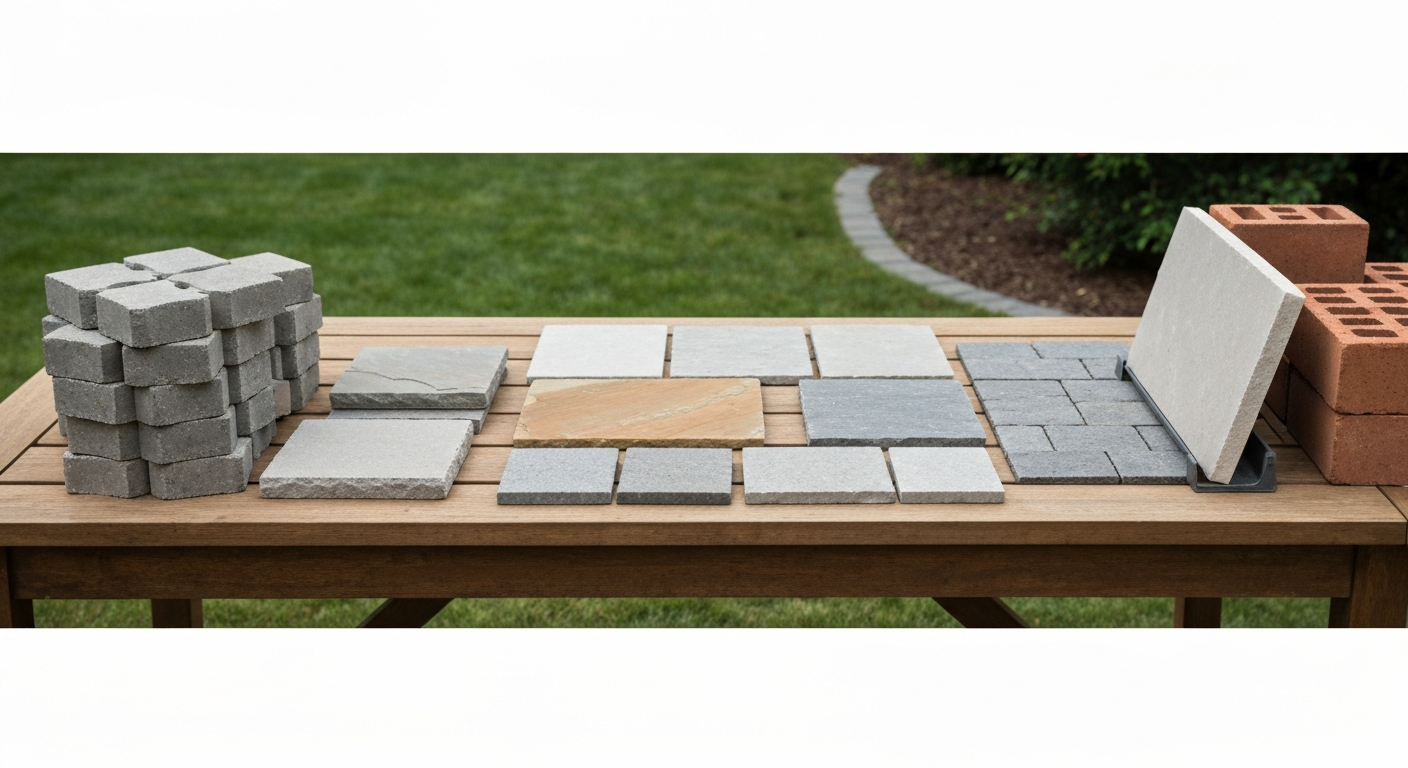
Your material choice drives where you buy, how much you pay, and what installation looks like. Concrete pavers and poured blocks are the most widely available and easiest to source locally. Natural stone like flagstone, bluestone, or travertine usually requires a masonry yard or stone supplier. Porcelain patio slabs are a showroom or specialty tile dealer purchase. Brick and reclaimed materials often come from masonry yards or salvage dealers. Getting clear on your material first saves a lot of wasted calls.
A few practical questions to answer before you search: What climate are you in? Freeze-thaw cycles eliminate certain stones and low-density pavers. What's your square footage? Anything over roughly 200 sq ft means you're almost certainly working with palletized delivery. What's your budget per square foot? Concrete pavers run roughly $2 to $6 per sq ft for material; natural stone starts around $5 and can run $20 or more; porcelain slabs with large-format sizing tend to land $8 to $20 per sq ft for the material alone. And what's your installation plan? Interlocking concrete pavers on a compacted gravel base are a realistic DIY project; large-format porcelain or irregular flagstone laid in mortar is harder to self-install without experience.
| Material | Typical cost/sq ft (material only) | Best source | DIY-friendly? | Freeze-thaw resistant? |
|---|---|---|---|---|
| Concrete interlocking pavers | $2 – $6 | Landscape yard, big-box | Yes | Yes (ASTM C936 rated) |
| Poured/cast patio blocks | $1 – $4 | Big-box, landscape yard | Yes | Moderate |
| Natural flagstone / bluestone | $5 – $20+ | Masonry/stone yard | Moderate | Depends on stone type |
| Brick (full and thin) | $3 – $8 | Masonry yard, salvage | Moderate | Yes (if rated) |
| Porcelain patio slabs | $8 – $20 | Tile showroom, specialty dealer | Harder | Yes (low absorption) |
| Slate | $6 – $15 | Stone yard, specialty dealer | Moderate | Variable by grade |
| Reclaimed/salvage stone | $2 – $10 | Salvage dealer, Craigslist | Moderate | Verify by piece |
If you're still deciding between patio slabs, paving stones, or brick, spend a few minutes comparing them on paper before you start calling suppliers. It's much easier to pivot before you've ordered three pallets.
How to search locally: getting the most out of 'near me' queries
Typing 'patio blocks near me' or 'landscape supply near me' into Google works, but you can do better. If you prefer a quick local search, try looking up where can i buy patio slabs near me to find nearby suppliers and options. Try searching 'where to buy patio stones near me' to surface nearby suppliers, map listings, and customer photos that confirm the yard carries hardscape materials. Search for the specific material type plus your city or zip code: 'concrete pavers [your city]', 'flagstone supplier [your zip]', 'masonry yard [your city]'. Google Maps is especially useful here because you can look at customer photos to confirm the yard actually carries hardscape material, not just mulch and topsoil. Look for businesses listed under categories like landscape supplies, masonry supplies, or stone yards rather than garden centers, which often carry only a limited decorative paver range.
Once you have a shortlist, call before you drive. Ask specifically what paver or stone products they stock, whether they sell by the piece or pallet only, what the minimum order is, and whether they have delivery. Many local yards keep most inventory outdoors in bulk, so visiting in person is worth it when you're buying natural stone or reclaimed material where color and texture variation matters. I've ordered flagstone by phone twice and been surprised at the color once it arrived on the pallet. Going in to hand-select pieces, or at least reviewing a sample slab, is almost always worth the trip for natural stone.
- Search '[material type] supplier [city or zip]' rather than just 'patio blocks near me' for more targeted results
- Use Google Maps photos to verify a yard stocks hardscape materials, not just mulch and plants
- Call ahead to confirm stock, unit pricing vs. pallet pricing, and delivery availability
- Ask if they sell by the piece for small jobs or samples before committing to a full pallet
- For natural stone and brick, plan to visit in person so you can check color consistency and surface quality
- Ask about trade or contractor pricing even as a homeowner — some yards extend it on orders over a certain dollar threshold
A quick map of local source types
There are four main categories of local supplier you'll encounter: landscape supply yards, masonry and brick yards, big-box home centers, and tile or stone showrooms. Each serves a slightly different customer and stocks a different material mix. Salvage and reclaimed material dealers are a fifth option that's harder to find but can offer real value, especially for brick and irregular flagstone. Here's how they compare at a glance before we go deeper on each.
| Source type | Best materials | Price level | Minimum order | Delivery | Returns |
|---|---|---|---|---|---|
| Landscape supply yard | Concrete pavers, flagstone, gravel, bulk stone | Mid (trade pricing possible) | Often 1 pallet or by piece | Yes, scheduled | Usually no returns on bulk |
| Masonry / brick yard | Brick (full/thin), block, natural stone, mortar products | Mid to high | Pallet or unit | Yes | Strict, case-by-case |
| Big-box store (HD/Lowe's/Menards) | Concrete pavers, basic slabs, step stones | Low to mid | By piece or pallet | Ship to home or store pickup | Policy-driven, logistics difficult for pallets |
| Tile / stone showroom | Porcelain slabs, travertine, slate, premium stone | Mid to high | Box or pallet | Freight delivery | Specialty rules, often limited |
| Salvage / reclaimed dealer | Brick, flagstone, irregular stone | Low to mid | By piece | Sometimes | Typically none |
Landscape supply yards: the DIYer's best all-around source
A local landscape supply yard is usually the best starting point for most patio block purchases. They typically stock concrete interlocking pavers from brands like Pavestone, Belgard, or regional producers, plus flagstone, natural fieldstone, step stones, and sometimes bulk crushed stone and gravel for the base. Pricing is often better than big-box stores, especially if you're buying a full pallet, and the staff tends to know the product well enough to answer installation questions. Many yards offer contractor pricing for volume orders, and some will extend that pricing to homeowners buying a full pallet or more.
Most landscape yards sell palletized pavers in 80 to 100 sq ft units per pallet, though this varies by paver thickness and size. A full pallet typically weighs between 2,800 and 3,500 lb, so delivery almost always requires a truck and sometimes a liftgate if your driveway isn't flat or accessible. When you call to order, ask whether delivery includes a liftgate drop or if you'll need to unload yourself. That distinction matters on the day of delivery.
One thing to confirm upfront at any landscape yard: returns on bulk or palletized material are almost universally not accepted once the pallet leaves the yard. This is the number one mistake I see new buyers make. Order 10 percent more than your calculated square footage to account for cuts and breakage, but don't assume you can send back the leftover half-pallet. Some yards will credit you at their discretion, but count on keeping what you order.
- Calculate your square footage accurately before calling (length x width, plus 10% for cuts and waste)
- Ask for pallet coverage specs so you know exactly how many pallets to order
- Confirm delivery includes a liftgate if your driveway has a curb or tight access
- Get the cancellation and return terms in writing before paying
- Request a sample piece or visit to inspect color consistency, especially for natural stone
- Ask about bulk base material (compacted gravel, sand) while you're ordering — many yards carry it
Brands you'll commonly see at landscape supply yards
Belgard and Techo-Bloc are two of the larger manufacturer brands with extensive dealer networks. Belgard publishes a downloadable hardscape resource guide and directs buyers to their authorized dealer locator. Techo-Bloc provides technical datasheets for every product and similarly connects buyers to local dealers for samples and purchases. Pavestone, another major producer, publishes paver specification documents that list compressive strength and dimensional tolerances, which is useful when comparing products. If you want to verify a product's quality claims, look for blank" rel="noopener noreferrer">ASTM C936 compliance on the spec sheet. That's the standard specification for solid concrete interlocking paving units and covers compressive strength, dimensional tolerance, and absorption rates.
Masonry and brick yards: full brick, thin brick, and structural block
If you're using full clay bricks, thin brick veneer, or structural concrete block as part of your patio design, a masonry yard is the right place to shop. If you need help finding local masonry suppliers, search "where to buy patio bricks near me" to locate nearby brick and masonry yards, showrooms, and reclaimed-material dealers. Masonry suppliers stock a wider range of brick types, grades, and colors than landscape yards or big-box stores, and the staff can speak to frost ratings, absorption classes, and appropriate setting mortars. This matters more than it might seem: not all bricks are rated for outdoor ground contact, and using an interior-grade brick on a patio in a cold climate is a recipe for spalling by year three.
Masonry yards also tend to stock natural stone more comprehensively than landscape yards, including cut bluestone, granite sets, limestone, and sometimes slate. If you're looking for slate specifically, a masonry or stone yard is a better first call than a big-box store, which rarely stocks it in any useful variety. For help locating suppliers and comparing options, see our guide on where to buy slate for patio. Pricing at masonry yards is generally quoted by the pallet, the square foot, or the linear foot depending on the product. Ask specifically whether the quoted price includes delivery and whether there are minimum order quantities.
Returns at masonry yards are typically handled case by case. Many will not take back brick or stone once it's been delivered, particularly if it's been stored outdoors or if the pallet has been broken open. If you're ordering a large quantity and want some protection, ask about a cancellation window before the order ships.
Big-box stores: convenient, limited, and tricky to return
Home Depot, Lowe's, and Menards are the most accessible sources for basic concrete pavers and patio blocks. All three sell pavers in-store and online, and Home Depot in particular maintains a Ship to Home option for palletized hardscape products through its online store. Prices at big-box stores are competitive for standard concrete pavers, basic step stones, and simple rectangular patio blocks. Selection is narrower than a dedicated landscape or masonry yard, and you won't find high-quality natural stone or premium porcelain slabs here.
The main drawback with big-box stores for patio block purchases is the return process. Home Depot has a dedicated large-order return and pickup form for bulky items like palletized masonry. Lowe's return policy notes that refunds for delivered merchandise may be issued via voucher rather than cash or card refund. Menards has its own returns and cancellations procedures for bulk orders. In practice, returning a pallet of pavers to any of these retailers is logistically difficult. Public forum threads on this topic are pretty consistent: you're often responsible for arranging a truck or moving the pallet yourself, and customer service can vary widely by location.
My honest take: use big-box stores for buying by the piece on smaller jobs, for picking up a few extra pavers to match an existing patio, or for convenience when a local landscape yard isn't close. For full pallet orders, a local landscape supply yard will usually give you better pricing, better selection, and more knowledgeable help. If you do order a pallet from a big-box store online, read the return policy carefully before you place the order, not after.
Online ordering from big-box stores: what to expect
Ordering palletized pavers online through Home Depot or Lowe's typically means LTL (less-than-truckload) freight delivery to your address. Expect a delivery window of several days, a call from the freight carrier to schedule, and a curbside drop. Liftgate service is usually available for an extra fee, which is worth it unless you have a forklift or a large crew. Inspect the pallet before signing the delivery receipt. Mark any damage on the delivery paperwork before the driver leaves. Once you sign clean, damaged goods claims are significantly harder to make.
Tile, stone, and showroom dealers: where to buy premium and specialty materials
For porcelain patio slabs, travertine, high-end limestone, premium slate, or any large-format stone tile rated for outdoor use, a tile and stone showroom is where you need to go. These dealers carry products from manufacturers that publish full technical datasheets including slip resistance (PEI rating and R-value), frost resistance, water absorption, and sometimes ICC and LEED documentation. Porcelain patio slab manufacturers like Tile Tech Pavers, for example, provide downloadable technical documents, sample kits, and specification packages for both homeowners and designers. Informational Downloads | Porcelain Pavers by Tile Tech Pavers® publishes downloadable datasheets, slip-resistance data, ICC/LEED approvals, installation-system guides, and sample kits for designers and homeowners.
The showroom visit is especially valuable for these materials. Large-format porcelain slabs, which can run 24x24 inches up to 48x48 inches, look dramatically different on a sample board versus installed across 200 sq ft of patio. Stone showrooms typically have installed displays or large sample boards so you can see how the material actually reads at scale. Ask for an outdoor-rated sample to take home and set it in your actual light conditions for a few days before committing.
Pricing at showrooms is higher than big-box stores but the product quality and the ability to verify technical specs before buying is worth the premium for complex or high-visibility projects. Natural stone suppliers should be able to provide test certificates from the production lot per Natural Stone Institute standards, covering compressive strength, absorption, and freeze-thaw performance. For porcelain, check that the slip-resistance rating is appropriate for an outdoor wet surface. These are details you simply cannot verify at a big-box store.
Delivery from showrooms and specialty tile dealers is almost always freight-only for palletized stone or slab orders. Return policies are typically stricter than at big-box stores. Custom cuts, special orders, and container shipments are generally non-returnable. Confirm this in writing before you order, especially on larger or specialty orders.
Buying online: marketplaces, specialty sites, and what to watch for
Online retailers like BuildDirect and Wayfair carry a range of pavers, patio blocks, and stone products and can be useful when local options are limited. BuildDirect offers a 6-month no-hassle return program on most products, but custom orders, container shipments, and special orders are explicitly excluded from that program, and return freight costs are the buyer's responsibility. Wayfair's typical return window is 30 days for standard items, but large freight items and custom products have exceptions and go through a specific return workflow. Before you order anything palletized online, read the exact return policy for that product, not just the general site policy.
Online ordering makes the most sense for specific branded products you've already identified and priced locally, when a local source doesn't stock the exact color or size you need, or for smaller accessory pieces. For large pallet orders, the freight costs often eat into any pricing advantage, and the inability to inspect material before it arrives is a real risk with natural stone and variegated materials where color matching matters.
Salvage dealers and reclaimed material
Reclaimed brick, salvage flagstone, and secondhand pavers can be excellent value if you know what to look for. Salvage dealers, architectural salvage yards, and even Craigslist or Facebook Marketplace are legitimate sources for reclaimed material. The upside is price and character: reclaimed brick in particular has a weathered look that's difficult to replicate with new material, and prices can be 30 to 60 percent lower than comparable new brick. The downside is inconsistency. Lot sizes are fixed and often non-repeatable, surface condition varies, and you're buying as-is with no returns. Inspect for spalling, efflorescence, crumbling mortar pockets, and frost damage before buying. For reclaimed flagstone, check for delamination by tapping the surface, a hollow sound means the stone is structuring poorly and will crack under load.
How to calculate how much to order
Measure your patio area in square feet (length x width for a rectangle; break irregular shapes into rectangles and add them up). Add 10 percent to your total for cuts, breakage, and future repairs. If you're using a running bond or diagonal pattern, some installers recommend 15 percent extra because diagonal cutting generates more waste. When you call a supplier, give them your final square footage after the waste allowance and ask them to confirm how many pallets that equals based on their specific paver's coverage rate. Paver coverage per pallet varies by size and thickness, so let the supplier do that math from their product specs rather than using a generic number.
Also account for base material. Most concrete paver installations need 4 to 6 inches of compacted crushed stone base plus 1 inch of bedding sand. Many landscape supply yards sell base gravel by the ton or cubic yard. Ask your supplier to quote base material at the same time as pavers to simplify delivery.
Taking delivery: pallets, liftgates, and what to do before you sign
Pallet delivery of patio blocks is heavy. A standard pallet of concrete pavers typically weighs 2,800 to 3,500 lb. Most residential deliveries are curbside, meaning the truck drops the pallet at the street and you move it from there. If your patio site is not adjacent to the street, think through how you'll move material to the work area before ordering. For large projects, some landscaping contractors or equipment rental places have forklifts or pallet jacks rated for outdoor use. A liftgate delivery service, which most freight carriers and landscape yards offer for an additional fee, lowers the pallet from the truck bed to the ground, but it still lands at the street.
Before you sign the delivery receipt, inspect the pallet for damage. Look for cracked or broken pavers, shifted pallet loads that suggest rough handling, and damaged corners where units may have chipped. Note any damage on the paperwork before signing. Signing a clean receipt on a damaged pallet makes the claim process much harder. If damage is significant, you can refuse the delivery and contact your supplier, but this requires clear communication with the driver before they leave.
Returns, warranties, and bulk order considerations
Returns on palletized patio block are consistently the most frustrating part of the buying process, and the policies vary widely by source. Here's the practical reality across source types.
- Local landscape and masonry yards: most treat bulk and palletized material as final sale once delivered; confirm before ordering
- Home Depot: has a large-order return process and a specific form for bulky hardscape items, but returning a pallet requires arranging truck pickup and is logistically complex per customer experience reports
- Lowe's: refunds for delivered merchandise may come as a voucher rather than a direct refund; large item returns have specific workflows
- Menards: has a formal returns and cancellations policy for bulk items; terms vary by product type
- BuildDirect: 6-month return program excludes custom, container, and special orders; return freight is the buyer's cost
- Wayfair: 30-day standard return window with exceptions for freight and custom products; large returns handled through a specific process
- Showrooms and specialty dealers: typically non-returnable for cut, custom, or special-order material; confirm in writing before ordering
On warranties: most concrete paver manufacturers offer a limited warranty against manufacturing defects, but it typically does not cover color fade, efflorescence (the white mineral deposits that appear on new concrete), or installation-related cracking. Belgard and Techo-Bloc both publish warranty terms alongside their product documentation. Natural stone has no manufacturer warranty because it's a natural product, though suppliers will sometimes work with you on clearly defective lots. Porcelain pavers are generally more consistent and some suppliers include a material warranty, but again, installation is excluded.
Buying checklist before you place your order
- Measure your patio area accurately and add 10 to 15 percent for cuts and waste
- Decide on your material type and confirm it's rated for your climate (check freeze-thaw and absorption specs)
- Identify at least two local sources (landscape yard, masonry yard, or big-box) and one online option for price comparison
- Request the supplier's pallet coverage spec so you can convert square footage to pallet count accurately
- Confirm delivery details: curbside vs. liftgate, delivery window, access requirements
- Get the return and cancellation policy in writing before paying, especially for large or custom orders
- Inspect a physical sample or visit the yard to check color consistency before committing to full pallet orders
- For concrete pavers, ask for ASTM C936 compliance; for natural stone, ask for NSI test certificates; for porcelain, check slip-resistance rating for outdoor wet use
- Order base material (compacted gravel, bedding sand) at the same time to simplify logistics
- Arrange equipment for moving pallets on delivery day before the truck arrives
Next steps after you've sourced your material
Once you've confirmed your material, supplier, and delivery date, the next decisions are installation method and whether to DIY or hire a contractor. Interlocking concrete pavers on a compacted gravel base are the most accessible DIY patio installation, and the Interlocking Concrete Pavement Institute (ICPI) publishes guide specifications and installation recommendations that are worth reading before you start. For natural stone in mortar, large-format porcelain slabs, or anything that requires leveled concrete substrate, getting at least one quote from an ICPI-certified or experienced hardscape contractor is a smart move even if you ultimately self-install. The material cost is real, and a failed installation on premium stone is an expensive mistake.
If you're still comparing material types and haven't fully committed, this site has detailed coverage of patio slabs, paving stones, brick, and slate as separate topics that go deeper on material-specific considerations. The sourcing process for each overlaps significantly with what's covered here, but the selection criteria, installation requirements, and regional availability have enough differences that they're worth reviewing before your final purchase decision.
FAQ
Where should I search first when looking to buy patio blocks/pavers locally?
Start with local landscape supply yards and masonry yards — they stock pallets, individual units and loose stone, offer contractor pricing and scheduled deliveries. Next check big‑box home centers (Home Depot, Lowe’s, Menards) for readily available, palletized pavers and curbside pickup or delivery. Also visit local tile/stone showrooms for natural stone and porcelain slabs, and look for authorized dealers of manufacturers (Belgard, Techo‑Bloc) for specialty lines. Finish by checking reclaimed-material dealers and local contractors who can sell leftover or surplus material.
What online sources are reliable for patio blocks and how do they differ?
Use manufacturer-authorized dealers (Belgard, Techo‑Bloc), specialty suppliers (porcelain pavers), and large marketplaces (BuildDirect, Wayfair) for wide selection. Manufacturer/dealer sites give specs, dealer networks, and samples; specialty suppliers provide technical datasheets and installation systems; marketplaces offer convenience but often exclude custom/container orders from easy returns. Expect LTL freight for palletized goods and verify delivery/return policies before purchase.
How do I compare price and quality between materials (concrete, natural stone, brick, porcelain, slate)?
Compare by unit cost and by area cost (cost per sq ft installed). For quality, request technical specs or test certificates: for concrete pavers ask for ASTM C936 data (compressive strength, absorption, dimensional tolerance); for natural stone request NSI/ASTM test reports (freeze‑thaw, absorption, density); for porcelain ask datasheets for slip rating and water absorption. Also compare finish (tumbled, smooth, sawn), grade (commercial vs residential), edge tolerances, and expected lifespan. Factor in needed base/preparation and maintenance when comparing total value.
How do I measure my patio and calculate how many blocks or slabs I need (including waste)?
Measure the length and width to get square footage (L × W). For irregular shapes, divide into rectangles or use on‑screen plan tools. Convert unit coverage: check the manufacturer’s coverage per unit or per pallet (sq ft/pallet). Add waste allowance: 5–8% for standard patterns/rectangles, 8–12% for herringbone or diagonal patterns, and 10–15% for cuts/irregular shapes or natural stone. Round up to the nearest pallet/box quantity and consider ordering one extra box or 5–10% extra for repairs later.
What are practical steps for placing a sample or small order before committing to a full pallet?
Order 2–4 full units or a sample kit to check color, finish, and slip/texture in your actual light and weather. If available, visit a showroom or dealer to view full pallets and request loose display pieces. For online orders, verify sample return policies; for custom colors or blends, ask for a blend sample (mixed units) to ensure color variation is acceptable.
What should I check when inspecting a pallet or boxes on pickup/delivery?
Inspect quantity against packing list, unit dimensions, color/finish, and look for cracked, chipped, or stained units. Check pallet integrity and that boxes are secured. For natural stone, inspect for excessive thickness variation, hairline fractures, or signs of freeze damage. Note any discrepancies on delivery paperwork and photograph damage before the driver leaves. Accept delivery with a signed damage note if necessary and contact supplier immediately.