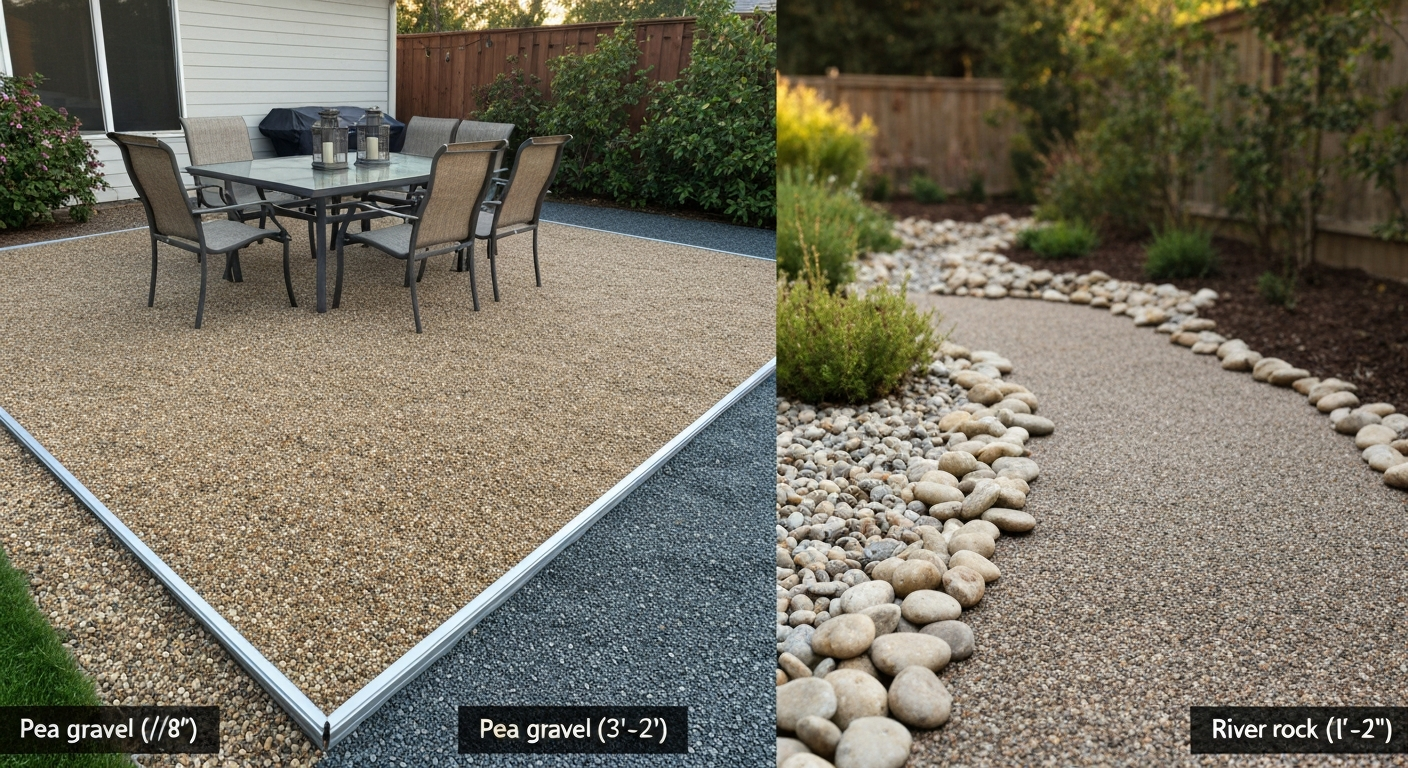
For most patios where people actually sit, eat, and walk around, pea gravel is the better choice between the two. It's smaller (typically 3/8 inch), compacts reasonably well into a stable surface when layered over a proper crushed-stone base, and costs less per bag or ton than decorative river rock. River rock looks great in drainage swales, around planters, and in low-traffic accent beds, but its larger size and smooth, rounded shape make it genuinely difficult to walk on and almost impossible to stabilize under furniture. If you're weighing these two for a functional outdoor seating area, pea gravel wins on comfort, stability, and practicality. River rock wins on bold visual impact and drainage capacity when foot traffic isn't a factor.
River Rock vs Pea Gravel for Patio: Which Is Best?
Nolan Ellison
28 Jul 2026
What you're actually comparing here
Both materials are water-worn, naturally rounded aggregates, which already puts them at a disadvantage compared to angular crushed stone when stability is the priority. Neither one interlocks the way crusher-run or decomposed granite does. But within that category, pea gravel and river rock are quite different products with different ideal applications. Pea gravel comes in a tight range of small sizes, river rock spans a much wider range of sizes often sold by the inch-range rather than a single nominal size, and those differences cascade through every category from aesthetics to drainage to how your patio chair legs sink in.
Appearance and aesthetic options side by side
Pea gravel has a naturally uniform, soft look. The stones are small and similar in size, and they come in a palette ranging from warm tans and creams to cool grays and mixed earth tones depending on the source region. A pea gravel patio reads as tidy and relaxed, which pairs well with cottage gardens, informal entertainment spaces, and naturalistic landscaping. It photographs well, fills evenly, and doesn't draw the eye to individual stones.
River rock has more visual presence. The stones are larger, rounder, and often strikingly patterned with color banding or speckle. A bed of 1/2-inch to 1-inch river rock can look polished and intentional, while 2-inch to 4-inch cobble-sized river rock reads more as a bold landscape feature. That scale is exactly what makes it appealing around water features, dry creek beds, and statement planters, and exactly what makes it awkward as a walking surface. The unevenness you see is the unevenness you feel underfoot.
| Feature | Pea Gravel | River Rock |
|---|---|---|
| Typical size range | 1/8" to 5/8"; standard patio size is 3/8" | 1/2" to 4"+ (sold in inch-ranges, e.g., 1/2"–1", 1"–3", 2"–4") |
| Surface texture look | Small, uniform, low-profile | Varied, bold, visually dominant |
| Color options | Tan, cream, gray, mixed earth tones | Multicolor, banded, speckled; varies by river source |
| Best aesthetic match | Informal patios, cottage gardens, relaxed spaces | Drainage features, accent beds, water features |
| Uniformity | High — sizes are tightly screened | Lower — natural mix within stated range |
Size, shape, and how they feel to use
Standard pea gravel for patios is 3/8 inch (about 9.5 mm). Suppliers also carry finer grades at 1/8 inch and 1/4 inch, and a coarser 5/8-inch grade. For a patio or path, 3/8 inch is the most practical size: fine enough to feel relatively stable underfoot, coarse enough not to track into the house on every shoe sole. I've worked with the 1/4-inch grade on path edges and it behaves almost like sand, scattering easily, so I'd stick with 3/8 inch for any area that sees regular foot traffic.
River rock is sold in screened inch-ranges rather than a single size because natural water-worn stone varies too much to classify by one number. Medium decorative river rock typically runs 1/2 to 1 inch; larger classifications hit 1 to 3 inches and 2 to 4 inches (cobble territory). Even the smallest river rock grade (1/2 to 1 inch) is noticeably larger than standard pea gravel, and that size jump matters more than it sounds. A 3/4-inch rounded stone shifts and rolls underfoot in a way a 3/8-inch stone does not. Once you're into 1-inch-plus territory, walking on the surface feels like walking on a bag of marbles.
Shape compounds this. Both materials are rounded from water tumbling, which means neither interlocks the way angular crushed stone does. Engineering research consistently confirms rounded aggregates produce lower shear strength and greater tendency to rearrange under load than angular aggregates. That's not an abstract finding: it's what you experience when your patio chair leg sinks two inches into loose river rock after one summer season.
Stability and compaction: which one actually stays put
Neither pea gravel nor river rock compacts into a truly firm surface the way crusher-run or compacted decomposed granite does. Rounded particles don't lock together. That said, there is a real and meaningful stability difference between the two materials, and pea gravel wins it clearly.
Smaller particles at 3/8 inch settle more densely than larger rounded stones, and the layer sits lower to the ground, reducing the rolling-underfoot sensation. When you build the installation correctly (more on that below), a pea gravel patio can feel reasonably firm. River rock, especially anything over 1/2 inch, shifts constantly under foot pressure because the large round stones have no mechanism to resist lateral movement.
The base is what actually creates stability
The single most important factor for a stable pea gravel patio isn't the gravel itself, it's the base underneath it. See our guide on the best base for pea gravel patio for step-by-step base preparation and material recommendations. Professional guides and installation manuals consistently recommend excavating 4 to 6 inches total: about 2 to 4 inches of compacted crushed stone (road-base or crusher-run) as the structural base layer, then 2 to 3 inches of pea gravel on top as the finish surface. This Old House, How to Build DIY Pathways and Patios recommends excavating 4–6 inches total, installing 2–4 inches of compacted crushed‑stone base, and topping with 2–3 inches of pea gravel for a stable loose pea‑gravel patio blank" rel="noopener noreferrer">This Old House — How to Build DIY Pathways and Patios. The compacted crushed-stone layer does the structural work. The pea gravel is essentially decorative fill sitting on top of a stable platform.
- Excavate 4–6 inches below finished grade, sloping slightly away from the house for drainage (about a 1% to 2% grade).
- Lay non-woven geotextile fabric on the excavated subgrade to separate native soil from the base material and suppress weeds.
- Add 2–4 inches of compacted crusher-run or road-base in lifts, compacting each lift with a plate compactor before adding more.
- Install rigid edge restraints (steel, aluminum, or concrete) anchored to the compacted base layer, not just staked into gravel.
- Add 2–3 inches of pea gravel as the finish layer, raking level.
- Top up annually or as needed when the surface thins from migration or displacement.
River rock does not improve meaningfully with a better base because the surface-layer problem is the stone size and shape, not the foundation. Supplier catalogs note that river rock is better suited to low-traffic drainage features than seating areas, and I'd agree with that assessment entirely. If you want to use river rock in a stabilization grid, be aware that most geocell and gravel-grid manufacturers explicitly warn against using rounded stone as the structural infill inside the cells, recommending angular compactable stone instead because rounded stone can behave like quicksand under confinement. A thin decorative top layer of rounded stone over properly compacted angular fill is the workaround some installers use.
Stabilization products worth knowing
Plastic HDPE gravel grids (products in the GravelPave2 / geocell category) reduce migration and rutting for pea gravel installations. The grid is placed over the compacted base and geotextile, then filled with the decorative gravel. The cellular structure prevents lateral migration without locking the surface into a rigid slab. For river rock, these systems are less effective because the large rounded stones don't fill the cells densely enough. Resin-bonded or resin-bound systems (where aggregate is mixed with resin and troweled onto a prepared base) are another option, though they tend to be used with smaller, uniform aggregates similar in size to pea gravel rather than river rock. For homeowners considering a permanent surface, see our guide to the best glue for pea gravel patio.
Drainage and weather performance
Both materials drain well by nature: water passes between rounded stones easily, and neither material is impervious. On that basic measure they're roughly equal. The differences show up in freeze-thaw conditions, erosion resistance, and long-term drainage performance.
In freeze-thaw climates, pea gravel handles winter better than you might expect. The small stones settle back into place reasonably well after frost heave, especially when the base is properly compacted and the geotextile layer prevents subgrade fines from migrating up. River rock shifts more dramatically after a hard freeze and does not resettle neatly. You're more likely to find uneven, displaced stones after a northern winter with river rock than with pea gravel.
For erosion and runoff, river rock actually outperforms pea gravel in swale and drainage applications because the heavier, larger stones resist being moved by water flow. This is why river rock is the go-to material for dry creek beds and stormwater management features. On a flat patio surface, however, erosion resistance is less relevant than the ability to stay put under foot traffic, and on that measure pea gravel again has the edge.
One maintenance note on drainage: even well-draining gravel installations can develop slow drainage over time if fine particles (dust, soil, decomposed organic matter) migrate into the voids and clog them. The non-woven geotextile layer helps prevent subgrade fines from rising, but surface contamination from leaves and debris still occurs. Raking and occasionally flushing the surface with a garden hose keeps drainage performing well.
Comfort underfoot, pets, and accessibility
Pea gravel at 3/8 inch is reasonably comfortable for barefoot walking for most adults, though it does have the characteristic 'massage mat' feeling that some people enjoy and others dislike. For shoes it's fine. Dogs generally do well on pea gravel, it's a commonly recommended surface for dog runs precisely because it drains urine, doesn't retain heat as badly as dark pavers, and doesn't compact into mud. Paws take to it better than larger stone. The caveats: smaller dogs or dogs with tender paws may dislike it initially, and some dogs will scatter it enthusiastically.
River rock is uncomfortable to walk on barefoot. Anything above 1/2 inch is genuinely painful for extended barefoot use, and the rolling sensation underfoot creates a real slip hazard. I've seen homeowners install it on a patio, use it for one summer, and then excavate the whole thing. For children playing, elderly visitors, or anyone with mobility issues, river rock is a problematic surface. It does not meet accessibility standards for wheeled mobility aids (wheelchairs, walkers, strollers) at any practical installation depth.
Pea gravel is also not ADA-compliant as a loose surface, but stabilized pea gravel (grid-confined or resin-bound) can approach accessible performance for lighter mobility aids. If accessibility is a genuine requirement for your patio, loose gravel of any kind should probably be replaced with a firm, stable alternative like concrete pavers, flagstone, or porcelain tile.
Durability and long-term performance
Gravel doesn't wear out in the way a wood deck or composite material does. The stones themselves are essentially permanent. What degrades is the installation: the stones migrate, the surface thins, and organic matter accumulates. On those fronts, pea gravel and river rock have different failure modes.
Pea gravel migrates. Small stones travel: on shoes, with heavy rain, along the edges of the patio, and into lawn areas adjacent to the border. Rigid edge restraints slow this significantly, but some annual replenishment is normal. Plan on adding a half-inch to an inch of fresh gravel every one to two years, depending on traffic and border quality. Budget around $50 to $150 per ton for pea gravel at landscape suppliers in 2026, with significant regional variation. For real-world user feedback and comparative ratings, check pea gravel patio reviews for installation tips and long-term performance reports.
River rock migrates less by weight but displaces dramatically under foot traffic. Larger stones get kicked to the edges or pushed down into the base. The surface develops low spots and uneven patches faster than pea gravel does on a trafficked area. Color fading is minimal for both materials since they're natural stone, but expect the appearance to shift over time as algae, lichen, and mineral staining accumulate on the surface, especially in shaded, damp environments. River rock develops this patina faster because the larger surface area of each individual stone is more exposed.
| Category | Pea Gravel (3/8") | River Rock (1/2"–1"+) |
|---|---|---|
| Stability under foot traffic | Moderate (better with proper base and edging) | Poor (large rounded stones roll underfoot) |
| Stability under furniture | Moderate (legs sink slightly) | Poor (significant sinking and displacement) |
| Drainage performance | Good | Good to excellent |
| Freeze-thaw recovery | Good (settles back well) | Fair (larger stones displace more) |
| Barefoot comfort | Moderate (manageable for most adults) | Poor (painful on stones above 1/2") |
| Pet-friendliness | Good (recommended for dog runs) | Poor (uncomfortable for paws, rolling hazard) |
| Accessibility (wheelchair/walker) | Poor (loose surface) | Poor (loose, uneven surface) |
| Migration over time | Moderate (small stones travel on shoes) | Moderate to high (large stones displace under load) |
| Replenishment needed | Every 1–2 years typically | Varies; surface leveling more frequent |
| Typical cost (bulk) | $50–$150/ton (regional variation) | $80–$200+/ton (regional variation; decorative premium) |
| Best use case | Patios, paths, dog runs | Drainage features, accent beds, dry creek beds |
Maintenance, weed control, and fixing common problems
Both materials need maintenance, but pea gravel patio maintenance is more predictable and manageable. Here's what to expect and how to deal with the most common issues.
Weed control
Gravel does not prevent weeds by itself. Seeds blow in from above and germinate in any accumulated organic matter between the stones. The non-woven geotextile layer suppresses weeds from below (stopping subsurface rhizomes and preventing soil contact), but it doesn't stop airborne seeds from establishing. See the TenCate Rock® PEC / Mirafi geotextile technical datasheet (manufacturer) for typical permittivity, tensile strength, and characteristic opening sizes used to prevent subgrade‑fines migration and match geotextiles to site needs. For ongoing weed control, a pre-emergent herbicide applied in early spring is the most effective tool. Spot-treating with a contact herbicide handles anything that gets through. Raking the surface occasionally removes the thin layer of decomposed debris where seeds germinate. I skip this step one year and always regret it the next spring.
Replenishing the surface layer
Pea gravel thins out gradually from normal use. Set a simple visual target: when the gravel layer looks thin enough that you can see the base material in spots, it's time to add more. A half-inch topdress over the existing surface, raked level, usually restores the patio for another season or two. For large patios, ordering a half-ton or ton from a landscape supplier is more cost-effective than buying bags at a home improvement store.
Leveling and fixing rutting
Ruts and low spots form in high-traffic lines: the path from the door to the seating area, around the table legs, near the grill. Fix minor ruts by raking gravel from higher areas into the low spots. For deeper, persistent ruts, the base material may have settled or failed. Excavate the problem area, re-compact the base (add crusher-run if needed), and replace the finish gravel layer. This is usually a small repair, not a full redo. Edge restraint failure causes the most dramatic migration: if the border lets go, gravel fans out into the lawn. Retrofit steel or aluminum edging anchored to the base with stakes to stop ongoing loss.
Algae, staining, and surface cleaning
In shaded, damp conditions, both pea gravel and river rock develop algae or lichen on the stone surfaces. A diluted bleach solution (about 1:10 bleach to water) rinsed over the surface and left for 10 minutes before hosing off removes most algae. For river rock used decoratively, some homeowners prefer the aged patina. For a pea gravel patio that looks clean and fresh, annual rinsing and a light rake go a long way.
Edging and border options for both materials
Edge restraints are not optional for a gravel patio. Without them, both materials migrate into surrounding lawn or garden beds within one season. The best options are rigid steel or aluminum landscape edging anchored with stakes driven into the compacted base, or a concrete haunch poured around the perimeter. Timber edging (railroad ties, landscape lumber) is a common DIY choice but it warps, rots, and loses holding capacity over time. Hardscape manufacturers and installation guides consistently recommend against timber as a long-term structural restraint for gravel systems. Decorative lightweight garden edging (plastic spikes or thin aluminum strips sold at garden centers) is not sufficient for a patio: it flexes under lateral gravel pressure and fails quickly. For detailed recommendations and installation tips, see our guide to the best border for pea gravel patio.
For river rock borders specifically, a raised concrete or stone edge that contains the larger stones is more effective than a flush edge restraint, because the bigger stones need something to stop against rather than just a thin metal edge they can roll over.
Alternatives worth considering before you commit
If you're on the fence about loose gravel of either type, a few alternatives are worth putting on the comparison list before committing to a design. Decomposed granite (DG) compacts into a firm, stable surface that still has a natural gravel aesthetic. Flagstone stepping stones set into a pea gravel field give you a stable walking surface with the visual softness of gravel. Concrete or porcelain pavers offer maximum stability and low maintenance at higher installation cost. Resin-bound gravel (aggregate mixed into resin and troweled smooth) creates a permeable, stable surface that looks like gravel but performs more like a hard surface. All of these can be explored as alternatives to a pure gravel approach, and for high-use patios with furniture, frequent guests, or accessibility needs, one of them is likely a better fit than either pea gravel or river rock on their own. For help choosing the best pebbles for patio use, see our detailed guide that compares sizes, stability, and appearance to match your project needs. See our detailed guide on alternatives to a pea gravel patio for side-by-side comparisons, costs, and installation tips.
Which one should you choose: a scenario-based decision guide
Here's how I'd direct a homeowner based on their actual situation, not just the material specs in isolation. If you want a quick answer to the question 'is pea gravel good for patios', see our short guide on pea-gravel patios.
| Your situation | Recommended choice |
|---|---|
| Relaxed seating area with chairs and a table | Pea gravel (3/8") on a compacted base with grid stabilization |
| High foot traffic path or entertaining area | Pea gravel on a solid base, or consider flagstone/pavers |
| Low-traffic accent bed or decorative border | River rock (1/2"–1" or larger) as aesthetic ground cover |
| Dry creek bed or drainage swale | River rock (1"–3" or 2"–4" range) for weight and erosion resistance |
| Dog run or pet area | Pea gravel (3/8") — recommended surface for drainage and paw comfort |
| Barefoot-primary use (pool surround, etc.) | Neither — consider smooth pavers, rubber surfacing, or flagstone |
| Accessibility required (wheelchair, walker) | Neither loose material — use pavers, flagstone, or resin-bound gravel |
| Budget-first, DIY installation | Pea gravel — lower cost, easier to work with, forgiving to install |
| Bold visual statement, minimal traffic | River rock (decorative pebble size) in a confined bed |
| Cold-climate freeze-thaw zone | Pea gravel — recovers better after heave than large river rock |
Sourcing and cost reality
Both materials are widely available from landscape supply yards, home improvement stores, and quarry direct suppliers. Buying in bulk from a landscape yard (by the ton or cubic yard) is significantly cheaper per unit than buying bagged product at a big-box store. As a rough 2026 guide, pea gravel runs approximately $50 to $150 per ton depending on region and whether it's a local or shipped material. Decorative river rock, especially colored or specialty varieties, often runs $80 to $200 or more per ton, with hand-sorted or polished river pebbles commanding premium prices. For a 200-square-foot patio at 2 to 3 inches deep, you'll need roughly 1.5 to 2 tons of finish material, plus base material costs on top of that.
When sourcing, ask the supplier for the actual screened size range (not just 'pea gravel' or 'river rock'), confirm whether it's locally quarried or shipped (which affects price and color consistency), and request a sample handful before ordering a full load. Color and character vary enormously by region, and what looks good in a photo may look quite different in your backyard light.
FAQ
What are the visual and aesthetic differences between river rock and pea gravel for patios?
Pea gravel: small (commonly 3/8"), uniformly sized rounded stones in colors from tan/cream to gray — gives a fine, textured, casual look that’s easy on bare feet. River rock: larger, mixed-size rounded stones (ranges from 1/2" up to several inches) with more variety in color and size — produces a bolder, more decorative, naturalized appearance but looks less like a finished patio surface and more like a decorative bed or drainage feature.
How do size and shape affect performance (stability, compaction, and movement)?
Rounded stones (both types) lack angular interlock. Pea gravel (3/8") is small enough to nest and form a reasonably stable walking surface but still can shift under repeated loading. Larger river rock doesn’t interlock and moves easily — it’s likely to roll and shift under foot or furniture. For stability and compaction, angular/crushed stone outperforms both; if using gravel surfaces, a compacted crushed-stone base beneath is essential.
Which material drains better?
Both drain well because they’re open-graded rounded aggregates. Pea gravel drains quickly when installed over an open, permeable base. River rock also drains but its large voids can concentrate flow and cause pockets of erosion unless properly retained and underlain by geotextile and a stable base.
Which is more comfortable for foot traffic, furniture, and pets?
Comfort: pea gravel (3/8") is substantially more comfortable for walking barefoot and for pets than medium to large river rock. Pea gravel is also easier to place furniture on (less rocking) though chairs can still wobble unless you use pads or a solid pad under legs. River rock is uncomfortable to walk on barefoot, will catch pet paws, and is poor under furniture.
How durable and low‑maintenance are they?
Durability: both are durable as inert stone, but rounded aggregates migrate and lose coverage over time. Pea gravel requires periodic raking and topping up (replenishing) and weed control; expect occasional leveling. River rock requires even more maintenance to keep it from migrating and collecting debris. Neither bonds or compacts into a hard wearing surface unless stabilized.
How do climate and use-case affect the choice?
Hot/sunny climates: color choice matters (lighter pea gravel stays cooler). Freeze–thaw: both perform well if drainage is good; frost heave occurs if base/drainage is inadequate. High foot traffic, dining/furniture areas, accessibility requirements, and households with pets favor pea gravel (or better: stabilized systems or hard surfaces). River rock is better reserved for low‑traffic decorative beds, swales, or accent areas.