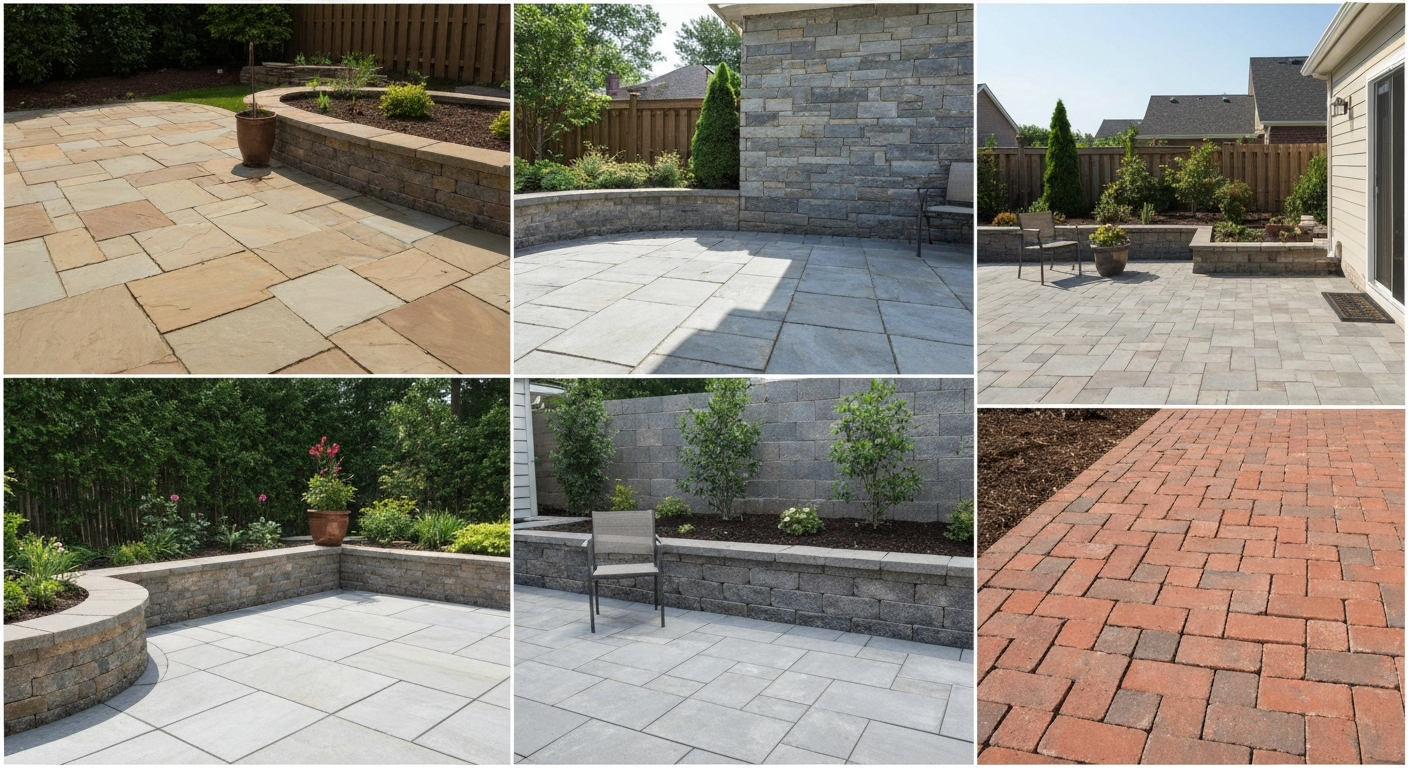
Pea gravel is cheap, drains well, and takes about a weekend to install, but it shifts underfoot, tracks into the house, and falls short if you need a firm, accessible surface. If you've decided pea gravel isn't the right fit, the good news is you have plenty of solid options: flagstone, natural stone, porcelain pavers, brick, and poured or stamped concrete all solve the problems that bring most homeowners here, each at a different price point and with a different set of trade-offs. Common alternatives to a pea-gravel patio include: flagstone, porcelain pavers/tiles, brick/clay pavers, concrete pavers, natural stone (bluestone/limestone/granite), poured/stamped concrete, compacted crushed‑stone (DG), stabilized (resin/polymer) gravel (resin‑bound/resin‑bonded), composite decking, and river rock blank" rel="noopener noreferrer">Common alternatives to a pea-gravel patio include: flagstone, porcelain pavers/tiles, brick/clay pavers, concrete pavers, natural stone (bluestone/limestone/granite), poured/stamped concrete, compacted crushed‑stone (DG), stabilized (resin/polymer) gravel (resin‑bound/resin‑bonded), composite decking, and river rock..
Best Alternative to Pea Gravel Patio: Durable Patio Options
Why homeowners look beyond pea gravel
Pea gravel has real strengths. It costs $30–$55 per ton in bulk, installs fast, drains almost instantly, and looks natural in informal garden settings. But homeowners typically start shopping for alternatives for one of a handful of reasons: the gravel migrates out of the patio area and into the lawn or back door; it's uncomfortable to walk on barefoot; it doesn't work for anyone using a wheelchair, walker, or cane because it fails basic firmness-and-stability requirements (ASTM F1951 testing consistently rules out loose rounded gravel for accessible routes); furniture legs sink and wobble on it; or they simply want a surface that looks more finished and adds more to resale value. If you're also weighing whether pea gravel could still work with the right edging or a stabilizing binder, that's worth exploring separately, but this article focuses on the materials that replace it entirely.
How to pick the right alternative for your situation
Before comparing materials, nail down these six factors. They'll cut the list of realistic options in half before you spend an hour reading spec sheets.
- Use and traffic: a quiet seating area for two adults has very different load and wear requirements than a patio that doubles as a kids' play area or hosts large gatherings. Heavier use pushes you toward concrete, brick, or concrete pavers over natural stone slabs.
- Budget (installed, not just material): material prices are only part of the story. A $5/ft² paver can easily require $10–$15/ft² in labor, base prep, and edge restraint, depending on site conditions. Plan around total installed cost.
- Climate: freeze-thaw cycles are the single biggest variable. Brick, natural stone, and porcelain all behave differently when water gets in — more on this in each section below.
- Drainage: if your yard has poor drainage or sits in a low spot, you want a permeable option or a well-designed slope (minimum 2% grade away from the house). Some materials handle this better than others.
- Accessibility: if anyone in the household uses a mobility device, or if you're building a route that must meet ADA/PROWAG standards, you need a firm, stable, hard surface with a running slope no steeper than 1:20 (5%) and a cross-slope no more than 2% (1:48).
- DIY vs. hiring a pro: flagstone, concrete pavers, and brick are genuinely manageable for a skilled DIYer with proper base preparation. Poured concrete and porcelain tile installation benefit significantly from professional execution, especially in climates with freeze-thaw.
At-a-glance comparison of top alternatives
| Material | Installed Cost ($/ft²) | Durability / Lifespan | Drainage | Maintenance | Accessibility | DIY-Friendly? |
|---|---|---|---|---|---|---|
| Flagstone | $15–$32 | 30–50+ years | Good (dry-laid); moderate (mortared) | Low–moderate | Good on firm, level sets | Moderate |
| Natural Stone (bluestone, slate, limestone) | $25–$45 | 25–50+ years | Moderate–good | Moderate | Good if set level | Moderate–hard |
| Porcelain Pavers/Tiles | $15–$55 | 25–40+ years | Low (impermeable surface) | Very low | Excellent | Hard |
| Brick / Clay Pavers | $12–$28 | 25–50+ years | Moderate (joints) | Low–moderate | Excellent on firm base | Moderate |
| Poured Concrete | $6–$15 | 25–40 years | Low (sealed surface) | Low | Excellent | Hard |
| Stamped Concrete | $12–$25 | 20–35 years | Low | Moderate (resealing) | Excellent | Not recommended DIY |
| Concrete Pavers | $8–$25 | 30–50+ years (lifetime warranty) | Good–excellent (permeable options) | Low | Excellent | Moderate |
Pea gravel for reference: $1–$4/ft² installed (DIY bulk), 5–10 year practical lifespan with annual raking and top-ups, excellent drainage, poor accessibility, very DIY-friendly. All cost figures above reflect typical national installed ranges as of 2026; actual quotes will vary with region, site prep complexity, and contractor market.
Flagstone patios
Flagstone is the most popular step up from pea gravel, and for good reason: it looks natural, pairs well with informal landscaping, and a dry-laid flagstone patio is genuinely achievable for a motivated DIYer with a weekend and a decent compactor. The material itself is usually sandstone, quartzite, or limestone slabs cut to irregular shapes, typically 1–2.5 inches thick. Installed costs run $15–$32/ft², with most of that labor cost going into site prep and fitting the irregular pieces.
Pros
- Natural, organic look that blends with gardens and informal outdoor spaces
- Dry-laid installations allow for drainage between stones and easy repair — lift a stone, re-level, reset
- Durable: well-set flagstone lasts 30–50 years with minimal intervention
- Relatively DIY-accessible compared to poured concrete or porcelain
Cons
- Irregular surfaces can be a trip hazard if stones settle unevenly — needs occasional releveling
- Porous stones like sandstone and some limestones absorb water; in hard freeze-thaw climates, spalling and cracking can occur over time
- Mortared installations are harder to repair and can crack if the base moves
- Gaps between stones invite weeds without a quality polymeric sand or ground cover fill
Installation basics
For a dry-laid flagstone patio, excavate 6–8 inches, compact the subgrade, and install 4–6 inches of compacted crushed gravel base, topped with 1 inch of coarse sand or stone dust. Set stones with a minimum 2% slope away from the house for drainage. Fill joints with polymeric sand to minimize weeds and lock the stones in place. Edge restraints (aluminum or plastic landscape edging) help keep perimeter stones from migrating. In freeze-thaw climates, denser stones like quartzite hold up better than soft sandstone. Mortared flagstone requires a concrete slab base, more stable but less forgiving to repair.
Climate and budget fit
Flagstone is a solid choice in most climates when you choose the right stone type for your region. In cold climates (USDA zones 3–6), stick to quartzite or dense bluestone rather than porous sandstone. In the Southwest, flagstone handles heat and UV well with almost no maintenance. Budget-wise, it sits in the mid-range, more than concrete pavers on the lower end, less than premium natural stone.
Natural stone patios: bluestone, slate, and limestone
Natural stone patios, particularly bluestone, slate, and limestone, are the premium end of the natural look. Installed costs typically land between $25–$45/ft², reflecting both material cost (these are quarried and cut to more precise dimensions than irregular flagstone) and the skill involved in tight, level installation. I've worked on bluestone patios that still look pristine after 30 years with just periodic sealing; I've also seen limestone pool surrounds spall badly after five winters because the wrong sealer was used. Material selection and installation quality matter more here than in almost any other category.
Bluestone
Pennsylvania bluestone is the gold standard for Northeast and Mid-Atlantic patios. It's dense, handles freeze-thaw well, has a naturally slip-resistant cleft surface, and ages beautifully. It's expensive, expect to pay $30–$45/ft² installed for thermal-finish or irregular bluestone, but it lasts 50+ years with proper base prep. A 4–6 inch compacted gravel base with 1 inch of stone dust setting bed is standard. Seal every 2–3 years with a penetrating sealer to prevent staining.
Slate
Slate is beautiful and has great natural texture for slip resistance, but it's more brittle than bluestone and will chip if subjected to heavy impact or snow plow contact. It's best suited to warmer climates or protected patio areas in cold regions. Avoid cheap imported slate, it delaminates and flakes. Domestic Vermont or Virginia slate is far more durable.
Limestone
Limestone is softer and more porous than bluestone, making it susceptible to staining (especially from leaves and organic matter) and to freeze-thaw spalling in cold climates. It's gorgeous in warm, dry regions, Arizona and Texas homeowners use it extensively, but I'd steer most Northern homeowners toward bluestone or dense quartzite instead. If you do use limestone, seal it thoroughly and keep it clean.
When natural stone makes sense
Natural stone is the right choice when aesthetics and longevity are the top priorities and budget isn't the binding constraint. It adds more to home value than concrete alternatives, it looks better as it ages, and it's irreplaceable from a curb-appeal standpoint. If you're building a showpiece patio around a pool or a primary outdoor entertaining space, the extra investment is usually worthwhile.
Porcelain tile and paver patios
Outdoor porcelain pavers have become one of the fastest-growing patio materials over the past decade, and the quality has genuinely improved to where they make sense for a lot of homeowners. The key spec to understand: outdoor-rated porcelain pavers have water absorption below 0.5% (ASTM C373), which means freeze-thaw cycles can't get water into the material to crack it the way they can with porous stone. That's a meaningful advantage in cold climates. Installed costs run wide, $15–$55/ft², depending on format (large-format 24x24 slabs cost more to install than 12x12 tiles), finish, and whether they're mortar-set or pedestal-mounted.
Slip resistance
This is the most important spec for outdoor porcelain. Look for products with a wet DCOF (Dynamic Coefficient of Friction, measured per ANSI A137.1) of 0.42 or higher. For pool surrounds or areas that stay wet, look for R11 or R12 rated finishes. Polished or honed porcelain with low DCOF values are for indoor use, don't install them outdoors regardless of how they look in a showroom.
Pros
- Nearly impervious to staining, moss, and mildew — rinse with a hose and you're done
- Freeze-thaw resistant when properly specified (<0.5% water absorption)
- Very wide range of aesthetics — convincing wood-look, stone-look, and concrete-look formats available
- Firm, stable, and fully accessible surface
Cons
- High installed cost, especially for large-format slabs that require precise base work
- Not a DIY-friendly installation: large-format porcelain is brittle during handling and requires a very flat substrate to prevent cracking
- Repairs are difficult — cracked tiles are hard to color-match and cutting replacements requires a wet saw with a diamond blade
- Low drainage at the surface (water sheets off rather than permeating)
Installation basics
Outdoor porcelain is typically either mortar-set over a concrete slab or set on adjustable pedestals over a compacted base. Mortar-set over concrete is the most common residential method: pour a minimum 4-inch concrete slab, allow full cure (28 days ideally), then set tile with a high-bond exterior-rated tile mortar and grout with a polymer-modified sanded grout. Pedestal systems allow drainage under the tile and easier access to utilities underneath, and they're increasingly popular for rooftop decks and modern-style spaces. Pedestal installs must still be supported by a structurally sound surface below.
Best use-cases
Porcelain pavers are a great fit for contemporary or modern home styles, pool surrounds, and homeowners who want near-zero maintenance and a clean, finished look. They're well-suited to hot climates (they stay cooler underfoot than dark stone or asphalt) and cold climates (when correctly specified). They're not the right call for informal cottage gardens or rustic settings where natural stone would look more appropriate.
Brick patios
Brick is one of the most time-tested patio materials available, properly installed brick patios from the 1970s are still in excellent shape in neighborhoods all over the country. Modern clay pavers are a refined version of the same idea: kiln-fired, dimensionally consistent, and available in a range of colors and patterns. Installed costs run $12–$28/ft², making brick one of the better value propositions in the mid-range category. Concrete paver manufacturers like Unilock and Belgard offer lifetime limited warranties on structural integrity for residential installations, a genuine mark of product confidence.
Look and feel
Brick has a warmth and traditional character that's hard to replicate with manufactured products. The natural color variation between units (a feature of clay firing) means the surface looks richer over time, not worse. Herringbone, running bond, and basketweave patterns all give you design flexibility without additional material cost. Brick patios also don't show dirt and aging as harshly as smooth concrete surfaces.
Pros
- Exceptional longevity — 50+ years is realistic with a good base
- Repairability: individual bricks can be lifted and reset without disturbing the rest of the patio
- Good drainage through joints (especially with polymeric sand or open jointing)
- Timeless aesthetic that suits traditional, colonial, and craftsman-style homes
- Fully firm and stable — excellent accessibility
Cons
- Clay pavers can be harder to source than concrete pavers in some regions
- Efflorescence (white salt deposits) is common in cementitious products and can be an aesthetic issue — it typically weathers away but can recur
- Brick can become slippery when wet and moss-covered in humid, shaded locations — plan for periodic cleaning and possible sealing
- Slightly higher material cost than standard concrete pavers for comparable aesthetics
Installation basics
Brick paver installation follows the same sequence as concrete pavers: excavate 8–10 inches total (accounting for 4–6 inches of compacted gravel base per manufacturer guidelines, 1 inch of bedding sand, and the paver thickness), compact the base in lifts, screed the sand bed, lay pavers, compact the surface, and sweep in polymeric sand. Edge restraints are essential, without them, pavers at the perimeter walk outward over time, loosening the whole installation. Plastic or aluminum edge restraint spiked into the base at 12-inch intervals is the standard approach. In freeze-thaw climates, make sure the base depth is adequate: Unilock's technical guides recommend 6–8 inches of compacted gravel for patios, with deeper bases for poor subgrade conditions.
Best applications
Brick suits traditional and cottage-style homes well. It's a practical choice for high-traffic patios, fire pit areas, and anywhere you want a surface that handles foot traffic without showing wear. It's a moderate DIY challenge, the base prep is the hardest part, and getting that right determines whether the patio stays level for 20 years or starts settling after three winters.
Concrete patios: poured and stamped
Poured concrete is the most affordable hard-surface patio option at $6–$15/ft² installed, and it gives you the widest customization range through stamping, staining, and exposed aggregate finishes. It's also the option where DIY most often goes wrong, concrete finishing is a skill that requires the right weather, the right mix, the right tools, and enough hands on deck. I've seen too many homeowners pour their own slab on a hot afternoon and end up with a surface full of surface cracks and dusting. If you're not experienced with concrete finishing, hire this one out.
Poured concrete
A standard broom-finish poured concrete patio is the workhorse of the category. At $6–$15/ft² installed, it's hard to beat on cost. Properly placed (4–6 inches thick over 4 inches of compacted gravel, with control joints cut at 8–10 foot intervals), it handles residential loads easily and will last 25–40 years before showing meaningful deterioration. The Achilles heel is cracking, concrete moves with temperature changes and soil moisture shifts, and control joints only reduce cracking; they don't eliminate it. In freeze-thaw climates, use air-entrained concrete (recommended minimum 6% air entrainment) to prevent freeze-thaw spalling.
Stamped concrete
Stamped concrete is regular poured concrete impressed with a texture pattern (slate, flagstone, brick, wood plank) while it's still plastic, then colored with integral pigment or surface release agent. Installed costs run $12–$25/ft². The appeal is obvious, you get the look of stone or brick at a fraction of the material cost. The trade-off is maintenance: the surface color sealer needs reapplication every 2–3 years to prevent fading and to maintain the slip-resistant texture. Neglected stamped concrete looks bad fast. Also, when stamped concrete cracks (and at some point it will), repairs are visible because matching the color and texture exactly is nearly impossible.
Pros of concrete patios
- Lowest installed cost of any hard-surface patio material — poured concrete at $6–$15/ft² is hard to beat
- Smooth, firm, fully accessible surface with no joints to settle
- Huge range of finishes: broom, exposed aggregate, salt finish, stained, stamped, or painted
- Integrates easily with existing foundations, steps, and structures
Cons of concrete patios
- Cracking is inevitable over time — control joints manage it but don't prevent it
- Repairs are visible and difficult to blend with the original finish
- Stamped concrete requires periodic resealing to maintain appearance and slip resistance
- Poured concrete is not DIY-friendly for most homeowners — incorrect finishing produces a weak, flaking surface
- No drainage at the surface — requires a properly graded slab and good site drainage to prevent pooling
Customization options
Beyond stamping, concrete patios can be given an exposed aggregate finish (wet-seeded or exposed during pour), stained with acid or water-based stains in a wide color range, or given a salt finish for subtle texture. Concrete pavers (as a distinct product from poured-in-place concrete) offer a middle ground worth considering: they use the same material but come pre-made in controlled factory conditions, offer permeable options for stormwater management, and are repairable unit by unit. Major manufacturers like Unilock and Belgard offer transferable lifetime limited warranties on residential paver structural integrity, which is a significant advantage over poured slabs.
When pea gravel is still the right call
All that said, pea gravel remains genuinely appropriate for certain situations. For firsthand accounts and product comparisons, see pea gravel patio reviews to understand performance, maintenance, and user satisfaction. For a deeper look at whether pea gravel is right for your patio, see Is pea gravel good for patios. If you're installing a casual garden path, a low-traffic seating area in a cottage-style yard, or a fire pit surround where you want the material to handle heat and sparks without issue, pea gravel makes a lot of sense. It's also the right call when budget is extremely tight, drainage is the primary concern, or you're filling a space temporarily while you decide on a permanent solution. The key is managing its weaknesses: use a proper compacted base (at least 4 inches of crushed stone topped with landscape fabric), install solid edge restraint to contain the material, and choose the right gravel size (typically 3/8 inch works best for stability). For guidance on choosing and installing a suitable edge, see the best border for pea gravel patio. For guidance on choosing sizes and types, see our guide to the best pebbles for patio. For step-by-step guidance on selecting and installing the best base for pea gravel patio, read our detailed guide on base materials and proper compaction. If you need help choosing specific products, see our guide to the best pea gravel for patio. If you want a more stable version, polymer-stabilized gravel (resin-bound systems) can dramatically reduce scatter and improve surface firmness while maintaining permeability, though the cost rises accordingly. For product recommendations and installation tips, see our guide to the best glue for pea gravel patio.
Drainage and accessibility: what every surface decision comes back to
Two practical factors tend to get underweighted in patio material decisions: drainage and accessibility. On drainage: any paved or hard surface that doesn't allow permeation (poured concrete, porcelain, mortared stone) concentrates runoff. The EPA recognizes permeable pavements as effective stormwater management tools, and permeable interlocking concrete pavement (PICP) systems with open-graded aggregate bases can achieve surface infiltration rates well above 100 inches per hour, essentially handling any rain event without pooling. If your yard has drainage issues, building in permeability through concrete pavers with open-graded joints and a permeable base, or through dry-laid stone, is worth the investment. On accessibility: if anyone in your household uses a mobility device now or might in the future, the surface firmness standard is non-negotiable. Loose gravel doesn't meet it. Any of the hard-surface alternatives covered here, set correctly, graded to a maximum 2% cross-slope, will. Build for the most demanding user in the household.
Your decision checklist
Use these questions to land on your best option. Work through them in order, by the time you get to the bottom, you'll have a short list.
- What's your total installed budget per square foot? Under $10: poured concrete or concrete pavers. $10–$25: brick, stamped concrete, flagstone, or concrete pavers. Over $25: natural stone, porcelain, premium flagstone.
- Does anyone in the household need a fully firm, stable, accessible surface? Yes: any hard-paved option works; eliminate pea gravel and river rock entirely.
- Do you live in a hard freeze-thaw climate (zones 3–6)? Yes: prioritize dense stone (bluestone, quartzite), air-entrained concrete, or low-absorption porcelain (<0.5% water absorption). Avoid porous limestone and soft sandstone.
- Is drainage a primary concern (low-lying yard, HOA stormwater rules, basement flooding)? Yes: prioritize dry-laid flagstone, brick with open joints, or permeable concrete pavers with open-graded base.
- How important is DIY installation? High: brick pavers, concrete pavers, and dry-laid flagstone are the most manageable. Low: poured concrete, stamped concrete, and porcelain are better left to pros.
- What's the aesthetic priority — natural/organic or clean/contemporary? Natural: flagstone, natural stone, or brick. Contemporary: porcelain, smooth poured concrete, or large-format concrete pavers.
- How much ongoing maintenance can you commit to? Minimal: porcelain (rinse only) or concrete pavers (occasional joint sand refresh). Moderate: brick (periodic sealing in shaded areas) or flagstone (weed management, releveling). Higher: stamped concrete (resealing every 2–3 years).
- What's your project timeline? Need it done this weekend with minimal site prep: pea gravel (if appropriate for the use) or dry-laid concrete pavers. Need it to last 40 years and look great: invest in natural stone or high-quality brick with proper base prep.
FAQ
What are the practical alternatives to a pea gravel patio and their quick pros/cons/use-cases?
Key alternatives: 1) Flagstone (bluestone, slate, sandstone) — Pros: natural look, high durability, good in freeze–thaw climates if set properly; cons: higher cost, irregular surfaces can be trip hazards; best for: rustic or high-end patios, firepits, terraced yards. 2) Porcelain pavers/tiles — Pros: low water absorption, wide colors/finishes, thin‑set or pedestal install options, freeze‑thaw resistant; cons: higher material & skilled labor cost, requires proper slip‑resistant finish; best for: modern patios, tight tolerances, pool surrounds (choose textured DCOF rated). 3) Brick/clay pavers — Pros: classic look, durable, easy to repair (individual bricks); cons: can effloresce, can be slippery when polished, moderate–high installation labor; best for: traditional yards, walkways, patios. 4) Concrete pavers/interlocking pavers — Pros: durable, wide sizing/price range, manufacturer warranties; cons: can fade/effloresce, require good base & edge restraint; best for: budget-conscious durable patios. 5) Natural cut stone (granite, limestone) — Pros: premium durability & look, long life; cons: highest cost, heavier & harder to DIY; best for: premium installations. 6) Poured/stamped concrete — Pros: lowest installed cost per ft² for large areas, seamless; cons: can crack, needs control joints, fewer repair options; best for: slab patios, pool decks, budget installs. 7) Compacted crushed‑stone/DG (decomposed granite) — Pros: inexpensive, native look, good for paths; cons: can erode, dusty, requires stabilizer or frequent maintenance; best for: informal patios, garden paths. 8) Stabilized gravel (resin‑bound/resin‑bonded) — Pros: permeable (resin‑bound), stable surface for wheelchairs, clean look; cons: higher upfront cost than loose gravel, UV and resin quality matters; best for: accessible gravel look, permeable solutions. 9) Composite decking — Pros: comfortable, no splinters, decking height gives usable underside storage; cons: much higher cost, requires framing and elevation; best for: raised patios/decks where height is acceptable. 10) River rock (decorative larger gravel) — Pros: decorative, good for drainage buffers; cons: poor underfoot stability, not suitable as primary walking surface unless stabilized; best for: accents, drainage swales.
How should climate and budget influence my material choice?
Cold/freeze–thaw climates: prioritize low‑absorption materials (porcelain, properly installed flagstone, dense natural stone, concrete pavers) and designs with good drainage and frost‑protected base. Hot/sunny climates: UV‑stable finishes (resin, composites) and lighter colors to reduce heat gain. Wet/poor‑draining sites: consider permeable options (permeable pavers, resin‑bound gravel, stabilized open‑graded base with underdrain). Tight budget: crushed stone/DG, poured concrete, or basic concrete pavers are lowest installed-cost options. Mid budget: concrete pavers, brick, or porcelain (material-only DIY) balance cost and finish. High budget: natural stone, premium flagstone, or composite decking. Also factor long‑term lifecycle costs: higher initial cost materials (pavers/stone) often need less frequent replacement and can preserve property value.
Can you provide a compact comparison of durability, cost, drainage, maintenance, and accessibility for these materials?
Summary (generalized): - Flagstone: Durability high; Cost high; Drainage good if gaps/grout/permeable base used; Maintenance low–medium (weed control, resetting); Accessibility medium (irregular). - Porcelain pavers: Durability high; Cost medium–high; Drainage variable (depends on joint/base); Maintenance low; Accessibility high if flat/large format. - Brick pavers: Durability high; Cost medium; Drainage moderate; Maintenance medium (joint sand refills, efflorescence); Accessibility medium. - Concrete pavers: Durability high; Cost low–medium; Drainage moderate to high (permeable option available); Maintenance low–medium; Accessibility high when tight jointed. - Poured/stamped concrete: Durability medium–high; Cost low; Drainage low unless designed with slope/perimeter drains; Maintenance medium (crack repairs, resealing); Accessibility high (smooth). - Crushed stone/DG: Durability low–medium; Cost low; Drainage high; Maintenance high (rake, refill, compact); Accessibility low (loose surface). - Stabilized/resin‑bound gravel: Durability medium–high; Cost medium–high; Drainage medium–high (permeable if resin‑bound); Maintenance low; Accessibility high (firm & stable). - Composite decking: Durability high; Cost high; Drainage low (decking above grade), maintenance low; Accessibility high (stable). Use this as a planning table in your article with numeric columns (1–5) for easy reader comparison.
What are the material‑specific basic installation notes (base, edging, adhesives) for each alternative?
Essential installation basics: - Flagstone (dry or mortared): base = 4–8 in. compacted crushed stone + 1 in. bedding sand (for dry) or mortar bed for wet set; edging = metal/stone restraints or mortar joints; adhesive = setting mortar or polymeric sand in joints. - Porcelain pavers (outdoor pavers or tiles): base = 4–8 in. compacted aggregate; for slab set use mortar bed or pedestal system for rooftop/pedestals; edging = concrete curb or paver edge restraint; adhesive = exterior thin‑set (ANSI A118.4/118.15) or mechanical clips for pedestal systems; grout or jointing sand/polymeric sand. - Brick/clay pavers: base = 4–8 in. compacted aggregate; bedding = 1 in. sand; edging = rigid edge restraint; jointing = polymeric sand or mortar. - Concrete pavers: base = 4–8 in. compacted aggregate (6 in. typical); edge restraint required (plastic/aluminum/curb); joint = polymeric sand or sand + sealing. - Poured/stamped concrete: base = compacted subgrade with 4–6 in. concrete slab and reinforcement as needed; control joints per slab design; edging is integral. - Crushed stone/DG: base = compact and roll subgrade; top = 2–3 in. compacted DG or 3–4 in. aggregate; edging = timber, metal, or concrete to contain material; adhesive = optional stabilizer (polymeric binder) for lower maintenance. - Stabilized/resin‑bound gravel: base = compacted aggregate (varies 2–6 in. depending on design) often on concrete or open‑graded base; edge restraint = rigid curb; adhesive = specialist resin binder mixed onsite. - Composite decking: base = pressure‑treated joists on posts or frame per manufacturer; flashing/footings required; fasteners = hidden clips or coated screws. Always follow manufacturer specs for bedding thickness, freeze–thaw detailing, and edge restraint; poor base or missing edge restraint is the most common cause of failure.
What are maintenance expectations and typical lifespans for each material?
Estimated lifespans and maintenance: - Flagstone: 25–50+ years; maintenance = joint refilling, occasional reset of slabs, seal optional. - Porcelain pavers: 25–50+ years; maintenance = low, occasional joint cleaning, regrout if needed. - Brick pavers: 20–50 years; maintenance = sweep/polymeric sand replacement, occasional leveling, watch for efflorescence. - Concrete pavers: 20–50 years; maintenance = similar to brick, replace individual units as needed. - Poured/stamped concrete: 20–40 years; maintenance = crack repair, reseal every 2–5 years. - Crushed stone/DG: 5–15 years (depends on use); maintenance = frequent raking, top‑ups, edging repair. - Stabilized/resin‑bound gravel: 10–25+ years (depends on resin quality/installation); maintenance = low, periodic power wash and spot repairs. - Composite decking: 20–30+ years (warranty dependent); maintenance = periodic cleaning, minimal staining or sealing. Lifespan depends strongly on installation quality, site drainage, and live loads.
What drainage and accessibility issues should I consider (incl. ADA/PROWAG targets)?
Drainage: design patios with positive slope (minimum 1–2% recommended away from structure), perimeter drains where needed, and consider permeable surfaces or underdrains on poorly draining soils. Permeable systems (resin‑bound, PICP, permeable concrete) are preferred where stormwater mitigation is a goal. Accessibility: ADA/PROWAG guidance expects accessible routes to be firm, stable and slip‑resistant with cross‑slope ≤2% and running slope ≤5% for routes (ramps up to 8.3%). Loose pea gravel and river rock typically fail the firm/stable test; use stabilized gravel, paving grids, concrete, pavers or porcelain to meet accessibility. If you must use gravel, choose resin‑bound or grid‑stabilized compacted gravel to achieve firm/stable surface.