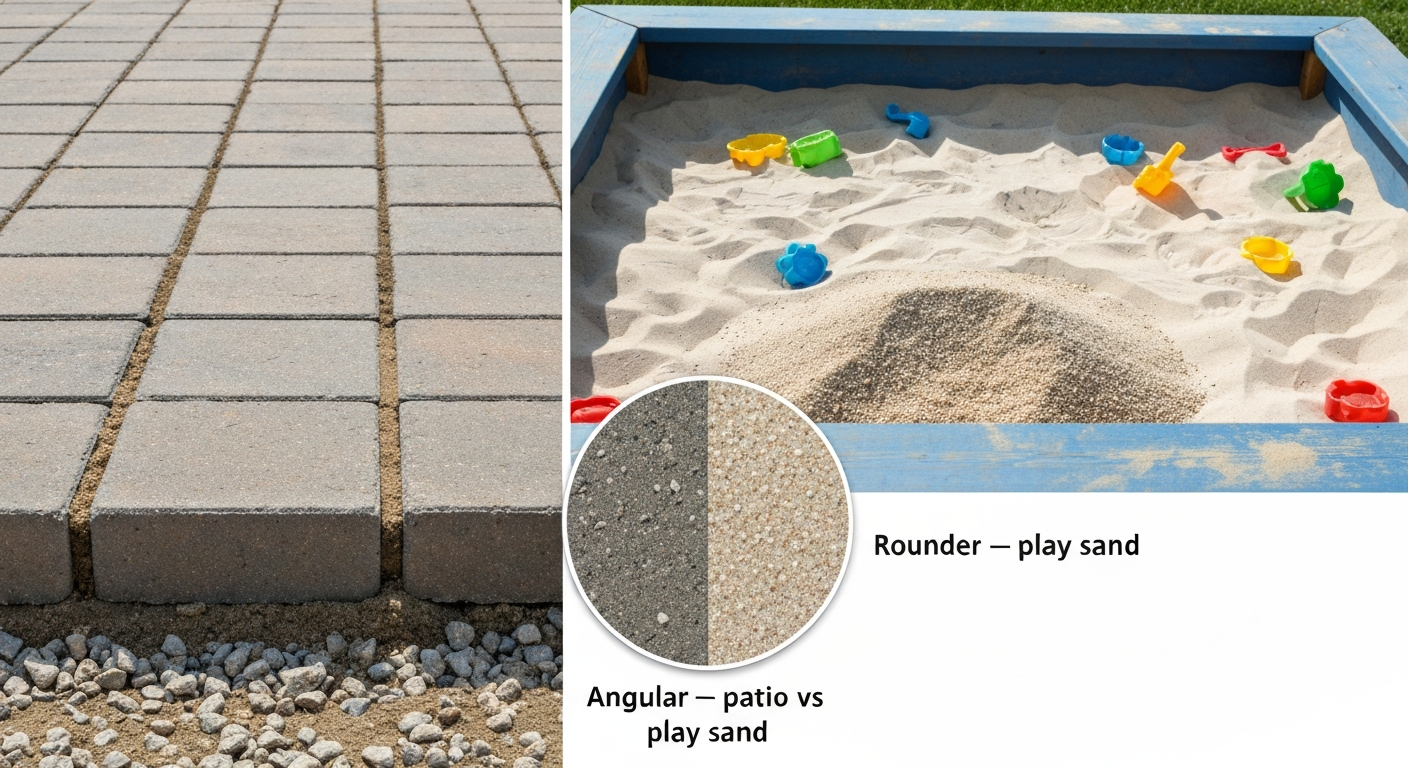
Patio sand and play sand are not interchangeable. Play sand is too fine and rounded for bedding pavers, too soft for joints, and has no place in mortar mixes. The right sand for a patio depends entirely on the job: coarse, angular, ASTM C33-compliant concrete sand for bedding and base layers; ASTM C144 masonry sand or polymeric sand for joints; and sharp masonry sand for mortar and pointing. For a quick buyer's summary of the best sand for patio and which type to use where, see the guide on selecting the best sand for patio. Play sand's only legitimate role on a patio is as a temporary filler in a sandbox tucked into a garden corner.
Patio Sand vs Play Sand: Best Choices & Installation Tips
Nolan Ellison
24 Jul 2026
Quick takeaways by patio task
- Bedding and setting pavers or patio stones: use clean, angular concrete sand (ASTM C33), screeded to a maximum 1 inch (25 mm) depth.
- Jointing paver joints: use polymeric sand for joints 1/16"–3/16" (1.5–5 mm) wide, or ASTM C144 kiln-dried jointing sand for dry-lay applications where polymeric is impractical.
- Mortar and pointing on brick patios: use sharp masonry sand meeting ASTM C144, mixed at roughly 3:1 sand-to-cement ratio.
- Under patio stones (bedding layer): ASTM C33 washed concrete sand, 1 inch deep, over a compacted gravel sub-base.
- Brick patios (dry-lay): ASTM C33 bedding sand beneath, ASTM C144 jointing sand between; for mortar-set, use C144 masonry sand throughout.
What people actually mean by 'patio sand' and 'play sand'
"Patio sand" is a retail catch-all. At the hardware store it might mean bagged concrete sand, coarse jointing sand, polymeric sand, or kiln-dried jointing sand depending on which shelf you grab it from. The only useful way to evaluate any bag labelled 'patio sand' is to read the spec sheet and check which ASTM standard it references. If there is no specification on the bag, ask the supplier for a gradation certificate or blank" rel="noopener noreferrer">sieve analysis done to ASTM C136.
Play sand is specifically manufactured for children's sandboxes. It is washed or kiln-dried, very finely graded, and intentionally rounded so it feels soft underfoot and won't cut small hands. The CPSC defines typical play sand with a sieve profile where 100% passes a No.16 (1.18 mm) sieve and only about 0–1% passes the No.200 (0.075 mm) sieve. Those fine, rounded grains make it great for children and terrible for structural patio work, where you need angular particles that interlock and resist lateral movement under load.
The sand types you'll actually encounter
Walk into any builders merchant or big-box store and you'll find several products called sand. Here is what each one actually is and where it comes from.
Concrete sand (masonry/coarse sand)
This is what most professionals mean when they say 'bedding sand.' It meets ASTM C33 gradation, is typically washed, and has a particle size distribution that spans roughly 0.1–9.5 mm with the bulk of the material between 0.5–2 mm. It feels noticeably coarser and grittier than play sand. The angular shape is the key feature: angular grains lock together and resist movement far better than rounded ones.
Sharp sand (aggregate or grit sand)
Sharp sand is a coarser, more angular variant often used in mortar mixes and as a bedding material. It drains well and compacts reliably. In the UK and parts of Europe this is the standard bedding and mortar sand; in North America it maps closely to ASTM C33 concrete sand. It should not contain clay lumps or organic material.
Washed sand
Washed sand simply refers to sand that has been processed to remove excess fines, clay, and silt. Concrete sand and sharp sand are typically washed. The washing step is what keeps the clay or minus-No.200 fines below the 1% threshold that ASTM C33 and C144 require for structural applications. An unwashed sand with 5–10% fines will bleed water, lose density, and settle unevenly under a patio.
Kiln-dried sand
Kiln-dried sand is dried at high temperature to near-zero moisture content. It flows freely into narrow paver joints and is the standard choice for dry brushing into joints after a polymeric sand application or as a standalone fine jointing sand. Its very low moisture content makes it easy to work with but means it offers no binder and will wash out over time if used as the sole joint filler in exposed joints. Do not use kiln-dried sand as a bedding material; it has no structural value as a base.
Polymeric sand
Polymeric sand is kiln-dried or fine sand blended with polymer binders (typically polyurethane or acrylic-based). When moistened and allowed to cure, the binders harden the joint, resist weed germination, and significantly reduce ant and insect activity compared with plain jointing sand. Brands like Techniseal HP NextGel and Alliance Gator Maxx are the most common in North America. Polymeric sand is not a structural material; it fills joints, it does not replace a proper bedding layer.
Key technical specs to check before you buy
Before purchasing any sand for a patio project, look at three things: particle size distribution (gradation), particle shape, and fines content. Here are the specific numbers to keep in mind.
| Property | Bedding sand (ASTM C33) | Jointing/masonry sand (ASTM C144) | Play sand (CPSC profile) | Polymeric sand |
|---|---|---|---|---|
| Max particle size | 9.5 mm (3/8") | 2.36 mm (No.8) | 1.18 mm (No.16) | Typically < 2 mm (brand-specific) |
| % passing No.16 (1.18 mm) | 50–85% | 70–100% | ~100% | 85–100% (varies) |
| % passing No.200 (0.075 mm, fines) | 0–1% | 0–5% | 0–1% | < 3% (varies by brand) |
| Particle shape | Angular to sub-angular | Angular to sub-angular | Rounded | Fine angular with polymer binder |
| Clay/plastic fines allowed | None (non-plastic) | < 5% passing No.200 | Near zero | None |
| Binder content | None | None | None | Polymer (polyurethane/acrylic) |
| Primary ASTM standard | C33 / C136 for testing | C144 | CPSC Pub. 325 profile | Manufacturer TDS (no single ASTM) |
The No.200 sieve (0.075 mm) fines figure is the most important number to track. Fines above about 1–2% in a bedding layer trap water, reduce drainage, and create a layer that can pump under repeated freeze-thaw cycles. If you're buying in bulk from a quarry, ask for a sieve analysis certificate run to ASTM C136. For bagged products, look for an ASTM C33 or C144 call-out on the label.
Bedding and setting pavers or patio stones: what to use and why
The bedding layer is the thin sand course directly under your pavers or patio stones. Its job is to provide a level, slightly compressible surface for setting stones to grade, not to act as structural support. That structural work belongs to the compacted gravel base beneath it. ICPI guidance is explicit: bedding sand should conform to ASTM C33 gradation, be clean and non-plastic, and should never be deeper than 1 inch (25 mm). Thicker bedding layers compact unevenly and cause settling and rocking.
I learned this one the hard way on a flagstone patio I installed years ago. I used a locally sourced 'patio sand' that had no spec sheet and felt like slightly gritty play sand. Within two winters the stones had settled in a wave pattern across the middle of the patio where the bedding layer had compressed unevenly. When I pulled the stones and tested the sand, it had around 8% passing the No.200 sieve. All that fine material had washed downward, leaving voids. Replacing it with proper C33 concrete sand solved the problem permanently.
Bedding sand: pros and cons
| Factor | ASTM C33 concrete sand | Play sand | Stone dust / screenings |
|---|---|---|---|
| Structural performance | Excellent: angular grains interlock under load | Poor: rounded grains shift laterally | Poor: high fines trap moisture and pump |
| Drainage | Good: low fines allow water to pass | Moderate: very fine but low fines | Poor: compacts to near-impermeable layer |
| Levelling ease | Good: screeds cleanly at 1" | Easy but unstable long-term | Easy but prone to heaving |
| Cost (bagged ~50 lb) | ~$5–$8 | ~$5–$7 | ~$3–$5 |
| Cost (bulk per ton) | ~$30–$60 depending on region | ~$40–$70 | ~$20–$40 |
| ICPI-recommended | Yes | No | No |
For purchase, concrete sand (C33) is widely available at builders merchants, landscape supply yards, and big-box stores. For more detail on where to buy patio sand, see our guide on where to buy patio sand. Buying in bulk by the ton is significantly cheaper for any patio over about 100 square feet. A 10x10 ft patio at a 1-inch bedding depth needs roughly 0.3 cubic yards, which is about half a ton. Bags work fine for small repair jobs or tight access situations.
Jointing and paver joints: polymeric sand vs regular jointing sand vs play sand
Joint sand does something different from bedding sand. It fills the narrow gaps between pavers, locks them laterally, and keeps debris and weed seeds from taking root. ICPI recommends joint widths of 1/16" to 3/16" (approximately 1. See the ICPI Manual, joint width recommendations and tolerances for industry guidance that standard concrete pavers (80–100 mm thick) commonly use 1/16"–3/16" (≈1.5–5 mm) joints with tolerances of about ±1/8" (≈3 mm) ICPI Manual — joint width recommendations and tolerances. 5–5 mm) for standard concrete pavers, and the sand choice needs to match that geometry.
Polymeric sand
For most residential patio projects, polymeric sand is the best joint material available. For guidance on choosing the best sand for patio joints, see best sand for patio joints. It hardens after activation with water, resists weed penetration far better than plain sand, significantly reduces ant and insect activity, and won't wash out in heavy rain the way regular jointing sand does. Techniseal, Gator, and similar brands require a dry window of at least 24–48 hours before installation and after activation, and they specify application temperatures above freezing. Full polymer cure can take up to 30 days, though the joint is functional within 24 hours of activation in good conditions. Keep pedestrian traffic off for the first 24 hours.
Polymeric sand is not suitable for joints wider than about 3/4" (19 mm) unless specifically formulated for wide joints; check the product TDS for the maximum joint width it can handle without cracking. It is also not suitable for joints that hold standing water before activation, and it should not be used when rain is forecast within 24 hours of application.
Regular kiln-dried jointing sand (ASTM C144)
Plain jointing sand meeting ASTM C144 is a legitimate choice for dry-lay patios that will be resanded periodically, or as a top-up material between polymeric sand applications. It is significantly cheaper than polymeric sand (roughly $4–$6 per bag vs $25–$40 for polymeric), requires no curing window, and is easy to apply by brushing across the surface and sweeping into joints. The trade-off: it will wash out, it invites weeds, and it needs to be replenished every one to three seasons depending on rainfall and traffic.
Play sand in joints: a hard no
Play sand should not be used as jointing sand. The rounded grains don't interlock, the material migrates out of joints quickly, and it offers no lateral support to adjacent pavers. In freeze-thaw climates it also holds moisture in the joint longer than angular sand, which accelerates frost heaving at paver edges. There is no scenario where play sand outperforms proper jointing sand in a paver joint.
| Jointing option | Weed resistance | Washout resistance | Best joint width | Approx. cost per bag | Cure required |
|---|---|---|---|---|---|
| Polymeric sand | Excellent | Excellent | 1/16"–3/4" (product-dependent) | $25–$40 (50 lb) | Yes: 24–48 hr dry; 30-day full cure |
| ASTM C144 kiln-dried jointing sand | Poor to moderate | Poor | 1/16"–3/8" | $4–$6 (50 lb) | No |
| Play sand | Very poor | Very poor | Not recommended | $5–$7 (50 lb) | No |
Sand for mortar and pointing on brick patios
If you're building a mortar-set brick patio or repointing the joints in an existing one, the sand specification changes again. For detailed specs on mortar and pointing materials, see what sand for patio pointing. For more on choosing what sand for patio mortar, see the mortar sand guide. Mortar sand needs to be fine enough to produce a workable, cohesive mix but angular enough to provide tensile strength within the cured mortar joint. ASTM C144 masonry sand is the correct specification here, with a gradation that requires approximately 70–100% passing the No.16 sieve (1.18 mm) and only 0–5% passing the No.200 sieve (0.075 mm). For a concise guide on selecting the best sand for brick patio mortar and pointing, see best sand for brick patio.
A standard mortar mix for brick patio pointing uses a 3:1 ratio of ASTM C144 masonry sand to Portland cement by volume, sometimes with a small addition of lime for workability. Do not substitute play sand in a mortar mix. Play sand's rounded, uniform grains reduce the surface area available for cement bonding, which lowers the compressive and tensile strength of the cured mortar. Concrete sand (C33) is also generally too coarse for fine joint pointing, though it works adequately in a bedding mortar bed.
Mortar sand: pros and cons
| Sand type | Workability | Bond strength | Drainage | Suitable for mortar? |
|---|---|---|---|---|
| ASTM C144 masonry sand | Excellent | Excellent | Adequate (low fines) | Yes — recommended |
| ASTM C33 concrete sand | Adequate for screed beds | Good for thick beds | Good | Acceptable for thick mortar beds only |
| Play sand | Good (too smooth) | Poor (rounded grains) | Good | No — not recommended |
| Stone dust / screenings | Poor (too high fines) | Poor | Poor | No |
When mixing mortar for pointing, keep the water-to-cement ratio as low as workability allows. A stiff mortar (sometimes called a 'dry mix') reduces shrinkage cracking as the joint cures. Work in sections of no more than about 10–15 square feet at a time to prevent the mortar from setting before you can finish tooling the joints. In hot or windy weather, mist the finished joints lightly with water for the first 48 hours to slow the cure and reduce cracking.
What to put under patio stones: bedding layer vs base layer
This is one of the most misunderstood parts of patio construction. There are two distinct layers below a paver or stone: the base (compacted gravel or crushed stone aggregate) and the bedding layer (the thin sand course on top of the base). For guidance on selecting the right sand for the bedding layer and joints, see what sand to use under patio stones. These layers have completely different jobs and different material requirements.
The base layer
The base provides structural support and drainage. It should be compacted crushed stone, typically a well-graded aggregate like #57 stone or 3/4" crusher run, installed at a minimum depth of 4 inches (100 mm) for pedestrian patios and 6–8 inches (150–200 mm) for driveways or areas with vehicle loads. The base must be compacted in lifts of no more than 4 inches (100 mm) using a plate compactor. Sand is not a base material. Using sand as a thick base layer is one of the most common DIY mistakes I see, and it always leads to settling.
The bedding layer
The bedding layer is the 1-inch (25 mm) maximum layer of ASTM C33 concrete sand that sits directly on top of the compacted base. You screed it flat to your finish grade, set the pavers or stones on top, then compact the whole assembly with a plate compactor (with a rubber pad to protect the surface). The compaction drives the pavers slightly into the sand, locking them in place and eliminating the voids that cause rocking. Never increase the bedding layer to compensate for an uneven base; always bring the base to grade first.
Drainage is built into this system at the base layer, not the bedding layer. The compacted gravel base should pitch away from the house at a minimum gradient of 1/8" to 1/4" per foot (about 1–2%). If you rely on the sand bedding layer to handle drainage you will get saturation, freeze-thaw damage, and heaving in cold climates within a few seasons.
Depth and compaction checklist
- Excavate to a depth that accommodates base depth (4"+ for pedestrian) plus 1" bedding sand plus the thickness of your paver or stone, plus 1/8" for the paver to sit slightly above final grade before compaction.
- Install and compact the crushed stone base in 4" lifts. Check for a consistent pitch of at least 1/8" per foot away from the house.
- Screed a 1" layer of ASTM C33 concrete sand over the compacted base. Do not walk on the screeded sand before placing stones.
- Set pavers or stones by hand, maintaining consistent joint widths of 1/16"–3/16" for interlocking concrete pavers.
- Run a plate compactor over the entire surface (use a rubber pad on natural stone or porcelain). This seats pavers into the bedding and removes voids.
- Sweep joint sand (polymeric or C144 kiln-dried) into joints. For polymeric sand, activate with water and allow the 24–48 hr cure window.
Safety considerations: crystalline silica and chickens
All types of sand, including play sand, patio sand, and polymeric sand, contain crystalline silica. OSHA's permissible exposure limit (PEL) for respirable crystalline silica is 50 µg/m3 as an 8-hour time-weighted average, with an action level of 25 µg/m3. For a DIYer doing occasional weekend work, routine exposure levels are generally well below occupational thresholds, but you should still wear an N95 respirator when cutting, compacting, or sweeping dry sand in enclosed or low-wind conditions. This applies to all sand types, not just construction products.
Polymeric sand adds an additional hazard layer. Products like Techniseal HP NextGel carry SDS hazard codes H319 (eye irritation) and H317 (skin sensitization) due to the polymer binders. Wear gloves and safety glasses during application, and avoid breathing the dry dust. The polymer itself is not toxic once cured, but the uncured dust should be treated with respect.
On the question of whether paver sand is safe for chickens: standard angular concrete sand or coarse grit is actually commonly used as poultry grit and is considered safe in appropriate grain sizes. For detailed guidance on keeping chickens safe around different paver and jointing sands, see the article titled "is patio paver sand safe for chickens.". The concern with fine silica sand is chronic respiratory exposure, not acute toxicity. Kiln-dried jointing sand and play sand, being finer, generate more airborne dust in dry conditions and are less ideal in a chicken run environment. Polymeric sand should be kept away from chickens entirely until fully cured, given the polymer binder chemistry. Coarse, washed ASTM C33 sand in a well-ventilated run is the least problematic option.
Climate and drainage: what changes depending on where you live
In freeze-thaw climates (USDA zones 4–6 and most of Canada and northern Europe), the drainage system underneath the patio matters more than almost anything else. A well-draining ASTM C33 bedding layer allows water to pass through quickly rather than pooling and freezing at the paver interface. Stone dust and high-fines sands behave almost like concrete when they freeze, and the expansion forces are enough to crack or displace pavers over multiple winters.
In very hot, dry climates, joint sand stability is the main concern. Polymeric sand performs better than plain jointing sand in high-UV, low-humidity environments because the cured polymer resists the thermal expansion and contraction cycles that regularly re-open joints in plain sand installations. In wet or tropical climates, polymeric sand's washout resistance is its primary advantage; just confirm that the product you select is rated for wet-climate use, as some formulations are less effective in consistently high-humidity conditions.
Costs, sourcing, and what to buy in bulk vs bagged
The cost difference between buying sand in bags and buying it in bulk is significant for any project over about 50 square feet. A ton of ASTM C33 concrete sand from a landscape supply yard or quarry typically runs $30–$60 depending on region and delivery cost. The same material in 50 lb bags costs roughly $5–$8 per bag, which works out to $200–$320 per ton. For a 200 sq ft patio needing 1 inch of bedding sand, you need roughly 0.6 cubic yards, which is just over half a ton. Buying bagged makes sense for repairs, fill-in work, and tight access sites; bulk almost always makes sense for new builds.
Big-box retailers (Home Depot, Lowe's, and their regional equivalents) carry bagged concrete sand, play sand, polymeric sand, and kiln-dried jointing sand. Landscape supply yards and concrete product suppliers are the best source for bulk ASTM C33 sand by the yard or ton, and they can usually provide a gradation certificate on request. Online retailers are a reasonable option for polymeric sand in bulk packs if local pricing is high, but shipping weight makes it expensive for large quantities.
Maintenance: resanding, weed control, and releveling
Even a well-installed patio will need joint sand top-ups and occasional releveling over time. With polymeric sand, the joint binder eventually breaks down over 5–10 years in high-traffic areas; when joints become friable or crumbly, scrape out the old material with a stiff brush or jointing tool and apply fresh polymeric sand. With plain C144 jointing sand, plan on sweeping in fresh sand every one to two seasons in climates with significant rainfall.
For releveling sunken or rocking pavers, pull the affected stones, remove the old bedding sand, and re-screed fresh ASTM C33 sand to the correct depth. Do not add sand on top of old sand as a shim; the layers behave differently under compaction and the fix rarely lasts. If multiple stones in a section are settling in the same direction, the problem is likely in the base layer, not the bedding sand, and the base may need to be excavated, regraded, and recompacted before reinstalling.
Weed control in sand-jointed patios comes primarily from using the right joint sand in the first place. Polymeric sand is the single most effective weed deterrent at the joint level. For plain jointed patios, a polymeric joint sand top-up on existing clean joints is a cost-effective retrofit. Pre-emergent herbicide applied to joints in early spring can also reduce weed germination without damaging surrounding vegetation if applied according to label directions.
Patio sand vs play sand: which wins for each job
Play sand has exactly one quality that makes it attractive for patio-adjacent projects: it is cheap, readily available, and safe for children. In every structural patio application, purpose-specified sands win clearly. The table below summarises the verdict across all main patio uses.
| Patio task | Recommended sand | Play sand suitable? | Key spec to verify |
|---|---|---|---|
| Paver/stone bedding layer | ASTM C33 concrete sand (washed, angular) | No | < 1% passing No.200; max 1" depth |
| Interlocking paver joints | Polymeric sand or ASTM C144 kiln-dried jointing sand | No | Joint width 1/16"–3/16"; 24–48 hr dry cure for polymeric |
| Mortar and brick patio pointing | ASTM C144 masonry/sharp sand | No | 70–100% passing No.16; 0–5% passing No.200 |
| Under patio stones (bedding) | ASTM C33 concrete sand, max 1" layer | No | Angular, non-plastic, washed |
| Sub-base layer | Compacted crushed stone (not sand) | No | Minimum 4" compacted depth, 1/8" per foot pitch |
| Sandbox or play area in garden | Play sand (CPSC profile) | Yes — only use case | 0–1% passing No.200; washed or kiln-dried |
The one thing play sand and patio sand share is the silica content and the associated need for basic dust precautions during dry handling. Beyond that, they serve entirely different purposes. Getting the right sand for each layer of your patio build is one of the cheapest and most impactful choices you will make. A bag of proper ASTM C33 concrete sand costs the same as a bag of play sand. The difference in long-term performance is not subtle.
FAQ
What are the main types of sand used for patios and how do they differ?
Common sands: - Paver/patio (concrete) sand: Washed silica sand, sub‑angular to rounded grains, gradation close to ASTM C33. Low fines (typically ≤1% passing No.200). Used for bedding and some jointing. - Joint (masonry) sand: Finer, more rounded, meets ASTM C144 limits (most passing No.16, very low fines ≤5% passing No.200). Used for mortar or fine joints. - Play sand: Washed, very clean, fine grains (CPSC ‘‘fine sand’’ profile), very low fines (0–1% No.200). Not engineered for interlock bedding under vehicles. - Masonry/concrete sand: Coarser angular sand used in mortar and concrete mixes; graded per ASTM C33/C144 depending on use. - Kiln‑dried sand: Extremely dry, used mainly for polymeric sand applications because it activates/bonds reliably. - Polymeric sand: Sand blended with polymers that harden when wetted; requires specific grain size (often kiln‑dried washed sand) and manufacturer installation. Key differences: grain size/gradation, grain shape (angular vs rounded), fines (percent passing No.200), and additives (polymer binders).
What gradation/spec values should I look for when buying sand for bedding (under pavers)?
Recommended spec: conforming to ASTM C33/C33‑like gradation as advised by ICPI. Typical target ranges: 100% passing 3/8" (9 mm); ~95–100% passing No.4 (4 mm); ~80–100% passing No.8 (2 mm); ~50–85% passing No.16 (1 mm); limited material passing No.200 (0–1%). Also: clean (washed), non‑plastic, essentially no clay lumps or silt; max bedding thickness about 1" (25 mm) per ICPI guidance.
What sand specs are best for paver joints (resanding and initial jointing)?
For conventional jointing sand: use washed joint or coarse masonry sand meeting ASTM C144‑style limits: most passing 1.18 mm (No.16) and generally ≤5% passing No.200 (0.075 mm). For narrow joints (1.5–5 mm / 1/16"–3/16"), use finer kiln‑dried sands (polymeric sand product requirements apply). For wider joints (>6 mm), coarser jointing sand or polymeric sand formulated for wide joints is recommended. Avoid stone dust/screenings for joints if installation expects drainage and movement.
When should I use polymeric sand instead of regular joint sand?
Use polymeric sand when you want hardened, stabilized joints that reduce insect/weed growth and resist wind/washout—best for pedestrian patios and low‑traffic areas. Consider polymeric sand if joint widths are within the manufacturer's recommended range (commonly 1/16"–1" depending on product) and you can meet installation constraints (dry weather, temperature above freezing, correct joint depth). Avoid polymeric sand where joints need to remain permeable for drainage in some permeable paver systems, or where frequent cutting/repair is expected.
Can I use play sand for patio bedding or joints?
Short answer: not ideal for bedding under pavers, but OK for limited joint use in some cases. Play sand is very clean and fine (low fines) and may be acceptable for narrow joints or temporary use, but it is typically too fine and rounded for bedding where interlock and load distribution are required. For bedding, use paver/concrete sand (ASTM C33‑type) with coarser, sub‑angular grains.
Which sand should I use for mortar and pointing on brick patios?
Use masonry sand meeting ASTM C144 combined with appropriate lime/cement mix per mortar type (e.g., Type N, S). The sand should be well‑graded (most passing No.16), clean, and contain limited fines (0–5% No.200). For historic or soft brick, use softer mortar (Type N) and matching sand color/grain to avoid damage. Do not use play sand or polymeric sand for structural mortar joints.