Plain patio paver sand (the coarse, washed ASTM C33-grade sand used as a bedding layer under pavers) is generally low-risk for chickens when it is properly installed, kept dry, and used as a surface or dust-bath substrate in moderation. The bigger concerns are polymeric joint sand, which contains hardening binders that are genuinely unsafe for birds to ingest or inhale during curing, and fine silica-heavy play sand or masonry sand, which generates more respirable dust. With the right sand type, sensible installation, and a few maintenance habits, you can build a patio or chicken run surface that works for both purposes, but the details matter.
Is Patio Paver Sand Safe for Chickens? Practical Guide

Nolan Ellison
26 Jul 2026
How patio paver sand differs from play sand, masonry sand, and polymeric sand
Not all sand is the same material, and the differences matter a lot when chickens are involved. Patio paver sand (also called concrete sand or bedding sand) is a coarser, angular product graded to ASTM C33 standards, with particles typically ranging from about 0.5 mm up to 4.75 mm. Its angular shape and wider gradation make it stable under paver loads and relatively free-draining. Play sand is finer, more uniformly sized, and rounded, better for sandboxes but too fine for structural paver use, and it generates considerably more airborne dust when dry. Masonry sand (ASTM C144) sits between the two in fineness and is designed for mortar mixing, not for loose substrate use. Polymeric sand is in a completely different category: it is sand combined with a polymer or resin binder that activates with water and hardens in paver joints. That binder chemistry is what makes it effective for jointing, and what makes it completely off-limits anywhere chickens can access loose or uncured material.
| Sand Type | Typical Particle Size | Main Use | Binders/Additives | Chicken Safety |
|---|---|---|---|---|
| Paver/Concrete Sand (ASTM C33) | 0.5–4.75 mm, angular | Paver bedding layer | None | Low risk when dry and clean |
| Play Sand | 0.1–0.5 mm, rounded | Sandboxes, dust baths | None | Low risk but more dust; monitor respiratory exposure |
| Masonry/Mortar Sand (ASTM C144) | Very fine, 0.05–2 mm | Mortar mixing | None (pre-mixed may vary) | Higher dust risk due to fine particles |
| Polymeric Joint Sand | Fine-medium graded | Paver joint filling | Polymer/resin binders | NOT safe — binders are a serious ingestion and inhalation risk |
One thing worth noting: every one of these sand types is predominantly crystalline silica (quartz). That is not unique to any brand or product, it is simply what sand is. The safety differences come down to particle size, additives, and how you manage dust, not some fundamental difference in mineral composition between, say, paver sand and play sand.
The actual risks, broken down
Respiratory dust and silica exposure
Respirable crystalline silica is classified by IARC as a Group 1 carcinogen in humans, and OSHA and NIOSH set strict workplace exposure limits (NIOSH recommends a time-weighted average REL of 50 µg/m³ for respirable crystalline silica). What many backyard chicken keepers do not realize is that poultry lungs are vulnerable too. Published veterinary research, including peer-reviewed studies specifically titled 'Silicate pneumoconiosis in hens' and 'Effect of Inert Dust Use on the Prevalence of Pulmonary Silicosis in Laying Hens,' documents silica and silicate particle accumulation in avian lung tissue following prolonged exposure to mineral dusts. Chickens scratch and flap vigorously in any loose substrate, and in an enclosed run or coop, that activity can generate sustained airborne dust at levels that matter. The risk is greatest with fine sands in poorly ventilated, enclosed spaces.
Ingestion and gizzard impaction
Chickens naturally ingest grit to aid digestion in their gizzard, so small amounts of sand passing through is normal and expected. The concern is not clean quartz sand in moderate amounts, it is unusual materials. Polymeric sands contain swellable polymer binders that are not safe to ingest, and even inert but unusually large or sharp fragments can cause obstruction. Published case reports of gastrointestinal obstruction in poultry have been linked to ingestion of materials like polyacrylamide gel, which behaves similarly to the water-activated binders in polymeric products. Stick to unmodified, particle-size-appropriate sand and the ingestion risk stays low.
Foot and skin irritation
Bumblefoot (pododermatitis) is a bacterial infection, usually Staphylococcus, that starts with a skin abrasion on the foot pad. The Merck Veterinary Manual and University of Maryland Extension both identify rough or abrasive flooring and wet, caked litter as key predisposing factors. Very coarse, sharp-edged sand or crushed aggregates can create the micro-abrasions that let bacteria in. Wet sand is worse than dry sand because it promotes bacterial growth and softens the foot pad skin. The practical takeaway: paver bedding sand that stays dry and is not excessively coarse is low risk for foot health, but anything that holds moisture or has very sharp, angular particles warrants more caution.
Chemical additives and binders
This is the clearest and most avoidable risk. Polymeric joint sands, the products used to lock paver joints, carry Proposition 65 warnings on their packaging and product listings, and manufacturers explicitly warn against allowing birds or pets to access loose or uncured polymeric material. If you are building a patio with pavers and plan to use polymeric sand in the joints, that is perfectly fine for the patio itself. The issue is if chickens can peck at fresh joint material before it has fully cured, or if erosion later exposes sand from the joints. Some polymer-fortified jointing compounds also include colorants, biocides (to resist weeds and moss), and other additives not intended for animal contact. Always pull up the Safety Data Sheet (SDS) for any sand product before using it in a chicken area, the SDS is where the ingredient details live, not the bag's front label.
What sand types and particle sizes are actually safe
For chicken runs and combined chicken-patio areas, the safest sand options are coarse, washed, additive-free quartz sands in the 0.5–3 mm range. This puts ASTM C33 paver/concrete sand at the top of the list. For a concise buying guide on selecting the best sand for patio, see our recommendations. YardMetric’s paver-sand guidance explicitly advises against using play sand and recommends coarse ASTM C33 concrete/paver sand for bedding to ensure stability and proper drainage blank" rel="noopener noreferrer">YardMetric summary: Do not use play sand; use coarse concrete (paver) sand (ASTM C33).. It is coarse enough to drain well (reducing the wet-litter foot health risk), angular enough to provide traction without being razor-sharp, and free of any added binders, polymers, or biocides. It is also widely available in bulk from landscape suppliers, which makes sourcing practical.
Chicken welfare research, including a Frontiers in Veterinary Science meta-analysis on floor substrate preferences, shows that hens actively prefer sand and peat as dust-bathing substrates. From a behavioral standpoint, providing some sand access supports a natural and important behavior. The key is managing the dust that comes with it, fine sands satisfy dust-bathing preferences but create more respiratory hazard, so coarser sand with a dedicated fine-sand dust-bath station in a well-ventilated area is a better compromise than a uniform fine-sand surface.
- ASTM C33 concrete/paver sand (0.5–4.75 mm): best all-round choice for run surfaces and bedding layers
- Coarse horticultural sand or sharp sand (1–3 mm): good for dust-bath mixes blended with peat or wood ash
- All-purpose construction sand (washed, no additives, confirmed by SDS): acceptable if particle size is in range
- Avoid play sand as your only surface material — fine particles create more dust and drain poorly
- Avoid masonry/mortar sand — too fine, higher dust generation
- Never use polymeric joint sand anywhere chickens can access it loose or before curing
Installation best practices to keep things safe
How you install a paver surface next to or over a chicken area is just as important as which sand you choose. Industry guidance from ICPI (Interlocking Concrete Pavement Institute) recommends a compacted aggregate base of at least 4 inches, with a 1-inch screeded bedding layer of ASTM C33 sand on top. ICPI / Interlocking Pavement guidance summarizing Tech Spec requirements (industry technical guidance) recommends a compacted aggregate base of at least 4 inches with a 1-inch screeded ASTM C33 bedding sand layer beneath pavers. That base setup is good news for chickens too: proper compaction and drainage beneath the surface means water does not pool, and a surface that sheds water quickly is far friendlier to foot health than one that stays damp.
- Start with a compacted gravel base (4 inches minimum for a residential patio) using crushed angular aggregate, not rounded pea gravel, for stability.
- Add a 1-inch bedding layer of ASTM C33 coarse sand, screeded level — do not substitute play sand or fine masonry sand here, as they drain poorly and can pump out under load.
- Install pavers and allow chickens to access the area only after installation is complete and all polymeric joint material (if used) has fully cured per the manufacturer's instructions — typically 24–48 hours after final water activation.
- For joints in chicken-adjacent areas, consider using plain ASTM C33 sand or kiln-dried sand swept into joints rather than polymeric sand, accepting that you will need to re-sweep joints more often.
- Install a physical barrier (a low border, edging, or grade change) between the formal paved patio area and the chicken run surface so birds cannot access joint material directly.
- Ensure the entire surface slopes at least 1–2% away from structures for drainage — flat or low-lying areas will pond and create damp substrate.
- Where the run surface itself is sand, aim for a depth of 4–6 inches of clean paver/coarse sand over a compacted, well-draining base.
Maintenance routines that keep sand genuinely safe
Routine cleaning and debris removal
Sand in a chicken run accumulates droppings, feathers, and food debris quickly. Rake the surface at least twice a week to break up clumps and turn the material so the top layer dries out. Remove obvious manure deposits during each pass. When sand starts smelling sour or feels consistently damp even in dry weather, it is time to replace the top 1–2 inches. A full sand replacement every 6–12 months is realistic for a run with 4–6 birds.
Dust control in enclosed spaces
In partially covered or enclosed runs, dry sand can reach dusty conditions that raise respiratory exposure for the birds (and for you). Lightly misting the surface with water before disturbing it, improving roof or side ventilation, and using coarser sand rather than fine sand all reduce airborne particulate load. Do not over-wet the surface, the goal is just enough moisture to keep dust from becoming airborne, not a wet substrate.
Parasite reduction
Sand does not harbor external parasites the way deep litter wood chips can, which is one reason many keepers prefer it. To keep mite and lice pressure down, allow the sand to dry fully between uses and supplement with a dedicated dust-bath station stocked with a mix of fine sand, wood ash, and diatomaceous earth (DE). Keep DE out of the main run surface, scattered loose DE in a confined space raises the dust load, and confine it to the designated dust-bath box where chickens interact with it intentionally.
Setting up a safe dust-bath station
A good dust-bath setup is a shallow container (a tractor tire, a half-barrel, or a built frame at least 12 inches deep and 24 inches across for small flocks) filled with a mix of roughly 50% coarse sand, 30% fine peat or loose topsoil, and 20% wood ash. Place it in a covered area so it stays dry, a soggy dust bath is useless to a chicken. Keep this station separate from the main run surface so the finer, dustier materials stay contained rather than becoming the primary substrate the birds spend all day on.
Alternatives to sand: what else works and when to choose it
Sand is not the only option, and for some situations it is not the best one. Here is how the main alternatives compare for combined patio and chicken run use.
| Material | Drainage | Foot Health | Dust Risk | Parasite Control | Maintenance | Best For |
|---|---|---|---|---|---|---|
| Coarse paver sand (ASTM C33) | Good | Good when dry | Moderate (coarser = less dust) | Good with dry conditions | Rake 2x/week; replace annually | Run surfaces, dual-use patio areas |
| Pea gravel (3/8–1/2 inch) | Excellent | Moderate (can be hard on feet) | Very low | Good | Rake occasionally; hose down | Borders, pathways, hardscape edges |
| Crushed stone / decomposed granite | Excellent | Moderate if sharp-edged | Low-moderate | Good | Rake and top-dress annually | High-drainage runs, informal patios |
| Wood chips / hemp bedding | Moderate | Excellent (soft) | Low | Moderate (can harbor mites in depth) | Replace every 3–6 months | Shaded runs, cold climates |
| Concrete (sealed) | Excellent (if sloped) | Poor (hard, needs rubber mat) | None | Excellent (easy to disinfect) | Hose and scrub weekly | Permanent coops, biosecurity-priority setups |
| Dedicated dust-bath mix (sand/peat/ash) | N/A (contained) | Excellent | Low (contained) | Excellent | Stir regularly; replace every 2–3 months | Dust-bath station only, not whole run |
Pea gravel is worth a special mention because it sits right at the intersection of patio aesthetics and chicken practicality. It drains beautifully, does not generate dust, and is easy on bare feet, but some keepers find their birds peck at and try to swallow larger pea-gravel pieces, which can be a problem. Keeping pea gravel at 3/8-inch diameter or slightly larger reduces the risk of birds picking it up as grit. Concrete is the easiest surface to disinfect completely, which matters if you have ever dealt with a coccidiosis outbreak, but standing on concrete all day without soft bedding over it contributes to foot pad soreness and bumblefoot risk, so it works best as a foundation layer rather than a bare surface.
Buying and sourcing: what to ask before you order
When buying sand for a chicken area, the front of the bag tells you almost nothing useful. Request or download the Safety Data Sheet (SDS) for any product before purchase. The SDS will list the crystalline silica content and any added binders, colorants, or biocides. For a bagged product at a home center, look up the SDS on the manufacturer's website using the product name and SKU, major brands like QUIKRETE and SAKRETE post them publicly. Manufacturer/retailer product pages and bag labels for typical 'play sand' or 'all‑purpose sand' may not emphasize respirable crystalline silica by name on the primary product listing but do provide SDS documents that list silica/quartz and applicable hazard statements (users should consult the SDS before assuming a product is 'silica‑free') SAKRETE 50 lb. Play Sand — Home Depot product listing (includes SDS link). For bulk sand from a landscape supplier, ask specifically: 'Is this sand washed? If you need help locating suppliers, see our guide on where to buy patio sand. Does it contain any polymer, binder, or chemical additive? What is the particle size gradation?'
- Ask for ASTM C33 graded washed concrete sand or coarse builder's sand — both describe the same general product category
- Confirm 'no additives' in writing or on the SDS before using bulk sand in a chicken area
- Avoid anything labeled 'polymeric,' 'stabilized,' 'jointing,' or 'weed-resistant' in a chicken context
- Bagged play sand is usable for a dedicated dust-bath mix, but review the SDS to confirm no added colorants or anti-caking agents
- Buy bulk for run surfaces (typically cheaper per ton and readily available from masonry or landscape suppliers) and bagged for dust-bath mixes where you want fine-tuned particle control
- Product names to be cautious about: any product marketed as joint sand, polymeric sand, or stabilized paver sand — these are for joints in hardscaping, not for animal contact
How to design a patio that works for both pavers and chickens
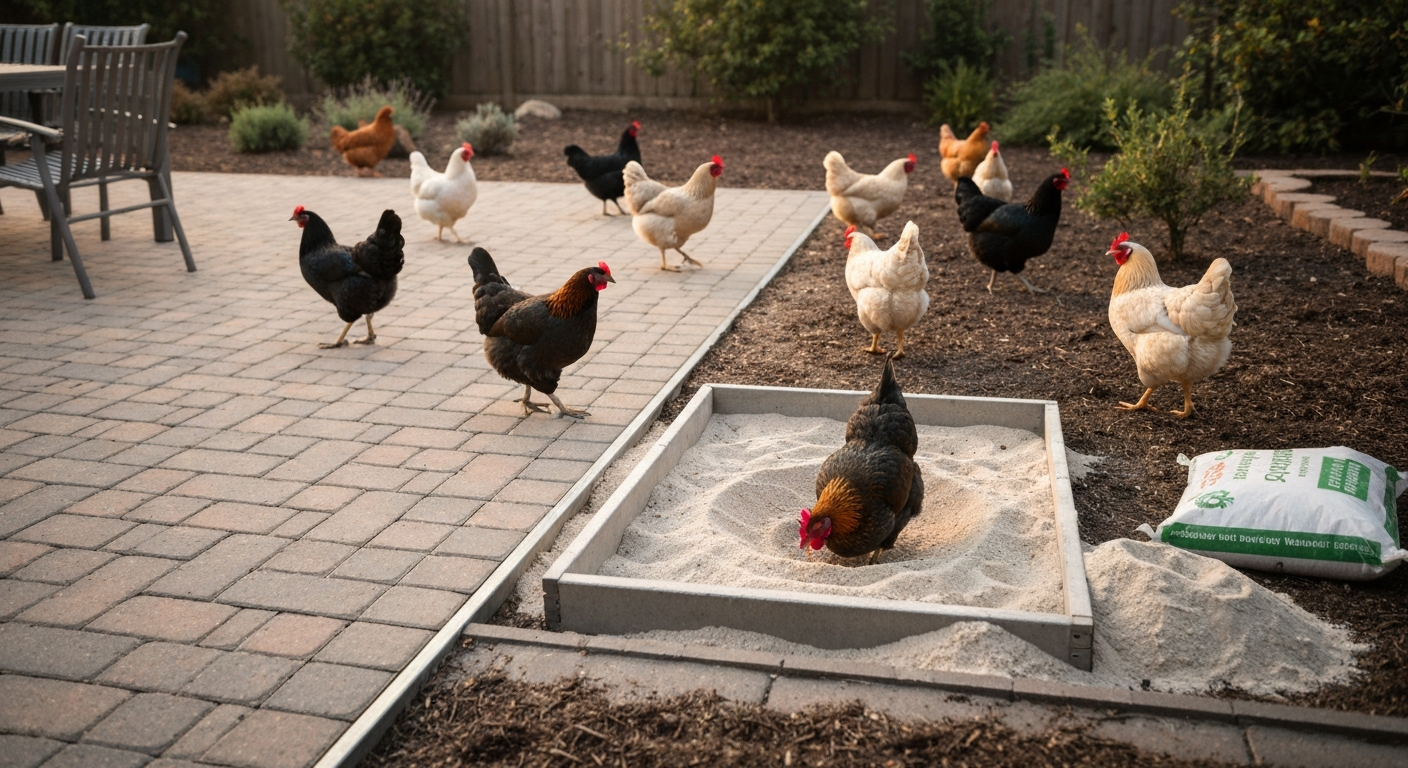
The homeowners I have seen handle this best treat the patio and the chicken run as two defined zones that share a thoughtful boundary, rather than one continuous surface. The paved patio, flagstone, concrete pavers, or brick, is the primary outdoor living area. The chicken run is adjacent, with its own surface material suited to the birds. A low edging board, a raised step, or a simple metal border keeps the two zones visually and functionally separated while allowing the chickens to range onto the patio when supervised.
Factors to weigh when combining the two uses
- Drainage: both patios and chicken runs need water to move away quickly; plan a consistent slope of at least 1–2% across both zones toward a drainage point
- Zoning: use edging, raised borders, or a low fence panel to define where the formal patio ends and the run begins, preventing chickens from accessing polymeric joint material in patio joints
- Ventilation: if any part of the run is covered or enclosed, factor in ventilation openings to reduce dust accumulation
- Cleaning access: hard surfaces (concrete, pavers) need to be hoseable; sand run surfaces need to be rakeable — design both zones so you can reach every part easily
- Foot traffic overlap: areas where chickens and humans share the surface need a material that handles both — sealed concrete, large-format pavers, or decomposed granite all work reasonably well for dual use
Layout and material combinations that work well
A layout I have seen work consistently well: a 12x16-foot concrete paver patio (using ASTM C33 bedding sand below, kiln-dried jointing sand in joints rather than polymeric) as the main outdoor seating area, with a 10x12-foot adjacent chicken run surfaced with 4 inches of coarse ASTM C33 sand over compacted gravel, separated by a 6-inch steel edging border. The dust-bath station sits inside the run in a covered corner, keeping fine material contained. The patio gets hosed down weekly; the run gets raked twice a week. Both surfaces drain to a shared gravel strip along the fence line.
Another practical option for smaller yards: use decomposed granite or crushed stone as a single shared surface across both zones. It handles patio furniture and chicken traffic equally well, drains excellently, and requires only occasional raking and annual topping-up. It does not offer the same formal patio aesthetic as pavers, but for a backyard that is genuinely a working mixed-use outdoor space, it is one of the most durable and low-maintenance choices available.
The overarching rule I would follow: keep polymeric joint sand strictly in paver joints where it can cure undisturbed, use plain ASTM C33 sand for any surface or layer that chickens can physically contact, and maintain drainage as your first priority across both zones. If you are also thinking through the broader patio build, what sand type goes under the pavers, what to use for joint filling, and where to source bulk materials, those decisions all connect back to the same product categories discussed here, and making informed choices at the build stage is far easier than retrofitting a safe setup for your birds later. For a concise buyer's guide on what sand to use under patio stones, see what sand to use under patio stones. For guidance on choosing sand specifically for patio pointing, see our guide on what sand for patio pointing. For specifics on choosing sand for bedding and mortar, see the guide on what sand for patio mortar. For specific recommendations on the best sand for patio joints, see our guide on best sand for patio joints. For more detailed recommendations on choosing the best sand for brick patio, see our dedicated guide on that topic.
FAQ
Is patio paver sand safe for chickens?
Short answer: It depends. Typical paver (concrete) sand is a coarse, angular silica sand often used beneath pavers and — when chosen and handled properly — is less risky than fine play sand or uncured polymeric joint sand. However all natural sands commonly contain crystalline silica (quartz). Long‑term inhalation of respirable silica dust is a documented respiratory hazard for birds and mammals, and poultry case reports show mineral dust can deposit in avian lungs. So use coarse, well‑draining paver sand and control dust, or choose an alternative surface when appropriate.
What are the main risks of using sand around chickens?
Main risks: 1) Respiratory dust — fine, respirable silica particles can be inhaled and deposit in avian lungs; 2) Ingestion/impaction — chickens eat grit, but very fine or unusual materials (swellable polymers, large fragments) increase impaction risk; 3) Foot and skin irritation — very sharp angular or overly abrasive particles, wet/caked sand, or poor drainage can contribute to footpad problems like bumblefoot; 4) Chemical additives/binders — polymeric joint sands and some treated sands contain binders or chemicals not intended for loose‑substrate contact with animals.
How does patio paver sand differ from play sand, masonry sand and polymeric joint sand?
- Paver (concrete) sand: coarser, angular grains, graded to ASTM C33/C33M ranges; intended as a bedding layer under pavers. - Play sand: much finer, rounded grains (washed silica) that produce more dust and are more likely to be respirable; often sold as 'play' but still contains silica. - Masonry/mortar sand: graded for mortar; typically cleaner but still finer than paver sand. - Polymeric joint sand: blended sand plus polymer/chemistry that hardens when wetted; not designed to be loose substrate and can contain chemicals and uncured binders that manufacturers warn against where pets/birds will access.
Which sand types and particle sizes are recommended for chicken areas?
Recommended: coarse, angular paver/concrete sand meeting general ASTM C33 coarse‑aggregate gradation or labeled as paver bedding sand. Particle sizes that reduce dust: predominantly 0.5–2.0 mm (#10 to #40 sieve range) — avoid very fine sands <0.5 mm. Avoid play sand or any product labeled as 'silica‑free' without SDS confirmation (many play sands are quartz). For dust‑bathing specifically, use a separate loose dust‑bath mix (see alternatives) rather than the paver bedding layer.
How should I install sand under pavers where chickens will run?
Installation best practices: 1) Base: build a compacted aggregate base (commonly 4" or more per paver guidance) to prevent movement and settling. 2) Bedding: use a 3/4"–1" screeded layer of ASTM C33 paver (bedding) sand — do not use fine play sand. 3) Barriers: use edging to keep bedding sand contained and a geotextile under the base to limit mixing with native soil. 4) Joints: use polymeric joint sand only if birds cannot access uncured material and after full cleanup — better to use non‑polymeric jointing sand if chickens will be in contact. 5) Drainage: slope and ensure subbase/drainage to keep substrate dry (wet, caked sand increases skin/foot problems). 6) Cleanup: remove loose dust after installation with a blower or water and keep area sealed/edged.
How should I manage and maintain sand or sanded areas that chickens use?
Maintenance steps: 1) Keep it dry — regrade and improve drainage if sand retains moisture. 2) Regular cleaning — remove droppings and wet spots daily/weekly as needed; rake or sift to aerate. 3) Dust control — lightly mist before raking to reduce airborne dust when working; consider a top layer of slightly coarser material to reduce dust generation. 4) Replace or top up bedding periodically — frequency depends on use and contamination (commonly annually for heavy use). 5) Provide a separate covered dust‑bath area with dedicated dust substrate so birds aren’t constantly clouding the run.