The best natural stone patio sealer for most homeowners is a water-based penetrating impregnator, such as Aqua Mix Sealer's Choice Gold, because it protects without altering the stone's appearance, stays breathable, and carries a VOC content of only 73 g/L. If you want a wet-look finish, a solvent-based penetrating enhancer like Foundation Armor WL550 is a better fit than a topical acrylic. If you're dealing with flagstone, sandstone, or limestone in a freeze-thaw or coastal climate, a high-solids silane/siloxane formulation such as Dry-Treat Stain-Proof Original gives you the deepest protection against salt and efflorescence. The right call depends on your stone type, climate, and how you want the finished surface to look, and this guide walks you through every variable. For specific product tests and side-by-side comparisons, see our patio stone sealer review for in-depth performance data and hands-on results.
Best Natural Stone Patio Sealer: Complete Homeowner's Guide
What this guide covers and who it's for
This article is aimed at homeowners tackling a new or existing natural stone patio, whether that's irregular flagstone, riven sandstone slabs, polished limestone, or a mixed-stone surface you've sourced from multiple places. I'll help you identify which sealer category fits your situation, compare specific products using published technical data, walk you through surface prep and application step by step, and give you a realistic maintenance schedule. I've pulled in lab and field research alongside manufacturer specs so you're not just taking marketing claims at face value. By the end you'll know exactly what to buy, how to apply it, and what to do when things go wrong.
Quick decision checklist: pick the right sealer in 5 steps
- Identify your stone type. Sandstone and limestone are highly porous and absorb sealers quickly — you'll need a higher-coverage product or multiple coats. Dense granite or quartzite needs far less. Do a water drop test: if a drop soaks in within 30 seconds, your stone is porous and sealing is urgent.
- Decide on finish. Do you want the stone to look exactly as it does when dry (natural/matte), slightly richer (satin/enhancing), or deep and glossy as if wet (wet-look)? Penetrating sealers preserve the dry appearance; topical or enhancing sealers darken the surface.
- Check your climate. Freeze-thaw regions need a breathable penetrating sealer so trapped moisture can escape. Coastal or salty environments call for a solvent-based silane/siloxane with high active-solids content. Hot, UV-intense climates degrade topical acrylics faster than penetrating options.
- Assess your VOC tolerance. If you're working in a confined courtyard, near children, or in a state with tight VOC regulations, choose a water-based product under 100 g/L. Solvent-based sealers like Miracle Sealants 511 Impregnator (~741 g/L VOC) need serious ventilation and PPE.
- Match your budget and recoat cycle. Premium silane/siloxane impregnators (Dry-Treat) cost more upfront but can last 10-plus years with minimal maintenance. Budget water-based options may need recoating every 2-3 years. Factor in labor, not just product cost.
Natural stone basics: flagstone, sandstone, limestone and mixed patios
Natural stone patios cover a wide range of materials that behave very differently under the same sealer. Before you buy anything, it's worth understanding what you're actually working with, because a sealer that's ideal for dense blue slate can be a poor choice for a soft buff sandstone or a highly porous limestone. Here's a practical breakdown of the stones you'll most commonly encounter on a residential patio.
Flagstone
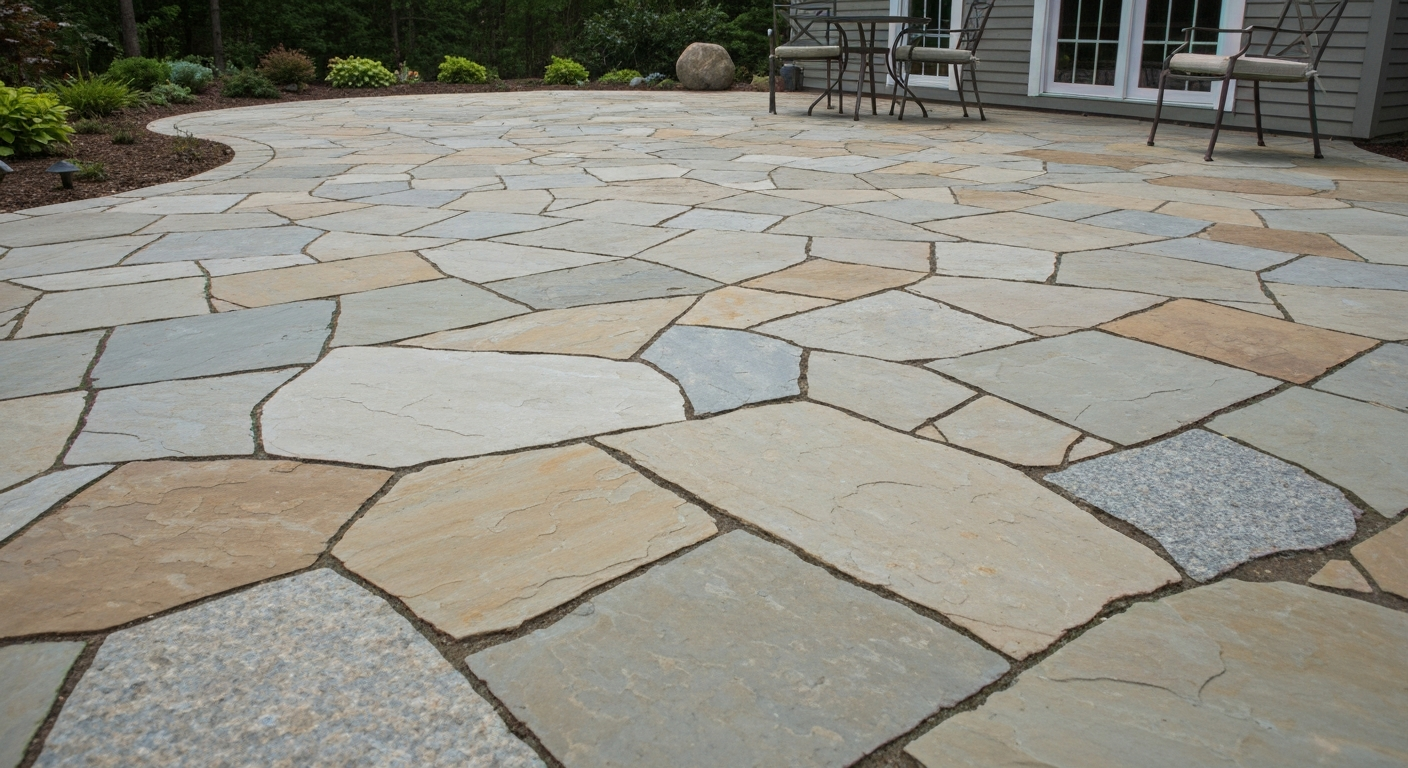
Flagstone is a broad commercial term for any flat-split stone used in paving, which can include sandstone, quartzite, slate, limestone, or travertine depending on the region and supplier. That variability is exactly the challenge: the same flagstone label covers stones with water absorption rates that differ by an order of magnitude. Dense slate or quartzite flagstone may barely need sealing, while softer sandstone flags can soak up a quart of sealer like a sponge. Always test porosity before applying any product. For more specific flagstone guidance, the flagstone patio sealer and best sealant for flagstone patio topics in this series go deeper on stone-specific flagstone selections. For detailed recommendations on the best sealant for flagstone patio, see the dedicated flagstone sealer guide in this series. See our flagstone patio sealer reviews for side-by-side product comparisons and real-world test results. See the dedicated best flagstone patio sealer guide for detailed product comparisons, porosity-specific recommendations, and test results.
| Stone Type | Typical Porosity | Freeze-Thaw Risk | Stain Risk | Key Sealer Priority |
|---|---|---|---|---|
| Sandstone (flagstone) | High (10-20%+) | High | High | Breathable penetrating impregnator; enhancing if you want richer color |
| Limestone | Medium-High (varies) | Medium-High | High (acid-sensitive) | Penetrating, breathable; avoid acid-based cleaners |
| Quartzite / slate flagstone | Low-Medium | Low | Medium | Penetrating impregnator; minimal product needed |
| Travertine | High (filled or unfilled) | Medium | High | Penetrating; fill open cells first if unfilled |
| Granite | Very low | Very low | Low-Medium | Light penetrating sealer; mainly for oil stain resistance |
| Mixed / multi-stone | Variable | Variable | Variable | Test each stone individually; use a product rated for most porous type |
Sandstone
Sandstone is one of the most porous natural stones you'll pave with, which makes sealing genuinely important rather than optional. See our sandstone patio sealer reviews for product comparisons and real-world performance on porous sandstones. Its grain structure absorbs oil, tannins from leaves, and water readily. The good news is that penetrating sealers sink in deeply and bond well with silicate-rich sandstone. The risk is over-application: pour on too much of a solvent-based product and you can trap residue on the surface, leaving a white haze that's hard to remove. For sandstone specifically, a water-based penetrating sealer applied in two thin coats with excess wiped off after each one is the safest approach. The best sandstone patio sealer topic in this silo goes into further product-level detail.
Limestone
Limestone is calcium-carbonate based, which means it reacts with acids, including wine, citrus juice, and most cleaning products not labeled as pH-neutral. Unsealed limestone stains quickly and can etch on contact with acidic liquids. Porosity varies a lot: a dense Jura limestone behaves very differently from a soft buff limestone. Because moisture can move through limestone, a breathable penetrating sealer is critical; a film-forming topical sealer over damp limestone can trap moisture and trigger spalling in cold weather. The best sealer for limestone patio topic in this series addresses this stone in full.
Mixed natural-stone patios
Mixed patios, where you've combined different stone types or sourced slabs from multiple suppliers, present the biggest sealing challenge. Each stone has a different absorption rate, so uniform application produces uneven results. My recommendation: do a water-drop test on at least three spots per stone type before you buy, note the absorption time, and choose a product rated for your most porous stone. Apply to a small test patch on each stone type and let it cure fully before committing to the whole patio.
Sealer types explained: penetrating vs topical, water- vs solvent-based
There are two fundamental categories: penetrating (impregnating) sealers that work inside the stone's pores, and topical (film-forming) sealers that coat the surface. Within each category, the carrier, water or solvent, affects VOC content, cure time, depth of penetration, and safety handling requirements. These distinctions matter more than any brand name.
Penetrating / impregnating sealers
Penetrating sealers use silane, siloxane, fluoropolymer, or silicone chemistry to line the pores of the stone from the inside, repelling water and oil without forming a visible surface film. Because they don't sit on top, they can't peel, and they have minimal effect on the stone's natural appearance or texture. Miracle Sealants 511 Impregnator is a widely available example: it has about 6.4% solids by volume, penetrates deeply, and can theoretically cover up to 4,000 sq ft per gallon on very smooth, low-porosity stone, though real-world coverage on porous sandstone will be far less. Aqua Mix Sealer's Choice Gold is water-based with 73 g/L VOC, offers a natural look, and is ready for light foot traffic in 2 hours. Dry-Treat Stain-Proof Original takes a different approach: it uses a 50% active-content alcohol-carrier formula that bonds covalently with the stone's pores rather than just coating them, which is why the manufacturer claims it lasts much longer and resists even the toughest freeze-thaw/salt conditions.
Topical / film-forming sealers
Topical sealers sit on top of the stone and form a physical barrier, think acrylic, polyurethane, or epoxy coatings. They're the ones that produce a high-gloss or wet-look appearance. They offer good stain resistance at the surface but they can trap moisture if the stone isn't fully dry before application, and they will eventually peel or flake as the film ages. Foundation Armor AR350 is a solvent-based acrylic topical with about 25% solids that produces a wet-look finish. Importantly, Foundation Armor's own technical data explicitly states the AR350 is NOT recommended for flagstone, slate, or natural stone, they direct natural stone users toward the WL550 or SX5000 instead. That kind of manufacturer honesty is worth paying attention to.
Water-based vs solvent-based: a clear comparison
| Attribute | Water-Based | Solvent-Based |
|---|---|---|
| VOC content | Low (e.g., 73 g/L for Aqua Mix SCG) | High (e.g., ~741 g/L for Miracle 511) |
| Penetration depth | Good on porous stone; reduced on dense stone | Deeper penetration on dense stone |
| Dry time | Fast (2-4 hours to foot traffic) | Slower (1-3 hours touch dry, 72 hours full cure) |
| Safety / handling | Low odor, minimal PPE beyond gloves | Requires ventilation, respirator, combustibility precautions |
| Appearance change | Minimal to none on most stones | Can darken stone slightly (enhancing effect) |
| Freeze-thaw suitability | Good if breathable formula | Excellent for high-solids silane/siloxane types |
| Shelf life after opening | Shorter (water evaporation) | Generally longer |
| Typical recoat interval | 2-5 years (product-dependent) | 5-15+ years for premium silane types |
Breathability, finish and appearance: matte, satin and wet-look options
Breathability is the single most misunderstood concept in stone sealing. A breathable sealer allows moisture vapor (water as gas) to pass through the stone from below, which is critical if your patio is laid on a substrate that holds moisture, which most outdoor patios are. A non-breathable topical sealer over a porous stone that sits on a wet mortar bed is a recipe for trapped moisture, efflorescence, and eventual spalling in cold climates. ASTM E96 is the standard test for water vapor transmission/permeance; look for products that publish their permeance data rather than just claiming to be 'breathable.'
Appearance is measured in gloss units (GU) using ASTM D523, typically at a 60-degree geometry. As a practical guide: a matte or natural finish sits around 0-10 GU at 60 degrees, satin lands in roughly the 20-35 GU range, semi-gloss runs 35-70 GU, and a high-gloss or wet-look finish exceeds 70 GU. Most penetrating sealers add essentially zero GU to the stone's natural reading. Enhancing penetrating sealers (like Foundation Armor WL550) add some depth and color richness without forming a film, landing in the low-satin range. True wet-look comes from film-forming topical sealers with higher GU readings.
- Natural/matte (0-10 GU): Aqua Mix Sealer's Choice Gold, Miracle Sealants 511 Impregnator, Dry-Treat Stain-Proof Original. Stone looks exactly as it does dry.
- Satin/enhancing (20-35 GU): Foundation Armor WL550, some silicone-based enhancers. Stone appears slightly deeper and richer in color without a glossy film.
- Wet-look/high-gloss (70+ GU): Film-forming acrylics and polyurethanes (e.g., AR350 on compatible surfaces). Strong visual change; not recommended for most natural stone.
- Wet-look without film: Certain penetrating enhancers on very porous stone can produce a near-wet-look effect without a topcoat film — test patch is essential before full application.
Durability, slip resistance and wear: what to expect by sealer type
Durability claims from manufacturers vary wildly and often reflect ideal lab conditions rather than a real patio in a temperate climate with foot traffic, furniture dragging, and leaf staining. Independent field data from NCHRP and state DOT research shows that penetrating silane sealers can perform well for 10-12-plus years before failure rates increase, but time-dependence matters: a sealer that tests well at year 2 may degrade significantly by year 8, especially in UV-intense or coastal environments. Foundation Armor WL550 cites a 3-5 year service life in typical conditions, which is honest and consistent with field experience for a mid-tier penetrating enhancer. Budget water-based penetrating sealers generally need recoating every 2-3 years. Premium Dry-Treat products, with their covalent bonding mechanism and 50% active content, credibly support longer intervals, though the higher upfront cost reflects that.
Slip resistance: a real concern with topical sealers
Penetrating sealers have minimal effect on slip resistance because they don't change the surface texture, your stone's natural grip remains intact. Film-forming topical sealers are a different story. A glossy acrylic topcoat on wet stone can reduce the wet dynamic coefficient of friction (DCOF) below the commonly cited safety threshold of 0.42 (per ANSI A137.1). If you're using a topical sealer on a patio that gets wet, you either need to choose a product with a built-in anti-slip aggregate or apply a separate anti-slip treatment afterward. Products like SlipDoctors Deck Grip report a wet DCOF of approximately 0.52 when tested to ANSI B101.3, which clears the safety threshold with some margin. Static COF measurements are a poor proxy for real-world slip risk; look for wet DCOF or pendulum test values (PTV) where available, with PTV 35-plus being the industry target for pedestrian surfaces.
Wear expectations by category
| Sealer Category | Typical Lifespan | Recoat Frequency | Slip Risk | Peeling Risk |
|---|---|---|---|---|
| Water-based penetrating (e.g., Aqua Mix SCG) | 3-5 years | Every 2-4 years | None (preserves texture) | None (no film) |
| Solvent-based penetrating (e.g., Miracle 511) | 5-10 years | Every 3-7 years | None to minimal | None (no film) |
| High-solids silane (e.g., Dry-Treat) | 10-15+ years | Every 10+ years | None | None (no film) |
| Penetrating enhancer (e.g., WL550) | 3-5 years | Every 3-5 years | Minimal | Very low (thin film) |
| Topical acrylic (wet-look) | 2-4 years | Every 1-3 years | HIGH if wet (add non-slip) | Moderate to high |
VOCs, safety and environmental considerations
VOC content is one of the most practically important variables to check before you buy, especially if you're applying in a hot climate (where solvents off-gas faster), near children or pets, or in a state with strict air quality regulations. Aqua Mix Sealer's Choice Gold comes in at 73 g/L, which is genuinely low and suitable for application in occupied areas with basic ventilation. Dry-Treat Stain-Proof Original uses an alcohol carrier and is listed as VOC compliant in containers of 1 liter or less. Miracle Sealants 511 Impregnator, by contrast, clocks in at approximately 741 g/L according to its November 2025 safety data sheet, that's a high-VOC solvent-based product. The SDS lists petroleum distillates, combustibility warnings, an aspiration hazard, and requirements for skin and eye protection plus cross-ventilation. This doesn't make it a bad sealer, but it means you should not apply it on a warm enclosed patio, store it near ignition sources, or use it without proper PPE.
- Always read the SDS before opening a container, not after — PPE and ventilation requirements vary significantly between products.
- Solvent-based sealers should never be applied in temperatures above 90°F (32°C); off-gassing and combustibility risk both increase sharply.
- Dispose of solvent-soaked rags in a sealed metal container — spontaneous combustion is a real hazard with petroleum-distillate products.
- Water-based sealers can typically be cleaned up with water while wet; solvent-based sealers require mineral spirits or specific cleaners for tool cleanup.
- Many municipalities classify solvent-based sealers as hazardous waste; check local disposal rules before pouring excess down a drain.
- If applying near a pond, garden beds, or storm drain, use a water-based or low-VOC formulation and avoid overspray.
Climate performance: freeze-thaw, UV, coastal/salt and humidity
Climate is the variable that separates a good sealer choice from a failed one. The same product that performs well in Southern California can fail badly on a New England patio after two winters. Here's how to think through your specific climate.
Freeze-thaw climates
Water expands by about 9% when it freezes. Any sealer that traps moisture inside a porous stone rather than letting it escape will accelerate freeze-thaw damage rather than prevent it. blank" rel="noopener noreferrer">Iowa State University InTrans research (2022) confirmed that while penetrating silane/siloxane sealers substantially reduce short-term water absorption, a sealer that blocks pores without being vapor-permeable can actually worsen freeze-thaw performance for some substrates by slowing desorption. The lesson is simple: for freeze-thaw climates, choose a penetrating sealer with documented water vapor transmission (breathability), and avoid any topical film-forming sealer unless the stone is completely dry year-round. For particularly soft or friable stone in harsh freeze-thaw or salt-spray environments, Dry-Treat specifically recommends their 40SK consolidator applied before Stain-Proof Original to strengthen the stone structure first.
UV and hot/dry climates
Topical sealers, particularly acrylic types, degrade faster under UV exposure. ASTM G154 is the standard accelerated UV weathering test, and products that publish G154 data give you a meaningful comparison point. In hot, sun-exposed climates, penetrating sealers hold up much better because there's no surface film to oxidize, yellow, or chalk. If you're in the Southwest US, Australia, or Southern Europe, prioritize a penetrating product and expect to recoat on the shorter end of the manufacturer's interval.
Coastal and salt environments
Salt is a dual threat: it draws moisture into porous stone through osmotic pressure, and it crystallizes inside pores as it dries, generating internal stress that can fracture stone from the inside out. This is called subflorescence. NCHRP and DOT field work consistently shows that high-solids silane/siloxane sealers (with documented chloride ingress resistance) are the best choice for coastal patios. Dry-Treat Stain-Proof Original explicitly claims protection against efflorescence and salt damage, and the company's technical guidance for salt environments recommends the consolidator primer for soft stones. If you're within half a mile of the ocean, or in an area where road salt drains onto your patio, this is the product category to invest in.
High humidity and wet climates
In humid climates, think the Pacific Northwest, Southeast US, or tropical regions, the main risks are moss/algae growth, efflorescence from constant moisture movement, and incomplete drying before reapplication. A water-based penetrating sealer with a biocide additive (or a surface cleaned with a biocide before sealing) performs well here. Breathability is again critical: stone that never fully dries needs a sealer that lets vapor out, not one that locks it in.
Climate-sealer match at a glance
| Climate Type | Recommended Sealer Type | Key Properties to Confirm | Products to Consider |
|---|---|---|---|
| Freeze-thaw (cold winters) | Breathable penetrating silane/siloxane | High vapor permeance; no film formation | Dry-Treat Stain-Proof Original, Aqua Mix SCG |
| Hot/UV-intense (desert, Mediterranean) | Penetrating impregnator | UV-stable chemistry; published G154 data ideal | Aqua Mix SCG, Miracle 511 |
| Coastal / salt spray | High-solids penetrating silane/siloxane | Chloride ingress resistance; high active-content | Dry-Treat Stain-Proof Original + 40SK consolidator |
| High humidity / wet climates | Breathable penetrating; biocide if available | Vapor transmission; moisture-tolerant cure window | Aqua Mix SCG, Dry-Treat |
| Mild / temperate climates | Any breathable penetrating impregnator | Porosity of stone is main driver here | Miracle 511, Aqua Mix SCG, WL550 (enhancing) |
Product category recommendations
I'm not going to pick a single 'best' product for every situation, because no such product exists. Instead, here are honest category-level recommendations based on stone type, budget, and goal, using published technical data rather than marketing copy.
| Category | Top Pick | Why | Approx. VOC | Recoat Interval |
|---|---|---|---|---|
| Best overall (most stone types) | Aqua Mix Sealer's Choice Gold | Water-based, low VOC (73 g/L), natural look, 2-hour return to service, well-documented TDS | 73 g/L | Every 3-5 years |
| Best for freeze-thaw / coastal | Dry-Treat Stain-Proof Original | 50% active content, covalent bonding, explicitly protects against efflorescence and salt; pair with 40SK for soft stone | Compliant (≤1L) | Every 10-15+ years |
| Best for flagstone (mixed types) | Aqua Mix SCG or Dry-Treat (by porosity) | Test each stone; use breathable penetrating product rated for most porous type | 73 g/L (SCG) | Varies |
| Best for sandstone | Aqua Mix SCG (water-based) or Dry-Treat | Porous substrate benefits from deep penetration; avoid over-application of solvent types | 73 g/L (SCG) | 3-5 years |
| Best for limestone | Aqua Mix SCG or Dry-Treat | Breathability critical; pH-neutral cleaner mandatory; penetrating protects from acid staining | 73 g/L (SCG) | 3-5 years |
| Best penetrating enhancer (satin look) | Foundation Armor WL550 | Solvent-based, breathable, non-film-forming, enhances color; manufacturer-cited 3-5yr life | <350 g/L | 3-5 years |
| Budget option | Miracle Sealants 511 Impregnator | Widely available, deep penetration, up to 4,000 ft²/gal on smooth stone; note: high VOC (~741 g/L) | ~741 g/L | 3-7 years |
| Wet-look (compatible surfaces only) | Foundation Armor AR350 (NOT for natural stone) | Manufacturer explicitly advises against use on flagstone, slate, natural stone — use WL550 instead | N/A for stone | N/A |
Surface prep and application: step by step
I've seen more sealer failures caused by poor prep than by wrong product choice. A sealer applied over a dirty, damp, or previously-sealed surface will not bond correctly. Set aside as much time for prep as you do for application.
Step 1: Clean the stone thoroughly
Remove all dirt, organic growth (moss, algae), old sealer residue, and efflorescence before you seal anything. Use a pH-neutral stone cleaner for routine dirt. For efflorescence (white salt deposits), use an efflorescence remover specifically formulated for your stone type, do not use acidic products on limestone. For old sealer residue, you'll need a chemical stripper rated for the sealer type you're removing. Power washing at moderate pressure (800-1,200 PSI) can help, but high pressure can damage soft sandstone and open joints.
Step 2: Allow the stone to dry completely
This is the most commonly skipped step. Most sealers require the stone to be dry before application, and 'dry' means more than surface-dry. For thick or porous stone, 24-48 hours of dry weather after cleaning is a minimum. In humid climates, 72 hours is safer. If you're sealing freshly laid stone over a mortar bed, wait at least 28 days for the mortar to cure fully. Applying a sealer over a damp mortar bed traps alkalis that cause efflorescence and can compromise the sealer's bond.
Step 3: Do a test patch
Always test a small, inconspicuous area first, ideally a 2-square-foot patch in a corner. Apply the sealer as directed, let it cure fully, and check for color change, haziness, or unexpected sheen. I've had clients who skipped this step and ended up with a white residue haze across an entire patio because their 'low-porosity' limestone turned out to be significantly more absorbent than expected. A test patch costs you 15 minutes; re-treating a whole patio costs you days and a lot of money.
Step 4: Apply the sealer correctly
For penetrating sealers on porous stone, apply generously with a pump sprayer, lambswool applicator, or soft brush. Allow the first coat to absorb (Dry-Treat recommends a 10-minute dwell between coats), then apply a second coat while the first is still slightly tacky. The key rule for all penetrating sealers: wipe off any excess that hasn't absorbed within the manufacturer's specified time window. Excess sealer sitting on the surface is the primary cause of white haze, sticky residue, and uneven appearance. For Foundation Armor WL550, a single coat is typically recommended; for Aqua Mix SCG on highly porous stone, two coats are standard. Never apply in direct hot sun or when rain is expected within 4-6 hours.
Step 5: Allow full cure before use
Dry-to-touch and ready-to-seal are not the same as fully cured. Aqua Mix SCG allows light foot traffic at 2 hours and reaches full cure at 24 hours. Miracle 511 is touch-dry in 1-3 hours but takes 72 hours to fully cure. During the cure window, keep foot traffic off the surface and protect it from rain. Moving furniture back too early can leave impressions in a partially cured topical sealer and can re-contaminate the surface of a partially cured penetrating sealer.
Coverage rates, quantity planning and where to buy
Coverage rates on product labels are almost always stated for smooth, low-porosity substrates. On real porous stone, expect to use significantly more product. Aqua Mix SCG lists 300-1,500 sq ft per gallon; on a thirsty buff sandstone, 300 is the realistic end of that range. Miracle Sealants 511 lists up to 4,000 sq ft per gallon, which is only achievable on very smooth, dense surfaces. Dry-Treat Stain-Proof Original runs approximately 1 liter per 20-250 sq ft depending on absorption, that's an enormous range and reflects the reality that stone porosity drives everything.
To estimate quantity: measure your patio area in square feet, do a water-drop absorption test on 5-6 spots and note average absorption time, then use the lower end of the manufacturer's coverage range if absorption is under 30 seconds, and the mid-range if absorption is 1-3 minutes. Always buy 10-15% extra for waste and touch-ups. Aqua Mix, Miracle Sealants, and Foundation Armor products are available at tile supply houses, big-box home improvement stores (Home Depot, Lowe's), and direct from the brands online. Dry-Treat is more often sold through specialty tile and stone suppliers or directly through their website, and it typically costs significantly more per liter than mainstream options.
Maintenance schedules and recoat timing
The water-drop test is your best maintenance diagnostic tool. Drip a few drops of water on a sealed surface: if they bead and roll off, the sealer is still active. If they soak in within a minute or two, protection has diminished and recoating is due. For high-use patios, check this annually. For lightly trafficked patios, every two years is sufficient. Most water-based penetrating sealers on porous sandstone or limestone need a full recoat every 2-4 years. Premium silane products like Dry-Treat in mild climates may go 10 years or more without needing attention, though annual cleaning still matters.
- Clean annually with a pH-neutral stone cleaner; avoid bleach or acid-based products on calcium-carbonate stones.
- Inspect annually for efflorescence (white deposits), which may indicate moisture movement through the stone — address the moisture source before re-sealing.
- Check grout and joints annually; deteriorating joints allow water infiltration that bypasses the sealer.
- Before recoating, clean thoroughly and ensure the old sealer is compatible with the new product; applying a water-based sealer over a silicone-based one can cause adhesion failure.
- For topical sealers, strip and recoat rather than layering new product over chalked or peeling old sealer.
- In high-UV or hot climates, check the surface at 18 months rather than waiting 3 years.
Troubleshooting: staining, peeling, haze and efflorescence
White haze or milky residue after sealing
This is almost always caused by excess sealer that wasn't wiped off and has dried on the surface. On solvent-based products, try buffing with a clean dry cloth while the residue is still within the reactivation window. After full cure, you may need a sealer residue remover or mineral spirits (for solvent-based products) applied carefully and wiped off. On water-based products, a light re-wet with the same sealer can sometimes reactivate the residue enough to buff it away. Prevention is far easier than cure: wipe excess every 10-15 minutes during application.
Peeling or flaking
Peeling happens with topical sealers, not penetrating ones. Causes include applying over a damp surface, incompatible underlying sealer, or natural stone that has too much moisture vapor moving through it (common with limestone over concrete). Strip the old sealer completely using an appropriate stripper, address any moisture source, allow full drying, and switch to a breathable penetrating sealer rather than another topical product.
Efflorescence (white salt deposits)
Efflorescence after sealing means that moisture is still moving through the stone, carrying soluble salts to the surface. This is a substrate and moisture management problem, not a sealer failure per se. Remove the deposits with an efflorescence remover, dry the area thoroughly, identify and address the moisture source (drainage, subgrade moisture, mortar mix issues), and then apply a breathable penetrating sealer. A non-breathable sealer will make this worse by trapping the salts inside.
Oil or organic stains through the sealer
If stains are penetrating a recently applied sealer, the sealer has either failed, wasn't applied adequately, or wasn't the right product for the stain type. Most penetrating sealers are water-repellent but not all are oil-repellent, look for a product labeled as both hydrophobic and oleophobic (like fluoropolymer-based formulations). Treat existing stains with a poultice before re-sealing, then apply an oil-and-water resistant penetrating impregnator.
How to evaluate sealer claims: a transparent methodology
Sealer marketing is full of inflated claims, and it can be hard to know what to trust. Recent peer‑reviewed work (Scientific Reports (2026), consolidation & surface protection studies using contact angle and EN/AST55 absorption methods) shows that combining contact‑angle (hydrophobicity) measurements with capillary water absorption (EN/AST55) tests improves prediction of early water uptake and stain resistance on natural stone Scientific Reports (2026) — consolidation & surface protection studies using contact angle and EN/AST55 absorption methods. Here's the framework I use to assess whether a product is worth recommending.
- Check for a published Technical Data Sheet (TDS). A credible product will have a TDS with specific numbers: solids content, VOC, coverage rates (with a range and substrate note), dry time, cure time, and temperature application window. Vague marketing copy without a TDS is a red flag.
- Find the Safety Data Sheet (SDS). This tells you VOC content, hazardous ingredients, and handling requirements. It also tells you if the product contains the chemistry it claims — a 'penetrating silane' sealer with no silane or siloxane in the ingredient list isn't what it says.
- Look for lab or third-party test data. Contact angle and capillary absorption tests (per ASTM C97 or EN standard equivalents) are reliable indicators of how a penetrating sealer will perform. Peer-reviewed conservation literature confirms these two measurements together have good predictive power for long-term water resistance and stain protection on natural stone.
- Do your own test patch. Lab data is generated under controlled conditions; your sandstone patio in a specific microclimate is not a lab. A test patch is your field validation.
- Apply the manufacturer's coverage range honestly. If a product claims 4,000 sq ft per gallon and your porous stone is drinking up product, you're not in the 4,000 sq ft scenario. Use the realistic low end for planning.
- Treat extraordinary durability claims with skepticism. A product claiming 25-year protection without any independent verification in field conditions is making a marketing claim, not a technical one. Look for products that acknowledge variability by substrate and exposure rather than offering blanket lifetime guarantees.
Final recommendations by stone type
To tie everything together: for sandstone and highly porous flagstone, use a breathable penetrating impregnator applied in two thin coats with excess wiped off religiously. Aqua Mix SCG is the safest all-around choice at low VOC and proven performance. For limestone, the same principle applies with an even stronger emphasis on breathability and pH-neutral maintenance. For mixed natural stone patios, test each stone type individually and use the product appropriate to your most porous stone. For freeze-thaw and coastal climates, Dry-Treat Stain-Proof Original with the 40SK consolidator on soft stones is the most defensible choice based on available technical and field data, even at the higher price point. For anyone wanting an enhanced/enriched appearance without a film, Foundation Armor WL550 is a legitimate option, just confirm it's compatible with your specific stone and be ready to recoat every 3-5 years. And regardless of what you buy, the test patch, the dry stone, and the wiped-off excess are non-negotiables.
FAQ
What are the main types of natural‑stone patio sealers and how do they differ?
Two broad categories: penetrating (impregnating) and topical (film‑forming). Penetrating sealers (silane/siloxane, siliconates, fluoropolymers, some water‑based impregnators) soak into pores, preserve texture, maintain breathability, and primarily provide water repellency and stain resistance with minimal sheen change. Topical sealers (acrylics, polyurethanes, epoxies) form a surface film, change appearance (matte to wet‑look), can add gloss and easier cleanability, but may reduce slip resistance and water‑vapor transmission. Within both categories there are solvent‑ and water‑based chemistries; solvent versions often penetrate faster and darken stone more, but have higher VOCs and flammability concerns.
Which sealer properties matter most for natural‑stone patios?
Priorities: breathability (water‑vapor transmission to avoid trapped moisture/efflorescence), hydrophobic performance (contact angle/capillary absorption reduction), durability (abrasion/UV/freeze–thaw resistance), appearance change (matte to wet‑look), slip resistance (especially when wet), VOCs and safety, and climate performance (freeze–thaw, UV, coastal/salt). Choose the balance that fits stone type, exposure and aesthetic goals.
How do I pick between penetrating vs topical for flagstone, sandstone, limestone or mixed patios?
Flagstone: usually benefits from penetrating breathable sealers to retain texture; avoid high‑film wet‑look topicals unless you want dramatically darkened stone and accept potential slip issues. Sandstone: often porous and benefits from stronger impregnators (silane/siloxane or higher‑content products) and consolidators for friable stone; topical films can cause peeling if substrate moves. Limestone: sensitive to film trapping salts—prefer breathable penetrating sealers; consolidators recommended for soft, weathered limestone. Mixed patios: use the most conservative approach required by the softest/most porous stone (typically breathable penetrating sealer or a two‑product approach: consolidator then breathable impregnator).
What product categories and specific products are recommended by use case?
Best overall (breathable penetrating): silane/siloxane impregnator with proven lab/field data (e.g., high‑silane formulations). Best for flagstone: breathable penetrating impregnator (water‑ or low‑solvent) designed for natural stone. Best for sandstone: impregnator plus consolidator for very soft stones (Dry‑Treat Stain‑Proof Original is an example; use Dry‑Treat 40SK consolidator for very soft/salt‑exposed stones). Best for limestone: breathable water‑based impregnator (Aqua Mix Sealer’s Choice Gold is a common option). Breathable options: products labeled ‘impregnator’ or ‘breathable penetrating sealer’ (Miracle Sealants 511 is an impregnator example but note high solvent/VOC). Budget: basic water‑based penetrating sealers with good reviews and test patching. Wet‑look: topical acrylic wet‑look products (Foundation Armor AR350 family or equivalent), but many manufacturers advise against using wet‑look on some natural stones—use with caution. (These examples illustrate category types; always compare TDS, VOCs, coverage and breathability claims and run test patches.)
How does climate affect sealer choice (freeze–thaw, UV, coastal/salt)?
Freeze–thaw: avoid pore‑blocking non‑breathable films on stones prone to moisture ingress and freeze cycles; choose breathable impregnators and consolidators for soft stone in freeze–thaw zones. UV: acrylic/topical films degrade and yellow faster in strong UV; select UV‑resistant formulations or recoat schedules. Coastal/salt: solvent‑based silane/siloxane impregnators and consolidants formulated for salt exposure perform better; follow manufacturer guidance (e.g., consolidators for salt‑exposed soft stones). For mixed exposure, favor high‑quality penetrating sealers proven in DOT/field studies for long‑term water repellency.
What is the decision checklist homeowners should use before buying a sealer?
Checklist: identify stone type(s) and porosity; check for existing coatings or contamination (efflorescence, salts, oils); decide desired appearance (matte vs wet‑look); confirm required breathability; check climate exposure (freeze–thaw, salt, UV); evaluate slip risk (walkways, around pools); review VOC/safety limits and ventilation needs; compare manufacturer TDS for coverage, dry/cure times, solids %, and recommended prep; plan for test patch and check recoat/maintenance schedule; choose products with lab/field data or reputable institutional testing when possible.