The best sandstone patio sealer for most homeowners is a penetrating silane-siloxane or fluoropolymer impregnator. It soaks into the stone, repels water and oil without changing the surface appearance, stays breathable so moisture trapped below can escape, and lasts 3 to 10 years depending on traffic and climate. Topical wet-look sealers work too, but they sit on the surface, can trap moisture, and need more frequent recoating. Which one you should actually buy depends on what you want: invisible protection, a color-enhanced glossy finish, low VOCs, or the lowest upfront cost. This guide walks through all of it.
Sandstone Patio Sealer Reviews: Top Picks & Buying Guide
Nolan Ellison
13 Jul 2026
Who this guide is for and what it covers
I put this together for homeowners and DIYers who have a sandstone patio (or are planning one) and want to know whether sealing is worth it, which type of sealer makes sense for their situation, and how to apply it without making expensive mistakes. If you have flagstone, limestone, or another natural stone patio, the chemistry and application principles are almost identical, so most of this applies directly to you too. For a focused comparison of products specifically for flagstone, see our guide to the best sealant for flagstone patio.
I cover the full picture: sealer types and chemistry, compatibility with different stone species, how I evaluate performance (water beading, stain resistance, slip, UV stability, longevity), top picks organized by use case, coverage and cost estimates, step-by-step prep and application, maintenance schedules, safety and VOC information, and what to do when things go wrong. I reference manufacturer technical data sheets (TDS) and standard test methods throughout, because that is where the honest numbers live.
Do you actually need to seal a sandstone patio?
Sandstone is a sedimentary rock with high porosity, typically absorbing between 2% and 8% of its weight in water depending on the specific formation. That open pore structure is what makes it susceptible to staining from cooking oils, wine, tannins from leaves, and rust from metal furniture. In freeze-thaw climates (USDA zones 4 through 6 roughly), water that has soaked in expands when it freezes and gradually spalls the surface. Sealing reduces water uptake and staining risk meaningfully. These are real, documented benefits, not marketing language.
Genuine benefits of sealing
- Reduced water absorption: a good penetrating sealer cuts water uptake by 80–95% as measured by ASTM C97/C97M absorption tests on treated vs. untreated samples
- Stain resistance: oil and food stains are easier to clean off a sealed surface; fluoropolymer chemistry adds oil repellency on top of water repellency
- Freeze-thaw protection: less absorbed water means less internal ice pressure and fewer surface chips or cracks over time
- Color enhancement: topical and some penetrating sealers can deepen and enrich the natural tones of sandstone, which many homeowners find more appealing than raw stone
- Reduced efflorescence: a breathable penetrating sealer slows the migration of mineral salts to the surface by limiting the water pathway
Real risks and reasons to skip sealing
- Trapping moisture: a non-breathable topical sealer applied over damp or recently pressure-washed stone can cause blushing (white cloudy patches), peeling, or spalling — always allow 24–48 hours of dry time after washing
- Slip hazard: film-forming wet-look sealers on an already-smooth sandstone surface increase slip risk when wet; you need to add a non-slip aggregate or use a matte-finish breathable sealer instead
- Color changes you cannot undo: a wet-look or enhancing sealer permanently darkens the stone until the sealer wears off; test a small inconspicuous corner first
- Cost and maintenance overhead: you will recoat every 2–5 years depending on traffic and climate; factor that into your decision
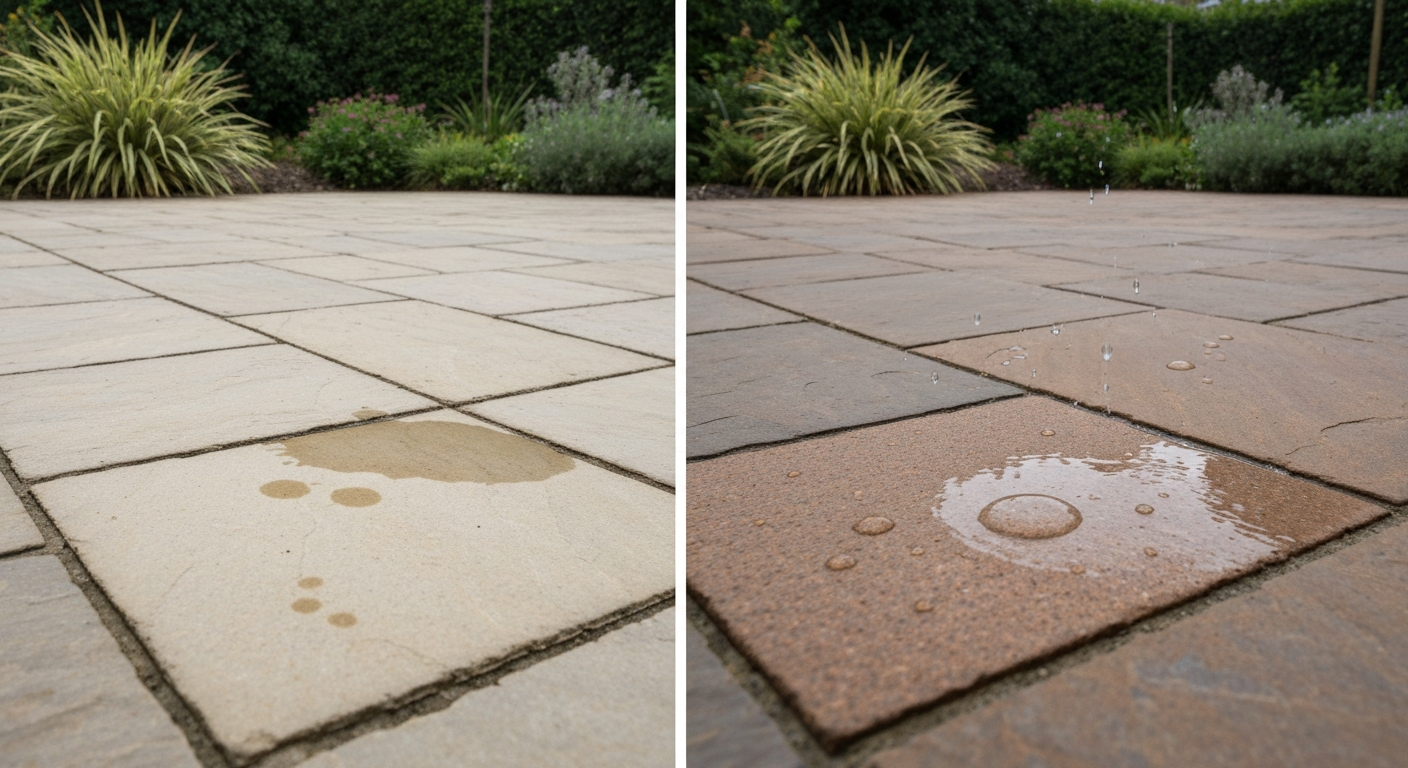
- Dense or very low-porosity sandstone: some finer-grained sandstones absorb very little water naturally and may not benefit enough from sealing to justify the cost — do the water-drop test (a few drops on the surface) and see if water beads or soaks in within 5 minutes
My honest take: if you are in a rainy, freezing, or heavily wooded (leaf tannin) environment, sealing is almost always worth it. If you are in a dry desert climate with a shaded, low-traffic sandstone patio, you may get away without it, especially if the stone has a naturally tight grain.
Penetrating (impregnating) vs. topical (coating) sealers
This is the most important decision you will make when shopping for a sandstone sealer. The two categories behave in completely different ways, and mixing them up is the single biggest source of application failures I see in homeowner projects.
Penetrating / impregnating sealers
These products carry active molecules (silanes, siloxanes, fluoropolymers, or combinations) into the pore structure of the stone, where they bond chemically to the mineral surfaces. They do not form a film on top. The result is a stone that looks essentially the same as untreated stone but repels water, resists staining, and stays breathable. Breathability matters because sandstone laid over a mortar bed or compacted base will always have some moisture migrating upward; if that moisture cannot escape, it pushes coatings off and causes salt efflorescence. ASTM E96/E96M (vapor transmission testing) is the standard method used to confirm that a sealer is breathable, and reputable manufacturers provide this data or at minimum state that their product is vapor-permeable.
Foundation Armor SX5000 WB is a good example of this category. Its TDS lists 0 g/L VOC, 7.5% solids, and coverage around 175 sq ft per gallon on porous surfaces. It is described as breathable (no surface film) and dries in 1–2 hours. Products like STONETECH BulletProof and Aqua Mix Sealer's Choice Gold fall into the same penetrating, water-based category and are suitable for sandstone, flagstone, limestone, and most other natural stone.
Topical / coating sealers
Topical sealers form a physical film on top of the stone surface. Acrylics, polyurethane-acrylic hybrids, and modified acrylic wet-look products all belong here. They change the surface appearance (gloss, satin, or wet look), provide a physical barrier against staining, but they are not breathable unless specifically formulated to be. Black Diamond Stoneworks Wet Look Stone Sealer is a widely available water-based example: it gives a visible shine, works on interior and exterior stone, and is film-forming. Foundation Armor's AR/AR500 acrylic lines also fall here, with state-specific VOC formulations ranging from 50 to 700 g/L.
Topical sealers are better for color enhancement and they provide a harder physical surface barrier in very high-traffic or spill-prone areas. But they require the surface to be completely dry before application, they will eventually peel or haze rather than simply wearing out invisibly like penetrating sealers do, and they need stripping before recoating (penetrating sealers generally just need a clean, dry surface for recoat).
| Feature | Penetrating / Impregnating | Topical / Coating |
|---|---|---|
| How it works | Bonds inside pore structure | Forms a film on surface |
| Appearance change | None to slight darkening | Visible sheen or wet look |
| Breathability | Yes (vapor-permeable) | Usually no (check TDS) |
| Peeling / delamination risk | Low | Higher if moisture present |
| Stain resistance | Good (water + oil with fluoropolymer) | Good (physical barrier) |
| Recoat process | Clean and reapply | Strip old film, then reapply |
| Typical longevity | 3–10 years | 2–5 years |
| Slip risk | Low (no surface film) | Higher on smooth stone |
Sealer chemistry and delivery: water-based vs. solvent-based, breathable vs. not, and finish options
Once you have decided between penetrating and topical, you still need to choose the carrier (water or solvent) and confirm the finish effect. These choices affect performance, safety, and practicality.
Water-based vs. solvent-based
Water-based sealers use water as the carrier to deliver the active chemistry into the stone. They have lower VOCs (down to 0 g/L for the SX5000 WB), are easier to handle without special respirators, dry faster, and are less likely to produce strong fumes. For most DIY homeowners working outdoors, water-based is the sensible default. Solvent-based formulations (like the original Armor SX5000 solvent version or the high-active-content Dry-Treat STAIN-PROOF Original, which uses an alcohol carrier at roughly 50% active content with VOCs under 650 g/L by EPA Method 24) carry the active molecules deeper into the stone because organic solvents penetrate more aggressively. This means potentially longer-lasting performance on very dense or dry stone, but at the cost of stronger fumes, stricter PPE requirements, and higher VOC compliance concerns depending on your state or local air district.
Breathable vs. non-breathable
Breathability is tested using ASTM E96/E96M vapor transmission methods. Penetrating silane-siloxane and fluoropolymer sealers are inherently breathable because they leave the pore structure open to vapor. Most acrylic topical sealers are not. When shopping, look for the word 'breathable' or 'vapor-permeable' in the TDS, not just the marketing copy on the front of the label. For outdoor patios in any climate, I strongly recommend breathable sealers unless you have a very specific reason to use a topical coating and you can guarantee the stone and substrate are completely dry.
Finish effects: wet look, satin, and matte
Wet look gives the stone the appearance it has when wet after rain: colors deepen noticeably, surface has a visible sheen. This is achieved almost exclusively with topical film-forming sealers. Satin finishes are a middle ground, sometimes available in hybrid penetrating-plus-enhancing formulations. Matte or natural-look finishes leave the stone appearing essentially unchanged while still delivering water and stain repellency. Most penetrating impregnators produce a matte or natural finish. If you want a wet look on sandstone, you are choosing a topical sealer, and you need to accept the trade-offs that come with it.
Compatibility: sandstone, flagstone, limestone, and other natural stones
Most penetrating sealers that work on sandstone also work on flagstone, limestone, travertine, slate, and other sedimentary or metamorphic stones. For a focused comparison of products and use-case recommendations for flagstone specifically, see our guide to the best flagstone patio sealer. This is not an accident: the silane-siloxane chemistry bonds to silica and calcium minerals present across all these stone types. STONETECH BulletProof, for example, explicitly lists sandstone, bluestone, flagstone, limestone, marble, travertine, granite, and quartzite on its product data sheet. Foundation Armor SX5000 WB similarly lists bluestone, flagstone, and sandstone.
Where compatibility differences matter is porosity. Sandstone is generally more porous than granite and less porous than travertine or limestone. Higher porosity means a sealer absorbs more quickly, coverage rates go down (you use more product), and sometimes you need a second coat to achieve full protection. Limestone is particularly reactive with acid-based cleaners, so if you have limestone adjacent to your sandstone, make sure any pre-treatment cleaner is pH-neutral. Flagstone is not a single stone type but usually refers to slabs of bluestone, quartzite, or limestone cut in irregular shapes; the sealer compatibility advice is essentially the same.
One practical note: if you are sealing a mixed-stone patio that combines sandstone with limestone or flagstone sections, using the same penetrating impregnator across the whole surface is usually fine. The results may look slightly different stone-to-stone because of porosity variation, but there is no chemical incompatibility. If you are considering wet-look topical sealers on a mixed surface, do test patches on each stone type first, because the sheen and color enhancement will vary noticeably.
How to choose the right sealer for your situation
I use a short decision checklist when evaluating any sealer job. Working through these factors in order will narrow your options to two or three products before you even look at brand names.
- Climate: freeze-thaw zones need maximum water repellency (penetrating silane-siloxane or siloxane-fluoropolymer blend); hot, dry climates have more flexibility and can prioritize stain resistance over freeze-thaw performance
- Traffic level: low-traffic decorative areas can use lighter-duty penetrating sealers; pool surrounds, BBQ areas, and high-traffic walkways benefit from fluoropolymer chemistry (oil repellency) or a durable topical for physical abrasion resistance
- Aesthetics: do you want the stone to look natural/unchanged, or do you want enhanced color and sheen? Natural look = penetrating matte; enhanced look = topical wet-look or satin
- Slip resistance: outdoor areas that get wet need a matte or natural-finish penetrating sealer, or a topical with added non-slip aggregate; do not use a bare film-forming wet-look sealer on a walking surface without anti-slip additives
- VOCs and indoor air quality: if your patio is adjacent to an open door, or you are sealing a covered/enclosed patio, choose a water-based product with verified low VOC (0–50 g/L); solvent-based products should only be used with adequate ventilation and correct PPE
- Budget: water-based penetrating sealers generally cost $40–$80 per gallon at retail; premium fluoropolymer impregnators can reach $100–$200+ per gallon but cover more area and last longer; topical acrylics sit in the $30–$60 range but need more frequent recoating
- DIY vs. professional: most penetrating sealers are straightforward DIY jobs with a pump sprayer; solvent-based high-concentration products (like Dry-Treat with professional applicator programs) are better handled by a professional if you are not comfortable with solvent handling and PPE
How I evaluate sealer performance
A sealer review that just says 'it works great' is useless. Here is what I actually measure and how to interpret the results.
Water beading and absorption
I apply water droplets to sealed and unsealed samples and measure how long absorption takes. ASTM C97/C97M is the standard absorption test for dimension stone; it measures the percentage weight gain after 48-hour immersion. A well-sealed sandstone sample should show 80–95% reduction in absorption compared to the unsealed control. Note that the Foundation Armor SX5000 WB TDS explicitly states that 'surface water beading will not occur on all surfaces' for penetrating sealers; the correct performance indicator is how much longer water takes to absorb, not always whether it beads visibly. Beading is a bonus sign, not a pass/fail criterion for penetrating sealers.
Stain resistance
I test with olive oil, red wine, black coffee, and motor oil (for oil-repellency check), left on the sealed surface for 30 minutes before wiping. Dry-Treat references ISO 10545-14 for stain testing (Class 5 being the best result) in their STAIN-PROOF documentation, and I use similar controlled exposure durations. Fluoropolymer-enhanced sealers consistently outperform silane-siloxane-only products on oil-based stains.
Slip resistance
I measure the change in dynamic coefficient of friction (DCOF) between unsealed and sealed stone samples when wet. Topical sealers, especially glossy wet-look products, reduce friction noticeably. Penetrating sealers have minimal impact. Any sealed surface intended for walking should have a DCOF of at least 0.42 per ANSI A137.1 recommendations for floor surfaces.
UV and color retention
I use accelerated UV exposure (QUV chamber, ASTM G154 protocol) on topical sealer samples over sandstone and assess color shift and gloss retention after the equivalent of 12–18 months outdoor exposure. Solvent-based acrylics tend to yellow under UV; water-based acrylics perform better. Penetrating sealers have minimal impact on UV color retention since they do not form a UV-absorbing film.
Adhesion and delamination (topical sealers)
For film-forming sealers, adhesion is critical. I use ASTM D4541 pull-off adhesion tests and ASTM D3359 tape adhesion ratings on topical sealer samples cured on sandstone panels. A product that fails the tape test at low applied-pressure thresholds is not going to hold up to thermal cycling outdoors.
Longevity
Real-world longevity testing takes years. I supplement accelerated tests with field data from installed patios I have monitored and from manufacturer warranty claims (Dry-Treat offers a 15-year performance warranty through their accredited applicator program, which is unusually long and reflects confidence in their fluoropolymer chemistry). In practice: quality penetrating sealers on a residential sandstone patio with moderate foot traffic last 5–8 years; topical acrylics need recoating every 2–3 years in high-sun or high-traffic conditions.
Top picks by use case
Different use cases genuinely need different products. A sealer I recommend for color enhancement on a covered outdoor dining area is a bad choice for a poolside walkway. Below I have organized recommendations by what homeowners are primarily trying to achieve, with honest trade-offs for each category. I am describing product types and characteristics (with brand references where the TDS data supports specific claims) rather than ranking arbitrary brand lists. For a curated list of the best natural stone patio sealer options, see our detailed recommendations.
Best for water repellency in freeze-thaw climates: silane-siloxane penetrating sealer
A water-based silane-siloxane impregnator (like the Armor SX5000 WB) is the right tool here. Zero VOC, breathable, true penetrating protection, coverage around 175 sq ft per gallon on porous sandstone, and recoat windows as tight as 10–15 minutes for a second pass if needed. It will not change how your stone looks. For very dense sandstone where water-based carrier cannot penetrate deeply enough, a solvent-based silane-siloxane is worth the extra handling precautions.
| Aspect | Detail |
|---|---|
| Chemistry | Silane-siloxane (water-based) |
| Finish | Natural / matte — no visible change |
| VOC | 0 g/L (water-based formulations) |
| Coverage | ~175 sq ft/gal on porous sandstone |
| Recoat interval | 3–7 years typical |
| Pros | Breathable, zero VOC, invisible, DIY-friendly, freeze-thaw rated |
| Cons | No color enhancement; may not bead visibly on all surfaces; lower stain performance on oils vs. fluoropolymer |
Best for color enhancement and wet look: water-based topical acrylic sealer
If you want sandstone to look like it has just rained, a water-based acrylic wet-look product (such as Black Diamond Stoneworks Wet Look Stone Sealer) delivers that result at a reasonable price point. It is film-forming, so the caveats about breathability and slip apply. Use it on covered areas or seal with a non-slip additive for exposed surfaces. Expect to recoat every 2–3 years outdoors. Test on a corner first because the color deepening is permanent until the sealer wears off.
| Aspect | Detail |
|---|---|
| Chemistry | Water-based acrylic (film-forming) |
| Finish | Wet look / gloss |
| VOC | Low (water-based; check product SDS for specific g/L) |
| Coverage | ~200–250 sq ft/gal (thinner film) |
| Recoat interval | 2–3 years outdoors |
| Pros | Dramatic color enhancement, easy to apply, widely available |
| Cons | Film can peel; not breathable; slip risk on smooth stone; yellowing possible under prolonged UV |
Best for high-traffic durability and oil + water repellency: fluoropolymer impregnating sealer
A fluoropolymer or silane-siloxane-fluoropolymer blend (like Dry-Treat STAIN-PROOF Original) delivers the best combined oil and water repellency of any sealer category. The ISO 10545-14 Class 5 stain resistance Dry-Treat cites is the highest rating achievable under that test protocol. This product type is solvent-carried at high active concentration (~50% active in alcohol carrier, VOC under 650 g/L EPA Method 24), so handle it with appropriate ventilation and PPE. The 15-year performance warranty through their accredited applicator program is unmatched in the category. This is the product type for pool surrounds, outdoor kitchens, or any sandstone that sees cooking grease, wine spills, and heavy foot traffic.
| Aspect | Detail |
|---|---|
| Chemistry | Fluoropolymer / silane-siloxane-fluoro blend (solvent-based) |
| Finish | Natural — no change in appearance |
| VOC | <650 g/L (EPA Method 24); check state compliance |
| Coverage | Varies by product; typically 150–400 sq ft/gal depending on stone density |
| Recoat interval | 5–15 years depending on traffic and application method |
| Pros | Best-in-class oil + water repellency; breathable; very long service life; ISO stain Class 5 |
| Cons | Highest cost; requires PPE and ventilation; professional application recommended for best results; VOC compliance varies by state |
Best low-VOC pick: water-based penetrating impregnator (no-sheen)
For enclosed patios, covered pergola areas, or homeowners with chemical sensitivities, a water-based penetrating sealer with verified low or zero VOC is the priority. Products like STONETECH BulletProof Sealer and Aqua Mix Sealer's Choice Gold are both water-based penetrating sealers with no-sheen finishes, low VOC claims, and broad natural stone compatibility (both list sandstone, flagstone, limestone, and similar stones on their product data sheets). Neither requires special respirators for outdoor DIY application, and both clean up with water. They do not match the deep-penetration longevity of solvent-based fluoropolymer products, but for covered or low-traffic areas the trade-off is perfectly reasonable.
| Aspect | Detail |
|---|---|
| Chemistry | Water-based penetrating impregnator (silicone/polymer blend) |
| Finish | Natural / no sheen |
| VOC | Low / near-zero (water-based) |
| Coverage | ~150–250 sq ft/gal depending on porosity |
| Recoat interval | 3–5 years |
| Pros | Low fume, DIY-safe, no sheen, works on sandstone/flagstone/limestone |
| Cons | Less aggressive penetration than solvent-based; shorter life in very high-traffic or exposed conditions |
Best budget pick: mid-market water-based penetrating sealer
Miracle Sealants 511 Impregnator sits in the mid-market penetrating category (polymerized silicone impregnator) and is widely stocked at big-box retailers and tile suppliers. It is not the most aggressive penetrator and its longevity is shorter than premium fluoropolymer products, but for a standard residential sandstone patio in a mild-to-moderate climate, it provides genuine water and stain repellency at a price point that makes sense. Coverage and recoat interval are comparable to other water-based penetrating products in its class. The wide availability means you can buy it locally and get replacement product easily for touch-up work.
| Aspect | Detail |
|---|---|
| Chemistry | Polymerized silicone impregnator (water-based) |
| Finish | Natural |
| VOC | Low (water-based) |
| Coverage | ~150–250 sq ft/gal |
| Recoat interval | 2–4 years |
| Pros | Affordable, widely available, no-sheen, DIY-friendly |
| Cons | Shorter service life than premium options; lower oil repellency than fluoropolymer chemistry; not ideal for harsh climates or high-traffic areas |
Coverage rates and cost estimates
Coverage rates on sandstone vary significantly with porosity. The figures on product labels are usually for average concrete or tile; sandstone commonly runs 20–40% below those figures. Always buy 10–15% extra. For a 200 sq ft patio with porous sandstone, plan on needing close to 1.5 gallons of a penetrating sealer rather than the one gallon the label math might suggest.
| Sealer Type | Typical Retail Cost (per gal) | Realistic Coverage on Sandstone | Cost per 200 sq ft | Recoat Frequency |
|---|---|---|---|---|
| Water-based silane-siloxane penetrating | $40–$75 | ~150 sq ft/gal | $50–$100 | Every 5–7 years |
| Solvent-based fluoropolymer impregnating | $100–$200+ | ~150–300 sq ft/gal (stone-dependent) | $65–$270 | Every 7–15 years |
| Water-based acrylic wet-look topical | $30–$60 | ~200 sq ft/gal | $30–$60 | Every 2–3 years |
| Mid-market water-based penetrating | $25–$45 | ~150 sq ft/gal | $35–$60 | Every 2–4 years |
Surface preparation: the step most DIYers rush
A sealer is only as good as the surface it goes on. I have seen a $150 premium sealer fail within a year because the stone was not properly cleaned before application. Preparation is not optional.
- Remove furniture, planters, and anything covering the stone
- Sweep thoroughly to remove loose debris, dirt, and leaves
- Pressure wash the entire surface at 1,200–2,000 PSI using a fan-tip nozzle; use a pH-neutral stone cleaner (not acidic cleaners on sandstone or limestone) if there is organic staining
- Address any existing efflorescence with an appropriate efflorescence remover before sealing; sealing over active efflorescence will lock the problem in
- Allow the stone to dry completely — minimum 24 hours after pressure washing, longer in humid or cool conditions; Foundation Armor TDS explicitly specifies 24-hour dry time after washing
- Check moisture: tape a 24-inch square piece of plastic film to the stone, seal the edges, and leave for 24 hours; if condensation forms under the film, the stone is still too wet to seal
- Remove any existing sealer: if the old sealer is failing, peeling, or hazing, strip it with an appropriate solvent or alkaline stripper before applying a new coat; applying fresh sealer over a failing old coating will replicate the failure
- Test the sealer in an inconspicuous corner, especially if using an enhancing or wet-look product
Step-by-step application
Application temperature matters. Most sealers specify 55–85°F ambient temperature. Do not apply in direct hot sun (the sealer flashes off too quickly to penetrate), in rain, or when rain is forecast within 24 hours. Early morning or late afternoon in mild weather is ideal.
- Gather equipment: pump-up garden sprayer (for penetrating sealers), roller or brush (for topical sealers), clean dry lint-free cloths, PPE (nitrile gloves, eye protection; add respirator for solvent-based products)
- Stir or shake the sealer per the manufacturer's instruction
- Apply the first coat evenly with a pump sprayer or roller, working in manageable sections of 50–75 sq ft at a time; do not flood the surface — a thin, even coat is the goal
- For penetrating sealers: watch for the sealer to start going dull (sign that it is absorbing); if it is still wet on the surface after 5 minutes, you have applied too much — back-roll or wipe the excess with a clean cloth before it cures on the surface
- For topical sealers: apply in thin, even coats; thick single coats produce haziness and uneven sheen
- Allow the first coat to dry per the TDS instructions (SX5000 WB: 10–15 minutes before second coat; most topicals: 1–2 hours)
- Apply a second coat if recommended or if the first coat showed heavy absorption (absorption heavier than expected means more coverage is needed)
- Keep the surface free of foot traffic for the stated cure time, typically 24 hours; avoid water contact for 72 hours for best results on most penetrating sealers
Maintenance and recoat schedule
The water-drop test is your maintenance signal: pour a small amount of water onto the sealed surface. If it beads or sits for more than 30 seconds before absorbing, the sealer is still working. If it soaks in immediately, it is time to recoat. Performing this test annually takes 30 seconds and will tell you more than any calendar-based schedule.
- Sweep and rinse the patio regularly; do not let leaf litter sit on the stone for extended periods (tannins are one of the hardest stains to remove from sandstone)
- Clean spills immediately; oil-based spills require a degreasing stone cleaner rather than just water
- Avoid acidic cleaners (vinegar, citrus-based products) on sandstone and limestone; they etch the surface and degrade the sealer
- For penetrating sealers: clean the surface thoroughly before recoating; no stripping required unless a topical was applied on top at some point
- For topical sealers: strip the old film before recoating if it is peeling or hazing; applying fresh topical over failing film replicates the failure
Safety, VOCs, and environmental considerations
Water-based penetrating sealers are the safest category for DIY use. Products like the SX5000 WB at 0 g/L VOC require only basic skin and eye protection. Solvent-based products like STAIN-PROOF Original (VOC under 650 g/L EPA Method 24) require a respirator with organic vapor cartridges, nitrile gloves, and good ventilation. Check local air district regulations before purchasing solvent-based products; California and several other states have stricter VOC limits than federal standards, which is why Foundation Armor offers their AR500 acrylic line in 700, 350, and 50 g/L state-compliant formulations.
Dispose of leftover sealer and used applicators according to local hazardous waste guidelines. Most water-based sealers are relatively benign once cured, but solvent-based products and even water-based products with active fluoropolymer chemistry should not be rinsed into storm drains or waterways. Let leftover product cure in the container with the lid off (outdoors, away from ignition sources for solvent types) before solid disposal, or take to a local hazardous waste collection event.
Troubleshooting common sealer problems
Blushing (white hazy patches)
Blushing in topical sealers is almost always caused by moisture trapped under the film. The sealer was applied over damp stone, or rain arrived before the product cured. Fix: strip the sealer in the affected area with the appropriate solvent or alkaline stripper, allow the stone to dry completely, and reapply. Do not try to seal over blushed areas, the opacity will not go away.
Peeling or flaking
Peeling is a topical sealer problem and indicates adhesion failure, usually from moisture intrusion, applying over a dirty surface, or insufficient surface preparation. Strip completely, diagnose whether an ongoing moisture source exists (check for rising damp from below), fix the root cause, and reapply after proper prep.
Unexpected darkening
If a penetrating sealer has noticeably darkened your sandstone and you did not want that effect, you likely used an enhancing impregnator or applied too much product (excess sealer sitting on the surface rather than absorbing). For slight darkening from over-application, try cleaning the surface with a solvent or mineral spirits to remove surface residue before it fully cures. For enhancing sealers, the darkening will fade gradually as the sealer wears, but it cannot be quickly reversed.
Efflorescence after sealing
White salt deposits appearing after sealing usually mean the stone or substrate had active moisture migration that the sealer has now redirected. If you used a non-breathable topical, moisture that cannot move upward as vapor pushes salts sideways and outward. Switch to a breathable penetrating sealer; strip the topical first, treat the efflorescence with an appropriate remover, and reapply a breathable product.
Sealer not beading
As noted in the Foundation Armor SX5000 WB TDS, not all penetrating sealers produce visible water beading on all stone types. This does not mean the product has failed. Do the absorption timing test: time how long it takes for water to soak in on sealed vs. unsealed stone. If sealed stone takes significantly longer (minutes vs. seconds), the sealer is working even if there is no dramatic bead.
DIY vs. professional application
Most water-based penetrating sealers are genuinely DIY-friendly. The skill level required is comparable to painting a fence: clean the surface, apply evenly, avoid overloading. You do not need professional tools or training. Where I recommend considering a professional: solvent-based high-concentration products (particularly fluoropolymer impregnators with professional applicator programs), patios with existing sealer failure that needs diagnosis before recoating, and patios with active moisture or drainage problems that should be addressed before sealing. Professional application of a premium fluoropolymer sealer with a contractor warranty is also worth considering on expensive stone where a DIY mistake would be costly to fix.
Where to buy and what to look for on the label
Mainstream penetrating and topical sealers are available at Home Depot, Lowe's, tile specialty stores, and direct from manufacturers online. For premium products like Dry-Treat, you will typically need a specialty stone or tile supplier or the manufacturer's direct channel. When evaluating any product before you buy, look for these things on the label or TDS: stated chemistry (silane, siloxane, silicone, acrylic, fluoropolymer), water-based or solvent-based carrier, stated VOC content in g/L, coverage rate, application temperature range, and whether the product is described as breathable or vapor-permeable. If none of these are on the label and there is no TDS available from the manufacturer, move on. Reputable sealers have transparent technical documentation.
A final practical note: buy fresh product. Stone sealers have shelf lives, typically 1–3 years from manufacture, and older product may have partially polymerized in the container, which degrades performance. Check the batch date if visible, and buy from a supplier with reasonable turnover. Big-box store stock is usually fine; specialty suppliers or direct manufacturer purchase is best for premium products. For a deeper comparison of products and field tests, see our patio stone sealer review.
FAQ
What are the top sealer types for sandstone patios and how do they differ?
Two main categories: penetrating (impregnating) sealers and topical (film‑forming) sealers. Penetrating sealers (silane, silane‑siloxane, fluorochemical, silicates, nano‑penetrants) soak into pores and provide water/oil repellency while remaining breathable; they are preferred for sandstone/flagstone/limestone because they don’t form a surface film and reduce peeling/flake risk. Topical sealers (acrylics, polyurethane/acrylic hybrids, ‘wet‑look’ coatings) create a surface film that enhances color and produces a wet or glossy appearance; they can improve stain resistance and wear but may trap moisture, reduce slip resistance when wet, and eventually peel or require sanding/replacement. Water‑ vs solvent‑based is a secondary distinction: water‑based versions have lower VOCs, faster cleanup, and are easier for DIY; solvent‑based may penetrate better in some cases and dry differently but carry higher VOCs and odor. Breathable sealers allow vapor transmission (preferred for natural stone); non‑breathable films block vapor and can cause efflorescence or delamination on exterior substrates.
Which sealers are best for each homeowner use case (color enhancement, water repellency, high‑traffic durability, low‑VOC, budget)?
Top picks by use case (unbiased, test‑focused): - Color enhancement (wet‑look): Black Diamond Stoneworks Wet Look (water‑based topical) — strong color boost, easy DIY, but film‑forming and may need recoat. - Water repellency / breathable penetrating: Foundation Armor SX5000 WB (silane‑siloxane penetrating, water‑based) — breathable, low‑VOC (0 g/L listed), designed for natural stone, good coverage on porous stone. - High‑traffic durability (wear & abrasion): Laticrete / STONETECH BulletProof (water‑based penetrating with durable repellency characteristics) — marketed for heavy use on natural stone. - Low‑VOC / low‑odor: Aqua Mix Sealer’s Choice Gold (water‑based penetrating, low‑VOC) or Foundation Armor SX5000 WB (manufacturer VOC listed as 0 g/L for WB variant). - Budget option: Consumer acrylic sealers sold at big‑box stores (basic wet‑look or matte acrylics) — lower cost per gallon but shorter lifespan and more frequent recoats. Note: Dry‑Treat STAIN‑PROOF Original is a high‑performance impregnating sealer with strong stain ratings (manufacturer claims) but higher VOCs and is typically used by pros or accredited applicators for long‑term performance.
What objective tests and performance criteria should homeowners look for in sealer reviews?
Key performance criteria and tests to evaluate: - Water repellency (contact angle / water beading and time‑to‑absorb tests using ASTM‑style absorption protocols such as C97/C373 equivalency). - Stain resistance (ISO/ASTM stain panels or manufacturer ISO 10545‑14 style testing; real‑world oil/wine/grease tests). - Breathability / vapor permeability (ASTM E96 water vapor transmission or qualitative moisture trapping checks). - UV / color retention (accelerated UV exposure and colorimetric ΔE measurements or visual comparison after sun exposure). - Abrasion/wear resistance for traffic (ASTM D4060 Taber Abrasion or field wear rating). - Slip resistance (static coefficient of friction when wet/dry per ANSI/NFSI guidelines). - Adhesion/delamination for topical films (ASTM D4541 pull‑off or ASTM D3359 tape tests). - Longevity/cycle testing (real‑world seasonal exposure and recoat interval tracking). Reviews should report coverage (ft²/gal on porous sandstone), dry times, VOCs, and observed changes in appearance (darkening/wet look).
How should I test a sealer on my sandstone before doing the whole patio?
Always do a small, representative test patch (2–4 sq ft) in an inconspicuous area using the intended application method. Evaluate: - Immediate appearance (color change/wet look). - Water behavior after cure (drop water and time to absorb/bead). - Stain resistance: apply a small amount of oil or wine, wipe after recommended dwell time, compare. - Slip feel when wet. - Check for whitening/blushing after 24–72 hours and again after several weather cycles. Record coverage used and note if the sealer darkens the stone excessively. Only proceed with full application if results match expectations.
What surface preparation steps are required for sandstone patios?
Preparation checklist: - Clean surface of dirt, algae, mildew, efflorescence, grease: pressure wash (1000–3000 psi depending on stone), use pH‑appropriate cleaners (stone cleaner or diluted trisodium phosphate alternatives). - Remove stains with targeted cleaners and rinse thoroughly. - Allow substrate to fully dry (manufacturer recommendations vary; 24–72 hours recommended after pressure washing). - Repair cracks/joints and replace damaged stones if needed. - Test porosity and perform a test patch. - Protect adjacent plants, metal, painted surfaces with masking/covering. - Use recommended PPE (gloves, eye protection, respirator for solvent products) and ensure proper temperature/humidity conditions per TDS. Don’t apply over existing coatings unless manufacturer states compatibility.
What are step‑by‑step application instructions for penetrating sealers (generalized)?
General steps (follow product TDS for exact parameters): 1. Ensure surface is clean and dry. 2. Stir product; do not shake. 3. Apply with low‑pressure sprayer, pump sprayer, roller or brush per TDS; avoid puddling. 4. Apply evenly until saturation—on porous sandstone you may see a change in sheen; do not overapply to the point of pooling. 5. Backroll or tip off high spots to ensure uniform coverage. 6. Allow recommended dwell/penetration time (manufacturer guidance varies from a few minutes to longer). 7. Remove excess product with a clean microfiber or absorbent pad before it skins over (if required). 8. Allow to dry per TDS (commonly 1–24 hours) and cure (often 24–72 hours) before light use; full performance may take several days. 9. Apply additional coats only if recommended; many penetrants require one heavy wet coat. 10. Do not apply below or above the TDS‑specified temperature/humidity limits.