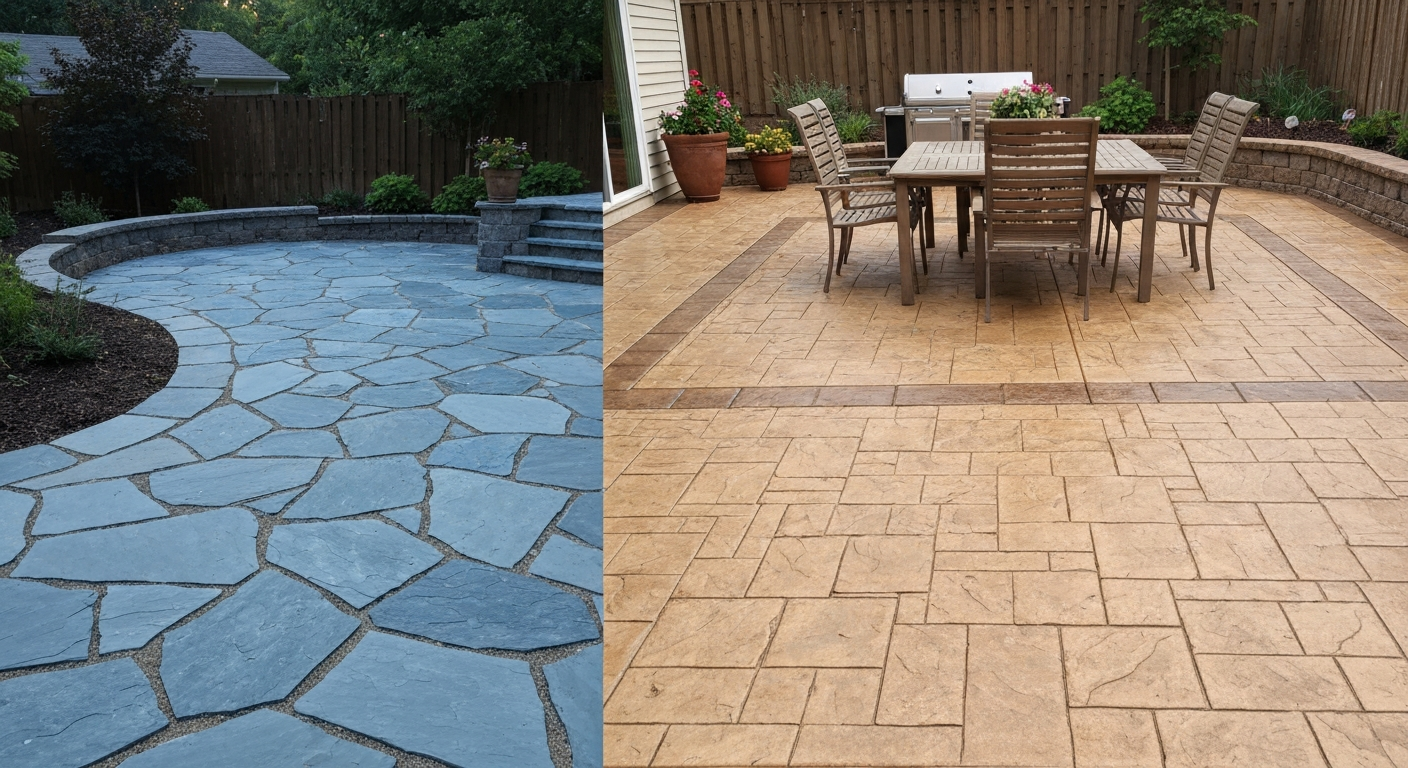
Stamped concrete typically costs $9–$25 per square foot installed, while a flagstone patio runs $15–$30 per square foot installed. On a 300 sq ft patio, that translates to roughly $2,700–$7,500 for stamped concrete versus $4,500–$9,000 for flagstone. So if budget is your primary driver, stamped concrete usually wins on upfront cost. But flagstone tends to last longer, holds up better through freeze-thaw cycles, and is far easier to repair when something goes wrong. Which one actually makes sense for your yard depends on your climate, budget ceiling, maintenance tolerance, and how long you plan to stay in the house.
Flagstone Patio Cost vs Stamped Concrete: Which Is Cheaper?
Nolan Ellison
10 Aug 2026
Who this guide is for and what it covers
This article is written for homeowners who have narrowed their patio surface shortlist to flagstone and stamped concrete and need a straight, numbers-backed comparison before committing to a contractor. I'll walk through real installed cost ranges, what actually drives those prices up or down, how each surface is built and how long installation takes, honest pros and cons, and which option performs better in specific climates and use cases. If you're also weighing a deck, the wood-versus-stone decision is a different conversation worth exploring separately. If you want a focused comparison between stone patios and wood decks, see our stone vs wood patio guide for the trade-offs and costs of those two approaches. For a side-by-side comparison with decking options, see our guide on wooden deck vs stone patio. For a focused comparison between hard-surface patios and raised wood or composite surfaces, see our guide on stone patio vs deck. Here we're staying focused on these two hard-surface options.
At-a-glance cost summary
Here are the headline numbers side by side before we get into the details. These are national averages for professionally installed work as of 2025-2026. Your actual quote will vary based on region, site conditions, and the specific stone or concrete finish you choose.
| Patio Size | Stamped Concrete (installed) | Flagstone (installed) |
|---|---|---|
| 100 sq ft | $900 – $2,500 | $1,500 – $3,000 |
| 200 sq ft | $1,800 – $5,000 | $3,000 – $6,000 |
| 300 sq ft | $2,700 – $7,500 | $4,500 – $9,000 |
| 400 sq ft | $3,600 – $10,000 | $6,000 – $12,000 |
| 500 sq ft | $4,500 – $12,500 | $7,500 – $15,000 |
The per-square-foot installed rate for stamped concrete is approximately $9–$25, and for flagstone it's approximately $15–$30. At the low end of each range you're looking at a basic installation: one pattern, one color, standard stone. At the high end you're paying for premium materials (bluestone, custom-pattern stamping), complex layouts, multi-color staining, and difficult site access.
Realistic cost estimates with regional and complexity caveats
These national averages are a useful starting point, but they can be misleading without context. Labor rates in the Northeast and West Coast metro areas routinely run 20–40% higher than the national midpoint. Material costs for natural stone are also significantly regional: bluestone is comparatively affordable in the Mid-Atlantic where it's quarried, but ships as a premium product to the Southwest. In contrast, flagstone varieties like Arizona sandstone or Oklahoma limestone can be sourced cheaply in their home regions and expensively everywhere else.
Complexity also shifts costs substantially. A simple rectangular patio with uniform stone size and single-color stamped concrete sits near the low end. Add curves, a fire pit surround, built-in seating walls, steps, or a sloped site that needs re-grading, and both options climb fast. Mortared flagstone on an existing concrete pad adds cost compared to dry-laid on compacted gravel. Multi-color stamped concrete with a contrasting border and decorative saw cuts pushes toward the top of the stamped concrete range. I've seen simple stamped concrete jobs come in at $10/sq ft and elaborate flagstone terraces quoted at $35/sq ft, so always get at minimum three contractor bids for your specific site.
What actually drives the cost for each option
Flagstone cost drivers
- Stone type and source: Common flagstone (sandstone, limestone) costs $6–$10/sq ft for materials alone. Bluestone, quartzite, and granite-family stones run $10–$15+/sq ft in materials.
- Installation method: Dry-laid over compacted gravel and bedding sand sits at the lower labor range ($15–$17/sq ft installed). Wet-set mortared flagstone, which requires mixing, setting, jointing, and curing, adds meaningful labor cost and pushes totals toward $20–$30/sq ft.
- Stone thickness and weight: Thicker slabs require more effort to cut and set. Irregular, hand-split stones mean more on-site fitting time compared to cut or dimensional pieces.
- Waste factor: Irregular flagstone typically has 10–20% waste built into the material order, which directly affects material cost.
- Subbase preparation: A standard 4-inch compacted gravel base is typical for a pedestrian-load patio; wet climates or heavy furniture setups may call for 6 inches, and if site grading or drainage work is needed, that adds to prep costs.
- Jointing: Polymeric sand (dry-laid) is inexpensive. Mortar grouting costs more in both materials and labor time.
- Permits: Most municipalities require a permit for a permanent patio structure. Permit fees vary widely by locality, commonly $50–$250 for a residential patio.
Stamped concrete cost drivers
- Base concrete pour: The structural slab itself runs approximately $6–$10/sq ft, including forming, reinforcement (wire mesh or rebar), and the pour.
- Stamping and texture labor: Applying stamp patterns and texturing the surface while the concrete is in its workable window adds $4–$10/sq ft.
- Color methods: Integral color (pigment mixed into the concrete) is less expensive than dry-shake color hardener applied to the surface; adding a release agent or secondary accent color adds $1–$8/sq ft.
- Sealer: A quality penetrating or film-forming sealer runs $0.50–$2/sq ft and should be reapplied every 2–3 years.
- Control joints: Saw-cut control joints are essential for crack management. Decorative saw cuts add labor time.
- Site prep and grading: Like flagstone, any sloped, poorly draining, or heavily vegetated site adds prep cost before concrete can be poured.
- Border treatments: A contrasting stamped or colored border is a popular upgrade that adds cost but significantly improves the finished look.
Side-by-side comparison
| Attribute | Flagstone | Stamped Concrete |
|---|---|---|
| Installed cost (per sq ft) | $15 – $30 | $9 – $25 |
| Typical 300 sq ft project | $4,500 – $9,000 | $2,700 – $7,500 |
| Appearance | Natural, unique, earthy; no two installations identical | Can mimic stone or brick; uniform pattern; artificial look up close |
| Durability | 30–50+ years (dense stone, proper base) | 20–30 years (properly sealed and maintained) |
| Freeze-thaw performance | Excellent for low-porosity stones (quartzite, bluestone); poor for porous sandstone | Good with air-entrained mix; prone to surface spalling and cracking in harsh climates |
| Maintenance | Re-sand joints annually; occasional sealing; weed management (dry-laid) | Reseal every 2–3 years; repair cracks as they appear |
| Slip resistance | Naturally textured surface; can be slippery when wet if polished | Texture can be slip-resistant when new; may become slippery as sealer wears |
| Heat retention | Absorbs heat but dissipates faster than concrete; cooler underfoot | Absorbs and retains heat; can be uncomfortably hot in direct summer sun |
| Repairability | Individual stones replaced without disturbing surroundings | Cracks and patches are difficult to blend; color matching is rarely perfect |
| DIY feasibility | Dry-laid: realistic for handy homeowners. Wet-set: hire a mason | Not recommended DIY; requires coordinated crew for timing-sensitive stamping |
| Estimated lifespan | 30–50+ years | 20–30 years |
How each patio is actually built
Flagstone: dry-laid method
Dry-laid flagstone is the more forgiving installation and the one I'd point a skilled DIYer toward for smaller projects. The process starts with excavating 6–8 inches of soil, compacting the subgrade, and laying a 4-inch base of crushed stone or gravel. Over that goes 1–2 inches of bedding sand, then the flagstones are set by hand, fitted together, and leveled individually. Joints are filled with polymeric sand, which is swept in, moistened, and hardens to lock the pieces in place. A 200 sq ft dry-laid patio can be completed by a two-person crew in 2–3 days, not counting the excavation. One thing to watch: don't skip the plate compactor on the gravel base. I've seen beautifully laid dry flagstone patios turn into a rocking, uneven mess within two seasons because the base wasn't compacted properly.
Flagstone: wet-set (mortared) method
Wet-set flagstone is either set in a mortar bed over a concrete pad or mortared directly onto a freshly poured slab. This method produces a more stable, weed-resistant surface with tighter, more finished joints. It's the right call for formal settings, pool surrounds, or anywhere you want a very tight, polished appearance. The trade-off is labor time and cost: setting stones in mortar, waiting for cure, then back-filling joints and waiting again adds 3–7 days to the timeline for a 300–400 sq ft project. If a stone cracks or chips years later, removing one piece without disturbing neighbors is possible but trickier than with dry-laid work.
Stamped concrete: the poured and stamped process
Stamped concrete installation is a coordinated, time-sensitive process. Day 1 involves forming the perimeter, placing wire mesh or rebar reinforcement, and pouring the concrete slab. While the concrete is still plastic, color hardener is broadcast onto the surface and floated in, then a release agent (which adds a secondary antique tone) is applied. The stamping crew then presses rubber pattern mats into the surface in sequence to create the texture. This entire finishing window typically lasts only a few hours, which is exactly why this is not a realistic DIY project for most people. One person getting behind, or weather changing the concrete's set time, and the whole slab can be ruined. After stamping, control joints are cut and the surface is cured for 24–72 hours before light traffic. Full strength is reached in 28 days, and most contractors recommend waiting the full cure period before applying the final sealer. Total on-site time for a 200–500 sq ft stamped concrete patio typically runs 2–7 working days from prep to sealed finish. Stamped Concrete Patio Ideas – Pro Tips & Homeowner Insights (Concrete Network) reports typical contractor timelines of about 2–7 working days on site for a 200–500 sq ft stamped concrete patio.
Honest pros and cons
Flagstone
- Pros: Genuinely beautiful, natural appearance that ages gracefully. Dense stones (quartzite, bluestone) are extremely durable and handle freeze-thaw well. Individual stones are replaceable without disturbing the whole patio. Cooler underfoot than concrete in summer sun. Dry-laid installations allow water infiltration, which is good for drainage and stormwater management.
- Cons: Higher upfront cost than stamped concrete. Irregular dry-laid joints require periodic re-sanding and can grow weeds or moss. Soft, porous stones (some sandstone, travertine) absorb water, stain, and deteriorate faster. Uneven natural surfaces can be a trip hazard if not properly leveled. Wet-set installations require skilled masonry labor.
Stamped concrete
- Pros: Lower upfront installed cost, especially on larger areas. Wide range of patterns and colors can mimic stone, brick, or slate at a fraction of the material cost. Monolithic surface with no joints means no weeds and easier cleaning. Good structural strength when properly reinforced.
- Cons: Requires resealing every 2–3 years; neglecting this leads to fading, surface wear, and moisture infiltration. Cracks are almost inevitable over time, especially in freeze-thaw climates, and color-matched patching is difficult to do invisibly. Surface can become slippery when the sealer wears. Holds and radiates heat more than natural stone. Once seriously damaged, full replacement is often the only real fix.
Which performs better in your climate and use case
Cold climates and freeze-thaw regions
This is where the two surfaces diverge most sharply. Concrete freeze-thaw performance is measured under ASTM C666 standards, and while a properly air-entrained concrete mix resists spalling reasonably well, outdoor slabs in regions with many freeze-thaw cycles still develop surface cracking and delamination over years, especially with road salt or ice melt applied. Flagstone performance in cold climates depends entirely on the stone type. Low-porosity stones like quartzite, dense bluestone, and granite-family stones have minimal water absorption and handle repeated freezing cycles extremely well. Porous stones like some sandstones and travertine absorb water, which expands on freezing and can fracture the stone from within. If you're in Zone 5 or colder, stick with dense, low-porosity flagstone or opt for stamped concrete with a premium air-entrained mix and commit to resealing annually rather than every 2–3 years.
Hot, sunny climates
In hot climates, stamped concrete's heat retention is a real drawback. Concrete can reach surface temperatures well above air temperature in direct sun, making it uncomfortable barefoot. Lighter-colored flagstone, particularly limestone and certain sandstones, reflects more heat and stays cooler underfoot. If the patio gets sun most of the day and you'll be using it barefoot, flagstone wins on comfort. Stamped concrete in a light color with a high-quality sealer is tolerable, but it will never be as cool as natural stone.
Pool surrounds and wet areas
Both materials can work around pools, but each requires attention to detail. Flagstone with a brushed or naturally textured surface provides good traction when wet. Smooth or polished flagstone gets slippery. For stamped concrete near a pool, choose an aggressive stamp texture and use a non-slip additive in the sealer. Pool chemicals and constant moisture also wear through sealers faster, so plan on resealing more frequently, every 12–18 months rather than the standard 2–3 years.
Heavy-use patios and furniture loads
Both surfaces handle standard patio furniture and foot traffic without issue. Dry-laid flagstone over a well-compacted base can shift slightly under very heavy point loads (think a large cast-iron fire pit or a heavy stone table), so wet-set installation is preferable for heavy permanent fixtures. Stamped concrete's monolithic slab handles point loads well structurally, but heavy furniture legs without protective pads can scratch or gouge the sealed surface.
Wet, humid, and Pacific Northwest climates
In consistently wet climates, moss and algae growth on both surfaces is a maintenance reality. Dry-laid flagstone allows water to drain through the joints, which is actually an advantage for stormwater management. Stamped concrete needs adequate slope (minimum 1/8 inch per foot away from the house) to drain properly, and pooling water accelerates sealer breakdown. Textured flagstone also provides better grip in wet conditions than sealed stamped concrete, which is worth considering in a climate where the surface is wet for much of the year.
Lifespan, maintenance, and long-term cost reality
Properly installed flagstone (dense stone, good base, adequate drainage) routinely lasts 30–50 years or more. Industry and stone‑science sources report dense flagstones can last multiple decades (commonly 30–50+ years) when installed with a proper base, drainage, and jointing, see Stone Restoration | International Masonry Institute (technical guidance on stone durability and factors). It's not uncommon to find century-old bluestone walkways still serviceable. The ongoing maintenance for dry-laid flagstone is modest: top up polymeric sand joints every few years, pull the occasional weed, seal if you want (not always required for dense stones), and replace a cracked piece if you ever damage one. That last point matters more than people realize. When a flagstone cracks or stains, you can pull that single piece and replace it. The fix is nearly invisible if you can source matching stone.
Stamped concrete's realistic lifespan is 20–30 years with proper care. The catch is that 'proper care' means resealing every 2–3 years, which costs $0.50–$2/sq ft each time. On a 400 sq ft patio resealed every two years for 20 years, that's 10 resealing cycles at a cost of $200–$800 each, or $2,000–$8,000 in maintenance cost on top of the original installation. Cracks are the bigger headache. Concrete will crack; that's not a question of if but when. Control joints manage where the cracking happens, but they don't eliminate it. Patching cracked stamped concrete is difficult to do invisibly because the color and texture never match the original exactly. If a large section needs to be replaced, you're essentially looking at saw-cutting and re-pouring, which is disruptive and expensive.
DIY vs. hiring a contractor
Dry-laid flagstone is the most realistic DIY patio project of the two options. If you're comfortable renting a plate compactor, can manage the physical work of moving heavy stones, and have a weekend or two available, a 100–200 sq ft dry-laid flagstone patio is achievable for a handy homeowner. You'll save the labor portion of the cost, which can be significant. Wet-set mortared flagstone is a different story: mixing and applying mortar, setting stones flat and level in a mortar bed, and grouting joints cleanly requires masonry experience. Hire a mason for mortared work.
Stamped concrete is not a realistic DIY project for most homeowners. The stamping and coloring window is narrow, the process requires a coordinated crew of multiple people, and any mistake during that window is permanent. Even experienced concrete finishers who haven't done stamped work specifically can run into trouble. Unless you have direct experience with stamped concrete finishing, hire a contractor with a documented portfolio of completed projects you can actually go look at.
Sourcing and finish options
For flagstone, your best sourcing strategy is to visit a local stone yard rather than ordering blind. Flagstone varies enormously in thickness, color variation, and surface texture even within the same stone type. Seeing and handling the stone in person lets you check for consistent thickness (easier to set), check porosity (pour a little water on it; if it absorbs quickly, it's porous and will need sealing and extra freeze-thaw care), and assess color against your house. Common flagstone types include bluestone (Northeast staple, dense, blue-gray), Arizona sandstone (warm reds and buffs, more porous), Pennsylvania bluestone cut flagging (more uniform), limestone, quartzite, and slate. For a formal look, cut or dimensional flagstone with straight edges is easier to lay and gives a cleaner result. For a naturalistic look, irregular hand-split flagstone is more organic.
For stamped concrete, the main decisions are pattern and color method. Popular patterns include ashlar slate, cobblestone, random stone, herringbone brick, and wood plank. Integral color (pigment mixed into the batch) is more fade-resistant than dry-shake color hardener. Adding a release agent in a contrasting accent color is the standard way to create an antique or multi-tone appearance. For the sealer, penetrating sealers protect against moisture without significantly changing the surface appearance, while film-forming (topical) sealers provide a wet, glossy look and better surface protection but require more frequent reapplication.
How to decide: a practical checklist
Run through these questions before you call a contractor or pull a permit. Your answers will point clearly toward one option or the other.
- What's my hard budget ceiling? If you need to stay under $5,000 for a 300 sq ft patio, stamped concrete is likely your only realistic option between these two.
- How long am I staying in the house? If you're planning to sell in 3–5 years, stamped concrete's lower upfront cost may make more sense. If you're in it for 20+ years, flagstone's longevity and repairability favor it long-term.
- What climate am I in? Cold, freeze-thaw climates favor dense-stone flagstone. Hot, sunny climates favor lighter flagstone for comfort. Wet climates favor flagstone for drainage and grip.
- Am I considering a pool surround or wet area? Prioritize texture and slip resistance; either option works if specified correctly.
- Do I care about repairability? If a 'set it and forget it for decades' surface matters to you, flagstone wins clearly.
- What appearance am I after? If you want a precise, uniform stone or brick look at lower cost, stamped concrete delivers it. If you want genuine natural variation and character, flagstone is the real thing.
- Am I willing to reseal? Stamped concrete requires it every 2–3 years. Flagstone may need occasional sealing depending on stone type but far less frequently.
- DIY or contractor? If you want to do it yourself and have some physical ability, dry-laid flagstone is feasible. Stamped concrete is not.
Sample budgets by scenario
| Scenario | Best pick | Estimated cost (300 sq ft) | Key reason |
|---|---|---|---|
| Tight budget, HOA neighborhood, selling in 5 years | Stamped concrete | $2,700 – $5,500 | Lower upfront cost; visually appealing |
| Long-term home, cold climate (Zone 4–5) | Flagstone (quartzite or bluestone) | $5,500 – $9,000 | Freeze-thaw resilience; repairability |
| Pool surround, South or Southwest | Flagstone (limestone or sandstone, sealed) | $4,500 – $8,000 | Cooler underfoot; natural texture grip |
| Large suburban patio, moderate climate | Stamped concrete | $3,500 – $7,500 | Cost-effective over larger areas |
| DIY project, handy homeowner | Dry-laid flagstone | $2,000 – $4,500 (materials + base) | Realistic to execute without professional help |
| Formal garden, high-end landscape | Mortared bluestone flagstone | $7,000 – $12,000+ | Premium appearance, long lifespan |
The bottom line
Stamped concrete costs less upfront and can look excellent for the first several years with proper maintenance. It's the right call if budget is tight, the climate is mild, and you're committed to resealing on schedule. Flagstone costs more initially but earns that premium back through longevity, repairability, and genuinely better performance in cold climates and hot, sunny conditions. For most homeowners planning to stay in their home long-term, flagstone with a proper compacted gravel base is the more cost-effective choice over a 20- to 30-year horizon when you factor in resealing cycles and the eventual difficulty of patching cracked stamped concrete. If you're comparing either of these against a wood deck or composite surface, that opens up a separate set of trade-offs around maintenance, drainage, and structure, but as hard-surface patio materials go, these two are the most direct competition to each other. For a focused comparison of flagstone patio vs wood deck, see the separate guide on choosing between a flagstone patio and a wood deck. For a direct comparison, see our guide on what is cheaper wood deck or stone patio. For a direct comparison of hard-surface patios and decking options, see our guide on patio stones vs deck for maintenance, drainage, and structural trade-offs.
FAQ
What are realistic installed cost ranges per square foot for flagstone patios vs stamped concrete?
Flagstone (installed): commonly $15–$30 per sq ft (national typical). Stamped concrete (installed): commonly $9–$25 per sq ft. Both ranges depend on stone type, concrete finish, local labor rates and project complexity.
What do those per‑sq‑ft ranges translate to for whole projects (example sizes)?
Using the typical ranges: Flagstone — 100 sq ft: $1,500–$3,000; 300 sq ft: $4,500–$9,000; 500 sq ft: $7,500–$15,000. Stamped concrete — 100 sq ft: $900–$2,500; 300 sq ft: $2,700–$7,500; 500 sq ft: $4,500–$12,500. Expect higher totals for premium stone, elaborate patterns, stairs, retaining walls or difficult access.
What are the main cost drivers for each option?
Flagstone: stone type (common vs premium bluestone/quartzite), material yield/waste (irregular shapes), base/subgrade prep, mortar vs dry‑laid method, labor skill for cutting/fitting, jointing material and sealing. Stamped concrete: base/subgrade prep, concrete thickness/reinforcement, choice of color method (integral/dry‑shake/stain), stamping patterns and multiple stamps, edge treatments/borders, control joints, sealers and labor timing/crew size. For both: site access, grading, drainage, demolition/tear‑out and local labor/permit costs.
How do installation methods differ and what are typical timelines?
Flagstone: Dry‑laid over compacted aggregate & bedding sand (faster, flexible) — small crews can complete 100–400 sq ft in a few days. Mortared/set flagstone (on concrete or mortar bed) requires more labor and cure time — plan 3–7+ days for comparable areas. Stamped concrete: formwork, base prep, reinforcement and concrete pour usually done in the same operation; stamping and color applied while concrete is plastic. Typical schedule: 1–3 days on site for pour and finishing, then 24–72 hours initial cure; light use in ~7 days; sealing often after 7–28 days. Larger or complex jobs take longer.
Which option is easier for DIY vs requiring a contractor?
DIY‑friendly: dry‑laid flagstone is realistically achievable for handy homeowners on small/simple patios (irregular layout, no mortar). Not recommended DIY: stamped concrete (time‑sensitive stamping and color work), mortared/set flagstone (masonry skill). For high‑risk tasks (large area, slabs, structural steps, drainage), hire an experienced contractor.
What are the pros and cons (aesthetics, durability, slip resistance, heat, maintenance, repairability)?
Flagstone — Pros: natural/varied look, better cooling (lower heat retention), good slip resistance with textured stone, long potential lifespan (30–50+ years with durable stone), easier localized repair (replace individual stones), permeability options with dry set. Cons: higher material cost for premium stones, irregular installation can be time consuming, some stone is porous and stains/crumbles, joints may need maintenance. Stamped concrete — Pros: wide range of patterns/colors to mimic stone/brick, generally lower installed cost, smooth even surface for furniture, easier to keep weed‑free. Cons: can crack (particularly in freeze‑thaw zones) and cracks are harder/visible to repair, can retain and radiate heat more than stone, may become slippery when sealed smooth, resealing every few years required, decorative finish can fade or chip.