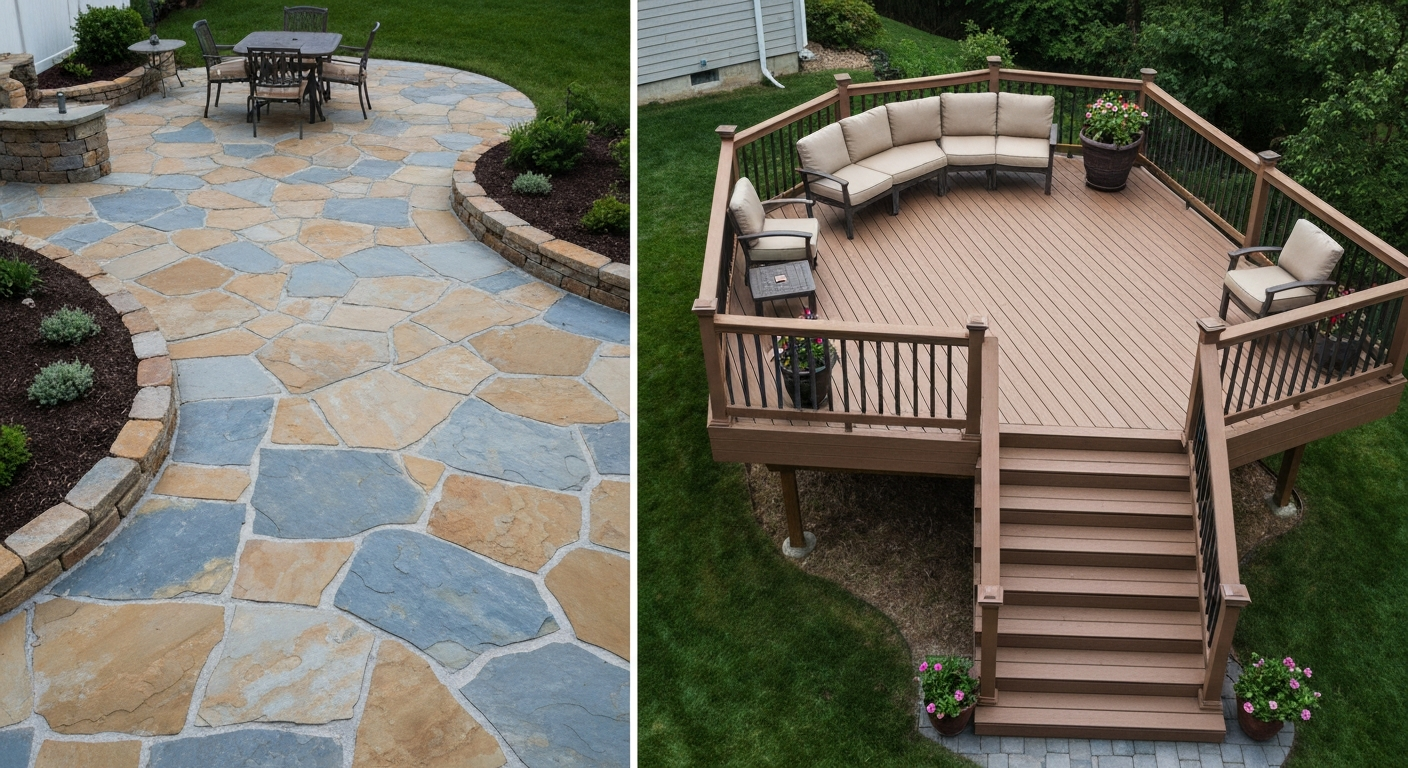
Flagstone patios and wood decks are both excellent outdoor surfaces, but they solve different problems. Flagstone sits at grade, drains well, handles freeze-thaw cycles if the base is right, and never rots. A wood deck gets you off the ground, bridges uneven terrain, and delivers a warm, springy feel underfoot, but it demands regular maintenance and eventually needs replacing. Most homeowners I've worked with make the choice within the first five minutes of answering three questions: How much slope do you have? What's your annual maintenance appetite? And what's your realistic budget, not just for installation but for the next 20 years? This guide walks through every dimension of that decision, including real cost ranges, climate suitability by material and construction method, installation basics, and a decision checklist you can use before you call the first contractor. For a direct side-by-side comparison of patio stones vs deck, see the dedicated patio stones vs deck guide for an at-a-glance breakdown.
Flagstone Patio vs Wood Deck: Cost, Durability & Best Choice
How to use this guide
This article is organized so you can jump straight to the section most relevant to your situation. If cost is your primary filter, go directly to the full cost comparison and budget range sections. If you're in a northern climate with hard winters, prioritize the lifespan and climate suitability section. If you're still undecided between options, the recommendation framework and side-by-side table give you the fastest path to a shortlist. The guide also covers installation methods, maintenance schedules, sourcing tips, and when to hire a pro versus doing it yourself. Related topics on this site, including stamped concrete alternatives, stone patio vs deck comparisons, and what is cheaper breakdowns, go deeper on specific sub-questions if you need them.
Narrowing your choice: a recommendation framework
Before comparing materials, answer these five questions honestly. Your answers will eliminate one option for most people without any further analysis.
- How much grade change do you have? A slope greater than about 12 inches across your target area almost always makes a deck more practical, since a flagstone patio on a steep slope requires significant regrading or retaining wall work, which adds cost and complexity fast.
- What is your freeze-thaw exposure? If you're in a USDA hardiness zone 6 or colder, a flagstone patio needs either a well-engineered dry-laid base (4 to 6 inches of compacted 3/4-minus crushed stone, geotextile, and stone dust bedding) or a full mortar-set installation on reinforced concrete to resist heaving. Wood decks on properly buried footings handle freeze-thaw with fewer surprises.
- What is your 10-year maintenance tolerance? Pressure-treated pine decks need cleaning and re-staining or sealing every 2 to 3 years. Hardwood and composite decks need less, but composite still needs annual cleaning. A well-built flagstone patio on a stable base can go 5 to 10 years with only joint maintenance and occasional resealing.
- What is your real budget ceiling? Installed flagstone runs roughly $15 to $30 per square foot. Pressure-treated wood decks commonly land in the low-to-mid $20s per square foot installed. Composite decks typically run $35 to $60 per square foot installed. On a 400-square-foot project, that difference is $8,000 to $14,000. Size this out before you fall in love with a material.
- Do you need the surface elevated or at grade? Flagstone is fundamentally a grade-level surface. If you need to step out of a back door that sits 3 feet above the yard, a deck is the practical answer, and no amount of fill or retaining will make flagstone as clean a solution.
If you answered 'flat yard, moderate climate, lower maintenance preference, mid-range budget' to those questions, flagstone is likely your better long-term value. If you answered 'sloped yard, northern climate, willing to maintain, or need elevation,' a wood or composite deck will serve you better. Most real-world projects fall somewhere in between, which is where the detailed comparison below becomes useful. For a direct, side-by-side comparison of stone vs wood patio options, see our stone vs wood patio guide.
Flagstone patio vs wood deck: side-by-side comparison
| Factor | Flagstone Patio | Wood Deck (Pressure-Treated) | Composite Deck |
|---|---|---|---|
| Typical installed cost (per sq ft) | $15–$30 | $18–$28 | $35–$60 |
| Average project total (400 sq ft) | $6,000–$12,000 | $7,200–$11,200 | $14,000–$24,000 |
| Lifespan (well-maintained) | 30–50+ years | 15–25 years | 25–35 years |
| Annual maintenance effort | Low (joints + occasional seal) | Moderate to high (clean, stain, seal every 2–3 yrs) | Low to moderate (annual clean) |
| Freeze-thaw performance | Good if base is correct; fair with poor base | Good with proper footings | Good with proper footings |
| Rot/insect risk | None | Moderate (PT reduces risk) | None |
| Slip resistance (wet) | Moderate (rough stone better; smooth stone worse) | Moderate (weathered wood can be slippery) | Good (most composites have textured surface) |
| Heat retention in sun | High (stone absorbs and radiates heat) | Moderate | Moderate to high (dark composites get hot) |
| DIY difficulty | Moderate (dry-laid) to high (mortared) | Moderate to high (framing, footings, ledger) | Moderate to high (same framing as wood) |
| Permit typically required | Rarely (at-grade) | Usually (elevated or ledger-attached) | Usually (elevated or ledger-attached) |
| Resale value contribution | Moderate to good | Good | Good to very good |
| Best climate fit | Temperate to dry; works in freeze zones with proper base | Wide range; needs ventilation in humid climates | Wide range; better than wood in high-humidity zones |
| Drainage | Excellent (dry-laid) to engineered (mortared) | Good (gap between boards) | Good (gap between boards) |
| Structural elevation capability | No (grade-level only) | Yes | Yes |
Appearance, comfort, and usability
How each surface looks and feels
Flagstone has a natural, irregular look that blends well with gardens and landscaping. Stone types range from Pennsylvania bluestone (dense, fine-grained, blue-gray) to Arizona flagstone (warm rust and tan tones), Tennessee crab orchard (reddish-brown with texture), and limestone (cream to gray). The joints, whether filled with polymeric sand, mortar, or ground cover, are part of the aesthetic and can be adjusted to lean rustic or refined. A wood deck has a linear grain pattern that reads as more structured and modern or traditional depending on board width and finish. Composite decking mimics wood grain and comes in a wider color range than natural wood, though the aesthetic is subtly different up close.
Underfoot, flagstone is firm and unforgiving on the joints. Standing for long periods, like during an outdoor party, is noticeably harder on feet and legs than a wood deck, which has slight flex and a warmer feel. This is one practical comfort difference that matters more than most people anticipate until they've hosted a four-hour cookout on stone. Wood and composite decks also stay warmer on bare feet in the morning because they don't absorb and hold cold the way stone does. On the flip side, stone stays cooler in direct afternoon sun than a dark composite deck, which can get uncomfortably hot in summer.
Furniture compatibility and furniture movement
Heavy furniture like cast iron or thick teak sits well on flagstone. Lighter furniture with small-diameter feet can rock on uneven stone joints, which is a legitimate annoyance. Leveling glides help. Furniture with casters works better on a smooth wood or composite deck surface. Flagstone is generally better for rugs (no concern about moisture trapping against a solid surface the way it can against wood), but any outdoor rug on stone or wood should be lifted and dried periodically to prevent staining and, in wood's case, moisture damage beneath the rug.
Durability, slip resistance, and safety
Wear, chipping, and surface damage
Flagstone is highly resistant to surface wear. Dense stones like bluestone and quartzite can handle heavy foot traffic for decades without visible wear. Softer stones like sandstone or certain limestones will show surface wear over time in high-traffic areas and are more susceptible to chipping at edges. The Natural Stone Institute's Dimension Stone Design Manual recommends selecting stone with absorption rates appropriate to local freeze-thaw severity and using thicker nominal stock (1.25 to 2 inches) for heavy pedestrian use. Flagstone at 2-inch thickness over a 2-inch mortar bed can weigh roughly 23 pounds per square foot (at 140 lb/ft3 for a mid-density limestone), so subgrade preparation matters.
Wood decks are susceptible to surface checking (small surface cracks), splintering on older boards, and soft spots if moisture gets into end grain or under the surface. Pressure-treated pine resists rot better than untreated wood, but the USDA Forest Products Laboratory's Wood Handbook is clear that decay resistance in pine is relatively low in untreated heartwood. Species matter a lot: western red cedar and old-growth redwood are rated resistant to very resistant for decay; dense tropical hardwoods like Ipe (Tabebuia) have very high Janka hardness ratings and exceptional decay resistance, with realistic lifespans of 40 to 75 years when properly maintained. Composite decks eliminate rot and splinter concerns but can show surface scratching more visibly on lighter colors.
Slip resistance and safety
Slip resistance is nuanced for both surfaces. Rough-textured flagstone (cleft-finish bluestone, textured limestone) has reasonable grip when wet. Honed or smooth-finish flagstone and polished stone can be dangerously slippery when wet or covered with algae. Applying a penetrating anti-slip sealer helps but needs to be reapplied regularly. Wood decks get slippery when wet and covered with organic growth, especially in shaded areas. Kiln-dried hardwoods tend to be smoother underfoot than rough-sawn PT pine. Composite decking from major manufacturers like Trex and TimberTech is specifically engineered with textured surfaces for wet-condition traction, and most current product lines perform well in this regard. For households with older adults or young children, composite is likely the safest wet-surface option among the three.
Insects and structural pests
Stone has zero insect vulnerability. Wood, even pressure-treated, can attract termites in warm and humid climates depending on treatment level and whether the wood contacts soil. Composite decking has no cellulose content, so termites cannot feed on it, though the framing underneath is still wood and needs to be protected or specified as treated. In termite-active zones (much of the southern and southeastern US), this distinction is worth taking seriously when budgeting long-term.
Full cost comparison
Materials and labor breakdown
Installed flagstone patio costs cluster between $15 and $30 per square foot nationally, with project totals commonly in the $3,000 to $12,000 range for typical residential projects depending on size, stone type, and installation method. Dry-laid flagstone on a compacted aggregate base is at the lower end of that range; mortar-set flagstone on a reinforced concrete slab sits at the top or above it. Premium stones like bluestone push costs higher: a 288-square-foot bluestone patio typically averages around $6,000 installed according to national consumer data.
Pressure-treated wood decks are commonly quoted in the low-to-mid $20s per square foot installed for straightforward residential projects. Hardwood species like Ipe or mahogany push that figure substantially higher due to material costs. Composite decks (Trex, TimberTech/AZEK, Fiberon) typically run $35 to $60 per square foot installed, with the higher end driven by premium board lines and complex framing requirements. Market aggregates show pressure-treated wood decks commonly quoted in the low‑to‑mid $20s per square foot installed and composite decks commonly $35–$60 per square foot installed (How Much Does It Cost to Build a Deck in 2026? Complete Guide, Hakaru (market summary)) How Much Does It Cost to Build a Deck in 2026? Complete Guide — Hakaru (market summary). Labor represents roughly 40 to 60 percent of total installed cost on both patio and deck projects, which means local labor markets shift these numbers significantly. RSMeans (Gordian) publishes regional cost indices used by contractors to adjust national figures to local conditions, so a deck in San Francisco or New York City can run 30 to 50 percent above the national midpoint.
Long-term maintenance costs
Maintenance costs are where flagstone often wins the lifecycle comparison. A well-built dry-laid flagstone patio on stable soil may need nothing more than periodic joint sand replenishment and a sealer application every 3 to 5 years. Budget roughly $200 to $500 every few years for a 400-square-foot surface. A pressure-treated pine deck needs cleaning and restaining or sealing every 2 to 3 years; professional re-coating runs $500 to $1,500 depending on size and condition. You may also face board replacement as the deck ages. Over a 25-year period, realistic cumulative maintenance costs on a PT pine deck can approach $4,000 to $8,000, on top of the original installation. Composite decking reduces this significantly but does not eliminate it; annual cleaning and occasional board replacement are realistic line items. Hardwood decks like Ipe can last 40 or more years with proper oiling, though annual or biannual oiling is required to prevent graying and cracking.
Permit and inspection costs
At-grade flagstone patios generally do not require permits in most jurisdictions. Decks almost always do, particularly when they are ledger-attached to the house or elevated. The IRC R507 provisions govern prescriptive deck construction, including a 40 psf live load basis, ledger anchorage, and lateral load connections. In snowy regions, ASCE 7 ground snow load provisions may govern over the standard 40 psf live load assumption, which can require upgraded framing. Permit fees range from roughly $100 to $500 or more depending on jurisdiction and project value. Budget for this plus the time required for inspection scheduling, which can add 1 to 3 weeks to a project timeline.
Sample budget ranges: what you'll actually spend
| Budget Tier | Flagstone Patio (300–400 sq ft) | Wood Deck (300–400 sq ft) | Composite Deck (300–400 sq ft) |
|---|---|---|---|
| Low (DIY-friendly, basic materials) | $3,000–$5,500 (dry-laid, local stone, DIY base prep) | $4,500–$7,000 (PT pine, DIY framing with pro footings) | $10,000–$14,000 (mid-range composite, standard layout) |
| Medium (contractor-installed, mid-grade materials) | $6,000–$10,000 (mixed stone, contractor-laid, poly sand joints) | $8,000–$12,000 (PT pine or cedar, contractor-built) | $14,000–$20,000 (Trex Enhance or equivalent, contractor-built) |
| High (premium materials, full install) | $12,000–$18,000+ (bluestone or quartzite, mortar-set on concrete) | $14,000–$22,000+ (Ipe or hardwood, professional install) | $20,000–$30,000+ (Trex Transcend or TimberTech Landmark, full build) |
These ranges reflect 2026 national mid-range figures and will vary significantly by region. Markets like the Northeast, Pacific Coast, and major metro areas typically run 20 to 40 percent above national midpoints. Rural areas and the South-Central US often come in below the midpoint. Always get at least three local quotes, and ask contractors to break out materials and labor so you can see where the money is going. For a quick cost-focused answer to what is cheaper, wood deck or stone patio, see our cost comparison summary that breaks down typical installed prices and lifecycle costs what is cheaper wood deck or stone patio.
Lifespan and climate suitability
Freeze-thaw zones (USDA zones 1–6)
Freeze-thaw cycling is the primary enemy of mortared flagstone installations. Water infiltrates joints and the stone itself, expands on freezing, and gradually lifts and cracks both stones and mortar. The Natural Stone Institute recommends selecting paving stone with water absorption rates suited to local freeze-thaw severity, and using thicker stock (1.25 to 2 inches or more) for cold-climate installations. The 2023 USDA Plant Hardiness Zone Map update shifted many areas one half-zone warmer, which matters when assessing freeze-thaw risk: check your updated zone if you're near a zone boundary. USDA Plant Hardiness Zone Map (interactive map; 2023 update), USDA Agricultural Research Service provides the updated zone boundaries used for assessing average annual extreme minimum temperatures USDA Plant Hardiness Zone Map (interactive map; 2023 update) — USDA Agricultural Research Service. Dry-laid flagstone on a properly engineered base actually handles freeze-thaw better than mortar-set in many cases because individual stones can move slightly and re-settle without cracking. The base design, 4 to 6 inches of compacted 3/4-minus crushed aggregate over geotextile, with stone dust bedding, is critical. A poorly compacted base will heave and shift regardless of stone thickness.
Wood and composite decks in freeze-thaw climates need footings that extend below the frost line, which varies from 12 inches in mild climates to 48 or more inches in northern states. The footings are the main vulnerability; the deck surface itself is generally fine with freeze-thaw as long as there is adequate clearance for air circulation beneath the structure. In areas with significant ground snow loads, ASCE 7 provisions may require structural upgrades beyond the standard IRC R507 prescriptive design, particularly for larger decks or those in mountain regions.
Humid and coastal climates (zones 7–10)
High humidity accelerates organic growth (algae, mold, moss) on both stone and wood. Flagstone in humid climates needs more frequent cleaning and benefits from a penetrating sealer that resists moisture intrusion without trapping it. Wood decks in humid climates are at elevated rot and insect risk; PT pine with a UC4B or higher treatment rating is recommended for ground-contact and high-humidity applications. Cedar performs better than pine in humid conditions due to its natural extractives, but still benefits from regular sealing. In high-humidity, termite-active zones like the Gulf Coast and much of Florida, composite decking over PT framing is the most practical low-maintenance choice for an elevated surface.
Arid and high-sun climates (Southwest, mountain West)
In hot, dry climates flagstone excels. Stone holds up extremely well without the rot concerns of wood and without the UV degradation that affects composite board color over time. The heat-absorption issue is real though: dark Arizona flagstone in full afternoon sun in Phoenix can get uncomfortable on bare feet. Lighter-colored stones (beige limestone, pale sandstone) stay notably cooler. Wood decks in dry climates last longer than in humid ones because moisture is the primary driver of decay, but UV exposure causes surface checking and graying on untreated or unsealed wood faster than in the East. Hardwoods like Ipe or composite decking hold color and structure better than PT pine in intense-sun environments.
Snow and ice regions
Snow removal is a practical consideration that gets overlooked. A flagstone patio can be shoveled, but ice melt products need to be chosen carefully: calcium chloride and magnesium chloride are safer on stone than sodium chloride (rock salt), which can pit and stain porous stone and damage joints over time. On wood decks, avoid metal shovels that can gouge the surface. Most composite manufacturers recommend plastic shovels and calcium chloride-based products; check individual manufacturer guidelines (Trex and TimberTech both publish maintenance guidance on this point). Deck structural design in heavy-snow zones should account for ASCE 7 ground snow loads; in many mountain and northern areas these exceed the standard 40 psf residential deck live load assumption.
Installation methods: what actually goes into each build
Dry-laid flagstone on compacted aggregate base
This is the most DIY-accessible flagstone installation and the most forgiving in freeze-thaw climates. The sequence is: excavate 6 to 8 inches below finished grade, install geotextile fabric, compact 4 to 6 inches of 3/4-minus crushed stone in lifts, add a 1-inch bedding layer of coarse concrete sand or stone dust, set flagstones with 1 to 2 inch joints, and fill joints with polymeric sand. Edge restraint (aluminum or steel landscape edging, or a soldier course of stone) is essential to prevent lateral creep. The whole system is permeable, which is an advantage for drainage and stormwater management. Individual stones can be lifted and re-leveled if they settle, which is the main advantage over mortar-set for DIY homeowners.
Mortar-set flagstone on reinforced concrete slab
Mortar-set installations start with a 4-inch (minimum) reinforced concrete slab poured on compacted subgrade. Stones are set in a 1/2 to 1-inch mortar bed, with mortar joints between stones. The result is a rigid, very stable surface with no individual stone movement. The trade-off is that any crack in the slab telegraphs to the stones above, and in freeze-thaw climates the slab must be designed with proper drainage and expansion joints to prevent heaving. This method is not DIY-friendly without concrete forming experience. It is the right choice for high-traffic areas, around pools, or where a perfectly flat surface is required.
Wood deck framing basics
A typical attached wood deck consists of concrete footings (poured below frost line), posts, beam, joists (typically 2x8 or 2x10 at 16 inches on center), a ledger board attached to the house rim joist with appropriate through-bolts and flashing, decking boards fastened to joists, and a railing system if the deck is elevated more than 30 inches above grade. Ledger attachment and flashing are the most critical structural and waterproofing details: a poorly flashed ledger is the most common source of rot and structural failure in residential decks. The IRC R507 provides prescriptive tables for span lengths, joist sizes, and ledger connections.
Composite decking: installation specifics
Composite decking uses the same framing system as a wood deck but has stricter manufacturer requirements that are tied to warranty validity. Trex Transcend and Enhance lines, for example, require 16-inch on-center joist spacing for straight-laid boards and 12-inch spacing for diagonal or picture-frame installations. TimberTech publishes product-specific installation manuals with explicit gapping requirements that vary by temperature at time of installation (composite expands and contracts with heat more than wood, so summer installation requires tighter initial spacing than winter installation). Using hidden fastener systems like Trex Hideaway or equivalent protects the surface from face-fastener holes and improves appearance. Follow the manufacturer guide exactly; deviations void the warranty.
Maintenance schedules and finishing
| Task | Flagstone Patio | PT Wood Deck | Composite Deck |
|---|---|---|---|
| Annual cleaning | Rinse with garden hose; spot-clean stains with stone-safe cleaner | Power wash or scrub with deck cleaner | Low-pressure rinse; scrub with composite-safe cleaner |
| Sealing | Penetrating sealer every 3–5 years | Stain/sealer every 2–3 years | Not required; soap and water adequate for most brands |
| Joint maintenance | Top off polymeric sand every 2–5 years | Check for gaps, fastener backs, popped boards annually | Check fastener systems; hidden fasteners rarely need attention |
| Board/stone replacement | Rare (dry-laid stones can be re-leveled; cracked stones replaced) | Replace checked or split boards as needed, every 5–10 years | Replace damaged boards; match color carefully (older boards may have faded) |
| Structural inspection | Check edge restraints and perimeter settling annually | Inspect ledger, posts, footings, and joist ends annually for rot | Inspect framing (same as wood deck); composite surface self-reports damage well |
| Ice/snow removal | Plastic shovel; calcium chloride products only | Plastic shovel; calcium or magnesium chloride only | Plastic shovel; follow manufacturer guidelines on deicers |
Structural and site considerations
Drainage and grading
A dry-laid flagstone patio drains through its joints, making it one of the better at-grade surfaces for managing surface water. Mortared patios need to be sloped at minimum 1/8 inch per foot away from any structure for positive drainage. Wood and composite decks drain between board gaps, but the ground beneath a deck can become a moisture trap if it isn't graded properly. Slope the grade under a deck away from the house before building, and consider a gravel bed beneath to prevent weed growth and mud splash.
Accessibility
At-grade flagstone patios are inherently more accessible for people with mobility challenges than elevated decks, assuming the surface is reasonably level. Dry-laid flagstone with larger, flat stones and tight joints minimizes tripping hazards. Elevated decks require ramps or steps for wheelchair access, which adds cost and complexity. If accessibility is a household priority now or in the future, the at-grade nature of a flagstone patio is a genuine advantage.
Permits and code compliance
Most at-grade patios do not require permits. Elevated decks almost universally do, especially when ledger-attached to the house. Freestanding decks not more than 30 inches above adjacent grade fall under an IRC exception and may avoid some attachment requirements, but local jurisdictions vary and many still require a permit. Always check with your local building department before starting a deck project. The cost of a permit and inspection is far less than the cost of a stop-work order or required demolition of unpermitted work.
Resale value and aesthetic appeal
Both well-built patios and decks add measurable outdoor living value to a home. Decks have historically shown strong returns in real estate surveys, particularly in markets where outdoor entertaining space is valued. Flagstone patios photograph extremely well and appeal to buyers looking for low-maintenance, natural-looking outdoor spaces. From a resale standpoint, a well-maintained flagstone patio in good condition is a stronger selling point than a worn, graying wood deck that shows deferred maintenance. For a focused comparison of wooden deck vs stone patio costs, maintenance, and climate suitability, see our detailed guide on wooden deck vs stone patio. The lesson I've seen play out repeatedly is that the quality of maintenance matters more than the original material choice when it comes to resale.
Sourcing and material selection tips
Flagstone types and what to look for
- Bluestone (Pennsylvania/New York): dense, low-absorption, excellent freeze-thaw performance, blue-gray color, slightly higher cost but very long lifespan
- Limestone: wide color range (cream, buff, gray), moderate absorption, choose low-absorption varieties for freeze-thaw zones, widely available
- Sandstone: warm earth tones, higher absorption than bluestone or limestone, better suited to mild climates
- Quartzite: very hard and dense, excellent durability, limited color range (silvers, tans), more expensive and harder to cut
- Arizona/Colorado flagstone: iron-rich, warm rust and red tones, variable absorption by source, good for dry climates
- Slate: fine-grained, natural cleft texture, can be slippery when wet in honed finishes, choose cleft-finish for outdoor use
- When buying: ask the supplier for absorption and density data; for freeze-thaw zones, request stone with absorption by weight under 3 percent for durability
Wood species and composite options
- Pressure-treated pine (PT): most affordable, widely available, requires UC4A or UC4B rating for above-ground or ground-proximity applications; needs regular maintenance
- Cedar: naturally decay-resistant, pleasant appearance, lighter than PT pine, more expensive but lower maintenance; good for low-humidity to moderate-humidity climates
- Redwood: similar to cedar, excellent natural decay resistance, higher cost, increasingly limited availability
- Ipe (Brazilian Walnut): extremely dense (very high Janka hardness), top-tier decay resistance, lifespan 40–75 years with proper maintenance, high upfront cost, needs annual or biannual oiling
- Composite (Trex, TimberTech/AZEK, Fiberon): no rot, no splinters, minimal maintenance, higher upfront cost, verify joist spacing requirements for your chosen product before framing
- Capped composite vs uncapped: capped composite (polymer shell on all four sides) resists staining and moisture better than uncapped; worth the premium in humid climates
Considering alternatives: stamped concrete and other surfaces
If you like the look of flagstone but want a more uniform surface and lower material cost, stamped concrete is worth considering. It typically runs $8 to $18 per square foot installed, placing it below flagstone cost, though it is more vulnerable to cracking in freeze-thaw climates and requires resealing every 2 to 3 years to maintain color and protection. Porcelain pavers offer another alternative: they are very hard, low-absorption, and available in large-format sizes that mimic natural stone, though installation cost is comparable to flagstone and the surface can be slippery when wet without a textured finish. These alternatives are covered in more depth in related articles on this site. See our detailed guide comparing flagstone patio cost vs stamped concrete for a side-by-side look at price, durability, and maintenance trade-offs.
DIY vs hiring a professional
Dry-laid flagstone is the most accessible DIY outdoor project of the options discussed here. If you're comfortable with a plate compactor and can manage the physical labor of moving stone (budget a full weekend minimum for a 300-square-foot project), the savings over contractor installation are substantial. The most common DIY mistakes I've seen are insufficient base compaction, inadequate edge restraint, and using the wrong joint filler. All three lead to shifting and uneven surfaces within a few years.
Wood deck framing is DIY-feasible for people with solid carpentry skills and comfort reading structural drawings. The ledger attachment and footing work are the most consequential steps; if you're uncertain about these, hire a pro for those phases at minimum. Composite decking over a pre-built frame is more DIY-accessible than framing from scratch. Full composite deck builds, particularly with multi-level designs, hidden fastener systems, and railing installation, are best left to experienced contractors.
Decision checklist: picking the right surface for your yard
- Measure your project area and confirm grade change across the space (more than 10–12 inches of slope across the area favors a deck)
- Identify your USDA hardiness zone (2023 map) to assess freeze-thaw risk for stone and frost-depth requirements for deck footings
- Set a realistic budget using the sample ranges above, then add 10 to 15 percent as a contingency for soil conditions, drainage corrections, and material overages
- Decide on your maximum annual maintenance commitment: high maintenance tolerance opens up PT pine and natural hardwood; low tolerance points to flagstone or composite
- Check local permit requirements before buying materials or hiring contractors
- Get three local contractor quotes with full material and labor breakdowns; compare line by line
- For flagstone: confirm stone type, absorption data, and freeze-thaw suitability with your supplier before ordering
- For wood decks: confirm species, treatment rating, and joist spacing requirements before framing, especially for composite decking
- Plan drainage before you build: confirm positive slope away from the house for both patios and the grade beneath decks
- If elevated access is needed for mobility, factor in ramp cost and design before choosing a deck over an at-grade patio
FAQ
What are the main objective differences between a flagstone patio and a wood deck?
Flagstone patio: ground‑level, permanent hardscape made of natural stone pieces set dry on a compacted aggregate base or mortared to a slab. Pros: very durable, low vibration, cooler surface in sun, high resale perception for stone, fireproof, minimal seasonal movement when properly installed. Cons: heavier, can be costlier per material if using premium stone, may settle/shift if base or drainage is poor, can be uneven for walking/bare feet, joint weeds/ants. Wood deck: elevated platform built with framing and decking boards (pressure‑treated, cedar/redwood, tropical hardwoods, or composites). Pros: warms underfoot, integrates with grade changes, easier to run utilities and attach railings/furniture, can be built at grade or elevated. Cons: regular maintenance (staining/sealing/fastener checks), vulnerable to rot/insects unless durable species or composites used, can be more expensive over time for composite, and requires structural design/footings and often permits.
How do appearance and lifestyle fit differ between the two?
Flagstone suits a natural, masonry look, blending with stone walls, gardens, and gravel pathways—good for traditional/mediterranean/cottage styles and heavy outdoor dining or fire features. Wood decks fit modern/traditional home extensions, are better for multi‑level access to doors, raised yard transitions, and for homeowners wanting warmer texture and built‑in seating/railings. For barefoot comfort and longevity with little maintenance, stone is cooler and rougher; wood is warmer and may be preferred for barefoot, cozy spaces but needs upkeep.
What are typical installed cost ranges for each option (low/medium/high budgets)?
Flagstone patio (installed): Low: $15–$20/sq ft (economy stone, dry‑laid, simple prep). Medium: $20–$30/sq ft (better stone or thinset on compacted base or light mortar). High: $30–$60+/sq ft (premium bluestone, custom patterns, mortar set, complex grading/drainage). Wood deck (installed): Pressure‑treated wood: Low: $15–$25/sq ft (basic framing, simple layout). Cedar/redwood: Medium: $25–$40/sq ft. Tropical hardwoods (Ipe) or high‑end wood: High: $40–$60+/sq ft. Composite decking: Medium‑High: $35–$60+/sq ft depending on brand, hidden‑fastener systems and substructure upgrades. Note: labor often accounts for 40–60% of installed cost; regional wages and permit/site conditions shift these ranges.
Which option is cheaper up front and over 10–20 years?
Cheaper up front: basic pressure‑treated wood deck typically has the lowest initial installed cost. Cheaper long‑term: well‑installed flagstone (dry‑laid on a good base) can have lower long‑term maintenance costs than wood (especially if comparing to higher‑maintenance wood species). Composites have higher initial cost but lower maintenance than wood; over 10–20 years composites may approach or exceed stone lifecycle costs depending on product and failure/replacement rates. Tropical hardwoods have high up‑front cost but long life with proper maintenance.
How long will each last (lifespan) in average conditions?
Flagstone patio: 25–100+ years if properly installed with a good base, drainage, and appropriate stone (many natural stone patios last decades to centuries). Wood deck: pressure‑treated wood 10–25 years depending on moisture, maintenance, and insect exposure; cedar/redwood 15–30 years; tropical hardwoods (Ipe) 25–50+ years if maintained; composites 20–30+ years depending on product and UV/weathering. Lifespan depends heavily on climate, drainage, installation quality and maintenance.
How does climate (freeze/thaw, humidity, sun, snow) influence the choice?
Freeze/thaw: choose low‑absorption stone and thicker units or mortar/concrete set in severe freeze climates; dry‑laid systems with a proper base and edge restraint perform well if stone has acceptable absorption ratings. Humidity and rot: avoid untreated softwoods in humid/tropical climates; prefer pressure‑treated, decay‑resistant species, tropical hardwoods, or composites. Sun/UV: composites and some woods fade or bleach—choose UV‑stable products and follow manufacturer gapping rules. Snow: elevated decks in snowy regions require proper footings and snow load consideration (codes/ASCE ground snow loads); patios must be frost‑protected or use frost‑heave‑resistant base design. Regional climate normals and local code ground snow maps should guide material and structural choices.