For most backyards, concrete pavers or natural flagstone hit the sweet spot of durability, looks, and realistic DIY-ability. For pool patios, the best material for pool patio designs usually prioritizes slip resistance and freeze-thaw durability. Pavers are the top all-around pick: they handle freeze-thaw cycles well when the base is built right, they're replaceable if one cracks, and they come in every budget range from about $8 to $25 per square foot installed. Flagstone wins when you want a more natural, organic look and are willing to spend a little more. Porcelain tile is excellent for a clean, modern aesthetic but demands professional installation and a perfectly stable substrate. Gravel is the budget-friendly, DIY-easy option. Brick is timeless and tough. The right answer depends on your climate, how your yard drains, how much foot traffic you expect, and what you're willing to spend, and this guide walks you through all of it.
Best Material for Backyard Patio: Choose by Climate & Use
How to choose the best patio material for your conditions
Before you fall in love with a material online, run through these four filters. They'll save you from an expensive mistake.
Climate and freeze-thaw exposure
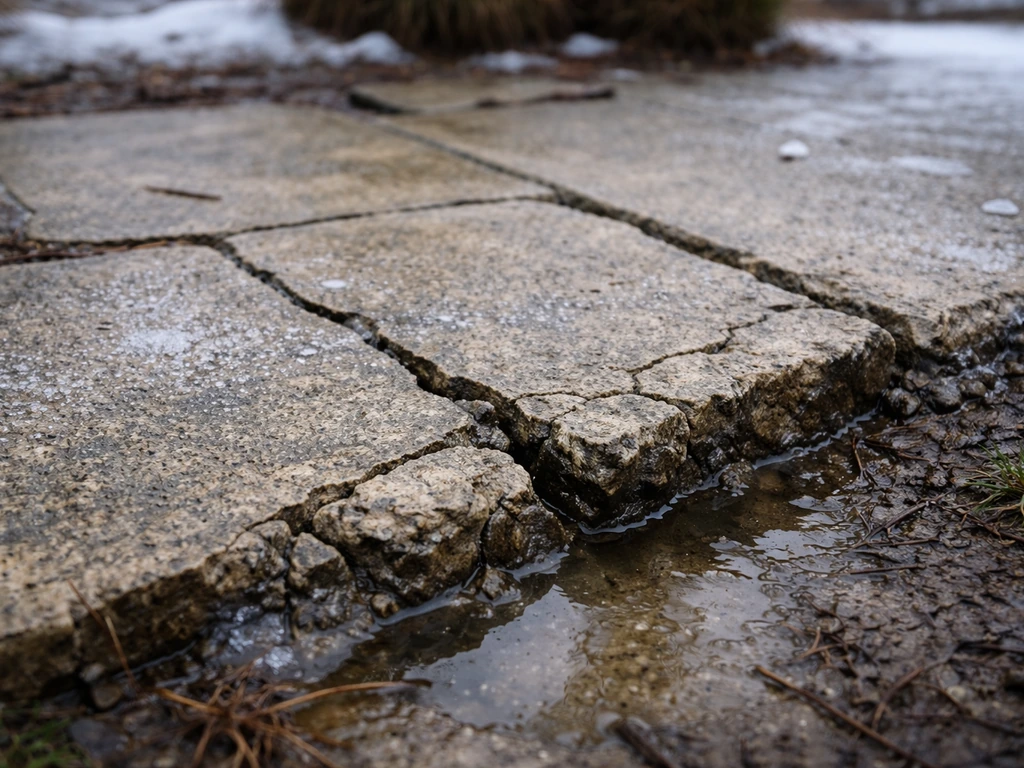
If you're in a climate that freezes and thaws repeatedly through winter, water absorption is the number one thing to watch. Water gets into porous materials, freezes, expands, and causes spalling, cracking, and heaving. Concrete pavers with proper air-entrainment and a well-compacted base handle this well. Porcelain tile rated for freeze-thaw (water absorption of 0.5% or less, verified by ASTM C1026 testing) also holds up reliably. Natural stone varies a lot: denser stones like granite and quartzite resist freeze-thaw damage; more porous stones like sandstone or softer limestone do not. Gravel is actually freeze-thaw forgiving because water drains straight through it. Brick ranges from excellent to poor depending on the specific product's density, always specify exterior-grade brick.
Drainage and soil type
Clay soils shift more than sandy or loamy soils, and poor drainage under any patio is a recipe for settlement and cracking. Permeable systems like gravel, dry-laid flagstone, and interlocking pavers handle wet, poorly draining sites better than rigid mortar-set systems. If your yard has standing water after rain, address that with a drainage plan before you pour a single bucket of base gravel. For sloped yards, you actually have an advantage: natural drainage is built in. The critical step is setting a consistent fall (typically 1/8 inch per foot minimum, away from the house) so water moves off the surface without pooling under adhered tile assemblies or washing out paver joint sand.
Foot traffic and use
A patio that sees daily family traffic, outdoor dining furniture, and the occasional wheeled grill cart needs a different surface than a quiet reading corner. Pavers and mortar-set flagstone are workhorses for high-traffic areas because loads distribute across the base system. Porcelain tile is durable for foot traffic but is less forgiving of point loads (dropped cast iron, heavy furniture legs) and more expensive to repair. Gravel is low-traffic friendly but loose material shifts under heavy furniture and isn't great for rolling anything (strollers, wheelchair, heavy carts). For accessibility purposes, any surface should be as flat and even as possible, a well-leveled paver or tile patio works well; loose gravel and unevenly set flagstone do not.
Budget reality check
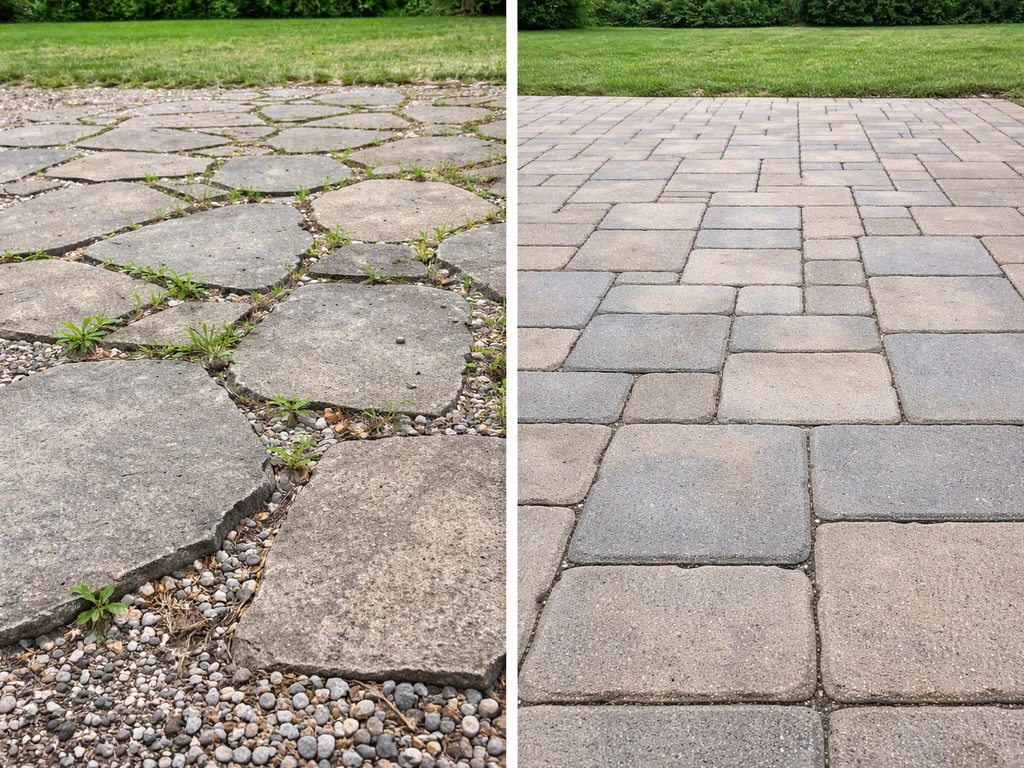
Budget drives a lot of decisions, but the cheapest material upfront isn't always the cheapest over time. Gravel is the lowest entry cost but needs replenishment and edging maintenance. Pavers cost more to install but can last 30+ years with basic upkeep. Porcelain tile has high labor costs that push total installed price up considerably. If budget is your primary concern, a separate look at the cheapest patio materials is worth your time before committing.
Top patio material options compared
Flagstone
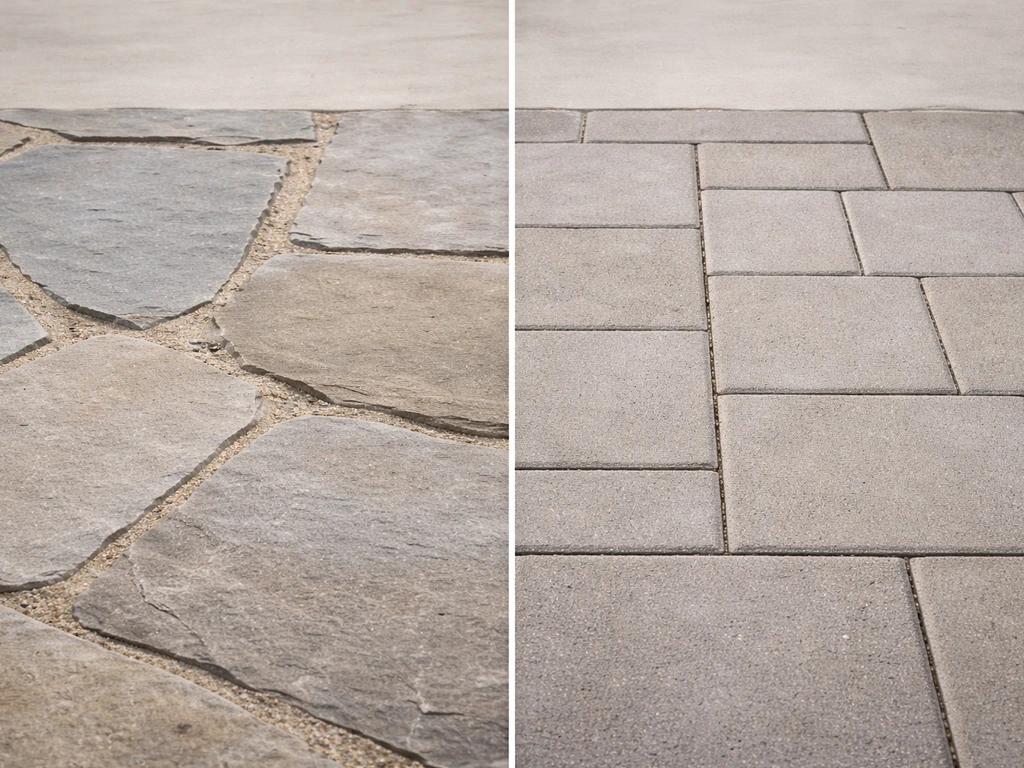
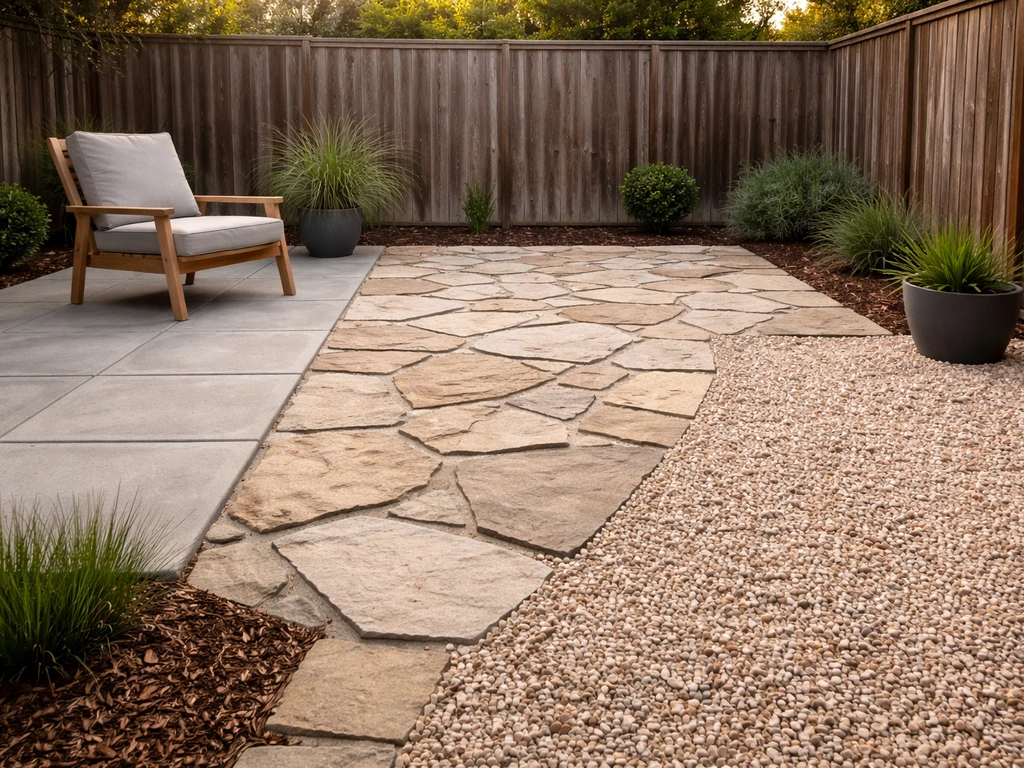
Flagstone means flat, irregularly shaped slabs of natural stone, bluestone, slate, limestone, quartzite, or sandstone being the most common. It's one of the most visually appealing options and blends naturally into garden settings. For a dry-laid patio, stones should be at least 1.5 to 2 inches thick to resist cracking under foot traffic. Thinner pieces crack, especially across irregular spans. Mortar-set flagstone is more permanent and reduces rocking and shifting, but it requires a stable concrete or compacted base and more skill. The most common failure with flagstone is uneven bedding: a stone that rocks just slightly becomes a tripping hazard and eventually cracks at the contact point. Take the time to bed each stone fully, with no hollow spots underneath. Flagstone runs roughly $15 to $27 per square foot installed depending on the stone species, region, and whether it's dry-laid or mortar-set.
Natural stone (cut/dimensional)
Cut natural stone, think sawn bluestone, granite pavers, or travertine, is flagstone's tidier cousin. The consistent thickness and square edges make installation more predictable and leveling easier. Freeze-thaw performance depends entirely on water absorption (ASTM C97 is the relevant test for natural stone porosity). Dense granite and quartzite: excellent freeze-thaw resistance. Travertine and softer limestone: use only in mild climates or fill and seal the surface carefully to block water entry. Cut stone costs more than flagstone because of the milling, but installation goes faster and the finished look is cleaner. It's a strong choice if you want the natural stone aesthetic with a more formal, uniform layout.
Brick
Brick is one of the most classic patio surfaces and, when properly installed, holds up extremely well for decades. Always specify exterior-grade or paving brick, not repurposed wall brick, which often has higher water absorption and will spall in freeze-thaw climates. Brick is typically set on a compacted gravel base with a bedding sand layer (the same system as concrete pavers). The warm, traditional look works beautifully with older home styles and cottage gardens. Efflorescence (white salt deposits on the surface) can appear after wetting cycles, especially when new, but it's mostly cosmetic and fades over time. Brick installed with polymeric sand joints resists weeds and washout better than plain sand.
Concrete pavers
Concrete pavers are the most versatile and reliably performed patio surface for the widest range of climates and conditions. If you’re trying to find the best material for patio paving across climates, concrete pavers are a top choice for durability and flexibility. The interlocking system distributes loads well, individual pavers can be replaced without demolishing the whole patio, and the ICPI-specified base system (compacted gravel base at 4 inches minimum for pedestrian use, 1-inch bedding sand, geotextile fabric to prevent fines migration, and edge restraints) is tried and tested. The most common DIY failures: skimping on base depth, skipping edge restraints, or misapplying polymeric sand. Polymeric sand needs to be dry-cured correctly and vibrated into joints properly, overfilling above the chamfer or applying it when rain is coming causes it to pop out or wash away. Get those two things right and a paver patio will outlast most other options.
Porcelain tile
Outdoor porcelain tile is sleek, low-maintenance, and genuinely beautiful, but it is the least forgiving material on this list when it comes to installation. For freeze-thaw climates, you must use frost-rated porcelain with water absorption at or below 0.5% (verified by ASTM C1026 testing). Slip resistance matters enormously outdoors: look for matte or textured finishes rated for wet external use (R11 or a DCOF of 0.42 or higher depending on your region's standard). The substrate must be fully stable (a cured concrete slab is ideal), crack-isolation membrane should be used, and the mortar bed must achieve proper contact area, 95% coverage for wet exterior applications per TCNA guidance. Professional installation for outdoor porcelain typically runs $8 to $15 per square foot in labor alone, on top of material costs. If the substrate isn't stable, tiles will crack or de-bond. This is not a beginner DIY project on a raw soil subbase.
Gravel
Gravel is the most budget-friendly and easiest to install patio surface. It drains perfectly, handles freeze-thaw conditions without damage, and can be installed by almost any homeowner in a weekend. The downsides are real though: it shifts underfoot, migrates out of bounds without proper edge restraint, and provides an unstable surface for outdoor furniture. Weed control requires a geotextile fabric layer (overlapped correctly at seams) beneath the gravel. The aggregate needs enough depth and the right gradation to stay stable underfoot, pea gravel looks great but moves around; crushed angular stone compacts better and stays put. Edge restraints are non-negotiable: without them, gravel spreads into the lawn within one season. Gravel patios work best as low-traffic accent spaces, fire pit surrounds, or budget starter patios you plan to upgrade later.
Composite and modern low-maintenance surfaces
Beyond the classic materials, a few modern options are worth knowing about, especially if low maintenance is a top priority.
Resin-bound gravel is a step up from loose gravel: angular aggregate is mixed with a UV-stable resin binder and troweled onto a prepared base, creating a firm, permeable, weed-free surface that looks much cleaner than loose gravel. It's slip-resistant when installed correctly and won't wash or migrate. The catch is that it's moisture-sensitive during curing, rain during installation ruins the batch. UV-stable formulations resist yellowing under sun exposure. This is typically a contractor installation due to the mixing and timing requirements.
Polymer-modified cementitious overlays (sometimes called micro-topping or decorative concrete overlay systems) are applied over an existing stable concrete slab to refresh or completely change the look. They're marketed for weather resistance and freeze-thaw scaling reduction, and slip-resistant finishes can be specified. These work well as a renovation play when you have a structurally sound existing slab that just looks tired. They are not a structural solution and won't fix a slab that's heaving or cracking from subbase failure.
Composite decking boards are sometimes used for ground-level patio decks rather than a paved surface. This fits better in the patio deck category and involves a different structural system (framing, posts, footings). If you're considering a raised or ground-level deck rather than a paved surface, that's a separate evaluation with its own material choices.
Cost, longevity, and value trade-offs by budget level
Here's a realistic breakdown of what you'll actually pay and what you get for it. All cost ranges are for installed price (materials plus labor) in the U.S. as of 2026. DIY savings are real but depend heavily on skipping labor, not skipping base prep materials.
| Material | Installed Cost (per sq ft) | Typical Lifespan | Freeze-Thaw Suitability | DIY-Friendly? |
|---|---|---|---|---|
| Gravel | $3–$7 | Ongoing maintenance needed | Excellent | Yes |
| Concrete pavers | $8–$25 | 30–50 years | Good with proper base | Moderate |
| Brick | $10–$20 | 25–50 years | Good (exterior grade only) | Moderate |
| Flagstone (dry-laid) | $15–$22 | 20–40 years | Varies by stone type | Moderate |
| Flagstone (mortar-set) | $18–$27 | 25–40+ years | Varies by stone type | Difficult |
| Cut natural stone | $20–$35+ | 30–50+ years | Varies (granite = excellent) | Difficult |
| Porcelain tile (exterior) | $20–$40+ | 20–30+ years | Excellent (frost-rated only) | Not recommended |
| Resin-bound gravel | $10–$20 | 15–25 years | Good | No |
A few things to understand about these numbers: excavation and base prep are a significant portion of total installed cost regardless of the surface material. That 4-inch compacted gravel base, the edge restraints, the drainage work, that cost is there whether you're installing $8/sq ft pavers or $30/sq ft cut granite. This is why cheap materials don't always produce cheap patios. Labor is the dominant cost driver, and complex patterns, small pavers, or mortar-set systems all add labor hours fast.
For budget-focused projects, pavers or dry-laid flagstone over a properly compacted base offer the best cost-to-longevity ratio. You can also DIY the labor portion more realistically with these systems than with porcelain or mortar-set stone. If you're working with a strict budget, it's worth exploring the cheapest patio materials in more detail before finalizing your plan.
Installation requirements and site prep basics
Site prep is where most patio failures start. Get this right and almost any material will perform well. To get started with a patio project, the next step is figuring out the specific patio materials you need based on your size, base prep, and chosen surface. Cut corners here and even the most expensive stone will shift, crack, or heave within a few years.
Excavation and base depth
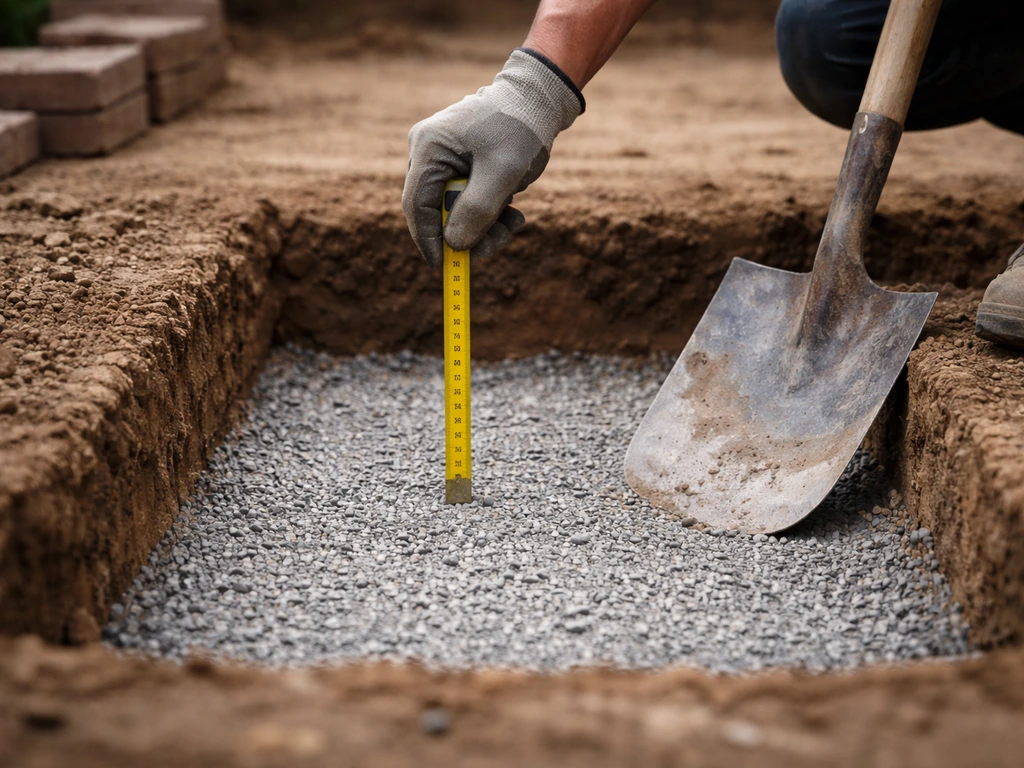
For a standard pedestrian patio using pavers or dry-laid stone, excavate to accommodate the base layer (4 inches of compacted gravel minimum for pavers, per ICPI standards), the bedding layer (about 1 inch of bedding sand for pavers), and the surface material thickness itself. Wood is less common for structural patio posts than masonry or metal, but if you do use it, choosing rot-resistant species and proper detailing helps it last through the seasons pavers or dry-laid stone. In freeze-thaw climates, deeper base depths (6 inches or more of compacted gravel) reduce heaving risk. For mortar-set systems over concrete, you need a properly cured, crack-free concrete slab as the substrate. The slab itself requires its own base prep and subgrade compaction, this is a separate, more complex project than a sand-set system.
Compaction and the layer-cake system
Compaction is not optional. Loose base material settles unevenly after installation and the whole surface moves with it. Compact the subgrade soil first, then add and compact the gravel base in lifts (no more than 3 to 4 inches at a time). A plate compactor is the right tool, hand tamping is inadequate for anything larger than a very small area. For paver systems, a geotextile fabric between the subgrade and the gravel base prevents fines from migrating upward into the base and bedding layers, which is a major cause of long-term settlement and joint sand loss.
Drainage and slope
Every patio needs to shed water away from the house. The standard minimum fall is 1/8 inch per foot (roughly 1%). For adhered porcelain tile, standing water at the assembly interface is one of the biggest freeze-thaw failure drivers, the water gets under the tile, freezes, and pops the tile off the substrate. Set your slope during base prep, not as an afterthought. For wet or poorly draining yards, consider adding a French drain or channel drain at the low edge of the patio to capture and redirect water before it becomes a problem.
Edge restraints
Edge restraints are the unsung heroes of any paver or loose-material patio. They hold the system together laterally. Without them, pavers migrate outward, gravel spreads into the lawn, and the whole assembly slowly unravels. Plastic paver restraints spiked into the subgrade work well and are affordable. For a more decorative edge, soldier-course brick or stone borders can double as edge restraint when properly bedded.
Material-specific installation notes
- Pavers: Compact gravel base (4 in minimum), geotextile fabric between soil and base, 1-inch nominal bedding sand screeded flat, pavers set with consistent joints, edge restraints before sweeping in polymeric sand, compact with plate compactor (rubber pad attached) to set sand.
- Flagstone (dry-laid): Compact gravel or crusher-run base, set each stone on a sand or stone-dust bed, adjust bedding under each stone until fully supported with no rocking, fill joints with stone dust, gravel, or ground cover plants.
- Flagstone (mortar-set): Requires a concrete slab base, use a mortar bed to fill the irregular underside of each stone completely, no hollow spots, allow proper cure time before walking on.
- Porcelain tile: Stable cured concrete substrate is required, crack-isolation membrane applied to slab, exterior-rated setting mortar (not regular thinset), achieve 95% mortar contact area in wet exterior applications, grout with exterior-rated grout, confirm frost rating and DCOF slip resistance before purchasing tile.
- Gravel: Excavate 4–6 inches, compact subgrade, lay geotextile fabric (overlap seams 12 inches minimum), install edge restraints, fill with 3–4 inches of angular crushed stone or pea gravel, rake level.
Maintenance, sealing, and long-term upkeep by material
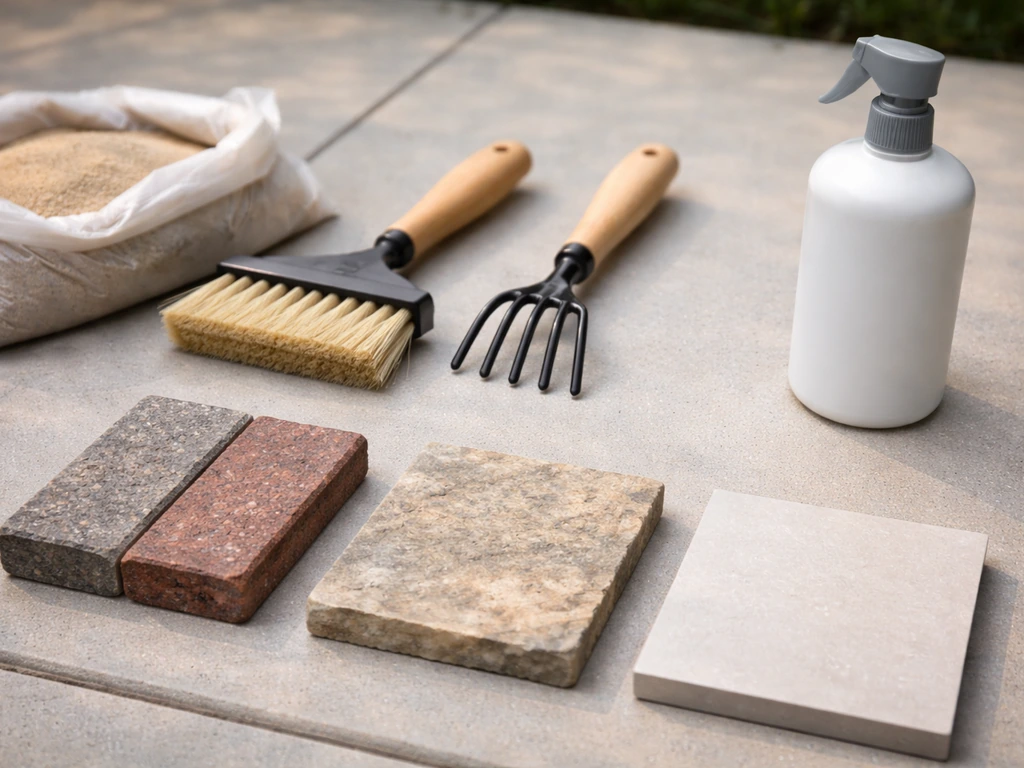
The best patio material is also one you're willing to maintain. Here's what each surface actually asks of you over the years.
Pavers and brick
The biggest maintenance task for paver and brick patios is keeping joint sand intact. A technical guide to paver and patio installation also emphasizes that for heavy daily use, paver systems rely on the correct layered base plus restrained construction, with long-term upkeep centered on maintaining joint sand and preventing base migration keeping joint sand intact. Polymeric sand washes out or degrades over time, and once the joints lose fill, weeds establish, pavers start to rock, and interlock is compromised. Inspect joints annually and refill as needed. Reseal pavers every 3 to 5 years depending on sun exposure and traffic, sealer protects against staining and helps lock joint sand. Use a paver-compatible sealer (not a film-forming sealer on natural stone). Avoid acidic cleaners; they etch surfaces and degrade sealer. Pressure washing can refresh pavers but use a fan tip at moderate pressure, too much force removes joint sand and can damage softer paver surfaces. For efflorescence, a mild masonry efflorescence cleaner applied carefully works; don't use muriatic acid at full strength.
Flagstone and natural stone
Whether or not to seal natural stone depends on the stone type. Porous stones (limestone, sandstone, unfinished travertine) benefit from a penetrating impregnating sealer that blocks water and staining without changing the surface appearance. Denser stones (granite, quartzite, honed bluestone) are more forgiving but still benefit from sealing in high-use areas. Reseal every 3 to 5 years or when water no longer beads on the surface. For dry-laid flagstone, check joints seasonally in freeze-thaw climates, frost heaving can displace stones slightly, and a flagstone that's lifted even a half inch becomes a trip hazard. Reset any stones that have moved before the gap underneath causes a crack.
Porcelain tile
Outdoor porcelain is genuinely low-maintenance once it's properly installed. It doesn't need sealing (the material is essentially non-porous). Clean with a neutral pH cleaner and a stiff brush or mop. Grout joints do need occasional regrouting if they crack or deteriorate, exterior grout is more rigid than interior grout and can crack at movement points over time. Check grout lines annually and re-grout any open joints before water infiltrates and causes freeze-thaw damage to the assembly.
Gravel
Gravel requires the most ongoing hands-on maintenance of any surface here. Rake and redistribute displaced stone after heavy rain or high foot traffic. Rake out leaves and organic debris before they break down and create a weed-friendly layer on top of the fabric. Top-dress with fresh gravel every 2 to 3 years as material compacts and migrates. Reapply or repair edge restraints as needed. Weed control fabric does a lot of the work, but some weeds will always find a way to germinate in the organic layer that accumulates on top, pull them early before roots push through the fabric.
Resin-bound gravel and overlays
Resin-bound surfaces are low-maintenance: rinse periodically with water and a gentle cleaner, and clear organic debris to prevent surface staining. Inspect annually for any cracks or lifting at the edges, repairs are possible but require matching the original material. Cementitious overlays should be sealed per manufacturer guidance, and the sealer reapplied on schedule (typically every 2 to 4 years) to maintain the weather and stain resistance the product was specified for.
The bottom line: best pick for each scenario
| Your Situation | Best Material Pick | Why |
|---|---|---|
| Freeze-thaw climate, tight budget | Concrete pavers (exterior-grade) | Handles freeze-thaw well with proper base; replaceable; mid-range cost |
| Freeze-thaw climate, premium budget | Frost-rated porcelain tile or dense natural stone (granite/quartzite) | Excellent durability; requires pro installation |
| Wet yard or poor drainage | Gravel or interlocking pavers (permeable system) | Permeable; won't trap water under rigid surface |
| High foot traffic, family use | Concrete pavers or mortar-set flagstone | Load distribution; repairable; durable |
| Low maintenance priority | Porcelain tile (on stable substrate) or concrete pavers with polymeric sand | Porcelain needs no sealing; pavers need minimal upkeep |
| DIY project, limited tools/skill | Gravel or dry-laid pavers/flagstone | Sand-set systems are forgiving and correctable |
| Natural/garden aesthetic | Flagstone or irregular natural stone | Organic look; blends with plantings |
| Modern/contemporary design | Large-format porcelain or cut natural stone | Clean lines; sleek finish |
| Strict budget | Gravel or basic concrete pavers | Lowest installed cost; gravel especially easy to DIY |
Whatever material you choose, the base prep will make or break the finished product. Spend the money on the right depth of compacted base, the right edge restraints, and the right jointing materials. A $10/sq ft paver patio built on a proper base will outlast a $30/sq ft stone patio on a substandard one. If you're comparing options for a pool deck specifically, the material priorities shift a bit given the constant water exposure, that's worth a separate evaluation. And if you're purely cost-driven, digging into the cheapest stone and patio material options before making a final call could save you a meaningful amount of money without sacrificing too much on performance.
FAQ
Can I install porcelain tile or mortar-set flagstone directly over an existing concrete slab?
Yes, but only for the right use case. If you want a paved look with minimal cracking risk, mortar-set stone or porcelain tile over a stable, properly cured concrete slab can work well, but you should not tile or mortar directly over new or unseasoned concrete. For any existing slab, check for active movement, visible cracking, or poor drainage. Overlays can refresh an existing slab, but they are not a fix for heaving or subbase failure, which will telegraph through the finish.
What are the most common mistakes that cause paver joint sand to wash out?
For pavers, poly sand joints need dry, stable conditions. Avoid joint-sanding right before rain, because the polymer needs time to dry-cure and polymerize in place. If it rained after install, wait until the joints are fully dry, then re-evaluate. Also, overfilling above the chamfer and running vibrators too aggressively can break paver edges or pull sand out of the joint channels.
If I buy frost-rated porcelain, why does my porcelain patio still crack or pop tiles?
In freeze-thaw areas, frost-rated porcelain is the main requirement, but the real-world risk is water trapped at the interface. That means you need the correct slope, crack isolation membrane where the system calls for it, and grout and movement details that prevent standing water from sitting beneath tiles. Even with the right tile rating, poor substrate stability or incorrect bedding coverage can lead to debonding and cracking.
What should I do first if my yard has standing water after rain?
If water sits on the patio after storms, the best material choice won’t save you, because the failure driver is drainage. Start by identifying the low point, then create a diversion strategy, typically a proper fall plus a drain element at the low edge (french drain or channel drain). After that, confirm the base is built to move water away from the house, not just toward the yard.
How can I prevent dry-laid flagstone from rocking and cracking?
For dry-laid flagstone, thickness matters, but bedding quality matters more. Stones that are only bedded on sand, or placed with hollow spots underneath, will rock and eventually crack at the contact point. Use full support during placement, then lock stones in place with a jointing plan appropriate for your freeze-thaw conditions.
Why does my gravel patio keep looking uneven, even when the gravel seems the same?
Use the right gradation and depth for the surface you want. Pea gravel looks nice but it tends to migrate and is less stable under furniture legs or wheels. For a more stable gravel patio, choose angular, crushed stone that compacts well, install enough depth to resist displacement, and use edging restraints so the gravel cannot spread into the lawn.
Can I use polymer-modified overlays to fix a worn patio without rebuilding the base?
Yes, but only as long as you treat it as a renovation over an existing structure and you verify the substrate is sound. Cementitious overlays and micro-toppings need a stable, non-heaving slab and proper surface preparation, otherwise the overlay won’t correct underlying movement. They also require slip-resistant finish choices if the patio gets wet.
Is resin-bound gravel a good choice for patios with a grill cart or stroller traffic?
Often, yes, because resin-bound gravel is designed to be a firm surface compared to loose gravel, and it stays permeable. However, the limitation is curing and installation timing, rain exposure during cure, and the need for a properly prepared base. If you have heavy rolling traffic, confirm the contractor’s product thickness and application specs for your load conditions.
What causes paver patios to settle unevenly, and can it be prevented?
You can dramatically reduce settlement by focusing on subgrade compaction and base design, not just the surface. Compact the soil first, then add base in lifts (so you can actually achieve density), and use geotextile where fines migration is a risk. Skipping compaction or underbuilding base depth is a common cause of pavers settling unevenly.
Which patio materials are best for wheelchair or stroller accessibility?
For accessibility, the surface must be both flat and stable under wheel loads. Pavers can work well if joints are properly filled and edge restraint is solid, so you do not get lips or rocking points. Loose gravel and uneven flagstone are harder to traverse, especially with strollers, wheelchairs, and rolling carts, so prioritize levelness and consistent elevation.