Most patio stones fall into one of five material categories: natural stone (like flagstone, limestone, sandstone, bluestone, or granite), concrete pavers or cast slabs, clay brick and masonry pavers, porcelain or ceramic-style pavers, and engineered or composite panels. A common way to specify quartz-based natural dimension stone used in construction is blank" rel="noopener noreferrer">ASTM C616/C616M, which covers quartz-based dimension stone under the natural stone category. Each one has a fundamentally different physical makeup, and that makeup is what determines how the patio looks, how long it lasts, how it handles freeze-thaw cycles, and how much work it takes to maintain. Once you know what you're working with, every other decision gets easier.
What Are Patio Stones Made Of? Materials, Pros, and Use
Common patio stone materials at a glance
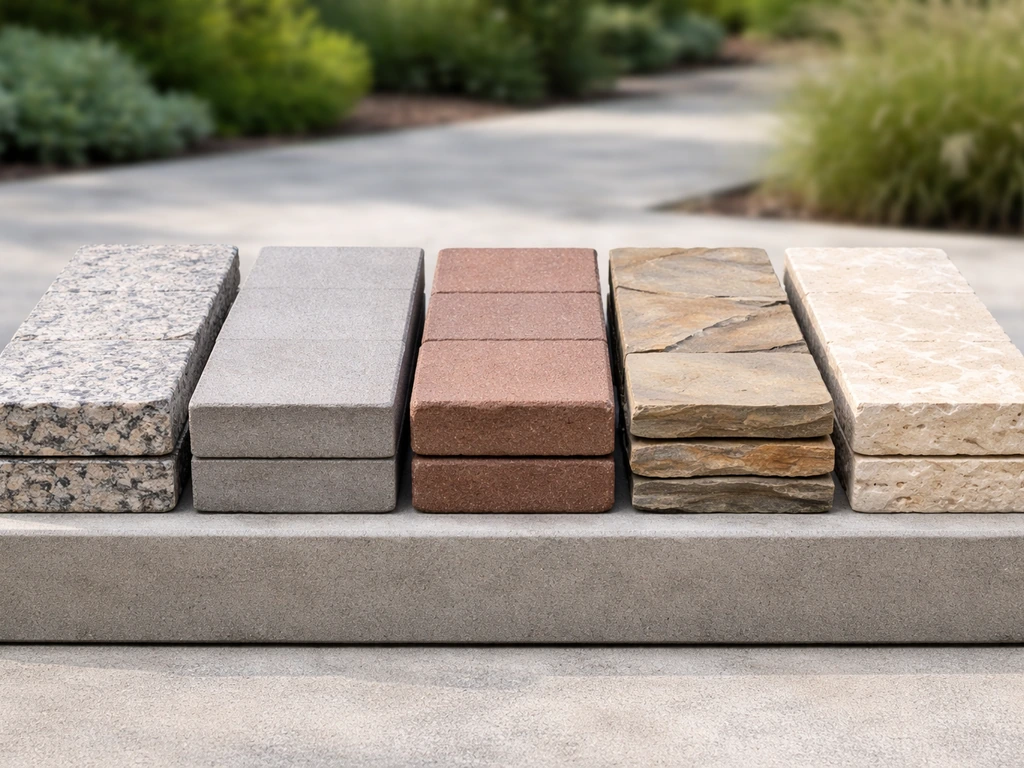
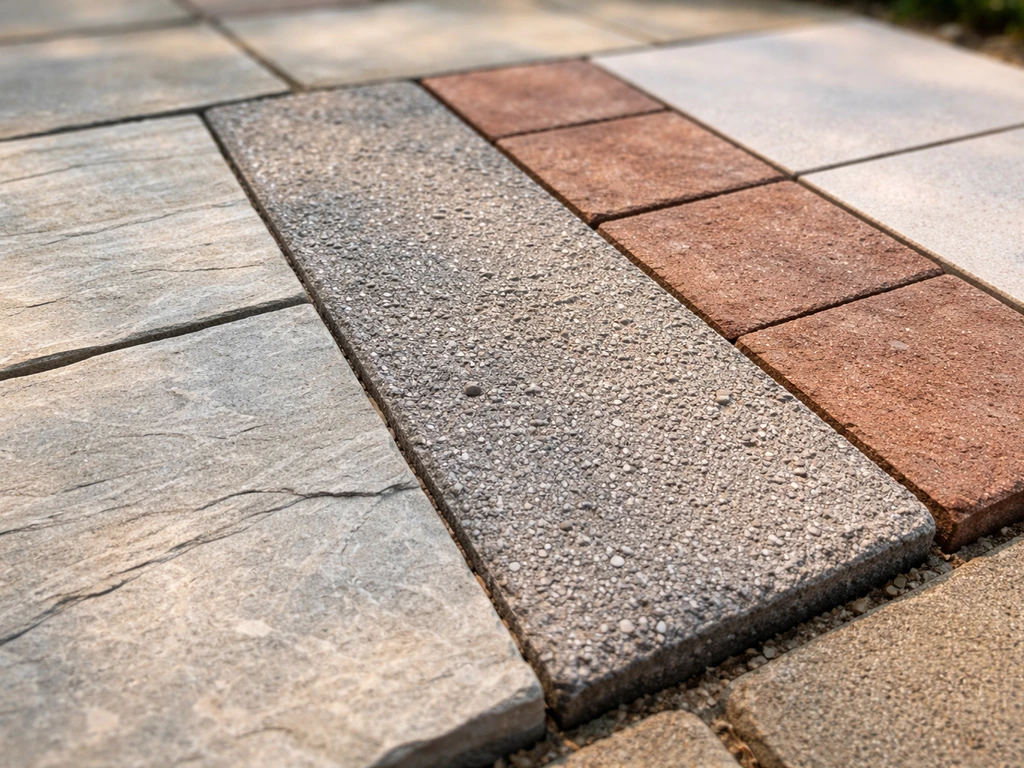
The patio and paver market includes five main material families. They look completely different on a supplier's lot, and they behave differently once they're in the ground. Here's the short version before we go deeper on each one.
| Material Type | Core Composition | Typical Thickness | Best Known For |
|---|---|---|---|
| Natural stone (flagstone, bluestone, granite, limestone, sandstone) | Quarried rock, mineral-specific | 1–2.5 inches | Unique appearance, longevity |
| Concrete pavers/slabs | Portland cement, aggregates, pigments | 2–3.5 inches | Uniformity, affordability, availability |
| Brick/clay pavers | Fired clay or shale | 2.25–3 inches | Classic look, excellent freeze-thaw performance |
| Porcelain/ceramic pavers | Kaolin clay body, fired at high heat, often glazed or textured surface | 0.75–1.25 inches (porcelain); up to 2 inches (large format) | Low absorption, modern aesthetics |
| Engineered/composite panels | Recycled polymers, rubber, wood-plastic composites | 0.75–1.5 inches | DIY-friendly, sustainability focus |
Natural stone: what it's actually made of and where it comes from
Natural stone is exactly what it sounds like: rock pulled out of the earth, cut or split into usable pieces, and sold with minimal processing. But there isn't one single thing called 'natural stone.' Each variety has its own mineral composition, and that changes everything about how it performs.
The main natural stone types used in patios
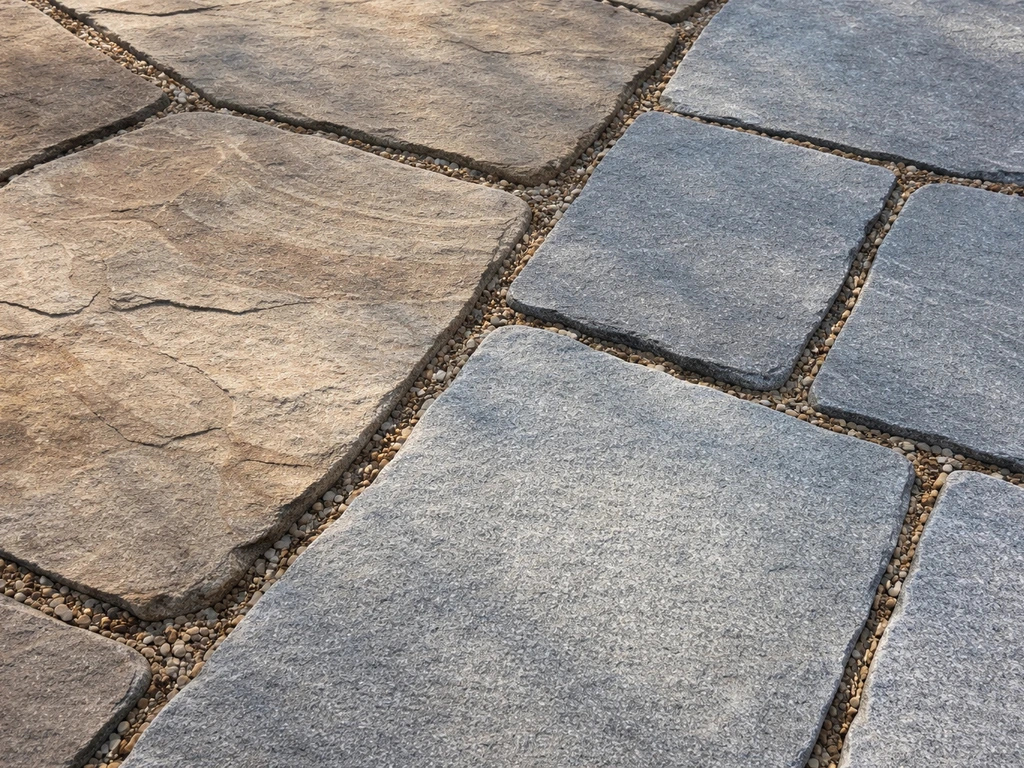
- Flagstone/bluestone: Dense sedimentary or metamorphic rock quarried mainly in Pennsylvania, New York, and the Midwest. Bluestone specifically is a variety of sandstone or argillite with a characteristic blue-gray color. It's very dense and handles foot traffic well.
- Sandstone: A sedimentary rock composed primarily of quartz or feldspar grains bonded by mineral cement. More porous than bluestone, which makes it softer and more susceptible to staining but easier to work with. ASTM C616/C616M covers quartz-based dimension stones in this family.
- Limestone: A sedimentary rock made largely of calcite (calcium carbonate). It's popular for patios because of its warm color tones, but it reacts to acids (think spilled lemonade or acid rain) and needs sealing in wet climates.
- Granite: An igneous rock with a crystalline structure made up of quartz, feldspar, and mica. It's the hardest and most durable natural stone option for patios, nearly impervious to water, and resistant to scratching.
- Slate: A fine-grained metamorphic rock that splits cleanly into flat layers. Good slip resistance due to its natural cleft surface, but some slate varieties are prone to delamination over time if exposed to repeated freeze-thaw cycles.
- Travertine: A form of limestone deposited by mineral springs, with characteristic pitting and veining. Beautiful aesthetically but requires filling those voids and sealing in any climate that sees moisture.
Because natural stone is quarried from geological formations, no two pieces are identical. Color, veining, and texture vary even within the same quarry lot, which is part of the appeal but also something to plan around when ordering. Most suppliers recommend ordering 10–15% extra to account for cuts, rejects, and future repairs. Natural stone slabs are also heavier than concrete counterparts of the same size, which affects both shipping cost and base preparation.
From a maintenance standpoint, most natural stones are porous to varying degrees, and sealing is recommended for all of them except granite. Unsealed limestone and sandstone will stain from cooking oils, rust from metal furniture legs, and etch from acidic cleaners. Natural stone also performs differently in cold climates: denser stones like bluestone and granite handle freeze-thaw cycles well, while more porous options like softer sandstone or travertine can spall (surface flaking) if water penetrates and freezes inside the stone.
Concrete pavers and cast slabs: the cement-and-aggregate story
Concrete pavers are the most common 'patio stones' sold at home improvement stores, and most people have used them without realizing exactly what's in them. At the core, they're made from a dry-cast mix of portland cement, fine aggregates (sand), coarse aggregates (crushed stone or gravel), water, and integral pigments for color. They're machine-pressed under high compaction rather than poured like a sidewalk, which gives them a denser surface than standard cast concrete.
The gold standard for interlocking concrete pavers in North America is ASTM C936 (Standard Specification for Solid Interlocking Concrete Paving Units). Pavers built to this spec must meet minimum compressive strength and water absorption limits, which is why it matters to ask a supplier whether their product is ASTM C936 compliant. CMHA’s guide for interlocking concrete pavement specifies that the paving unit material should comply with ASTM C936 ASTM C936 compliant. Products that meet this spec are typically 2.5 to 3.5 inches thick and designed for interlocking systems where the joints between units carry as much load as the stones themselves.
Beyond standard interlocking pavers, you'll also encounter concrete paving slabs, which are larger-format pieces (often 12x12, 16x16, 24x24 inches or bigger) cast with slightly different mixes. These are usually thinner and lighter than interlocking pavers and are meant to be set with wider joints on a compacted base. Some high-end slabs incorporate exposed aggregate or stamped surfaces to mimic the look of natural stone, though they still share the same cement-and-aggregate core.
One newer option worth knowing about is permeable interlocking concrete pavers, which are designed with open joints and a void-containing structure to let water pass through the surface and into a gravel subbase. These still meet ASTM C936 requirements but serve stormwater management goals in addition to standard paving functions.
Concrete pavers are generally more frost-resistant than poured concrete slabs because the interlocking joints allow for small movements without cracking. However, the pigments used to color them can fade over time with UV exposure, especially darker colors. They're also susceptible to efflorescence, which is that white powdery residue that appears when soluble salts migrate to the surface and react with air. It's not a structural problem, but it's a common maintenance complaint.
Brick and clay pavers: fired earth underfoot
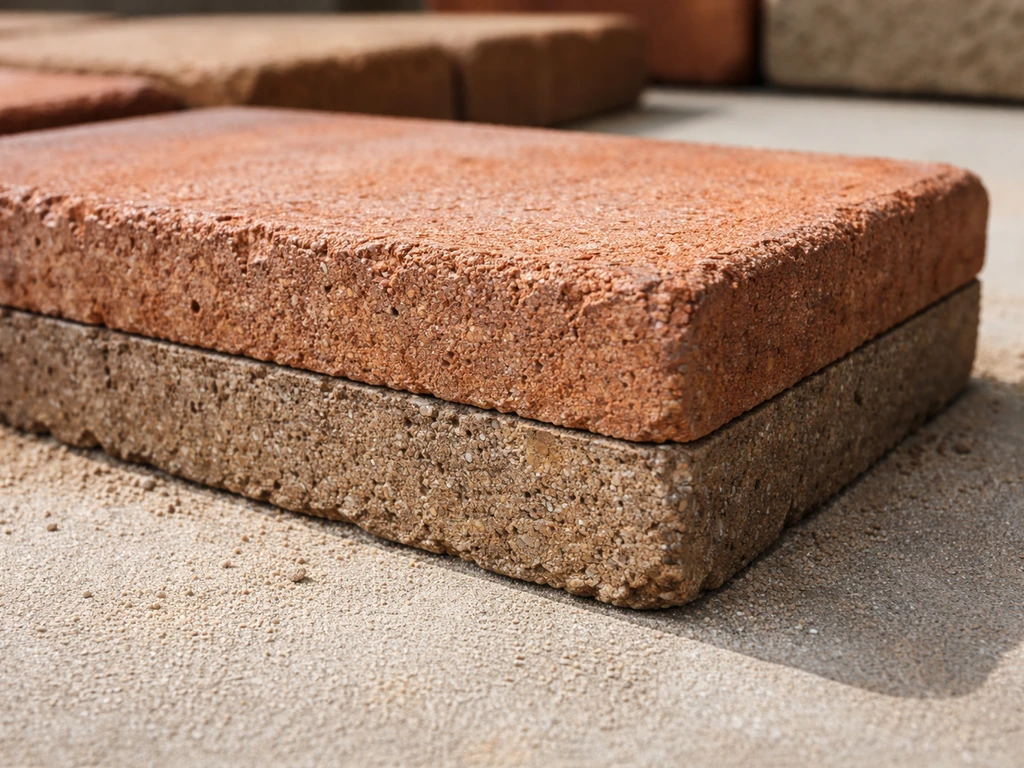
Brick pavers are made from natural clay or shale that's shaped and then kiln-fired at extremely high temperatures, typically between 1800 and 2400 degrees Fahrenheit. The firing process vitrifies the clay, fusing the mineral particles into a dense, hard unit that's fundamentally different from concrete, even though they look similar in use. ASTM C902 is the governing specification for pedestrian and light-traffic paving brick, and it sets out the minimum durability requirements including freeze-thaw performance grades.
The iron content of the clay determines the red, orange, or brown tones you see in brick. There are no added pigments. The color goes all the way through the unit, so chips and scratches don't expose a different-colored core the way surface-colored concrete can. This is one of the reasons old brick patios look better with age rather than worse, the surface character just deepens.
Clay pavers come in different durability grades based on how they'll be used and the severity of the local climate. For residential patios in freeze-thaw climates, you want SX grade (severe weathering exposure) as defined under ASTM C902. Using a lower-grade MX or NX brick outdoors in a northern climate is a mistake I've seen homeowners make, and it results in spalling within a few winters. Always confirm the weathering grade when buying.
Brick pavers are typically 2.25 to 3 inches thick and available in modular sizes that interlock well with standard patterns like herringbone or running bond. They have moderate water absorption, higher than granite or porcelain but lower than many sandstones, and that absorption combined with their density means they manage freeze-thaw reasonably well at the SX grade. Maintenance is straightforward: periodic cleaning with a pH-neutral cleaner, re-sanding of joints as needed, and occasional sealing if you want to protect against staining (though many people leave brick unsealed and let it weather naturally).
Porcelain and ceramic-style pavers: a different kind of fired clay
Porcelain pavers are having a real moment in residential patios right now, and it makes sense once you understand what they're made of. The body of a porcelain paver is primarily kaolin clay (a very fine, white-burning clay), mixed with feldspar, silica, and other minerals, then fired at temperatures above 2200 degrees Fahrenheit. This extreme heat fuses the material into an almost glass-like structure with very low water absorption, typically less than 0.5%. For comparison, most natural stone and concrete absorb several times that amount.
That ultra-low absorption is why porcelain performs so well in wet or freezing climates. There's almost no water in the material to freeze and expand. This also means porcelain is highly stain-resistant and doesn't need sealing the way natural stone does. The surface can be manufactured to mimic almost any look: wood grain, slate, marble, travertine, or concrete. Large-format porcelain slabs (24x48 inches or even larger) are increasingly used to create seamless, modern patio surfaces that would be expensive or impossible to achieve with natural stone.
The tradeoffs are real though. Porcelain is hard and dense, which makes it difficult to cut without a wet-saw with a diamond blade. Thickness is typically 0.75 to 1.25 inches for standard pavers, though 20mm (about 0.8 inch) outdoor-grade versions are now available specifically designed for loose-laid installation over a compacted base. Porcelain is also more brittle than concrete or brick, meaning a single sharp impact from a heavy dropped object can crack or chip a paver. And because the color is either surface-glazed or printed through a thin wear layer, a deep chip can expose a different-colored body underneath on some products (though rectified through-body color porcelain avoids this).
Slip resistance is worth verifying on any porcelain paver you're considering for an outdoor patio. Polished or high-gloss finishes become dangerous when wet. Look for products with a COF (coefficient of friction) rating of 0.60 or higher for outdoor use, or choose a textured, matte, or anti-slip surface finish.
Engineered, composite, and alternative patio surfaces
Beyond the four traditional categories, there's a growing range of engineered and composite products marketed for patio use. These aren't stone at all in a literal sense, but they're frequently sold alongside patio pavers and used in the same applications.
- Rubber pavers: Made from recycled rubber (often old tires), these are soft underfoot, excellent for play areas or around pools, and highly slip-resistant. They handle freeze-thaw cycles well because rubber flexes rather than cracks. Downside: they don't look like stone, they can fade and become brittle in UV-heavy climates over many years, and they're not appropriate for formal outdoor living spaces.
- Wood-plastic composite (WPC) decking tiles: Interlocking tiles made from a mix of wood fiber and polyethylene or PVC. Designed to look like wood decking but function more like a paver. Resistant to rot and insects, but can warp or fade in direct sun and aren't ideal for areas with standing water pooling under them.
- Recycled plastic pavers: Made entirely from post-consumer HDPE or PVC. Very durable, impervious to moisture, and lightweight. Available in muted grays and browns. The look is utilitarian rather than decorative, so they're more common in utilitarian paths and utility areas than formal patios.
- Resin-bound gravel: Not a paver in the traditional sense, but a mix of rounded aggregate (often crushed stone or quartz) bound together with a two-part polyurethane resin. Applied as a seamless surface directly over a prepared base. Permeable, low-maintenance, and available in a wide range of aggregate colors.
- Porcelain-look cement: Some modern cast products use white cement with dry-shake finishes or pressed aggregate surfaces to closely mimic the appearance of porcelain or natural stone. These sit in a gray zone between concrete pavers and true porcelain, worth distinguishing when sourcing.
For most homeowners planning a primary outdoor living patio, engineered and composite options are best suited for secondary uses: a side path, a utility area, a play zone, or a quick weekend project. They rarely hold up aesthetically or physically as a main entertainment patio for more than 10 to 15 years, whereas well-installed natural stone, brick, or quality concrete pavers should last 25 to 50 years with normal maintenance.
How to tell what your patio stones are made of
If you're inheriting an existing patio or trying to match replacement pieces to what you already have, identifying the material is the first step. Here's a practical inspection process that doesn't require any lab equipment. If you want a quick definition before choosing materials, patio stones are the durable paving units used to build outdoor surfaces like patios and walkways what is a patio stone.
Visual and physical tests
- Look at a broken or chipped edge: Natural stone will show a consistent mineral grain structure through the entire thickness with no layering or color change. Concrete will show a mix of aggregate (sand and small stones) in a gray cement matrix. Brick will appear uniform fired clay from edge to edge, usually red or brown. Porcelain will have a very fine, dense body, often gray or white at the core.
- Check for uniformity: Concrete pavers and brick are very consistent from piece to piece in a batch. Natural stone pieces vary in color, thickness, and texture even within the same quarry lot. Porcelain tiles are extremely uniform, with near-perfect edges and consistent dimensions.
- Test surface hardness: Scratch an inconspicuous spot with a steel nail. Granite won't scratch easily. Sandstone and softer limestones will show a scratch. Concrete is somewhere in the middle. Porcelain is extremely hard and will resist the nail. Rubber or composite products will dent rather than scratch.
- Water drop test: Drip a small amount of water on the surface and watch absorption. Porcelain will bead water almost immediately. Concrete pavers will absorb it slowly. Natural stone absorption varies widely by type. Brick falls somewhere in the middle. This tells you a lot about what kind of sealing the surface needs.
- Weight and thickness: Pick up a piece (or look at an exposed edge where two pavers meet). Concrete pavers are heavy and thick (2.5 to 3.5 inches). Porcelain is lighter for its size but dense. Natural stone varies dramatically by type. Composite and rubber pavers are noticeably lighter than any of the mineral options.
- Tap test: Tap with a knuckle or small mallet. A hollow sound suggests debonding from mortar or a loose base beneath. A solid thud is what you want. This won't tell you the material type but will flag installation problems worth addressing.
What the material means for durability and maintenance
Once you've identified what you have (or what you're planning to install), the maintenance and durability picture becomes much clearer. Natural stone and concrete both benefit from periodic sealing, though granite is the exception and needs it rarely. Brick and SX-grade clay pavers are largely self-maintaining aside from joint sand replenishment. Porcelain needs almost no sealing but requires careful cleaning to avoid soap residue buildup that makes the surface slippery. Composite and rubber products typically just need occasional washing.
| Material | Seal Required? | Freeze-Thaw Risk | Stain Resistance | Typical Lifespan (residential) |
|---|---|---|---|---|
| Natural stone (granite) | Rarely | Low | High | 50+ years |
| Natural stone (limestone/sandstone) | Yes, annually or biannually | Moderate to high | Low to moderate (unsealed) | 25–40 years with care |
| Concrete pavers (ASTM C936) | Recommended every 3–5 years | Low to moderate | Moderate | 25–40 years |
| Clay brick (SX grade, ASTM C902) | Optional | Low | Moderate | 40–50+ years |
| Porcelain pavers | Not needed | Very low | Very high | 30–50 years |
| Composite/rubber | Not needed | Very low (rubber/plastic) | High (non-porous) | 10–20 years |
Sourcing tips and what to ask a supplier
When you're buying patio stones, don't just shop by looks. Ask your supplier or installer three specific questions: What standard does this product meet (for concrete, look for ASTM C936; for brick, ASTM C902; for natural stone, ask for the quarry origin and species)? What's the water absorption rate? And what weathering exposure grade is it rated for if you're in a freeze-thaw zone? A supplier who can't answer those questions is selling you a product without accountability, and that matters when you're putting several thousand dollars of material into the ground.
For natural stone, always verify the species name and origin. 'Bluestone' from different quarries can vary significantly in density and frost resistance. 'Travertine' can range from dense, filled-and-honed slabs appropriate for cold climates to open-pored decorative material that will spall in the first hard winter. If you're matching an existing patio, bring a sample piece and match it physically rather than relying on a name alone.
Once you've sorted out the composition of your patio stones, other related questions tend to follow naturally. Whether the material is suitable for heavy loads like a hot tub, whether it can be repainted or recoated, and what permits might be required for a new installation all depend partly on what material you're working with. In many areas, you may need a permit for a stone patio, especially if it involves changes to drainage, utilities, or property lines what permits might be required for a new installation. Getting the composition question answered first puts you in a much better position to tackle everything else.
FAQ
Are patio stones always made of real stone?
Not always. Many products marketed as “patio stone” are actually pavers or slabs, not true stones. The key distinction is composition: natural stone, concrete, brick clay, porcelain, or engineered/composite materials each behave differently, so you should verify the material type on the spec sheet rather than relying on the store name.
How do I confirm the material will handle freezing weather?
For freeze-thaw areas, the most useful spec is not just “frost resistant,” it is water absorption and a weathering exposure grade (for brick, this is tied to ASTM C902 grades). Low absorption materials (porcelain, dense natural stones) are safer than higher-absorption options unless they’re installed on the right base and kept from trapping water.
If my patio looks like stone, could it still be an overlay instead of true pavers?
Sometimes. If your patio is a bonded overlay or resurfacing system, the “surface” may look like stone but the substrate can be concrete and the topping can be thin. Check whether you see a thick unit that can be lifted and replaced (true pavers) or a coating/overlay system (not the same composition).
Does porcelain patio stone type (glazed, polished, through-body) change what it’s made of and how it performs?
Yes, and it affects longevity and performance. Rectified porcelain, surface-glazed porcelain, and through-body options can all crack/chip differently under impacts and show different color at chips. Ask whether the finish is polished, glazed, or textured, and whether the manufacturer specifies outdoor-rated thickness and installation method.
Is all concrete patio material the same, or are there big differences in what it’s made of?
Concrete pavers are usually dry-cast, but “concrete patio slab” products may be different from interlocking units, and not all are engineered for the same freeze-thaw conditions. Confirm whether the item is made for interlocking use, whether it meets ASTM C936, and what its water absorption limit is.
How do grout or joint materials interact with the paver material composition?
Yes. Some installers use jointing sand, others use polymeric sand, and some use gravel-filled joints for certain permeable systems. The material’s makeup still matters, but incorrect joint material can increase water movement, efflorescence, or weed growth even if the paver itself is the right type.
Can I repaint or recolor patio stones, depending on what they’re made of?
You generally cannot “repaint” pavers back to a uniform new look permanently, especially for natural stone and brick. For concrete, surface stains or sealers may change appearance, but heavy prep and the right coating system are crucial. For porcelain, coatings typically won’t bond like they do on porous materials.
Does thickness or installation method change what patio stones should be made of (or at least which ones are appropriate)?
Yes. Even within the same category, thickness and intended installation style differ. Porcelain often needs a specific outdoor thickness and a compatible base, while interlocking concrete pavers are typically thicker and designed to rely on joint interlock. Verify thickness and whether the product is rated for loose-laid vs mortar-set.
What common maintenance issues are caused by the actual materials, not installation mistakes?
Look for a “quiet” problem that can be composition-related: porous stones (limestone, sandstone, travertine, some natural varieties) can develop staining or surface etching if you use acidic cleaners, and they may need periodic sealing. For concrete, efflorescence can show up as white residue after moisture exposure even if the paver is otherwise fine.
Are engineered or composite patio stones made of the same stuff as the traditional pavers, and are they suitable for heavy use?
It can. Some composite or rubber products may be fine for a side area but not for heavy furniture, hot-tub loads, or long-term main patio traffic. Engineered products also age differently visually, often losing surface appearance sooner. Before buying, ask what weight class and intended use the product is rated for.