Title: Brick vs Flagstone Patio: Which One Is Right for Your Yard?
Brick vs Flagstone Patio: Which Is Better for Your Home?
Nolan Ellison
13 Aug 2026
Meta description: Brick vs flagstone patio compared on cost, durability, slip resistance, drainage, and installation. Practical guidance to help you choose the right surface.
For most homeowners, flagstone is the better-looking choice and brick is the more predictable, budget-friendly one. Flagstone gives you natural variation, organic shapes, and a surface that feels genuinely unique. Brick gives you uniform, tested units with a known compressive strength (Grade SX brick must hit 8,000 psi under ASTM C902), consistent sizing that makes installation easier, and a classic look that suits a wide range of homes. If your priority is character and a naturalistic aesthetic, go flagstone. If you want reliable performance in a freeze-thaw climate with simpler DIY installation, brick earns that nod. Both can last 25 to 50 years or longer with proper base prep and maintenance.
Questions to Ask Before You Decide
Before committing to either material, run through these four filters: site conditions, budget, climate, and style. The answers will narrow your choice faster than any comparison chart.
- Site: Is your subgrade stable compacted soil or soft fill? Unstable ground punishes flagstone more harshly — irregular slabs can rock and crack on an uneven base, while small brick units distribute load more forgivingly.
- Budget: Brick typically runs $8–$20 per square foot installed; natural flagstone ranges from $15–$35 per square foot installed depending on stone type and region. Irregular flagstone cut from local quarries can land closer to $12–$18/sq ft, while premium bluestone or imported slate pushes toward the top of the range.
- Climate: In hard freeze-thaw zones (USDA zones 4–6 and colder), both materials can handle winter if your drainage is right — but higher-porosity sandstone flagstone (which can hit 12–22% porosity) absorbs more water and is more vulnerable to spalling than dense fired brick or low-absorption bluestone.
- Style: Brick suits colonial, cottage, and traditional architecture. Flagstone fits naturalistic, Mediterranean, craftsman, and contemporary designs equally well. If the look matters a lot to you, browse some examples of flagstone patios before deciding — the variation in color and form is hard to fully appreciate from a product sheet.
- DIY ability: Brick's uniform size makes layout and cutting more predictable. Flagstone requires more judgment fitting irregular pieces, though dry-laid flagstone on a sand bed is well within reach for a capable DIYer.
Appearance and Design: Color, Texture, and Pattern
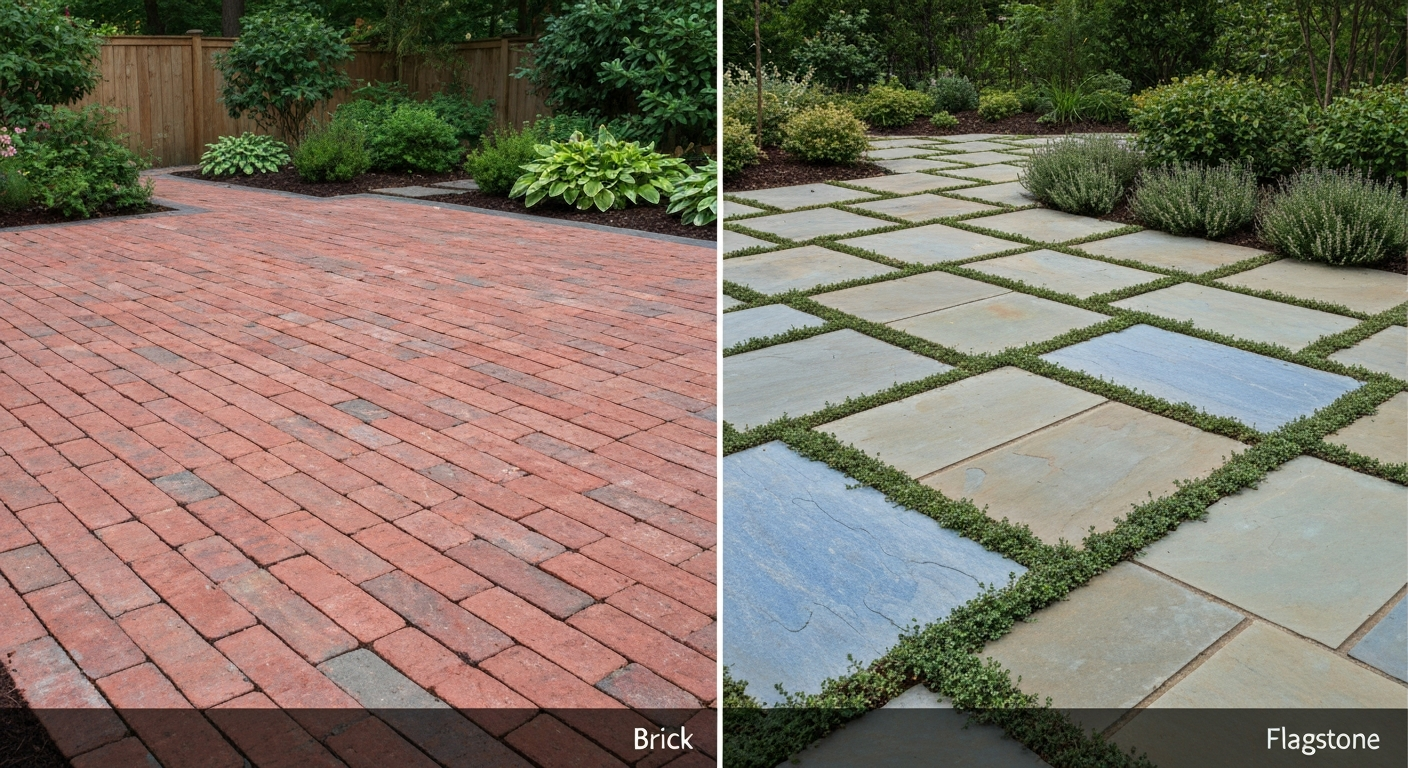
Brick comes in a range of reds, buffs, and browns set by the clay body and firing temperature. The colors are consistent from unit to unit within a batch, which makes patterns like running bond, herringbone, and basketweave crisply geometric and easy to plan. That consistency is also the limitation: your patio will look manufactured, which suits some homes perfectly and feels too rigid for others.
Flagstone is the opposite. Each piece carries the geology of its quarry, iron staining, lichen shadows, quartz veining, fossil impressions. Common flagstone types include Pennsylvania bluestone (blue-grey, fine-grained), Arizona sandstone (warm terracotta and rust tones), limestone (creamy buff to grey), and quartzite (silver, gold, and pink). For a direct comparison of slate vs flagstone patio options, see slate vs flagstone patio. You can lay flagstone in irregular (crazy pave) patterns, cut it into rectangles for a more formal look, or mix sizes in an ashlar pattern. The variety in laying patterns is one reason examples of flagstone patios look so different from one project to the next.
Texture also varies by finish. Both brick and flagstone can be ordered with a rougher surface (tumbled brick, sandblasted or thermal-finished stone) or a smoother one (wire-cut brick, honed flagstone). Rougher finishes look more natural and perform better for wet traction. Smooth finishes photograph beautifully but require more care underfoot when wet.
Durability, Strength, and Weight
Fired clay brick manufactured to ASTM C902 Grade SX has a minimum average compressive strength of 8,000 psi and strict limits on cold-water absorption. That consistency is a real advantage: you know what you're getting before a single unit leaves the factory. I've pulled up old brick patios that were laid in the 1950s and found the brick itself in near-perfect condition, the base had failed, not the brick.
Flagstone strength varies enormously by rock type and quarry. Dense bluestone and quartzitic sandstone can exceed brick's compressive strength. Soft limestones and highly porous sandstones run lower and are more prone to edge chipping, delamination, and surface spalling, especially when moisture gets in. The Natural Stone Institute is clear that you need the test data sheet (TDS) from the specific quarry and lot, stone properties aren't standardized the way fired brick is. Ask your supplier for ASTM C97 absorption and density results before ordering for a freeze-thaw climate.
Weight matters for handling and subgrade loading. A 1-inch slab of typical limestone flagstone (density around 163 lb/ft³) weighs roughly 13.6 lb/ft², and a 2-inch slab roughly 27.2 lb/ft². By comparison, a standard paving brick (roughly 4 in x 8 in x 2.25 in) weighs about 4–5 lbs per unit, and laid on a 1-inch sand bed the total thickness is still well under 4 inches. Large flagstone pieces, especially at 2-inch thickness, are genuinely heavy and awkward to move alone, factor that into your DIY plan.
Slip Resistance and Safety
The ANSI A326.3 standard (used alongside ANSI A137.1) sets a dynamic coefficient of friction (DCOF) threshold of 0.42 or higher for hard surface flooring walked on when wet in level interior spaces, this benchmark is widely applied as a minimum for exterior wet surfaces too, though outdoor use often warrants higher values. The key thing to understand is that slip resistance is about finish, not material category. A polished flagstone or a smooth wire-cut brick can both fall below safe DCOF thresholds when wet. Peer-reviewed testing confirms that COF correlates directly with surface roughness, not with whether a surface is stone or clay.
For outdoor patios, specify textured finishes. On flagstone, thermal (flamed), sandblasted, or natural cleft surfaces all provide meaningful grip. On brick, tumbled or wire-cut faces with a light texture outperform smooth faces. If you're installing near a pool or in a region with frequent rain, ask your supplier for DCOF test results on the specific product and finish. Don't assume any natural surface is automatically slip-safe, I've seen beautifully veined limestone that became genuinely dangerous when wet because it was honed for interior use and mistakenly spec'd for an outdoor project.
Permeability, Drainage, and Freeze-Thaw Performance
Water management is where these two materials diverge most practically. Brick pavers laid in a sand-set system with open joints allow water to percolate through the joints and into the aggregate base, a genuine permeable paving approach aligned with ICPI guidance for permeable interlocking systems, which typically call for an open-graded aggregate base of 6–12 inches depending on infiltration requirements. Mortar-set brick creates an essentially impermeable surface that depends entirely on surface slope for drainage.
Flagstone behaves similarly depending on how it's set and what's in the joints. Dry-laid flagstone with gravel or sand joints is permeable. Mortar-set flagstone with tight joints is not. The choice of what to put between flagstones (sand, polymeric sand, mortar, gravel, or moss) determines both permeability and maintenance load. Wide joints filled with pea gravel or planted with creeping thyme or moss maximize drainage and look beautiful but require occasional weeding. Polymeric sand is more maintenance-free but largely blocks infiltration and has strict installation requirements, it must go down on clean, dry stone, and many product bulletins warn against use in installations designed to remain fully permeable.
In freeze-thaw climates, the base is more important than the surface material. Trapped moisture under any paving surface, brick or stone, will heave and crack it. Both materials need a minimum 4–6-inch compacted aggregate base for pedestrian patios in stable soils, increasing to 6–8 inches or more in frost-vulnerable or poorly draining sites. Dense, low-absorption stone (absorption under 3% is a commonly used threshold for frost-exposed stone) handles freeze-thaw better than high-porosity sandstone, which can hit 12–22% porosity. Petrographical and petrophysical properties of sandstones (peer‑reviewed article describing porosity/absorption ranges) reports many sandstones have porosity in the 12–22% range and recommends quarry/lot ASTM C97-style absorption testing to confirm freeze–thaw suitability. Brick fired to ASTM C902 Grade SX has strict absorption limits built into the specification, giving you a predictable frost performance that a random quarried sandstone cannot match without individual lot testing.
Technical Specs: Thickness, Sizing, and Base Requirements
Getting the dimensions right before you order saves expensive mistakes. Here's what the industry guidance and supplier specs generally call for.
Flagstone Thickness
For pedestrian patios, a nominal 1.25 inches (approximately 30 mm) is commonly cited as the minimum thickness for foot traffic on a well-prepared base. Increase to 2 inches (50 mm) nominal where you have concentrated point loads, heavy outdoor furniture, or any area where a vehicle might roll over the edge. For more detailed guidance on how thick flagstone for patio to choose based on traffic, load, and base conditions, see our thickness guide. Dry-laid flagstone, set directly on a compacted aggregate base and bedding sand, needs the thicker end of that range (closer to 1.5–2 inches) because it lacks the mortar bond to distribute load. Mortar-set flagstone on a concrete slab can work at 1.25 inches for pedestrian use if the concrete substrate is sound and continuous.
Flagstone Piece Sizes
Irregular flagstone is typically sold by the ton rather than by piece count. For a dry-laid irregular pattern, pieces ranging from about 1 square foot to 4 square feet work well, smaller pieces fill gaps and reduce waste while larger pieces anchor the pattern. For a cut-stone or ashlar layout, 18x18, 24x24, and 12x24-inch pieces are common nominal sizes. Very large pieces (over 5 sq ft) are impressive but genuinely difficult to handle safely without two people and proper lift assists.
Base and Subgrade Specs
For a standard residential pedestrian patio in stable soil with reasonable drainage, industry and ICPI guidance generally calls for: excavate to 8–10 inches below finished grade, compact the subgrade, install 4–6 inches of compacted crushed aggregate base (increase to 6–8 inches in freeze-thaw zones or soft soils), add a 1-inch bedding sand or stone dust layer for sand-set installations, then lay your surface units. Pitch the finished surface 1–2% (roughly 1/8 inch per foot) away from the house for drainage. Edge restraint, plastic paver edging or concrete curb, is essential on sand-set installations to prevent lateral creep.
Side-by-Side Comparison
| Factor | Brick Patio | Flagstone Patio |
|---|---|---|
| Typical installed cost | $8–$20/sq ft | $12–$35/sq ft (varies by stone type) |
| Compressive strength | ≥8,000 psi (ASTM C902 Grade SX) | Varies widely by rock type; requires lot TDS |
| Absorption / frost risk | Strictly controlled by ASTM C902 | Highly variable; dense bluestone/quartzite low-risk; sandstone can hit 12–22% porosity |
| Weight at 1 in. thickness | ~4–5 lbs per standard unit | ~13.6 lb/ft² (limestone density) |
| Typical lifespan (well-maintained) | 30–50+ years | 25–50+ years |
| Slip resistance (wet) | Finish-dependent; textured/tumbled recommended | Finish-dependent; natural cleft/thermal recommended |
| Permeability (sand-set) | Good — open joints permit infiltration | Good — varies by joint fill material |
| Pattern flexibility | High (herringbone, basketweave, running bond) | Very high (irregular, ashlar, cut geometric) |
| DIY difficulty | Moderate — uniform units simplify layout | Moderate-high — irregular pieces need fitting judgment |
| Climate suitability (freeze-thaw) | Excellent (Grade SX) | Good to excellent (dense stone); poor (high-porosity sandstone) |
| Maintenance | Occasional joint sand top-up; periodic sealing optional | Joint maintenance varies by fill type; sealing recommended for porous stone |
| Aesthetic style | Formal, traditional, geometric | Naturalistic, organic, versatile |
Installation: What Each Material Actually Demands
Both materials share the same base preparation logic: excavate, compact the subgrade, build your aggregate base, add bedding, and lay the surface. The differences show up in the surface-laying phase.
Brick Installation
Sand-set brick is about as approachable as patio installation gets. After your base is compacted and your 1-inch bedding sand screeded flat, you set bricks in your chosen pattern, keeping joints at about 1/8 to 3/16 inch. Once a section is laid, you sweep dry sand or polymeric sand into the joints, compact the surface with a plate compactor (with a protective pad), and you're done. Cutting bricks for borders or pattern fitting requires a wet saw or angle grinder with a diamond blade, neither is particularly intimidating. The main thing to get right is base compaction; I've seen beautifully laid brick patios fail within two seasons because the homeowner skipped a second pass with the plate compactor on the subgrade.
Flagstone Installation
Dry-laid irregular flagstone takes more patience. You're essentially solving a jigsaw puzzle where the pieces are heavy and you can't see the picture on the box. Work from a central anchor piece outward, fitting stones so joints stay roughly 1–2 inches wide. For each piece, scoop out or build up the bedding layer so the stone sits flat without rocking, this test-fit-adjust cycle is the most time-consuming part. Once everything is fitted, fill joints with your chosen material (see the jointing section below). Mortar-set flagstone on a concrete slab is more durable and better suited to high-traffic or wet areas, but it commits you to a rigid installation that's harder to repair if a single stone cracks.
Jointing Options for Flagstone
What you put between flagstones has a big effect on both the look and the long-term behavior of the patio. For a detailed guide on what to put between flagstones on a patio, see the linked resource comparing sand, polymeric sand, mortar, gravel, and planting options. Sand or stone dust joints are simple, inexpensive, and fully permeable, but they need annual top-ups and can allow weed germination. Field research (Field Survey of Permeable Pavement Surface Infiltration Rates) found that routine maintenance such as vacuuming and cleaning can significantly improve or restore surface infiltration rates, showing permeable pavers’ long‑term performance is maintenance‑sensitive Field Survey of Permeable Pavement Surface Infiltration Rates (research study). Polymeric sand hardens when activated with water, resists weeds and ants better, and lasts longer between reapplications, but it largely blocks infiltration, requires clean dry stone surfaces at installation (surface haze is a common mistake), and is incompatible with installations designed to remain permeable. Mortar joints lock everything in place and suit mortar-set applications, but a cracked joint on a dry-laid installation will heave and pop adjacent stones. Gravel (pea gravel or crushed stone) in wide joints maximizes drainage and looks naturalistic. Moss or creeping groundcovers in wide joints are beautiful and essentially maintenance-free once established, though they take a full season to fill in. The right choice depends on your climate, maintenance tolerance, and whether drainage through the patio surface is a priority.
Maintenance and Sealing
Brick patios are relatively low-maintenance. Sweep joints back up with sand or polymeric sand as needed, typically every 1–3 years depending on traffic and weather. Sealing brick is optional; a penetrating sealer can reduce staining and slow efflorescence, but many homeowners leave brick unsealed for decades without problems. If you use polymeric sand, plan to re-apply every 3–5 years.
Flagstone maintenance depends heavily on the stone type and jointing method. Dense bluestone or quartzite with tight sand-set joints needs about the same attention as brick. Porous sandstone or limestone benefits from a penetrating impregnator sealer applied every 1–2 years to reduce absorption and staining, particularly in climates with hard winters. Avoid film-forming (topcoat) sealers on exterior flagstone in freeze-thaw climates, trapped moisture under a non-breathable sealer accelerates spalling. For any stone, clean spills promptly and avoid acidic cleaners (vinegar, citrus) on limestone or marble-family stones.
Climate-Specific Recommendations
In hard freeze-thaw climates (northern US, Canada, high elevations), prioritize low absorption above all else. Brick rated ASTM C902 Grade SX is purpose-built for this. If you choose flagstone, insist on dense, low-porosity stone: Pennsylvania bluestone, quartzite, or granite are the safe choices. Get the ASTM C97 absorption data before ordering, and make sure your base drains freely, this is the single biggest variable in whether a patio survives ten winters intact.
In hot, dry climates (desert Southwest, Southern California), thermal expansion and UV exposure matter more than freeze-thaw. Both brick and flagstone handle heat well, but lighter-colored flagstone (limestone, sandstone) reflects more heat than dark brick, making the surface more comfortable barefoot. Seal porous stone to prevent salt efflorescence from irrigation water.
In coastal environments, salt air and moisture are the primary stressors. Dense stone and well-fired brick both hold up well. Avoid mortared joints directly on sand-set bases in these areas, the constant moisture cycling works the mortar out over time. Permeable jointing that allows water to move freely through the assembly tends to perform better long-term.
Cost Reality: What You're Actually Paying For
The material price is only part of the installed cost. Labor for fitting irregular flagstone typically runs 20–40% higher than for brick because of the extra time spent fitting and adjusting each piece. That said, material costs for flagstone from a local quarry can be surprisingly competitive with quality brick in regions where stone is quarried nearby, local sourcing makes a real difference. Always get a price per square foot including base materials (aggregate, bedding sand, edge restraint) when comparing contractor quotes, because some low bids achieve their number by skimping on base depth.
| Cost Component | Brick (approx.) | Flagstone (approx.) |
|---|---|---|
| Material (surface units) | $3–$8/sq ft | $5–$20/sq ft (type-dependent) |
| Base aggregate + sand | $1.50–$3/sq ft | $1.50–$3/sq ft |
| Labor (installation) | $4–$10/sq ft | $6–$14/sq ft |
| Typical total installed | $8–$20/sq ft | $12–$35/sq ft |
| Sealing (optional, first year) | $0.50–$1.50/sq ft | $0.75–$2/sq ft |
| Lifespan before major repair | 25–50+ years | 20–50+ years |
DIY vs. Hiring a Pro
Sand-set brick is the most DIY-accessible patio option available. If you're comfortable renting a plate compactor, using a wet saw, and following a straightforward layout sequence, a standard 200–400 sq ft brick patio is a realistic weekend project for two people. Budget a full day for base prep and a second day for laying and jointing.
Dry-laid irregular flagstone is still DIY-able but takes longer and more patience. The heavy, awkward pieces demand a helper for anything over about 18 inches square, and the fitting process is slower than brick's uniform layout. Allow 2–3 days for a 200 sq ft irregular flagstone project if you're doing it for the first time. Cut-stone flagstone in regular shapes is closer to brick in DIY difficulty.
Hire a pro for: mortar-set installations over concrete (getting the mortar consistency and slope right requires experience), any project with significant drainage challenges, large-format stone pieces over 4 sq ft (genuinely hazardous to handle alone), or if your base prep reveals soft spots, high water tables, or other subgrade problems that need engineering judgment.
Alternatives Worth Considering
If neither brick nor flagstone feels quite right, there are solid alternatives. Porcelain pavers (2 cm, approximately 3/4 inch thick) are manufactured to tight dimensional tolerances, weigh roughly 8–10 lb/sq ft, resist staining and freeze-thaw cycling extremely well, and can mimic stone or wood grain convincingly. They cost more per square foot than most brick but less than premium flagstone, and installation is similar to large-format tile. The main trade-off is that they look manufactured at close range, which bothers some people and doesn't bother others at all.
Concrete pavers offer the uniformity of brick with lower material cost and a wider range of sizes and colors. Gravel (decomposed granite, pea gravel) is the most affordable and permeable option but lacks the stability and formality of stone or brick. For those who like the look of flagstone but want more consistency, cut travertine, quartzite, or bluestone in standard tile sizes bridges the gap between flagstone's character and brick's predictability. If you're exploring the full range of options, the site's coverage of alternatives to flagstone patios goes deeper into porcelain, concrete, and composite paver options.
The Bottom Line
Brick wins on consistency, predictable frost performance, and DIY ease. Flagstone wins on visual character, design flexibility, and the ability to source locally in many regions. The right choice for most people comes down to one honest question: do you want a patio that looks built, or one that looks grown? Brick looks built, in the best sense. Flagstone looks like it belongs to the landscape. Both are excellent surfaces when properly installed on a well-drained base. The base, not the surface material, is where most patio failures originate, so invest the time and money there regardless of which material you choose.
FAQ
Which is better for a patio: brick or flagstone?
It depends on priorities. Brick offers uniform size, high compressive strength (meets ASTM C902 for paving brick), a tidy modular look, and long life in freeze‑thaw climates when properly installed. Flagstone gives a natural, variable look, wider color/texture range, and flexible laying patterns but performance varies by stone type and quarry. Choose brick for predictable strength, easier modular installation and lower long‑term maintenance in harsh climates; choose flagstone for a natural aesthetic, permeability options and design flexibility if you select dense, frost‑rated stone and a correct base.
How do appearance and design options compare?
Flagstone: irregular shapes, varied colors and textures, works with naturalistic layouts, wide joints for planting or gravel. Brick: regular rectangular units, many laying patterns (herringbone, basketweave, running bond), uniform color blends available and easier to create geometric designs and straight edges. Use flagstone for organic patios; brick for formal, patterned or historically styled patios.
What about durability and load capacity?
Brick is manufactured to standards (ASTM C902 Grade SX) with high compressive strength and low absorption for severe weather. Flagstone durability varies by rock type—bluestone and quartzitic sandstones are strong and weather well; softer sandstones or limestones absorb more water and can spall in freeze–thaw conditions. Verify quarry test data (compressive strength, absorption) for flagstone if durability is a concern.
How thick must flagstone be for a patio?
Common guidance: a minimum nominal thickness of ~1.25 in (≈30 mm) for foot traffic in dry‑laid installations; increase to ~2 in (≈50 mm) or more for mortar‑set or where concentrated loads, heavy furniture, or occasional vehicle overhangs may occur. Exact thickness depends on stone type, span between supports, and installation method—confirm with supplier technical data and project conditions.
How do slip resistance and finishes compare?
Slip resistance depends mainly on surface finish, not just material. Textured, thermal, flamed or sandblasted finishes increase wet traction; honed or polished finishes reduce it. Specify and, if necessary, test the finish (DCOF/ANSI A326.3 or equivalent) for patios exposed to wet conditions. Brick pavers and textured flagstone typically provide adequate slip resistance when untreated; avoid polished stone near wet zones.
What base and subgrade prep do both materials need?
Excavate to required depth, establish a stable subgrade, compact it, install an appropriate base of compacted angular aggregate (typical pedestrian base 4–6 in.; increase to 6–12 in. in poor soils or freeze‑thaw areas), provide a bedding layer (2 in. open‑graded bedding for permeable assemblies or ~1 in. sand for sand‑set), install edge restraints, and slope the surface 1–2% for drainage. Follow ICPI/industry guidance and local code for your site.