For most residential patios, you want flagstone that is at least 1.5 inches thick, and honestly 2 inches is a safer target if you're dry-laying over sand. Thinner pieces (around 1 to 1.25 inches) can work for small-format stones under 2 square feet, but anything larger needs that extra half-inch to resist cracking under foot traffic and seasonal ground movement. Those numbers hold for typical pedestrian use. If you're parking heavy planters, rolling grills, or dealing with freeze-thaw winters, bump up your expectations accordingly.
How Thick Flagstone for a Patio Choose the Right Thickness
Nolan Ellison
10 Jul 2026
Quick recommended thickness ranges for patio use
Here's how the thickness breaks down across common patio scenarios. These are the ranges you'll see from installers, vendors, and structural guides, and they align with what actually holds up in the field.
| Use / Situation | Minimum Thickness | Recommended Thickness |
|---|---|---|
| Small-format pieces (under ~2 sq ft), dry-laid | 1.0 in. | 1.25 in. |
| Standard residential patio, dry-laid over sand | 1.5 in. | 2.0 in. |
| Standard residential patio, mortar-set over concrete | 1.5 in. | 1.75–2.0 in. |
| Large-format pieces (over 2 sq ft) | 1.5 in. | 2.0–2.5 in. |
| Freeze-thaw climate, dry-laid | 1.5 in. | 2.0–2.5 in. |
| Heavy-use area (heavy furniture, planters, equipment) | 2.0 in. | 2.5 in.+ |
The practical sweet spot for most homeowners is 1.5 to 2 inches. Thinner than 1.5 inches and you're gambling on cracking, especially on larger pieces or uneven bases. Thicker than 2.5 inches gets expensive fast and is usually overkill for a residential patio that's just handling foot traffic and furniture.
How patio load and use change required thickness
A flagstone patio that holds patio chairs and the occasional backyard party is a different engineering problem than one that supports a rolling gas grill, heavy stone planters, or regular foot traffic from a large family. If you're looking for an alternative to a flagstone patio, the same load and movement factors will help you choose a material that performs well under your specific use alternative to flagstone patio. Stone is strong in compression but weak in flexion. That means if a slab is spanning across any soft or unsupported spot in the base and something heavy sits on the middle of it, it can snap.
For purely pedestrian use with lightweight furniture, 1.5 inches is fine if your base is well-compacted and level. Once you're regularly moving heavy objects across the surface, placing planters that weigh hundreds of pounds, or expecting the patio to handle any kind of vehicle (even a lawn tractor), move to 2 inches minimum. The extra half-inch more than doubles the slab's resistance to bending forces.
Keep in mind that 'light use' doesn't stay light forever. If you're building once and not planning to re-do it, erring toward 2 inches is the right call. It adds cost at the supply stage but saves you from cracked slabs five years in.
How base, bedding, and installation method affect thickness
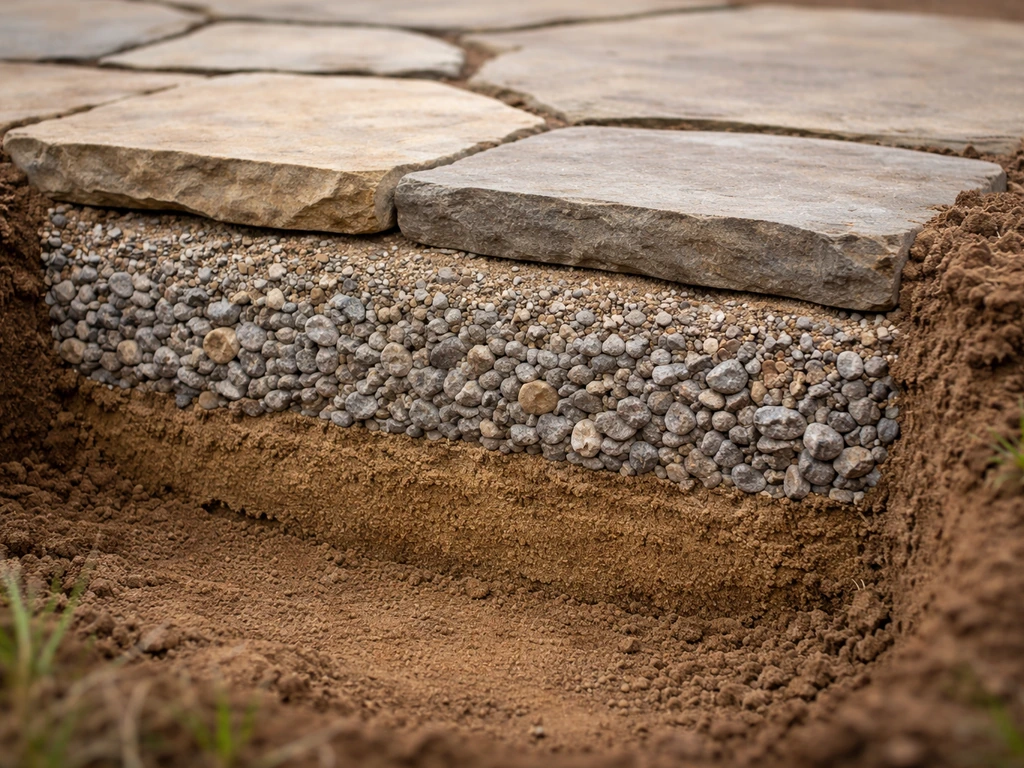
The flagstone thickness you need is directly connected to how much support the material beneath it provides. A well-built base does a lot of the structural work. A weak or shallow base shifts all that stress onto the stone itself, which means you need thicker stone to compensate. Landscaping Network recommends installing a patio or walkway base at least 3 inches deep with compacted gravel, then covering it with coarse sand before setting the flagstone a patio or walkway base at least 3 inches deep with compacted gravel and coarse sand.
The base layer: compacted gravel
A standard dry-laid assembly starts with 4 inches of compacted crushed gravel (road base or crusher run). JLC Online’s paver installation guidance also describes starting with a thick layer of compacted crushed stone beneath the paver system 4 inches of compacted crushed gravel. Some guides say 3 inches minimum, but 4 to 6 inches is the real-world standard, especially if you're in a freeze-thaw climate or on soil that shifts seasonally. This layer handles drainage and distributes load. Skimping here is the single biggest cause of long-term patio failures, regardless of how good your stone is.
The bedding layer: sand or mortar
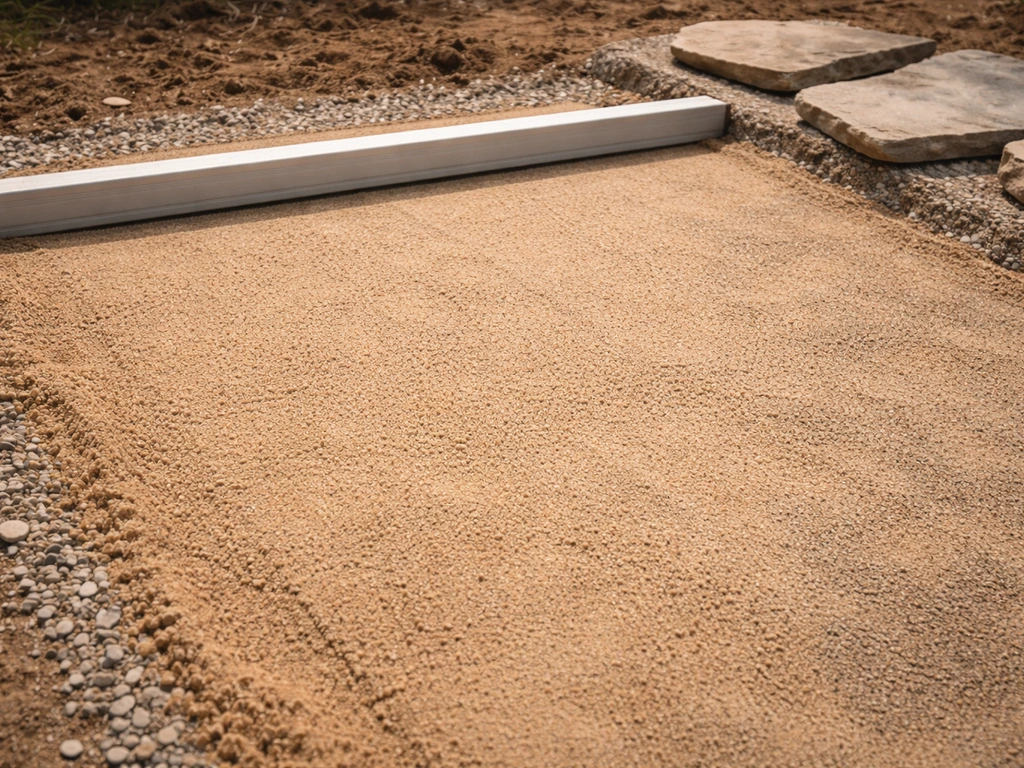
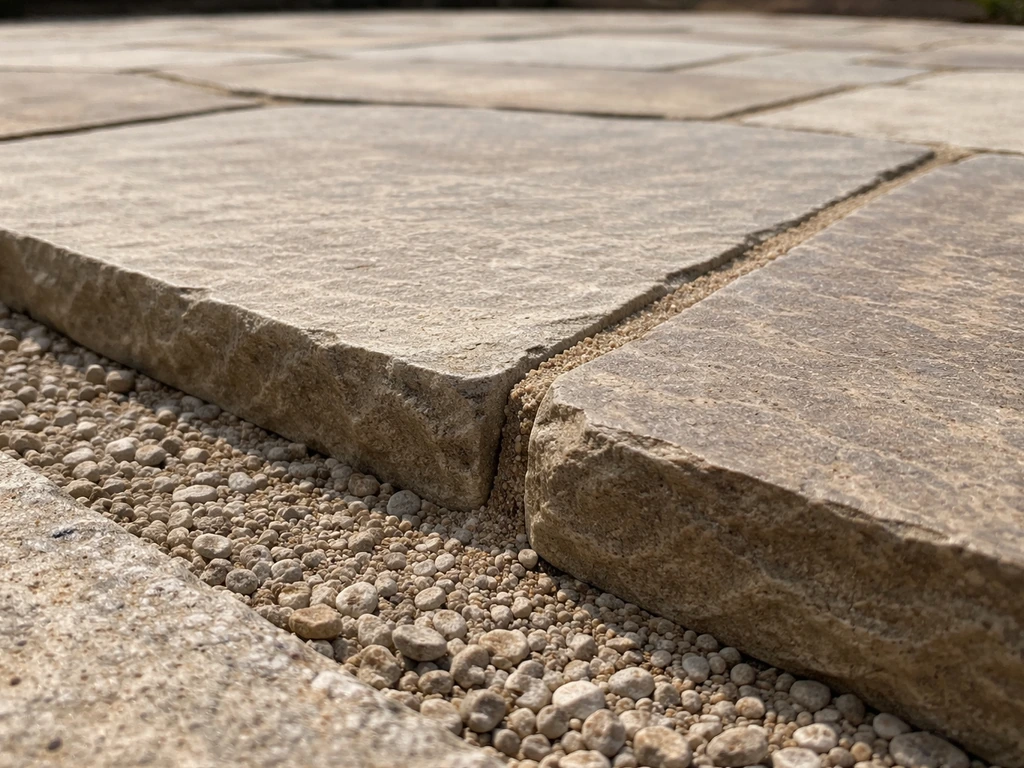
On top of the compacted gravel goes a bedding layer, typically 1 inch of coarse sand for dry-laid work. This is what you actually set the stone into and use to fine-tune level. Keep this layer at 1 inch, not more. A thicker sand bed sounds easier to work with but actually creates more instability: the stone can rock, settle unevenly, and shift under foot traffic. Thin sand beds (even 3/8 inch in some tighter applications) give less room for movement but require a very flat, well-compacted gravel base beneath them.
Dry-laid vs. mortar-set: does it change stone thickness?
For dry-laid installations over a sand bed, you're relying on the stone's own mass and the friction of the compacted system to hold everything in place. This is why thickness matters more here: thinner stone over a flexible sand bed is more prone to cracking. For mortar-set flagstone over a poured concrete slab, the rigid substrate does more structural work, which means you can technically get away with slightly thinner stone. That said, 1.5 inches is still the safe minimum in either method. Going thinner than that in mortar-set work creates risks at the joints and edges where the stone is most vulnerable. Also worth noting: not all mortars work equally here. Type S and Type N mortars are generally not recommended for natural flagstone setting beds because they lack the flexibility to handle minor movement without cracking the bond.
Here's a full picture of what a properly built dry-laid assembly looks like from the ground up: excavate to depth, lay and compact 4 to 6 inches of crushed gravel, add 1 inch of coarse sand, then set your flagstone (1.5 to 2 inches thick). Total excavation depth before adding material is typically around 7 to 8 inches to end up flush with grade.
Choosing thickness by flagstone size and shape
Stone size and thickness are directly linked. A small piece, say a 12x12-inch irregular flag, has short span distances and doesn't need much thickness to stay rigid. A large piece, like an 18x24-inch slab or a big irregular flag covering 3 or 4 square feet, has to span a much larger unsupported area. Any soft spot under the middle of a large thin piece is a cracking waiting to happen.
- Pieces under approximately 1 square foot: 1.0 to 1.25 inches can work, especially for pathways
- Pieces between 1 and 2 square feet: minimum 1.25 inches, 1.5 inches preferred
- Pieces over 2 square feet: 1.5 inches minimum, 2 inches or more strongly recommended
- Very large irregular pieces (stepping stones, accent slabs): 2 to 2.5 inches for safety
Shape matters too. Irregular flagstone with thin points or narrow sections along the edges can break right at those weak spots during installation or under load, even if the average thickness seems adequate. When sorting your stone at the yard or on delivery, set aside any pieces with noticeably thin edges or obvious stress fractures. Those pieces work fine as filler or for edges where they won't take a direct load hit, but don't put them in the center of your patio.
If you're comparing flagstone types, thicker-cut bluestone or limestone tends to come in more consistent thicknesses, which makes planning easier. Some natural stone like slate splits thin and irregular, so verifying actual thickness at the quarry or yard is important. That comparison is worth digging into if you're deciding between stone types for your project. Slate and flagstone patios can perform differently based on thickness, so it helps to compare material properties before you choose.
Climate and freeze-thaw: where thickness really earns its keep
If you're in a climate with regular freeze-thaw cycles, every part of your flagstone assembly needs to be built with that in mind. Water expands by about 9 percent when it freezes. Any water trapped under, within, or around your flagstone will create pressure when temperatures drop. Over several seasons, that cyclic expansion and contraction chips away at the mechanical strength of the stone itself, at mortar joints, and at the stability of the base.
Research on natural stone slabs confirms that freeze-thaw cycling reduces flexural strength in a non-linear way, meaning the damage accelerates rather than accumulating at a steady rate. In plain terms: a stone that's survived three winters might crack in the fourth if it's marginal. This is exactly why thicker stone (2 inches or more) is the right call in cold climates. More mass means more resistance to the bending forces from heaving ground and temperature swings.
Your base also needs to be deeper in freeze-thaw climates. A 4-inch compacted gravel base may be borderline in mild climates but is insufficient in zones where frost penetrates deep. In those areas, go with 6 inches of compacted crushed stone at minimum, and make sure drainage is genuinely good so water doesn't pool under the slab during snowmelt. One Reddit installer with cold-climate experience put it well: aim for about 6 inches of road base plus 1 inch of setting bed, with about 7 total inches of excavation, to keep frost heave from destroying your work.
Joint material choice also matters in freeze-thaw zones. Polymeric sand handles minor movement better than rigid fillers. Some blank" rel="noopener noreferrer">rigid jointing products, including certain forms of hardened jointing compound, can crack and spall out of joints as micro-movements accumulate over freeze-thaw cycles. If you're in a cold climate and choosing between jointing systems, lean toward flexible polymeric sand over rigid options. For more detail on what goes between the stones, that topic covers the full range of jointing options and their trade-offs.
Common mistakes when setting flagstone thickness (and how to prevent them)
These are the failure modes I see come up over and over, both in professional installations and DIY projects. Most of them trace back to either the wrong stone thickness for the application or problems in the system around the stone. Brick patios and flagstone patios are both viable, but the right choice depends on your site conditions, expected loads, and the look you want flagstone thickness for the application.
- Using stone that's too thin for the piece size. Large flags under 1.5 inches thick are an easy cracking setup. The fix: confirm thickness at the supplier before ordering, not after delivery.
- Inconsistent thickness across a batch. Natural stone varies. One flag might be 1.75 inches, the next 1.1 inches. Sort your stone before setting: use thicker pieces in the middle and high-traffic zones, thinner pieces at edges and low-load spots.
- Too much bedding sand. A 2-inch sand bed feels easier to work with but creates a spongy, unstable surface. Keep sand at 1 inch and spend the time getting your gravel base flat and well-compacted.
- Stray grit or debris under a flag. Even a small piece of aggregate caught under a flag creates a rocking problem and focuses stress on a single point, leading to cracking. Sweep the sand bed carefully before setting each piece.
- Ignoring thin spots on irregular pieces. A flag that averages 1.75 inches but has a 0.75-inch thin corner will break at that corner. Either flip it so the thin section is at a low-stress edge, or set it aside.
- Setting mortar-bedded stone on a damp substrate. Moisture in the bed (or on the stone surface) prevents full bonding and leaves voids that cause rocking and premature joint failure. Dry conditions are not optional.
- Skipping base compaction. A visually level gravel layer that isn't mechanically compacted will settle unevenly over time, leaving flags rocking or cracking as the support shifts beneath them. Rent a plate compactor and use it.
Planning and ordering: coverage, specs, and installation checklist
Measuring coverage and estimating material
Start with your finished patio dimensions and calculate square footage (length x width). Add 10 to 15 percent for cuts, irregular shapes, and the occasional reject piece that breaks during installation or handling. Irregular flagstone is sold by the ton, and coverage per ton varies by thickness: a ton of 1.5-inch flagstone typically covers 70 to 80 square feet, while 2-inch material covers roughly 55 to 65 square feet. Ask your supplier for their specific coverage estimate because stone density varies by type (bluestone is denser than limestone, for example).
What to ask your stone supplier
- What is the actual thickness range of this batch? (Ask for min and max, not just nominal)
- Is this stone rated or commonly used for freeze-thaw climates?
- What is the average coverage per ton at the thickness I'm ordering?
- Are there any known thin or weak pieces in the batch I should watch for?
- Do you have any pieces that are pre-cut to consistent thickness for a more uniform installation?
Pre-installation checklist
- Confirm patio dimensions and calculate square footage, adding 10–15% overage
- Verify stone thickness on delivery: measure actual pieces, not just the spec sheet
- Sort stone by size and thickness before starting: large/thick pieces for center and high-traffic zones
- Excavate to correct depth: typically 7 to 8 inches below finished grade (accounting for gravel, sand, and stone)
- Install and compact gravel base in lifts (don't dump it all at once): minimum 4 inches, 6 inches for freeze-thaw climates
- Check base for level and flatness before adding sand
- Spread 1 inch of coarse sand evenly across the compacted base
- Dry-fit stone layout before final setting to check for rocking or uneven bearing
- Remove any debris from under each piece before final placement
- Fill joints with polymeric sand (or chosen jointing material) and follow manufacturer's activation instructions
- Sweep and inspect the surface after the first full dry period to catch any movement or settling
Getting the thickness right is one piece of the puzzle, but it works together with everything else: the base, the bedding, the jointing, and the stone type you choose. If you're still deciding between flagstone and other materials for your patio, or working through what goes in the joints, those decisions interact with thickness too. A well-built flagstone patio at the right thickness, over a properly compacted base, can last decades without significant maintenance. If you want inspiration before you start planning thickness, check out examples of flagstone patios in different layouts and climates. Cut corners on thickness or base depth, and you'll be pulling up and resetting slabs in half that time.
FAQ
Can I use 1.25-inch flagstone for my patio if I’m careful with the base?
If your patio is built as a dry-laid system over compacted gravel and sand, stick with at least 2 inches when you have any pattern of moving point loads (planters, grill, frequent rearranging of furniture). For a mortar-set installation on a true, stable slab, 1.5 inches can be acceptable, but you should still verify the slab is not cracking or moving, because thin flagstone over a shifting concrete substrate will fail at the edges and joints first.
What should I check when my flagstone arrives if thickness is inconsistent?
Not reliably. Even if the average thickness looks okay, irregular flags can have thin edge zones or slight warping. Before installation, measure thickness at multiple points (center and at least two edges) and reject any pieces with noticeably thin sections, stress fractures, or voids that appear during handling. This is especially important for large-format slabs where bending spans are bigger.
Is it ever okay to mix thinner flagstone with thicker pieces on the same patio?
Yes, but only with a design adjustment. If you must place thin stone (around 1 to 1.25 inches), use it as filler panels or edge pieces and reduce the effective unsupported span by tightening spacing, adding better base support, or using more pieces so each individual piece spans less distance. Putting thin flags in the patio’s load-bearing centers is where cracking risk spikes.
What do I do if some flagstones rock after installation?
If you see rocking after setting, the issue is almost always uneven gravel or a too-thick, poorly constrained bedding sand, not the nominal thickness. Remove the affected stones, re-level the gravel base with a proper compaction pass, and keep the sand bed at about 1 inch (or less if your base is extremely flat). Replacing the stone is only necessary if it has hidden fractures or thin edge failures.
Does joint material choice affect how thick the flagstone needs to be?
For foot traffic and furniture only, joints still matter, but the depth and sizing of the joints matter too. Use joint sand with the right particle size for your gap width, then avoid overfilling, which can create a weak surface that washes out. If you have freeze-thaw, plan for a more flexible jointing approach so small movements do not cause joint spalling.
How does flagstone size change the recommended thickness?
Not usually. Larger pieces need more thickness because they span farther unsupported. A practical way to decide is to treat bigger flags (for example, about 18x24 inches or multi-square-foot irregular flags) as higher-risk and target the upper end (around 2 inches or more) especially if your base may not be perfectly flat. Small-format pieces can sometimes tolerate thinner stone, but only when the base is excellent and the piece span is short.
What thickness should I use if I plan to drive a lawn tractor across the patio?
If you want to support a lawn tractor or any vehicle that concentrates weight, you should assume the patio needs a much more rigid and heavily supported build, not just thicker stone. Increase base depth and compaction, and consider moving away from a dry-laid approach for vehicle loads. If you stay with flagstone, plan on at least the thicker end and consult the stone’s load and flex limits, because vehicle tires create dynamic loads.
If my soil shifts seasonally, is thicker flagstone alone a solution?
You generally do not. If your ground is prone to seasonal movement, the fix is base depth, drainage, and compaction, not just increasing stone thickness. A deeper, well-drained gravel base (often closer to the higher end in freeze-thaw climates) plus correctly installed bedding and flexible jointing is what prevents water buildup and heave. Thicker flagstone helps, but it cannot fully compensate for water pooling or an underbuilt base.
How important is drainage compared with thickness in cold climates?
Yes, but be deliberate. When you have freeze-thaw, drainage must keep water from remaining under or around the stone, otherwise thicker stone can still fail after repeated cycles. Also, ensure the grade slopes away from the house and that the base is installed to the correct depth in cold climates. If you rely on sand for drainage performance, thick sand beds can trap water and increase movement.