Slate and flagstone are both natural stone, both beautiful, and both genuinely durable when installed correctly, but they behave differently underfoot, hold up differently in cold climates, and cost different amounts to source and lay. If you want a low-maintenance, high-traction surface in a freeze-thaw climate, true quartzite or bluestone flagstone usually wins. If you want a refined, finely textured surface in a mild climate and you are willing to seal it regularly, slate can be stunning. This guide walks through every factor that should drive that decision: appearance, durability, climate performance, thickness and base requirements, installation methods, joint-filling options, maintenance, cost, sourcing, and whether to DIY or hire a pro.
Slate vs Flagstone Patio: Compare, Install, Maintain Guide
Who this guide is for and how to use it
This article is written for homeowners who are past the "which stone looks nice?" stage and need to understand what they are actually committing to. Whether you are planning a 200 sq ft back patio, a 600 sq ft entertaining space, or a series of stepping stones through a garden, the same structural and material decisions apply. Read straight through for a full picture, or jump to the section most relevant to your stage: the quick comparison table if you are still deciding, the climate section if you live in a freeze-thaw zone, the cost section if you are budgeting, and the DIY checklist if you plan to lay it yourself.
Slate vs flagstone at a glance
| Attribute | Slate | Flagstone (sandstone/bluestone/quartzite) |
|---|---|---|
| Stone type | Foliated metamorphic rock | Sedimentary (sandstone, limestone) or metamorphic (quartzite, bluestone) |
| Typical colors | Dark grey, charcoal, black, purple, green, rust | Buff, tan, grey-blue, brown, multi-color; varies widely by region |
| Surface texture | Natural cleft (slightly uneven), smooth gauged, or textured | Natural cleft, sawn, or tumbled; generally rougher than gauged slate |
| Common patio thickness | 1.25–2.0 in (30–50 mm) | 1.0–2.5 in (25–65 mm); 1.5 in minimum recommended for sand-set |
| Freeze-thaw suitability | Fair to poor (high absorption in some varieties; risk of delamination) | Varies: quartzite excellent; sandstone fair to poor; bluestone good |
| Slip resistance (wet) | Good when natural-cleft; poor when honed/polished | Good to excellent on natural cleft or textured surface |
| Typical installed cost (material + labor) | $15–$30/sq ft | $12–$28/sq ft |
| DIY difficulty | Moderate to hard (brittle, splits along cleavage) | Moderate (heavier but more forgiving to cut) |
| Sealing required | Yes, annually in most climates | Recommended every 1–3 years depending on stone type |
| Main failure mode | Delamination, flaking along cleavage planes | Spalling (freeze-thaw), surface erosion (soft sandstone) |
Visual differences and how each stone looks in practice
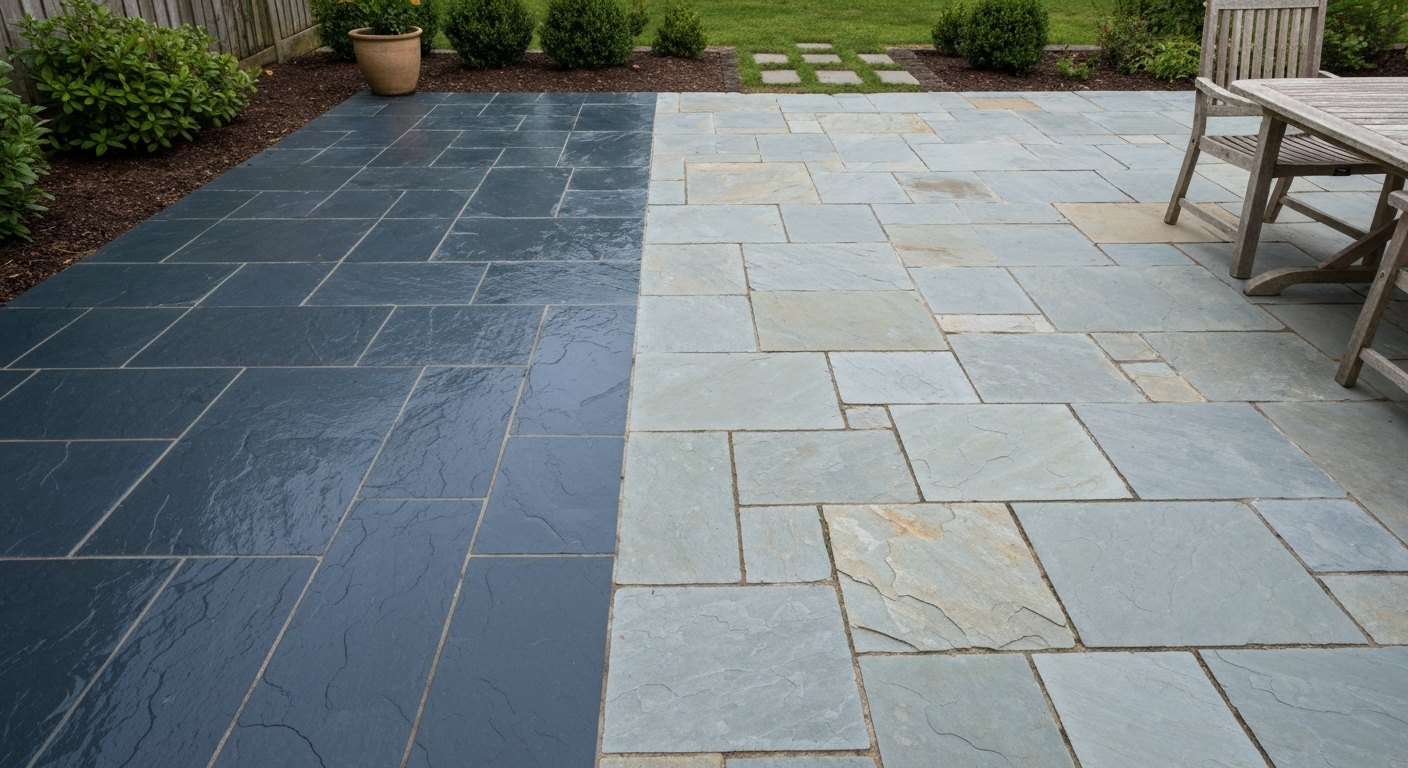
Slate has a distinctly refined, layered look. The natural-cleft surface shows fine parallel lines from the foliation planes, and the color range runs from deep charcoal and blue-black through to rusty reds, greens, and purples depending on the quarry. Chinese and Indian slate tend toward strong color variation; Welsh and Vermont slate are more uniform and grey-green. When wet, slate darkens noticeably and often takes on a rich, almost glossy appearance that a lot of homeowners love.
Flagstone is a broader category. The term covers any flat-splitting stone used for paving, so the visual range is enormous: Pennsylvania bluestone gives you that cool grey-blue tone with faint layering; Arizona sandstone is warm tan and terracotta; Oklahoma flagstone ranges from reddish-brown to buff; quartzite flags can be almost white, silver-grey, or golden. The surface texture on natural-cleft flagstone is generally more pronounced and irregular than slate, which contributes to its rustic, naturalistic look. If you want something that reads as elegant and refined, slate is usually the pick. If you want something that reads as organic and earthy, flagstone typically fits better.
Shape is another practical difference. Slate splits into relatively thin, fairly consistent slabs and can be cut to regular geometric shapes without too much effort. Flagstone is commonly sold in irregular random shapes, though it is also available in cut squares and rectangles. The irregular random layout is one of the signature looks of a flagstone patio, and it requires more fitting and cutting on-site than a regular pattern does. If you want a precise geometric layout, gauged slate tiles or cut flagstone both work, though slate's brittleness means cutting should be done carefully with a wet saw.
Durability, hardness, and slip resistance
Slate is a metamorphic rock, which generally means high strength, but its foliated structure is a double-edged sword. The same layering that gives slate its characteristic look also creates natural cleavage planes. Under point loads or freeze-thaw stress, slate can split along those planes, a failure mode called delamination. Thin slate (under about 1.25 in / 30 mm) on a sand base is particularly vulnerable. Gauged slate tiles, which are machined to a consistent thickness, are more uniform but thinner, and they need a full mortar bed or concrete substrate to avoid cracking.
Flagstone durability depends almost entirely on which stone you are actually buying. True quartzite is extremely hard (Mohs 7+) and has very low water absorption, typically well under 3.0% by weight, which makes it among the best natural paving stones available. Bluestone (a dense sandstone or argillite, depending on the quarry) is also dense and durable. Softer sandstones and limestones can be prone to surface erosion and spalling, especially in wet or freeze-thaw conditions. When a supplier just says "flagstone" without specifying the rock type, always ask for the absorption test data. The Natural Stone Institute's Dimension Stone Design Manual lists maximum recommended water absorption values by stone class, and that number tells you a lot about freeze-thaw risk.
Slip resistance is where natural-cleft surfaces, both slate and flagstone, have a real advantage over smoother materials. The ANSI A326.3 standard provides a DCOF (dynamic coefficient of friction) threshold of 0.42 for wet level floors, but for outdoor and pool-adjacent surfaces, the pendulum test method (referenced in BS 7976/EN 13036 and widely used internationally) gives a better real-world picture of wet-surface traction. For an accessible overview comparing pendulum and DCOF methods, see StoneUpdate, overview of slip‑resistance test methods and classifications (pendulum vs DCOF) StoneUpdate — overview of slip‑resistance test methods and classifications (pendulum vs DCOF). Both natural-cleft slate and rough-textured flagstone generally perform well on these metrics. The problem arises if slate is honed or polished for a smoother look: that surface becomes genuinely slippery when wet. Keep the natural-cleft or textured finish for any exterior application.
Freeze-thaw suitability by climate
This is the section that matters most if you live anywhere in the northern US, Canada, or high-altitude regions. Water absorption is the key variable: when water trapped in stone pores freezes, it expands roughly 9%, and repeated freeze-thaw cycles will eventually spall, crack, or delaminate the surface. The ASTM C666 test method is the laboratory standard for evaluating freeze-thaw durability, and you should ask your supplier whether the specific stone lot has been tested to it.
Slate's absorption varies significantly by source. Some dense Vermont and Welsh slates have very low absorption and perform acceptably in freeze-thaw zones if installed over a well-drained base. Many imported slates, particularly softer Chinese and Indian varieties, have higher absorption rates and are genuinely not suitable for sustained freeze-thaw exposure. I have seen patios in zone 5 climates where low-grade imported slate was barely recognizable after five winters. If you are in a freeze-thaw zone and want slate, specify domestic or verified low-absorption slate and confirm the test data.
Among flagstone options, quartzite and dense bluestone are the top performers in cold climates. Dense sandstones with absorption under about 3% can work with good drainage and proper sealing. Soft sandstones and limestone should generally be avoided where hard freezes are routine. Whatever stone you choose, frost depth is a local engineering input: the IRC Table R301.2 directs you to the local authority having jurisdiction (AHJ) for the frost depth that governs your base design. The International Code Council, IRC (sample text showing frost depth/local AHJ requirement) indicates that frost depth is determined by the local authority having jurisdiction, as referenced in IRC Table R301.2 International Code Council — IRC (sample text showing frost depth/local AHJ requirement). In parts of the upper Midwest and New England, frost can penetrate 48 in or more, and a properly compacted, well-drained aggregate base is not optional.
| Climate Zone | Slate | Flagstone (quartzite/bluestone) | Flagstone (sandstone) | Key consideration |
|---|---|---|---|---|
| Freeze-thaw (zones 4-6) | Risky unless verified low-absorption domestic slate | Good to excellent | Fair to poor | Check ASTM absorption data; ensure free-draining base |
| Mild/temperate (zones 7-9) | Excellent | Excellent | Good | Sealing frequency is the main maintenance driver |
| Hot/arid (zones 9-11) | Good; color may fade in intense UV without sealing | Good; thermal expansion needs expansion joints | Good if absorption is low | Thermal expansion; UV sealing protection |
| High rainfall/humid | Good if sealed and sloped properly | Good | Fair (soft varieties absorb moisture) | Drainage slope 1.5–2%; algae/moss management |
Thickness and structural requirements
The Natural Stone Institute's Dimension Stone Design Manual specifies a mortar-bed minimum of 1.25 in (30 mm) and a recommended thickness of 2.0 in (50 mm) for full mortar-set stone paving. For sand-set pedestrian patios, industry practice calls for a minimum 1. For more detail on recommended flagstone thicknesses and when to step up the section for concentrated loads, see how thick flagstone for patio. 5 in (38 mm) nominal stone thickness, stepping up to 2.0 in (50 mm) or greater anywhere you have concentrated point loads: heavy planters, outdoor kitchen equipment, or fire pit bases. Thin gauged slate tiles (typically 3/4 in / 19 mm) need a rigid concrete substrate, not a flexible sand base, because they simply do not have the cross-sectional strength to bridge voids or span between sand high points.
The aggregate base under the stone is equally important. ICPI guidance calls for a minimum 4 in (100 mm) compacted aggregate base for pedestrian patios, placed in lifts no deeper than 4 in (100 mm) each and compacted to approximately 95% Proctor density. In freeze-thaw climates or where soils are expansive or poorly draining, increasing the base to 6 in (150 mm) or more is standard practice. Bedding sand (specified as ASTM C33 concrete sand, not stone dust or mason's sand) is screeded at a nominal 1 in (25 mm) depth. Drainage slope across the patio surface should be a minimum of 1.5%, which works out to roughly 3/16 in per foot, directing water away from the house foundation.
- Gauged slate tiles (3/4 in): full concrete slab substrate required
- Natural-cleft slate or thin flagstone (1.0–1.25 in): mortar bed on concrete slab preferred
- Standard sand-set patio (flagstone or thick slate): 1.5 in minimum stone, 4 in compacted aggregate base, 1 in bedding sand
- Point-load zones (heavy planters, kitchen equipment): 2.0 in minimum stone or switch to concrete slab substrate
- Freeze-thaw climates: minimum 6 in compacted base; verify base extends below local frost depth
- Surface slope: minimum 1.5% (about 3/16 in per linear foot) away from structures
Installation methods explained
Dry-lay on compacted sand base
This is the most common DIY method and works well for irregular flagstone patios at pedestrian loads. You excavate to the required depth, compact the subgrade, lay and compact the aggregate base in 4 in lifts, screed a 1 in layer of ASTM C33 bedding sand, then set the stone directly into the sand. The advantage is that the system is flexible: individual stones can be lifted and re-leveled if settlement occurs, and the permeable base handles surface water well. The limitation is that it requires heavier stone (1.5 in minimum) to avoid cracking, and joint stability depends entirely on what you fill between the stones. Slate is trickier on a sand base than flagstone because it is more brittle and more prone to cracking if voids develop beneath thin sections.
Mortar bed over concrete slab
This is the right method for gauged slate tiles, thin natural-cleft pieces, or any patio where you want rigid, grout-jointed results. You pour or use an existing concrete slab, allow it to cure, then set stone in a 1.25–2.0 in thick mortar bed (Type S mortar for exterior use). The result is extremely stable and the joints can be pointed with grout or mortar for a clean, finished look. The trade-off is cost and permanence: a concrete substrate costs more upfront, and if the slab develops cracks from frost heave or settlement, those cracks typically telegraph through the mortar bed into the stone above. Control joints in the concrete slab need to align with or be covered by expansion joints in the stone layout.
Dry-lay on compacted aggregate base (no bedding sand screed)
Some contractors set heavy, irregular flagstone directly on a well-compacted crusher-run base without a bedding sand layer, particularly for very large irregular pieces that are self-leveling due to their weight and irregular bottom surfaces. This is less precise and requires more hand-fitting, but it can work well for rustic stepping-stone layouts or very large pieces where screeding sand under irregular undersides is impractical. It is not recommended for tightly fitted or geometric patterns.
What to put between the stones: joint-filling options compared
Joint width and fill material are decisions that affect both how the patio looks and how much maintenance it needs year to year. For a focused walkthrough of joint-fill choices and application tips, see our guide on what to put between flagstones on a patio. Joint widths on irregular flagstone typically run from about 1/2 in to 2 in; on regular cut patterns, joints are usually 1/4 in to 3/4 in. Each fill option has real trade-offs.
| Joint fill | Best for | Joint width range | Weed resistance | Water permeability | Maintenance level | Notes |
|---|---|---|---|---|---|---|
| Dry sand | Rustic informal patios, budget DIY | Any | Poor | Excellent | High (refill after rain/wind) | Ants colonize easily; weeds establish quickly |
| Polymeric sand (standard) | Cut or regular flagstone with moderate joints | Up to 3/4 in | Good | Moderate | Low to medium | Follow product TDS exactly; haze must be removed before curing |
| Wide-joint polymeric sand | Irregular flagstone with wide joints | 1 in – 4 in | Good | Moderate | Low to medium | Different product from standard poly sand; separate activation instructions |
| Mortar pointing | Mortar-set patios over concrete; formal designs | 1/4 in – 1 in | Excellent | Low (requires drainage slope) | Low (but cracks require repointing) | Will crack if base moves; use only over rigid substrate |
| Planted groundcover (thyme, moss, etc.) | Informal garden patios; wide irregular joints | 1 in or wider | Good once established | Excellent | Medium (weeding until established; watering) | Beautiful but requires establishment period; not suitable in high-traffic or shaded areas without moss |
A note on polymeric sand specifically: standard fine polymeric sand is formulated for joints up to about 3/4 in wide. If your irregular flagstone joints run wider than that (which they often do), you need a wide-joint product, such as those marketed as "Xtreme" or "wide-joint" polymeric blends. Using a standard product in wide joints leads to washout and poor compaction. Always check the manufacturer's Technical Data Sheet for joint-width limits, activation temperature range (most require 32°F and rising), and the haze-removal window, which is typically a short period right after application before the polymer sets.
Maintenance, sealing, and repairs
Routine care
Both slate and flagstone patios need relatively little routine care: sweeping debris regularly, rinsing with a garden hose, and using pH-neutral cleaners (no vinegar, no bleach) for spot stains. The main enemy is anything acidic, which can etch the surface of calcareous stones (limestone-based flagstone or any stone with calcium carbonate content). For algae and moss in shaded or humid settings, a diluted sodium hypochlorite solution or a dedicated stone biocide works, but rinse thoroughly and avoid saturating the joints.
Sealing
Slate should be sealed with a penetrating impregnator sealer (silane/siloxane-based) every 12 months in moderate to heavy-use climates, or every 18–24 months in mild, dry climates. The sealer reduces absorption, which directly improves freeze-thaw performance and stain resistance. Do not use a topical film-forming sealer on exterior slate: film-formers trap moisture, peel in UV exposure, and become slippery when wet. Flagstone sealing frequency depends on stone density: dense quartzite may only need sealing every 3 years, while porous sandstone benefits from annual sealing. Apply sealer to clean, dry stone on a day between 50°F and 90°F with no rain forecast for 24 hours.
Stain removal
Oil stains: apply a poultice made from an absorbent powder (diatomaceous earth or unscented cat litter) mixed with a degreaser; leave 24–48 hours, then remove and rinse. Rust stains: use a diluted oxalic-acid-based stone cleaner; test on an inconspicuous area first. Efflorescence (white salt deposits): dry-brush first, then treat with a diluted phosphoric acid cleaner, rinse thoroughly, and reseal. Metal furniture rust rings respond to the same oxalic acid treatment.
Common repairs
On sand-set patios, the most common repair is re-leveling a sunken or tipped stone. This is straightforward: lift the stone, add or redistribute bedding sand, relay the stone, check level, and re-fill the joints. Cracked stones are more common with slate than flagstone because of the foliation-plane weakness; a cracked slate piece usually needs to be replaced rather than repaired. On mortar-set patios, cracked mortar joints should be repointed before water infiltration causes deeper damage: rake out the old mortar to at least 3/4 in depth, clean the joint, dampen, and pack with new Type S mortar. If the crack pattern is extensive and systematic, it usually indicates movement in the substrate slab that needs to be addressed first.
Cost ranges and what drives them
Installed costs for natural stone patios are wide-ranging because material prices vary enormously by stone type and region, and labor rates vary by market. The numbers below are 2025–2026 US national ranges for reference; always get local quotes.
| Item | Slate (per sq ft) | Flagstone (per sq ft) | Notes |
|---|---|---|---|
| Material (stone only) | $4–$12 | $3–$10 | Domestic/premium stone at high end; imported or regional at low end |
| Base materials (aggregate, sand) | $0.75–$2 | $0.75–$2 | Depth and drainage requirements drive cost |
| Labor (professional install) | $8–$18 | $7–$16 | Mortar-set costs more than sand-set; irregular pattern costs more than regular |
| Total installed (sand-set) | $15–$25 | $12–$22 | Typical pedestrian patio, contractor-installed |
| Total installed (mortar-set) | $20–$35 | $18–$30 | Includes concrete substrate if not already present |
| DIY material cost only | $5–$14 | $4–$12 | Excludes tool rental and consumables (roughly $200–$600 for a typical project) |
The biggest cost variables are: stone type and origin (domestic quarried bluestone costs more than imported sandstone; domestic Vermont slate costs significantly more than Chinese slate), pattern complexity (irregular random patterns require more cutting labor), whether you need a new concrete substrate for mortar-set work, and local labor rates. A mortar-set installation over a new concrete slab can easily run 40–60% more than a sand-set installation of the same area. Size also matters: most contractors price patios under 200 sq ft at a higher per-square-foot rate than larger jobs because mobilization costs are spread over fewer units.
Sourcing stone: types, regional varieties, and how it is priced
Flagstone is quarried across the US, which means regional availability significantly affects price and what you will find at local suppliers. Pennsylvania and New York produce bluestone; Oklahoma, Kansas, and Texas produce warm-toned buff and reddish sandstones; Arizona and New Mexico produce desert-toned flagstone; Idaho and Montana produce quartzite flags. Buying stone quarried within a few hundred miles of your project reduces freight costs considerably and is worth asking about at your local stone yard.
Slate for exterior paving comes primarily from Vermont, Virginia, and Pennsylvania domestically, with large volumes also imported from China, India, Brazil, and Wales. Quality is highly inconsistent in the import market. Chinese and Indian slates range from excellent dense material to very soft, high-absorption pieces that should not be used outdoors in cold climates. Welsh slate is generally very dense and high-quality. If you are specifying slate for a project in a freeze-thaw zone, pay the premium for verified domestic or Welsh-origin material and ask for the absorption test data.
Stone is typically priced by the pallet (covering approximately 150–200 sq ft per pallet for standard flagstone thicknesses) or by the ton. Per-square-foot pricing at a stone yard is usually based on typical coverage at a stated thickness, so confirm exactly what thickness and coverage you are paying for. Add 10–15% to your square footage estimate for waste, cuts, and breakage on irregular flagstone; add 5–10% for regular cut stone.
Questions to ask suppliers and contractors
Most people walk into a stone yard or call a contractor without asking the questions that actually matter for long-term performance. Here is a practical checklist.
For stone suppliers
- What is the water absorption rate for this specific stone (ASTM C97 or equivalent)? Can you provide the test data?
- What is the country and region of origin? Is this quarry-direct or a consolidated import lot?
- What is the actual finished thickness range in this pallet? (Ask to see a few pieces, not just the specs sheet)
- Has this stone been tested for freeze-thaw performance (ASTM C666 or equivalent)?
- What are your recommended joint widths and joint-fill products for this stone?
- What finish does this stone have, and is it appropriate for exterior wet conditions?
- What is the coverage per pallet at the stated thickness, and what waste factor do you recommend for irregular pieces?
- Can I take a sample home to test sealer compatibility before committing to a full pallet?
For contractors
- What base depth and aggregate spec do you use for this climate and stone type?
- Will you show me photos of comparable completed projects, ideally after 3+ years in service?
- What is your subgrade preparation method and how do you handle soft spots?
- Are you specifying the stone, or am I sourcing it separately? If you are specifying, can I see the absorption data?
- How do you handle drainage slope, and will it direct water away from my foundation?
- What joint-fill product are you using and why?
- Do I need a permit for this project, and will you pull it?
- What warranty do you offer on the installation (not the stone itself)?
- Who performs the work: your crew or a subcontractor?
DIY vs hiring a pro: an honest assessment
A sand-set flagstone patio is genuinely DIY-accessible for a motivated homeowner with basic tool skills, a willing back, and a free weekend. The main challenges are: getting the base compaction right (renting a plate compactor is non-negotiable, not optional), achieving consistent drainage slope, and doing the patient fitting work with irregular stone. I have seen beautiful DIY flagstone patios that outperformed contractor work simply because the homeowner spent more time on careful base prep than a rushed crew would have. I have also seen DIY patios that turned into swamp problems after the first hard rain because the drainage slope was not checked with a level.
Slate is harder to DIY well than flagstone, for two reasons: it is more brittle (cracks during cutting or if dropped), and gauged tile work requires a concrete substrate and mortar-bed skills that most homeowners do not have. If you want mortar-set slate, hire a mason with specific stone paving experience. For a sand-set irregular slate or flagstone patio, a competent DIYer with proper tools and a careful approach to base prep can achieve very good results.
On permits: many municipalities do not require a permit for a ground-level patio that is not attached to the house, but check with your local building department before you start. Some jurisdictions require permits for any impervious surface over a certain area, and some HOAs have separate approval requirements. It takes 15 minutes to check and it is not worth the risk of a stop-work order or required demolition.
| Factor | DIY | Hire a Pro |
|---|---|---|
| Base cost (labor) | $0 (your time) | $7–$18/sq ft labor |
| Tool investment | $200–$600 rental/purchase | Included in labor |
| Skill required | Moderate for sand-set; high for mortar-set | High; verify stone paving specific experience |
| Time for 300 sq ft patio | 2–4 weekends | 2–5 days |
| Risk of base failure | Moderate if first project | Low with experienced contractor |
| Permit responsibility | Homeowner | Usually contractor |
| Best for | Sand-set irregular flagstone; motivated DIYers | Mortar-set slate; complex designs; freeze-thaw climates |
DIY tool and materials checklist
Tools
- Plate compactor (rent; essential for base prep — do not skip this)
- Wet saw or angle grinder with diamond blade (for cutting stone to fit)
- Screed board and screed rails (for leveling bedding sand)
- 4 ft level and 6 ft straightedge
- String lines and stakes (for layout and slope control)
- Rubber mallet
- Hand tamper (for bedding individual stones after placement)
- Wheelbarrow
- Measuring tape and chalk line
- Garden hose with spray nozzle (for compacting sand and activating polymeric sand)
Materials
- Crushed aggregate base (3/4 in compactable gravel or crusher run): qty based on base depth x area
- ASTM C33 concrete sand (bedding layer): approximately 0.5 cu yd per 100 sq ft at 1 in depth
- Stone (add 10–15% waste factor for irregular flagstone; 5–10% for cut stone)
- Joint fill material: polymeric sand (standard or wide-joint depending on joint width), mortar, or groundcover plugs
- Landscape fabric (optional; use at subgrade interface only, not between base layers)
- Edge restraint (aluminum or plastic paver edging, or natural stone border pieces)
- Penetrating impregnator sealer (silane/siloxane-based)
Common installation mistakes and how to avoid them
- Skipping plate compaction: hand-tamping an aggregate base does not achieve adequate density. Rent a plate compactor and compact in lifts no deeper than 4 in each.
- Wrong drainage slope: failing to establish a consistent 1.5% or greater slope away from the house results in water pooling. Set your slope with string lines before you lay any stone, and check it repeatedly as you work.
- Using stone dust instead of ASTM C33 sand: stone dust (crusher fines) compacts rigidly and does not allow the bedding adjustments you need; it also retains water poorly and can migrate in freeze-thaw. Use concrete sand.
- Too much bedding sand: a 1 in nominal screed is the maximum. More sand means more settlement potential and less stable footing for the stone.
- Using standard polymeric sand in wide joints: the product will not compact or bond correctly in joints wider than its specified maximum. Use a wide-joint product for joints over 3/4 in.
- Setting gauged slate tiles on a sand base: thin tiles will crack. Use a concrete substrate with mortar bed for tiles under 1.25 in.
- Not sealing before the first winter: an unsealed porous stone going into a freeze-thaw season is a high-risk scenario. Seal before temperatures drop below 32°F.
- Ignoring subgrade drainage: if the underlying soil does not drain (heavy clay), surface slope alone is not enough. Consider a perforated drain pipe at the base perimeter or a geotextile drainage layer.
- Cutting slate with a dry blade: slate splits unpredictably under thermal stress from a dry cut. Always use a wet saw for slate.
- Buying stone without checking absorption data in freeze-thaw climates: appearance tells you nothing about absorption. Ask for the number.
Layout patterns and design ideas
The layout pattern you choose affects both the look of the finished patio and how much cutting and fitting work is involved. Here are the main options and when each makes sense.
Random irregular (ashlar)
This is the classic flagstone look: irregular shapes fitted together like a jigsaw puzzle with organic, varied joint lines. It works best with naturally irregular flagstone in warm, earthy tones. It requires significant on-site fitting and cutting, particularly at edges, but it rewards patience with a result that looks like it has always been there. Wide joints (1–2 in) filled with polymeric sand, mortar, or planted thyme or creeping sedum suit this style perfectly.
Coursed random
Stones are fitted in rough horizontal bands (courses) but with variable stone widths within each course. This is a good middle ground: more structured than fully random, less precise than a grid, and it suits both flagstone and larger slate pieces. It is somewhat easier to install than fully random because you are only fitting in one direction at a time.
Regular grid (cut stone)
Cut gauged slate tiles or cut flagstone squares laid in a regular grid pattern produce the most refined, contemporary look. This works particularly well with slate's fine surface texture and uniform color. The trade-off is that any movement in the substrate is visible as misalignment, so a rigid concrete substrate and mortar bed are essentially required for this pattern to stay looking right.
Stepping stone layout
Individual large-format flags (18 in x 18 in or larger) set at walking stride intervals through a lawn or garden bed. This uses less stone, is the fastest installation, and is extremely DIY-friendly. Heavy irregular pieces at 2+ in thickness work best here because they stay in place without edging restraints. Either slate or flagstone works well in this application, though large flat flagstone is easier to source in big single pieces.
Herringbone and geometric patterns
Cut rectangular flagstone or slate can be laid in herringbone or running bond patterns, similar to brick layouts. These read as formal and architectural, suit contemporary or transitional house styles, and require precise cutting and a rigid substrate for best results.
Edging, transitions, and landscaping integration
Edge restraints prevent the perimeter stones from shifting outward over time. For sand-set patios, aluminum or heavy-duty plastic paver edging spiked into the aggregate base is the practical solution. For a more natural look, a border course of upright-set stone (called a soldier course or mowing edge) defines the patio edge and integrates cleanly with adjacent lawn or planting beds. Keep the top edge of border stones at finished patio height or just slightly above, so mowing over the edge is possible without scalping.
Transitions to adjacent surfaces need thought: where the patio meets a door threshold, the stone surface should be at or slightly below the threshold sill, with a slope away from the door. Where it meets a deck or concrete walkway, use an expansion joint (a thin strip of closed-cell foam backer rod and sealant) rather than a hard mortar joint, because the two surfaces will move at different rates with temperature changes. Where the patio meets planting beds, a gravel or mulch buffer zone at least 6 in wide helps prevent soil migration into the joints.
How slate and flagstone compare to other patio materials
Natural stone is not the only option, and for some situations it is not the best one. Here is a quick honest comparison with the most common alternatives, which are covered in more depth in related articles on this site.
| Material | Durability | Freeze-thaw | Maintenance | Cost (installed) | Best for |
|---|---|---|---|---|---|
| Slate | Good (if thick and dense) | Fair to poor (varies by source) | Annual sealing | $15–$35/sq ft | Mild climates; refined aesthetic |
| Flagstone (quartzite/bluestone) | Excellent | Excellent | Sealing every 1–3 yrs | $12–$28/sq ft | All climates; naturalistic look |
| Brick | Very good | Good (if SW-grade) | Low | $15–$25/sq ft | Traditional styles; freeze-thaw zones |
| Porcelain pavers | Excellent (very low absorption) | Excellent | Very low (no sealing) | $18–$35/sq ft | Contemporary look; pool surrounds; low-maintenance |
| Gravel/decomposed granite | Fair (shifts over time) | Good | Annual raking/topping | $4–$10/sq ft | Informal gardens; tight budgets; good drainage |
| Composite decking | Good (UV/moisture treated) | Good | Low (occasional cleaning) | $25–$50/sq ft | Raised decks; not ground-level patios |
Brick is the closest structural competitor to flagstone in freeze-thaw climates: SW-grade (severe weathering) brick pavers have very low absorption and a long track record in cold zones. Porcelain pavers have essentially zero absorption, which makes them freeze-thaw bulletproof and eliminates the sealing requirement, but they read as manufactured rather than natural and can be slippery when wet if you choose the wrong finish. Gravel costs a fraction of stone but shifts underfoot and is not suitable for furniture-intensive spaces. The brick vs flagstone comparison and the alternatives to flagstone articles on this site go into more detail on each of these. For a detailed comparison, see our brick vs flagstone patio guide.
Climate-specific recommendations
Freeze-thaw zones (USDA zones 3–6, upper Midwest, New England, Mountain West)
Prioritize quartzite or dense bluestone flagstone over slate. Verify ASTM absorption data on any stone before buying. Use a 6 in minimum compacted base with free-draining aggregate and ensure the base extends below the local AHJ frost depth. Seal with a penetrating silane/siloxane sealer before the first winter and annually thereafter. Avoid soft sandstone, limestone, and any slate without verified low-absorption test data. Use polymeric sand joints to minimize freeze-thaw water infiltration through joints.
Temperate and mild climates (zones 7–9, Pacific Northwest, Mid-Atlantic, Upper South)
The widest range of stones performs well here. Slate is a strong option for its aesthetics in mild climates where freeze-thaw stress is low or absent. Manage algae and moss in shaded, high-rainfall areas with annual biocide treatment and ensure consistent drainage slope. A 4 in compacted base is typically sufficient.
Hot and arid climates (zones 9–11, Desert Southwest)
Thermal expansion is the main structural concern: large stone patios need expansion joints at intervals of approximately 10–15 ft to prevent buckling. Choose lighter-colored stone where possible to reduce surface temperature; dark slate can reach surface temperatures well above 120°F in full desert sun, which is uncomfortable barefoot and accelerates sealer breakdown. UV-resistant sealers and more frequent reapplication (every 12 months) are the norm here.
High-rainfall and humid climates (Gulf Coast, Pacific Northwest, parts of Southeast)
Drainage slope is critical; 2% or greater is advisable. Algae and biofilm accumulation on stone surfaces are the main recurring maintenance issues. Natural-cleft surfaces that hold slight texture resist becoming dangerously slippery better than smoother surfaces. Permeable joint fills (polymeric sand or planted groundcover) help manage surface water. Reseal more frequently (every 12 months for most stones) in sustained humid conditions.
Step-by-step decision checklist
Use this flow to work through the slate vs flagstone decision for your specific situation. Answer each question before moving to the next.
- Do you live in a freeze-thaw climate (hard winters, frost depth over 12 in)? If yes: eliminate soft slate and soft sandstone flagstone from your shortlist; proceed with verified low-absorption quartzite, bluestone, or dense domestic slate only.
- What aesthetic do you want: refined and formal (slate leans this way) or naturalistic and organic (irregular flagstone leans this way)?
- What is your budget per square foot installed? Under $15/sq ft points toward budget flagstone sand-set DIY; $20–$30/sq ft covers most professionally installed flagstone or slate options; over $30/sq ft opens premium stone and mortar-set options.
- Will you have concentrated point loads (heavy outdoor kitchen, large planters, fire pit)? If yes: specify 2 in minimum stone thickness or plan for a concrete slab substrate.
- Are you doing this yourself or hiring a contractor? If DIY: choose irregular sand-set flagstone as the most forgiving starting point; if mortar-set slate or complex pattern, hire a mason.
- What joint fill matches your maintenance tolerance? If you want low maintenance: wide-joint polymeric sand or mortar over rigid base. If you want a naturalistic look and accept more weeding: planted groundcover.
- Have you confirmed local frost depth requirements with your building department? Do this before you finalize the base specification.
- Have you received at least three quotes with written specs (base depth, stone thickness, joint product, drainage slope) from contractors? Compare specs, not just price.
- Have you requested stone samples and the absorption test data for your shortlisted stone? Test the sealer on the sample before ordering the full quantity.
- Is your soil drainage adequate, or do you need a perimeter drain or drainage layer in the base? Probe the subgrade after a rain event to assess.
Next steps: selecting stone, getting quotes, and going deeper
Once you have worked through the decision checklist, the practical next steps are: visit two or three local stone yards with a sample of the stone you are considering and the questions from the supplier checklist above; get written contractor quotes that specify base depth, stone thickness, joint product, and drainage slope (not just a per-square-foot lump sum); request physical samples of your shortlisted stone to test sealer compatibility and see the actual color in your site's light; and if you are going DIY, use the tool checklist to plan your rental and materials list before you start.
For more detail on specific aspects of this decision, the articles on this site covering brick vs flagstone patio, alternatives to flagstone patio, examples of flagstone patios, how thick flagstone for a patio, and what to put between flagstones on a patio each go deeper on those individual topics and are worth reading alongside this comparison guide.
FAQ
What are the primary visual and aesthetic differences between a slate patio and a flagstone patio?
Slate: fine‑grained, typically cleft sheets or gauged tiles with thinner profiles, consistent flat surfaces, and colors often in grays, blues, greens, purples. Good for a modern, clean look and tight joints. Flagstone: irregular shapes and thicknesses, more texture and natural edges; materials include sandstone, bluestone, quartzite with warmer earth tones or blue/gray tones. Flagstone reads more rustic or organic and allows varied joint widths with groundcover or sand.
How do slate and flagstone compare for long‑term durability and freeze–thaw performance?
Durability depends on specific stone type and quarry lot, not just the name. True quartzite and dense bluestone generally offer the best freeze–thaw resistance (low absorption, high strength). Slate can be durable but thin, foliated slate may delaminate along cleavage planes if unsupported or wet‑prone—choose thicker pieces and textured finishes. Some sandstones and soft limestones can absorb more water and are more likely to spall in freeze–thaw climates. Always request absorption and freeze‑thaw (or ASTM C666) data for the specific material; prefer low absorption values for cold climates.
Which surface is safer under wet conditions—slate or flagstone?
Surface texture matters more than stone type. Natural‑cleft or textured finishes (cleft slate, flamed or bush‑hammered stone) provide significantly better traction. Smooth, polished or very thin slate tiles can be slippery when wet. For outdoor patios, choose textured finishes and test realistic samples; where slip risk is critical (poolside, stairs) look for accredited slip test data (pendulum/PTV or ramp tests) rather than DCOF alone.
What thickness should I specify for slate or flagstone used on a pedestrian patio?
Typical pedestrian patio thickness ranges: slate tiles (gauged) 3/4–1.25 in (19–32 mm) for thin tiles, but irregular slate/flagstone for patios is commonly 1.25–2.0 in (30–50 mm). Many contractors use 1.5 in (38 mm) minimum for sand‑set flagstone and 2 in (50 mm) where concentrated loads (heavy planters, grills) are expected. Increase thickness or use a rigid concrete slab where point loads are likely.
What base and bedding specifications should I use for a durable patio?
Sand‑set (flexible) pedestrian patio typical specs: compacted aggregate base 4 in (100 mm) minimum (increase to 6 in for light vehicle traffic); place base in ≤4 in lifts and compact to ~95% density; bedding sand screeded to ~1 in (25 mm) nominal (use ASTM C33 concrete sand). For full mortar set, Dimension Stone Design Manual recommends 1.25 in (30 mm) minimum mortar bed (2.0 in / 50 mm recommended for many installations). Always follow local codes and site drainage needs.
What are the main installation methods and when should each be used?
Dry‑lay/sand‑set: permeable, DIY‑friendly, flexible—use for typical backyard pedestrian patios with proper compacted base. Mortar/grout set (wet set): rigid, durable against washout and good for tight joints and steps—used when stone thickness varies or higher durability is required; requires proper mortar bed thickness and control joints. Full concrete slab with stone topping: use when heavy point loads, vehicle traffic, or deck/house transitions demand rigid support. Choose method based on stone type, thickness, expected loads, and local freeze conditions.