Belgard Lafitt patio slabs are a solid, mid-to-upper-range concrete paver option that delivers a convincing natural stone look, meets ASTM durability standards, and holds up well across most US climates when installed on a proper base. They are not the cheapest slab you can buy, and they do have a few real-world quirks around color batch consistency and cutting, but for most homeowners who want a low-maintenance, long-lasting patio that looks genuinely good, Lafitt slabs are worth serious consideration.
Belgard Lafitt Patio Slab Reviews: Durability & Cost Guide
Nolan Ellison
5 Aug 2026
Quick summary and who this review is for
This review is aimed at homeowners who are actively shopping patio materials and have landed on Belgard Lafitt as a candidate. Maybe a contractor recommended it, you saw it in a neighbor's backyard, or you found it while comparing patio slab prices and want to know whether it justifies the cost. I have looked at Belgard's own technical documentation, warranty terms, installer guides, and real-world feedback from homeowners and contractors to give you an honest picture of what you are actually getting. If you are also weighing alternatives like porcelain tile, natural stone, brick, gravel, or resin-bound surfaces, this article covers that comparison too so you can make a clean decision.
What are Belgard Lafitt patio slabs?
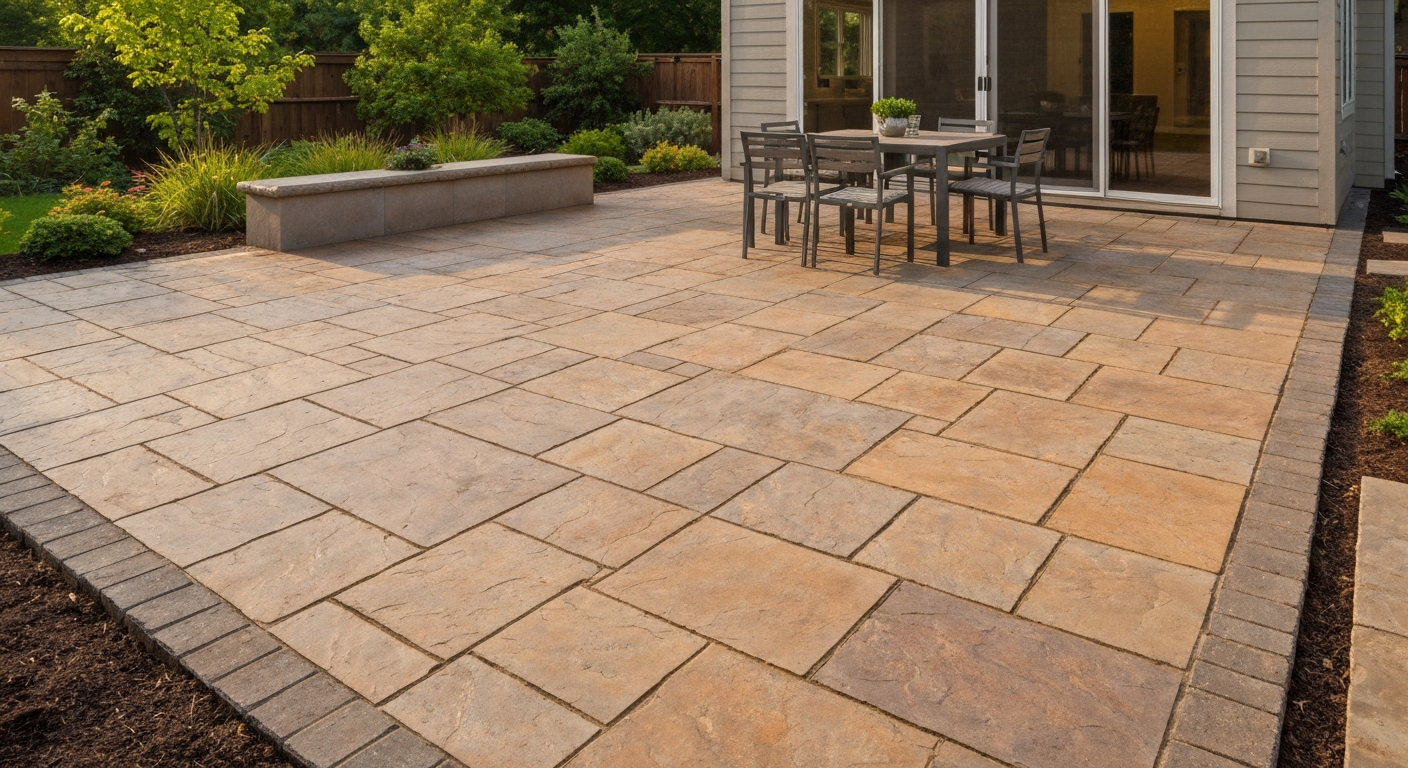
Lafitt is Belgard's residential and light-commercial patio slab line, designed to mimic the irregular, weathered look of natural flagstone without the unpredictability of actual stone. Belgard makes these as interlocking concrete paving slabs, meaning each unit is a factory-manufactured concrete product that fits together in a defined pattern system. The line includes variations such as Lafitt Grana (a granular, stone-textured surface), Lafitt Slate (with a split-slate texture), and the Mega-Lafitt family (larger format slabs). What sets the Lafitt system apart from a basic concrete paver is the multi-piece module approach: three complementary paver sizes are designed to be laid together in patterns that replicate the random coursing you would expect from hand-laid flagstone. Belgard sells these through an authorized dealer and contractor network across North America, and the product is a popular choice for pool decks, residential patios, and walkways.
Technical specifications: sizes, finishes, colors, textures, and slip resistance
Module sizes and thickness
The Lafitt Grana Slab is sold as a three-piece system at a nominal 60 mm (2 3/8 inch) thickness. According to the Belgard commercial product cut sheet LAFITT GRANA SLAB (Belgard Commercial product cut sheet), Lafitt Grana Slab is sold as a 3‑piece patio slab system in a nominal 60 mm (2 3/8") thickness; the three module sizes are Paver A 3 9/16" x 7 1/16" x 2 3/8", Paver B 7 1/16" x 7 1/16" x 2 3/8", and Paver C 7 1/16" x 10 5/8" x 2 3/8". The three modules are: Paver A at 3 9/16 inches x 7 1/16 inches, Paver B at 7 1/16 inches x 7 1/16 inches, and Paver C at 7 1/16 inches x 10 5/8 inches. These three sizes are designed to be combined in running bond, basket weave, and other recommended laying patterns that Belgard publishes in its pattern specification sheets. The 60 mm thickness is the key structural number here: it makes these slabs heavier and more stable than a 40 mm or 50 mm paver, which matters for load distribution and resistance to rocking under foot traffic.
Surface finishes, colors, and textures
The Lafitt line comes in multiple surface textures depending on the specific product variant. The Grana finish is a coarser, granite-like surface with visible aggregate texture. The Slate variant uses a textured split-slate surface. Both finishes are designed to reduce the flat, uniform look that plain concrete pavers are criticized for. Color options vary by dealer and region but typically span earth tones: charcoal, tan, brown-blend, sandstone, and similar naturalistic shades. One thing to be aware of: colors are achieved through pigmentation in the concrete mix, and some homeowners and a few BBB complaint records have documented color variation between production batches. Belgard Hardscapes – BBB complaints (sample consumer dispute) documents consumer escalations about color matching, batch variation, and replacement logistics where buyers reported inconsistent colors between units and coordination disputes over replacements. If you are ordering slabs across multiple pallets or doing a phased project, ask your dealer specifically about batch consistency and try to pull all material from the same production run.
Slip resistance
Belgard measures slip resistance using wet DCOF (Dynamic Coefficient of Friction) per ANSI A326.3, tested with the BOT-3000E device. The company recommends a minimum wet DCOF of 0.42 for pedestrian use and states that many of its pavers and slabs can exceed this threshold. The textured surface of the Lafitt Grana and Slate variants generally performs well here compared to smooth-faced concrete or polished porcelain. That said, Belgard recommends requesting specific DCOF test reports from your local rep before specifying for pool deck or commercial use, because exact numbers vary by color and production lot.
Real-world performance: durability, freeze-thaw, fading, staining, and load capacity
Belgard designs the Lafitt line to meet or exceed both ASTM C-936 (concrete paver units) and ASTM C-1372 (segmental concrete paving slabs). In practical terms, this means the slabs are tested for compressive strength, water absorption, and freeze-thaw durability. Belgard's commercial specifications cite water absorption below 5% and freeze-thaw resistance of less than 1% weight loss after 40 cycles, which is the kind of number that matters in cold climates. In my experience reviewing hardscape products, meeting ASTM C-1372 is a meaningful baseline because the standard specifically addresses the thicker slab format and loading requirements for pedestrian and light vehicular use.
Fading is a realistic consideration with any pigmented concrete product. The Lafitt slabs will lighten somewhat over the first year or two as the surface cement paste weathers and the aggregate becomes more prominent. This is not the same as fading to a washed-out gray: the texture becomes more pronounced, which many homeowners actually prefer. Applying a paver sealer every three to five years, as Belgard recommends, will slow this process and restore some color depth. For stain resistance, the relatively low water absorption rate (under 5%) helps, but the surface texture can trap fine debris. Oil stains, rust from furniture, and organic staining from leaves are the most common issues reported, and all are manageable with Belgard-recommended cleaners like Techniseal Paver Prep before sealing.
On load capacity, the 60 mm thickness and ASTM C-1372 compliance make Lafitt appropriate for pedestrian patios, pool decks, and driveways in many residential applications, provided the base is built to spec. Thin-overlay slabs (20-30 mm) are not the same product and carry different load ratings, so confirm the thickness you are ordering.
Pros and cons of Belgard Lafitt slabs
- Realistic flagstone appearance at a lower cost than natural stone
- Three-module system creates varied, non-repetitive layouts
- Meets ASTM C-936 and C-1372, giving verifiable performance benchmarks
- 60 mm thickness provides stability and load capacity for residential use
- Textured surface achieves good wet slip resistance (wet DCOF above 0.42 for most variants)
- Low water absorption under 5% supports freeze-thaw durability
- Individual units are replaceable without disturbing the whole patio
- Wide dealer network across North America makes sourcing relatively straightforward
- Lifetime Transferable Limited Warranty when installed by an authorized contractor
- Color batch variation between production runs is a documented issue, not just anecdotal
- Heavier 60 mm format requires more effort to cut cleanly, adding labor cost
- De-icing salts (sodium chloride, calcium chloride, ammonium salts) are explicitly prohibited and will damage the surface, which is a real constraint in cold climates
- Warranty covers product replacement but not installation labor or consequential costs
- Material pricing varies significantly by region and dealer; per-sq-ft costs are not transparent without quotes
- Installed cost of $22-38 per sq ft is not budget territory; cheaper alternatives exist
- Requires authorized contractor installation to activate the lifetime transferable warranty benefit
Climate suitability and what to expect by region
Lafitt slabs can perform well across most US climate zones, but the installation details have to change based on where you live. The single biggest factor is freeze-thaw cycling combined with de-icing salt exposure, which is the combination most likely to cause surface scaling and long-term deterioration on any concrete paver.
| Climate Zone | Key Risks | Installation Adjustments | Verdict |
|---|---|---|---|
| Cold / Freeze-Thaw (Upper Midwest, Northeast, Mountain West) | Repeated freeze-thaw cycling; de-icing salt damage | 10-12 inch compacted base minimum; excellent drainage; NO salt de-icers (use sand or calcium magnesium acetate instead) | Suitable with proper base and strict de-icer avoidance |
| Hot / Arid (Southwest, Desert) | Thermal expansion; UV bleaching of pigment; occasional flash flooding | Standard 8-inch base; seal every 3 years to slow UV fading; ensure drainage slopes | Well-suited; one of the better climates for concrete paver longevity |
| Humid / Subtropical (Southeast, Gulf Coast) | Algae and moss growth on shaded surfaces; occasional freeze cycles inland | Polymeric joint sand essential to reduce weed/moss intrusion; reseal regularly | Good performance; surface texture traps moisture in shade, so keep clean |
| Coastal / Salt Air (Atlantic Coast, Pacific Coast) | Airborne salt exposure accelerates surface degradation; reinforces need to avoid salt de-icers | Same base prep as climate zone; rinse surfaces periodically; seal more frequently (every 2-3 years) | Suitable with more frequent maintenance; avoid any salt-based de-icing products |
| Mild / Maritime (Pacific Northwest, Northern California) | Persistent moisture; moss and algae; minimal freeze risk | Standard base; polymeric sand; reseal as needed | Excellent fit; low thermal stress, just manage organic growth |
The de-icing salt restriction is worth emphasizing because it catches a lot of cold-climate homeowners off guard. Belgard is explicit that sodium chloride, calcium chloride, and ammonium salts (common sidewalk salt products) are destructive to concrete pavers and void performance expectations. This is not a Belgard-specific quirk: it is a well-documented concrete durability issue. In cold climates, you have to commit to using sand, kitty litter, or calcium magnesium acetate (CMA) for traction during ice events. If that is not realistic for your household, a natural stone or porcelain slab is genuinely more salt-tolerant.
Installation: base prep, laying, jointing, and edging
Base preparation
Getting the base right is where most DIY patio failures start. Belgard's Paving Systems Installation Guide is specific: excavate a minimum of 8 inches below finished grade in temperate climates, and 10 to 12 inches in freeze-thaw regions or wherever the soil is soft or poorly draining. The base material should be dense-graded aggregate (crushed stone, typically a 3/4-inch minus or similar specification), compacted to 98% Standard Proctor density in 2-to-4-inch lifts. Do not compact it all at once in a single thick layer: it will not consolidate properly, and you will get settlement later.
Bedding sand layer
On top of the compacted base goes a 1-inch nominal bedding sand layer using concrete sand (not masonry sand, which is too fine and unstable). This layer is screeded flat, not compacted before the slabs go down. The slabs are set on the screeded sand, and the bedding compacts and levels under the weight of the pavers and a plate compactor pass after installation. Do not over-water or disturb the screeded sand surface before laying.
Laying patterns and cutting
Belgard publishes recommended laying patterns for the Lafitt three-module system including running bond and basket weave arrangements. Follow these patterns to get the non-repetitive, flagstone-like result the product is designed to produce. Cutting the 60 mm slabs requires a wet-saw with a diamond blade rated for hard concrete. A standard angle grinder works for straight cuts in a pinch but is not ideal for curved or tight cuts. Budget extra time and blade cost if your layout involves a lot of edge cuts.
Edge restraints and jointing
Plastic or aluminum edge restraints with at least 1 inch of vertical restraining surface contact are required per Belgard's installation guide. Do not skip these: without proper edge restraints, the perimeter slabs drift over time and the whole pattern opens up. After setting all slabs, sweep polymeric joint sand into the joints, compact the field with a plate compactor (use a rubber pad or protective mat to avoid surface scratching), and sweep in a final top-up of polymeric sand before activating it with water. Polymeric sand is worth the extra cost over plain sand because it resists weed germination and ant activity that would otherwise hollow out the joints.
Maintenance: what you actually need to do to keep Lafitt looking good
- Sweep or blow off debris weekly during the growing season to prevent organic staining and moisture retention
- Remove any cutting dust from the initial installation with a stiff brush and water before the first rain (cement dust residue can haze the surface permanently if left)
- Address oil, rust, or leaf stains promptly using Belgard-recommended cleaners such as Techniseal Paver Prep; let the cleaner dwell per instructions before scrubbing and rinsing
- Inspect joint sand annually and top up polymeric sand in any joints that have settled or washed out
- Apply a penetrating paver sealer every 3 to 5 years (or every 2 to 3 years in coastal or high-UV environments); this slows UV fading, reduces staining, and helps maintain color depth
- In winter climates, use only sand, CMA, or non-chloride traction agents; never use rock salt or calcium chloride on the surface
- If a slab chips or cracks, individual units can be removed and replaced without disturbing surrounding slabs, which is one of the genuine practical advantages of the interlocking system
Cost and value: what you should realistically budget
Installed cost for Belgard paver patios, including the Lafitt family, runs roughly $22 to $38 per square foot based on contractor pricing across North America. That range covers excavation, base aggregate, bedding sand, the slabs themselves, edge restraints, jointing, and cleanup. Where you land in that range depends on regional labor rates, site access and excavation difficulty, the number of cuts your layout requires, and whether the contractor is factoring in polymeric sand and sealer in the initial scope. A 200-square-foot patio would therefore run approximately $4,400 to $7,600 installed.
Materials-only pricing is harder to pin down precisely because Belgard sells through authorized dealers and pricing varies by region, color, and pallet quantity. Historical catalog references show Mega-Lafitt Large Square at roughly $8 per square foot for material alone, which gives you a rough anchor, but expect dealer pricing to vary. Ordering by the full pallet is almost always cheaper per square foot than ordering partial quantities, and dealers frequently have better pricing for contractor accounts than for walk-in retail purchases. If you are getting quotes, ask contractors to break out the materials cost separately so you can compare apples to apples.
Is Lafitt good value? It is a fair value if you want the natural stone aesthetic without natural stone maintenance (natural stone and porcelain installs commonly run $30 or more per square foot installed). It is not good value if your primary goal is the lowest possible price: plain poured concrete, gravel, or simpler concrete pavers will cost less. If you are weighing resin-bound surfaces against slabs on cost, resin is sometimes cheaper for materials but requires a different installation skill set and has its own lifespan considerations. See the guide 'Is a resin patio cheaper than slabs' for a direct cost comparison between resin-bound surfaces and slab options. For readers actively comparing on price, the gap between budget slab options and a premium product like Lafitt is a real consideration worth exploring alongside other patio slab price research.
How Lafitt compares to other common patio options
| Material | Approx. Installed Cost ($/sq ft) | Freeze-Thaw Suitability | Salt/De-icer Tolerance | Maintenance Level | Aesthetic Flexibility | Replaceability |
|---|---|---|---|---|---|---|
| Belgard Lafitt (concrete slab) | $22-38 | Good with proper base | Low (avoid all salts) | Low-Medium | Good (multiple patterns/colors) | Excellent (individual units) |
| Natural flagstone | $30-50+ | Good (varies by stone type) | Better than concrete | Medium (sealing, re-grouting) | High (fully custom) | Difficult (matching stone) |
| Porcelain tile (outdoor) | $30-50+ | Good (frost-rated grades) | Better than concrete | Low (easy to clean) | Very high (many formats) | Moderate (matched tiles) |
| Brick paver | $18-30 | Good with proper base | Low (avoid salts) | Low | Moderate (classic look) | Excellent |
| Poured concrete | $8-18 | Fair (cracks over time) | Fair | Low (but repairs are ugly) | Low | Poor (full slab replacement) |
| Resin-bound gravel | $10-25 | Fair (base-dependent) | Good | Low | Moderate | Moderate |
| Gravel/decomposed granite | $3-10 | Excellent (flexible) | Excellent | Medium (raking, topping up) | Low | Easy (add more material) |
The table above uses approximate ranges; actual quotes in your area will differ. The key takeaways are that Lafitt sits in a middle tier on cost, competes well on aesthetics and replaceability, and loses ground to natural stone and porcelain only on salt tolerance and high-end customization. Porcelain has surged in popularity for patios precisely because it pairs very low maintenance with excellent freeze-thaw and salt performance, though at a higher price point. Brick offers a similar interlocking replaceability advantage at a lower cost but a more traditional look. For homeowners whose main priority is low maintenance with good looks, Lafitt is a strong contender, but it is worth comparing it directly against the best low-maintenance slab options to make sure the maintenance restrictions (especially the no-salt rule) fit your situation. For a direct comparison of low-maintenance options, see our guide to the best outdoor patio slabs. For a quick comparison of top choices, see our guide to the best low maintenance patio slabs. For a direct comparison of top choices, see our guide to the best garden patio slabs.
Warranty coverage and expected lifespan
Belgard offers a Lifetime Transferable Limited Warranty on its interlocking concrete pavers and segmental paving slabs, including the Lafitt line. This is a meaningful warranty on paper, but the details matter. Here is what you need to understand before relying on it:
- The Lifetime Transferable benefit applies when the product is installed by a Belgard-authorized contractor; DIY installations may not carry the same warranty level, so confirm this with your dealer before deciding to self-install
- Belgard will replace defective product under the warranty, but the warranty explicitly does not cover labor costs for removal and reinstallation, or consequential damages
- The warranty covers manufacturing defects, not damage from improper installation, de-icer use, or other maintenance failures
- Always request a copy of the current warranty document at the time of purchase, not just a verbal assurance; warranty terms can be updated and the version in effect at purchase is the one that applies
- The transferable feature adds genuine resale value: if you sell your home, the warranty can pass to the new owner, which is worth noting in a home sale
On expected lifespan under normal use: properly installed interlocking concrete paver patios regularly last 25 to 40 years or longer with routine maintenance, and many installations go well beyond that. The individual-unit replacement feature means you never have to replace the whole patio; you replace the damaged slab. The main lifespan threats are base failure from inadequate compaction or drainage (a installation problem, not a product problem), de-icer salt damage in cold climates, and persistent heavy loads the base was not designed for. Follow the base specifications, avoid prohibited de-icers, and reseal every few years, and you should expect decades of service from a Lafitt installation.
Where to buy and sourcing tips
Belgard products are sold through an authorized dealer network, not through general home improvement chain stores in most cases. Use the dealer locator on Belgard's website to find local suppliers. Pricing is almost always better through the dealer's contractor channel, so if you are working with a Belgard-authorized contractor, let them handle procurement. For quick comparisons on patio slabs best price, ask dealers for current pallet and contractor-channel pricing. If you are buying direct as a homeowner, call at least two or three dealers for pricing because regional variation is real and significant. Always buy enough material to complete the entire project from a single production lot, and order 5 to 10 percent extra for cuts and breakage. Ask the dealer to hold back a few extra slabs for future repairs: color matching years later is much easier if you have a few originals stored.
One practical note from installer experience: inspect pallets for obvious color variation before the material is unloaded and mixed. Blend slabs from multiple pallets during installation (pull from two or three pallets simultaneously) to average out any minor batch variation across the finished surface, rather than installing one pallet at a time, which can leave visible color bands.
Decision checklist: is Lafitt the right choice for you?
Use this checklist as a quick filter before committing. If most of your answers are yes, Lafitt is likely a strong fit. If several are no, review the alternatives table above.
- Do you want a natural stone appearance without the irregular maintenance and cost of actual flagstone?
- Is your budget in the $22-38 per sq ft installed range, or can you fund materials-only for a DIY approach?
- Are you willing to commit to a no-salt de-icing approach in winter (sand, CMA, or non-chloride alternatives only)?
- Is your site's drainage manageable, and are you prepared to build the correct base depth (8-10 inches minimum)?
- Do you value individual unit replaceability over the seamless look of poured concrete?
- Are you planning to use a Belgard-authorized contractor (required for the full lifetime transferable warranty)?
- Is low long-term maintenance more important to you than the lowest possible upfront cost?
- Are you comfortable with a 3-5 year resealing schedule as part of ongoing maintenance?
FAQ
What are Belgard Lafitt patio slabs (basic product overview)?
Belgard Lafitt is a family of interlocking concrete patio slabs designed to mimic natural stone. A common domestic product is Lafitt Grana Slab sold as a 3‑piece module system nominally 60 mm (2 3/8") thick with three module sizes (approx. 3 9/16" x 7 1/16" x 2 3/8", 7 1/16" x 7 1/16" x 2 3/8", and 7 1/16" x 10 5/8" x 2 3/8"). It’s distributed through Belgard dealers and installed by landscapers/hardscape contractors.
What technical specifications should homeowners know (sizes, finishes, colors, slip resistance)?
Key specs: nominal thickness ~60 mm (2 3/8") using three slab modules. Finishes are stone-like (Grana, Slate, Rustic palettes) with multiple color blends depending on plant/region. Belgard reports water absorption typically <5% and compliance with ASTM C‑936/C‑1372. For pedestrian slip resistance Belgard recommends a wet DCOF ≥0.42 and can provide specific test data per product/finish via reps; many Belgard slabs meet or exceed that guideline.
How do Lafitt slabs perform in real-world conditions (durability, freeze‑thaw, fading, load capacity)?
Durability: as concrete pavers they’re engineered to ASTM standards and perform well with proper base/drainage. Freeze‑thaw: concrete pavers with correct base and compaction resist freeze‑thaw; Belgard cites <1% weight loss after 40 cycles for plaza-grade products, but repeated cycles plus de‑icer exposure raise risk of surface scaling. Fading: color is integral/blend but some batch variation and gradual UV/weather fading can occur over years. Load capacity: designed for pedestrian loads (patios, pool decks); thicker section and correct base can support light vehicular loads, but check product/installation specs for drives.
What are the main pros and cons of choosing Lafitt slabs?
Pros: attractive stone-like appearance; modular sizes for varied patterns; manufactured to ASTM standards; good slip-resistance options; replaceable individual units; wide dealer/contractor network; established warranty. Cons: concrete can scale with de‑icer or poor drainage; possible color/batch variation; installed cost higher than plain poured concrete; requires proper base prep for long life; some homeowners prefer natural stone or porcelain aesthetics.
Are Lafitt slabs low-maintenance? What maintenance is required?
Relatively low‑maintenance compared with loose gravel or wood decking. Routine tasks: sweep/blow debris weekly, remove stains promptly with manufacturer-recommended cleaners, use polymeric joint sand to reduce weeds, re‑apply paver sealant every ~3–5 years if desired for color preservation, and avoid corrosive de‑icers. Inspect joints and edge restraints annually. Maintenance checklist: weekly sweeping, seasonal inspection, clean oil/food stains ASAP, top-up polymeric sand after freeze/thaw seasons, reseal every 3–5 years (optional).
How long can I expect Lafitt slabs to last?
With correct installation (proper excavation, compacted aggregate base, edge restraints, adequate drainage) and routine maintenance, expect multiple decades of service—commonly 20–40+ years for patio applications. Life expectancy shortens with poor base/drainage, heavy de‑icer use, or significant freeze‑thaw cycling without mitigation.