Most flagstone patio problems come down to three root causes: a weak or poorly drained base, the wrong bedding or jointing material for the conditions, and water that had nowhere safe to go. If you suspect a broken flagstone patio, start by identifying where water is pooling and which stones are actually moving flagstone patio problems. Once you figure out which of those applies to your patio, the repair path becomes a lot clearer. This guide walks you through diagnosing symptoms, fixing what's broken, and making sure it doesn't happen again.
Flagstone Patio Problems: Diagnose, Repair, and Prevent
Nolan Ellison
2 Jul 2026
How to Diagnose Your Flagstone Patio Problem
Before you spend money or muscle on a repair, spend 20 minutes doing a proper inspection. Walk the patio slowly and press down on every stone with your foot. Listen and feel for rocking, hollow sounds, or any give. Then grab a garden hose and run water across the entire surface, watching where it pools, where it flows toward the house, and where it seems to disappear into joints faster than expected. That simple two-step test will tell you more than most quotes will.
Use the symptom list below to match what you're seeing to a likely cause. Keep in mind that symptoms often overlap, especially when the base has been failing slowly for years.
| Symptom | Most Likely Cause | Where to Look Next |
|---|---|---|
| One or two stones rock underfoot | Voids under the stone from bedding erosion or washout | Lift the stone and check the bed depth and condition |
| Several stones in one area are uneven or sunken | Subbase settlement or localized drainage failure | Check slope and base depth across that zone |
| Widespread unevenness across the whole patio | Base compaction failure, wrong base material, or original slope error | Full-patio assessment, likely partial or full reset |
| White powdery deposits on stone surface | Efflorescence from moisture carrying soluble salts upward | Check joint integrity and whether water is pooling below |
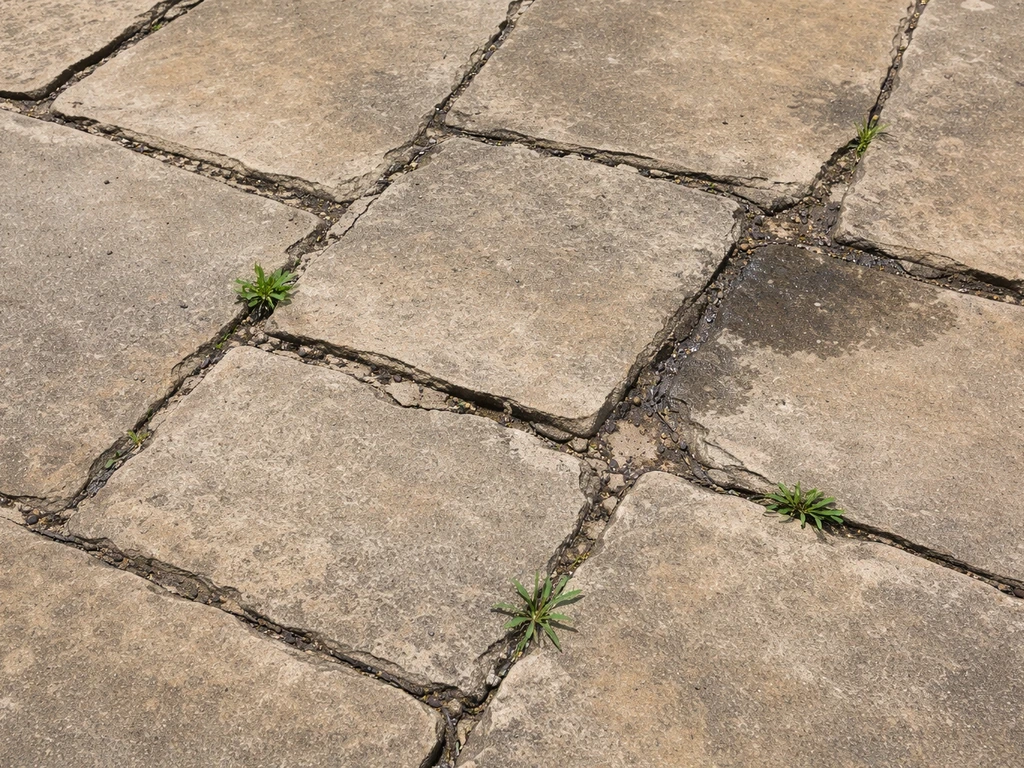
| Weeds growing through joints | Joint fill washed out or never properly installed | Probe joints with a screwdriver to check fill depth |
| Cracked or chipped stones | Freeze-thaw cycling, point loading, or stone too thin for the application | Check stone thickness and look for drainage issues nearby |
| Water pooling on the patio surface | Inadequate slope or clogged drainage path | Measure slope; 1.5–2% (about 1/8" to 1/4" per foot) is the minimum |
| Slippery surface when wet | Smooth stone finish, algae growth, or worn sealer | Identify stone type and finish; test for algae/moss |
| Joint sand or grout crumbling and washing out | Wrong joint product, insufficient joint depth, or chronic water movement through the patio | Check joint depth and whether base is draining properly |
The key diagnostic split is whether the problem is localized to individual stones or spread across a broader area. Localized movement almost always means bedding failure under specific stones. Broad unevenness or drainage issues usually point to base or slope problems, which require more extensive work to fix properly.
Common Failure Modes: Shifting, Unevenness, Cracking, and Rocking Slabs
Rocking and Shifting Stones
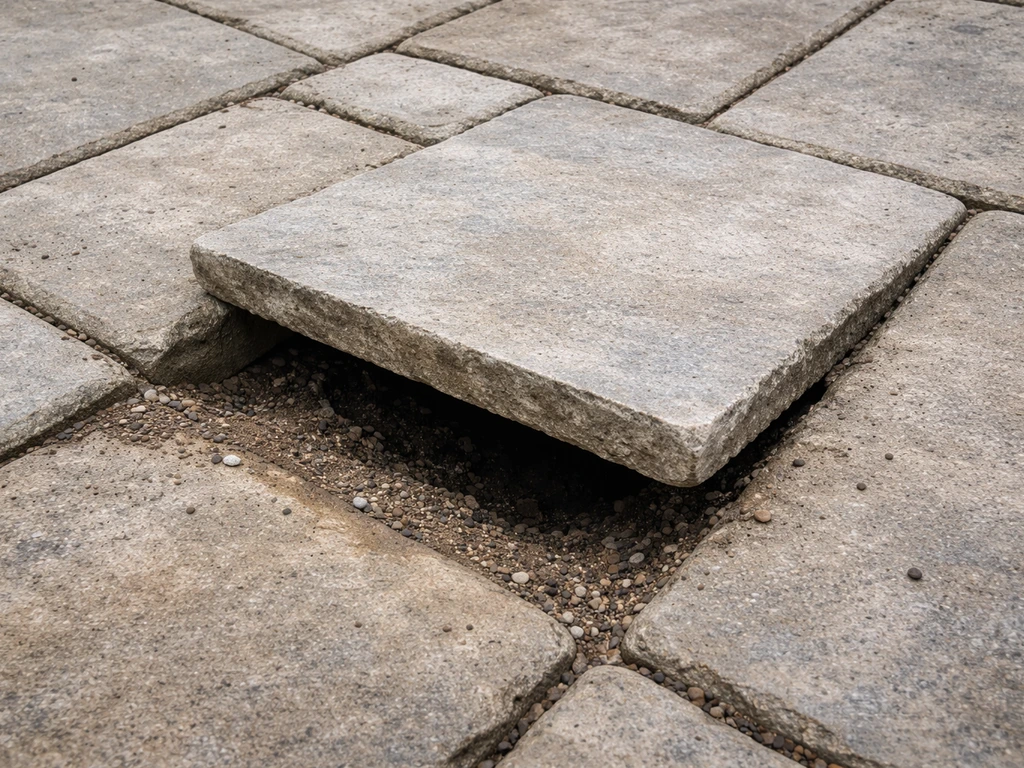
A stone that rocks when you step on it has a void underneath it. What happens is water gets under the flag, erodes or washes away the bedding material, and leaves the stone balanced on its edges or on high spots with nothing supporting the middle. This is one of the most common flagstone patio problems I see, and it's often the first visible symptom of a drainage problem that's been quietly developing for a season or two.
The fix for individual rocking stones is straightforward: lift the stone, clear out the degraded bedding, and re-lay it on a solid bed. If the original bedding was plain sand, consider switching to a cement-bound bedding mix (roughly a 10:1 grit sand to cement ratio) to give the stone a stable, water-resistant platform. If you find multiple stones rocking in the same zone, that's a signal to dig deeper and check whether the base itself has settled or eroded.
Uneven and Sunken Surfaces
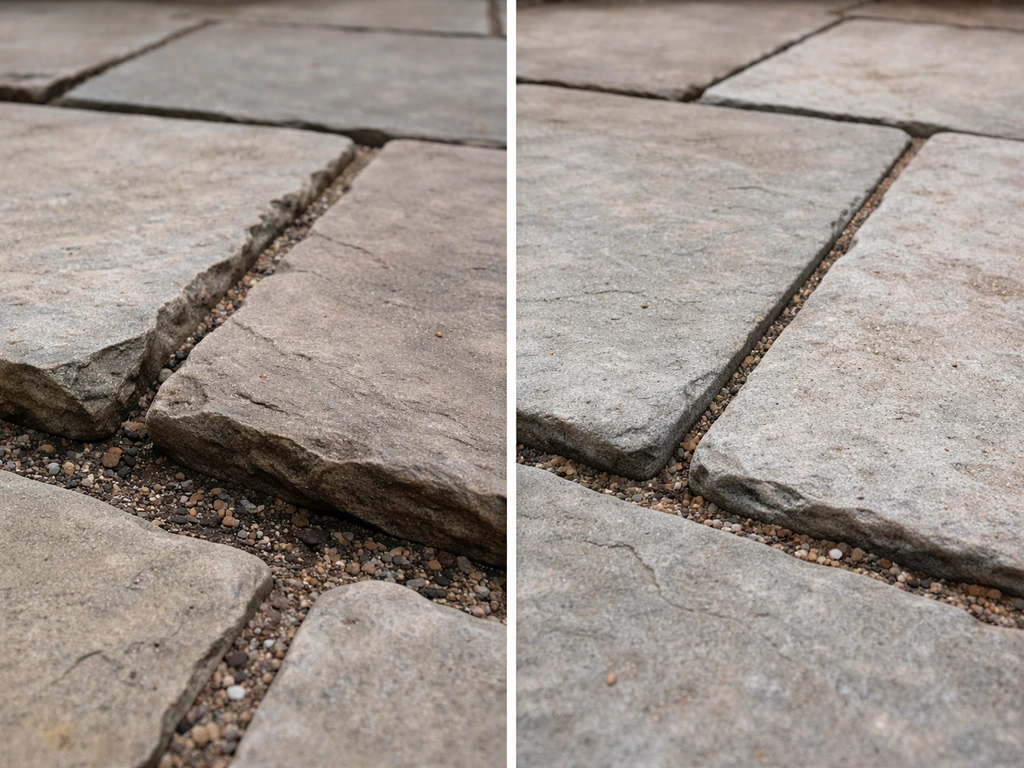
Uneven surfaces fall into two categories. The first is differential settlement, where one part of the patio sinks relative to another because the subbase compacted unevenly or because it was installed over soft or poorly prepared soil. The second is heaving, which is the opposite: sections of the patio lift higher than their neighbors, typically from frost pressure pushing up from below. Both look like unevenness, but the causes and fixes are different, so it's worth figuring out which you're dealing with.
Cracking and Chipping
Flagstone cracks for a few reasons. Stones that are too thin for the span they're covering will crack under point loads like furniture legs or heavy foot traffic. Freeze-thaw cycling causes cracking when water gets into existing micro-fractures and expands. And stones that are bedded with voids underneath them will crack because they have no continuous support, so load concentrates at the edges. If you're in a cold climate and seeing a lot of cracking, drainage and frost heave are the most likely culprits. If the cracking is concentrated near furniture or heavy planters, check whether your stones are thick enough for the application. Most natural flagstone used in patios should be at least 1.5 inches thick for pedestrian use.
Joint Problems: Sand Washout, Weeds, Settling, Staining, and Efflorescence
Joint Washout and Weed Intrusion
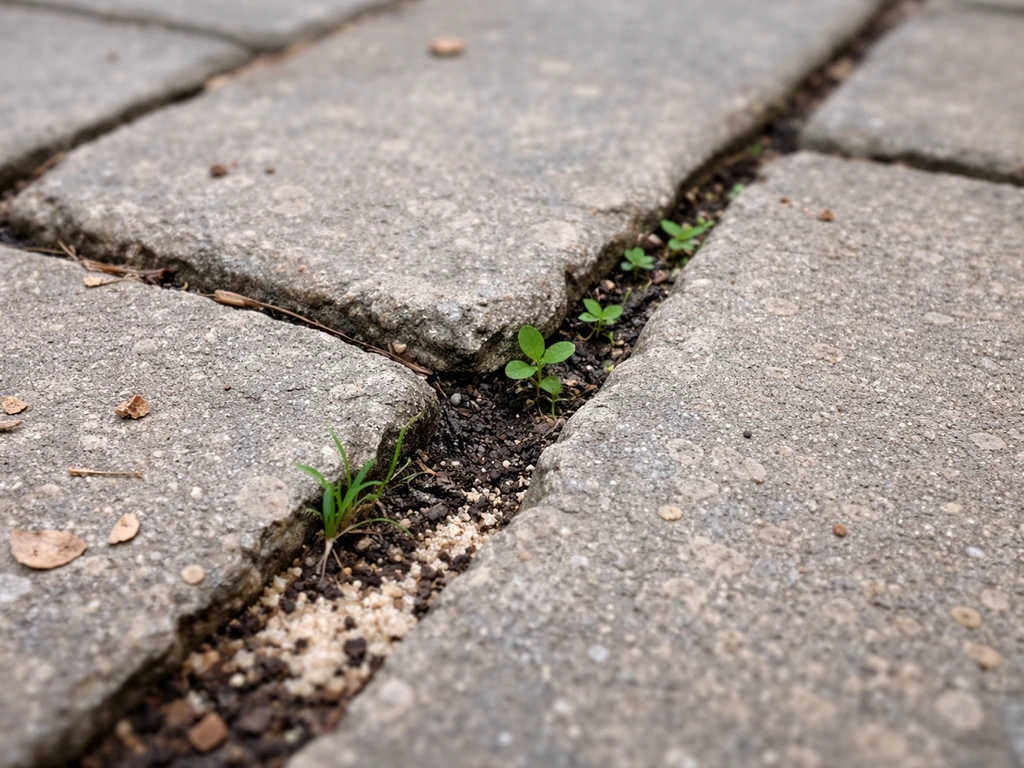
When joints lose their fill, the whole patio structure starts to loosen up. Joints aren't just cosmetic, they lock the stones in place and prevent water from channeling straight down through the patio to the base. Once joint material washes out, weed seeds blow in, moisture accumulates in the voids, and the stones gradually lose their lateral stability. I've seen patios that looked fine from 10 feet away but had almost no joint fill left at all because it had slowly washed out over several rainy seasons without anyone noticing.
For repair, brush out any remaining loose or degraded joint material and decide on your refill approach. Regular dry sand is the easiest to install but the least durable and the most weed-friendly. Polymeric sand performs better: it hardens after activation with water and resists washout and weed germination. Polybind Complete Sand G2 must be installed in accordance with the ICPI Tech Spec 2 requirements, which supports compatible jointing and installation practices Polymeric sand performs better: it hardens after activation with water and resists washout and weed germination.. The catch with polymeric sand on natural flagstone is that joint dimensions matter. Most polymeric sand products are designed for joints in a specific width and depth range, and irregular flagstone joints can be too wide, too shallow, or too inconsistent for proper polymerization. Read the product specs before you buy and check whether your joint geometry is compatible. For very wide or irregular joints, a dry mortar mix or a dedicated joint compound may be more appropriate.
Efflorescence
Efflorescence is those white, powdery or crusty deposits you see on stone or mortar surfaces. What's happening is that water moves through the bedding or mortar layer, picks up soluble salts, travels to the surface, and then evaporates, leaving the salts behind as a visible deposit. It's not just a cosmetic issue. Persistent efflorescence means moisture is moving through your patio structure, which is usually a sign of failed joints, poor drainage, or water pooling in the base.
Removing efflorescence involves three steps: dry-brush the loose deposits off first, then apply a diluted acid solution (a common ratio is one part phosphoric acid to seven parts water), let it dwell briefly, and rinse thoroughly with clean water. Always pre-wet the stone before applying acid, and never apply acid to dry stone. For persistent or heavy efflorescence, you may need two or three treatments. But cleaning the surface is only half the job. If you don't fix the moisture source driving the salts to the surface, the deposits will come back within a season.
One important caution: don't seal a patio that still has efflorescence or that is still damp. Sealing over moisture traps water vapor below the sealer, which causes it to blister and turn milky white. This is a very common mistake and it makes the problem significantly worse and more expensive to fix.
Drainage and Base Problems: Slope, Subbase Failure, and Freeze-Thaw Damage
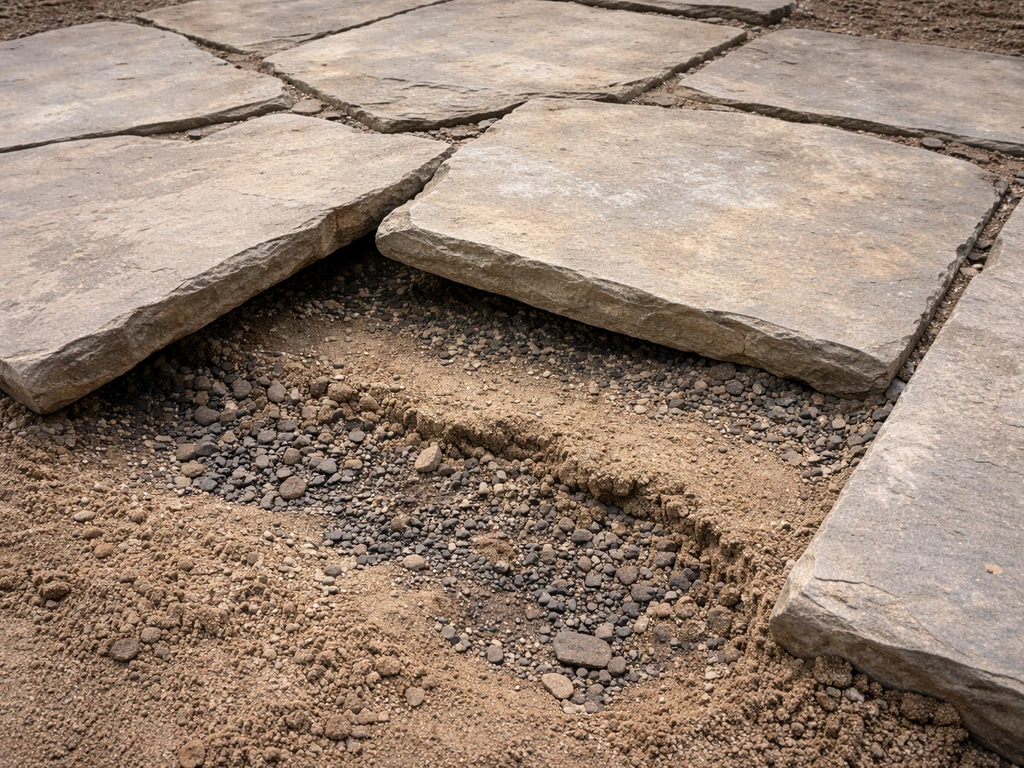
This is the section that matters most if your problems keep coming back no matter what you do on the surface. Almost every chronic flagstone patio problem, including repeat heaving, persistent joint washout, ongoing efflorescence, and stone rocking, can be traced back to either too little slope or a base that wasn't built to handle water properly.
The minimum slope for a flagstone patio is 1.5 to 2 percent, which works out to about 1/8 to 1/4 inch of drop per foot of run. That might not sound like much, but it's the difference between water draining away from your patio and water sitting in the base, slowly weakening it. You can test your current slope by hosing the whole surface down and watching where water flows and where it sits. If water is pooling anywhere on the surface, or if it's running toward your house foundation, you have a drainage problem that no surface fix will permanently solve.
For freeze-thaw climates, drainage becomes even more critical. When water gets under your patio and into the base aggregate, it freezes in winter. In winter, frost heave damage is driven when water infiltrates pavement layers and freezes, with trapped water under slabs or pavers providing the lifting “push.” water gets under your patio and into the base aggregate. Water expands roughly 9% when it freezes. That expansion is what causes frost heave: the ground literally pushes your stones upward. In spring, the ground settles back but rarely to exactly the same position, so you end up with a progressively more uneven surface after each freeze-thaw cycle. The fix isn't just better jointing or re-leveling the stones. It's eliminating the water source that's getting into the base in the first place.
Base construction that handles these forces well typically includes a compacted crushed aggregate base (6 inches is a common recommendation for problematic or clay-heavy subgrades), a geotextile fabric layer between the native subgrade and the aggregate to prevent fine soil particles from migrating up and clogging drainage, and a correctly established slope built into the base itself, not just the surface.
Repair Options by Severity: Spot Fix, Partial Reset, or Full Rebuild
Not every flagstone problem needs a full teardown. Here's how to match the scope of repair to what you're actually dealing with.
| Problem Severity | What You're Dealing With | Appropriate Repair Approach | Rough Effort Level |
|---|---|---|---|
| Minor (1–3 stones) | One or a few rocking or slightly uneven stones, intact joints elsewhere | Spot lift: remove stones, rebed on cement-bound mix, reset level | DIY-friendly, half day |
| Moderate (one zone, up to 25% of patio) | Cluster of problems in one area, joint washout in sections, minor pooling | Partial reset: lift affected zone, check and correct local base, rebed and re-joint | Moderate DIY or contractor, 1–2 days |
| Significant (joint failure across whole patio) | All joints are degraded but stones still reasonably level and base is sound | Full re-jointing: clean and refill all joints, consider polymeric sand or mortar depending on joint size | DIY-friendly, full day |
| Serious (widespread movement or wrong slope) | Multiple shifting stones, water pooling, evidence of base settlement or heave | Partial or full reset with base regrading and compaction; correct slope throughout | Contractor recommended, multi-day |
| Severe (base failure, chronic heave, major cracking) | Ongoing freeze-thaw damage, cracked or broken stones throughout, fundamentally wrong base depth or drainage | Full rebuild: excavate to correct depth, install proper base, relay all stones | Contractor required, consider stone condition before investing |
When you're deciding between a partial reset and a full rebuild, the honest question to ask is whether the base is sound. If the drainage and slope are correct and the base material is intact, lifting and relaying stones is a reasonable fix. If the base was undersized, poorly compacted, or wrong for the climate, any surface repair is temporary. If you suspect a broken slab patio, the same diagnostic approach for base support and drainage will help you identify the actual cause before you start repairs. You'll be doing it again in two or three years.
It's also worth considering stone condition at this point. If the stones themselves are heavily cracked, spalling, or simply worn out, a rebuild is a natural opportunity to replace them. Broken flagstone patterns and what to do about individual broken or cracked stones is worth looking at separately if you're dealing with significant stone damage alongside the structural issues. Broken tile patio repairs often follow the same logic as flagstone: diagnose whether the issue is localized to a few units or spread across the base and drainage system broken or cracked stones.
Prevention and Upgrades for Your Climate
Installation Method Choices
The bedding method you choose should match your climate and stone type. Dry-laid flagstone (stone set on compacted sand or gravel without mortar or cement) is flexible and relatively easy to repair, but it's more vulnerable to frost heave and joint washout in wet climates. Mortar-set flagstone (stone bedded in a cement-mortar mix over a concrete or compacted base) is more rigid and resistant to movement, but when it does fail, it fails harder and is more expensive to repair. For freeze-thaw climates specifically, many installers now use a semi-dry cement-bound bedding (the 10:1 grit sand to cement mix mentioned earlier) over a well-drained crushed aggregate base. It provides stability without the brittleness of a fully mortared installation.
Edge Restraints
Missing or inadequate edge restraints are a contributing factor in a lot of flagstone patio problems that homeowners don't immediately identify. Without proper edging, stones at the perimeter gradually migrate outward, joints open up, and the whole installation loosens from the outside in. Choosing the best edging for a flagstone patio helps lock the perimeter stones in place and reduces shifting and joint washout over time best edging for flagstone patio. If you're doing any kind of reset or rebuild, making sure the edging system is right is worth the attention. The right edging approach depends on your installation method and the overall look you're going for.
Jointing Material Selection
For cold climates, polymeric sand is generally a better choice than plain sand for joints, provided your joint geometry is compatible with the product. For mortar-set installations, a sanded or unsanded grout appropriate for the joint width is the standard approach. Wide, irregular joints in natural flagstone sometimes perform best with a dry-pack mortar or a dedicated joint stabilizer rather than polymeric sand, which can struggle to fully cure in very wide or deep gaps.
Sealers
Sealing flagstone protects against staining and slows moisture infiltration, but it's not a substitute for good drainage and sound joints. The type of sealer matters: penetrating sealers (silane/siloxane-based) soak into the stone and don't change the surface appearance much; topical sealers sit on the surface and can enhance color but may make the stone slippery when wet. For exterior use in wet or freeze-thaw climates, penetrating sealers are generally the safer bet. Always apply sealer to completely dry, clean stone, and never seal over active efflorescence.
Maintenance and Cleaning That Won't Ruin Your Stone or Joints
Regular maintenance is mostly about keeping joints intact, preventing organic buildup, and catching small problems before they become big ones. Here's what actually works and what to avoid.
- Sweep the patio regularly to remove debris that holds moisture against the stone and in the joints.
- Rinse with a garden hose seasonally. You don't need a pressure washer for routine cleaning, and high-pressure washing can erode joint material and open up micro-cracks in softer stone.
- If you do use a pressure washer, keep the pressure below 1,500 PSI and use a wide fan tip, not a concentrated stream. Keep the nozzle moving and don't dwell in one spot.
- For general cleaning, a mild pH-neutral stone cleaner is appropriate for most natural flagstone. Avoid acidic cleaners like vinegar for routine use, especially on limestone or marble-based flags, as acid etches the surface.
- For algae, moss, or mildew, a diluted bleach solution (roughly 1 part bleach to 10 parts water) applied and then rinsed thoroughly works well. Test on an inconspicuous area first.
- For oil or grease stains, a degreasing poultice or a commercial stone stain remover is more effective than soap and water. Apply, let it draw the stain out, then rinse.
- For efflorescence, follow the dry-brush then diluted acid treatment process described earlier. Don't just scrub it with water; that can spread the salts around without removing them.
- Inspect joints annually, especially after winter. Top up any areas where fill has settled or washed out before the next wet season.
- Check and reapply sealer every 2 to 4 years depending on foot traffic and climate. Test by dropping water on the surface: if it soaks in rather than beading, it's time to reseal.
The biggest cleaning mistake I see is homeowners using aggressive acid washes or high-pressure washing to deal with surface grime, not realizing that both methods can erode mortar joints and etch softer stone types. The damage isn't always immediately obvious but shows up as accelerated joint failure and increased efflorescence in the following seasons.
What to Ask Contractors and How to Budget for Repairs or Rebuilds
If you're getting quotes for a repair or rebuild, the quality of the quote itself tells you a lot about the contractor. A thorough contractor will ask about your climate, the existing base, and where water currently goes. A poor one will just price the stone and labor without addressing why the previous installation failed.
Here are the specific things to ask before signing anything:
- What base depth are you specifying, and what aggregate are you using? For most residential flagstone work, a minimum 4-inch compacted crushed aggregate base is standard; 6 inches is better for clay-heavy or wet subgrades.
- How are you addressing slope and drainage? The answer should include a specific slope percentage (not just 'we'll slope it away from the house') and mention of where the water exits the patio area.
- Are you using a geotextile fabric between the subgrade and aggregate? This isn't always required, but in wet or clay soil conditions it's good practice and worth asking about.
- What bedding material and jointing system are you recommending for my climate and stone type? A contractor who gives you the same answer regardless of whether you're in Phoenix or Minnesota is not thinking about your specific conditions.
- What edge restraint system are you installing, and how is it anchored? Plastic edging spiked into soil is not appropriate for mortared flagstone; ask for specifics.
- What is your warranty and what does it cover? Movement within the first year is a red flag for improper installation.
- Can I see examples of patios you've installed that are at least 3 years old? Recent installs always look good; how they hold up over time is what matters.
On budgeting: a basic spot repair (lifting and relaying a few rocking stones with proper bedding) is often a DIY job you can do in an afternoon for the cost of materials. A full re-jointing job on a medium-sized patio typically runs a few hundred dollars in materials if DIY. Partial resets with base regrading move into contractor territory and can range from a few hundred to a few thousand dollars depending on size and access. Full rebuilds with excavation, new base, and new stone are a significant investment, often comparable to a new installation, which currently runs roughly $15 to $35 per square foot for natural flagstone depending on region, stone type, and installation complexity.
One final point on the fix-vs-rebuild decision: if flagstone has repeatedly failed in your specific conditions despite proper installation attempts, it may be worth reconsidering the material itself. Flagstone performs exceptionally well when it's the right fit for the climate, slope, and use case. But in very cold, wet climates with heavy freeze-thaw cycling and poor natural drainage, other surfaces like porcelain pavers (which are non-porous and more dimensionally consistent) or even well-built concrete slabs can be more durable long-term. That's not a knock on flagstone; it's just an honest cost-benefit reality worth considering before you invest in another repair.
FAQ
Can I just seal my flagstone patio to stop the white deposits and cracking?
Yes, but only after you confirm the cause of the moisture movement is fixed. If you seal while there is dampness or active efflorescence, the trapped vapor can blister the sealer and turn the surface milky, and the deposits usually return quickly. Wait until the patio is dry throughout and the joints are stable, then consider a penetrating sealer for exterior freeze-thaw areas.
How do I tell if my flagstone patio problems are really caused by slope instead of bad joints?
Use the hose test and then verify the path with a straightedge or level. If water runs toward the house, stays in low spots, or disappears unusually fast into joints everywhere, you likely have base and slope problems rather than a joint-only issue. A surface patch will not fix water that is entering the base.
Is polymeric sand always the best joint material for flagstone patios?
No, polymeric sand is not automatically a better upgrade. It depends on whether your actual joint width and depth match the product spec, because improper gaps can prevent full activation and reduce weed resistance. For very irregular or wide flagstone joints, a dry mortar approach or a dedicated joint compound can cure and lock better.
Do I need to remove all joint material before re-jointing, or can I just add more sand?
You should replace rather than top-off when joint voids are widespread or when the existing fill is washing out repeatedly. Simply adding new sand over a deteriorated base of failed bedding can keep the same voids underneath, so stones keep rocking and efflorescence continues. Lift and relay only the affected stones if the damage is localized.
What does efflorescence on a flagstone patio actually mean, where does the moisture come from?
Most of the time, efflorescence means water is transporting salts to the surface, but the salt source is not always the stone or mortar. It can originate from the bedding, subbase materials, or even groundwater migrating through the base, so you should treat the moisture path first (drainage, slope, and joint integrity). Cleaning alone will usually be temporary.
My stones rock mostly after it rains, is that still a bedding problem or a base problem?
If stones rock underfoot but only after rain, you likely have voids under the stones and bedding failure. Try lifting a single rocking stone in the problem zone, check whether the underside has washed-out sand, and look for dark, wet bedding remnants. That snapshot tells you whether you can spot-fix or must address base drainage.
What’s the correct way to remove efflorescence safely without damaging the patio?
Avoid acid on dry stone, and pre-wet the surface before any diluted phosphoric wash. Also, protect nearby plants and rinse thoroughly, because remaining residue can trigger renewed staining or weaken certain mortar components. For heavy deposits, plan on multiple treatments, then verify the moisture source so it does not come back.
When cracks appear, when should I repair individual stones versus planning a larger rebuild?
Not always. If only a few stones are cracked from point loads, lifting and resetting those units may be enough. But if cracks align with rocking zones, widespread cracking follows freeze-thaw seasons, or you see widespread voiding under stones, it indicates a support and drainage failure that typically requires base correction.
Could edge restraints be one of the hidden causes of flagstone patio problems?
Missing edge restraints can cause outward creep that opens joints and loosens the perimeter even when the center looks fine. If you see joints widening near the outer border or stones migrating, inspect the entire perimeter and consider reinstalling or upgrading edging before you re-joint. Otherwise, the new joint material can wash out again.
What should I look for in a contractor quote so I do not get stuck with repeat flagstone patio problems?
Use a contractor quote checklist approach. A good pro should discuss where water goes now, what slope exists, what the existing base is, and whether the bedding type fits your climate. If the estimate ignores drainage and base conditions and only prices stone replacement, you are at higher risk of repeating the same failure within a couple of seasons.
How do I decide between a partial reset and a full rebuild without wasting money?
You can do a careful “scope reality check” by deciding whether the base is still intact. If water pools on the surface, the patio is progressively more uneven each freeze-thaw season, or efflorescence keeps returning, the base is likely failing and a surface-only fix will be temporary. Conversely, if drainage looks correct and only a small zone rocks, a localized reset is often the best first step.