For most patios, a resin-based brush-in jointing compound like EasyJoint or Bostik All Weather is the best all-round choice: they're weed-resistant, flexible enough to handle freeze-thaw movement, and straightforward for a competent DIYer to apply. If you're tiling with large-format porcelain or need vehicular-grade strength, a two-part epoxy mortar like GftK vdw 850 is worth the extra cost. Polymeric sand (such as Techniseal SmartSand) suits interlocking concrete pavers and brick with wide, deep joints. Below I've broken down every major product type and brand, with a decision checklist so you can match the right product to your patio, your climate, and your skill level.
Best Patio Grout Reviews: Top Picks, Uses & Installation Guide

Nolan Ellison
20 Jul 2026
Top picks at a glance
The table below cuts straight to my recommended product type and brand pick for the most common patio material and climate combinations. Detailed brand reviews and installation notes follow further down.
| Patio material / climate | Recommended product type | Brand pick |
|---|---|---|
| Porcelain tile, any climate | Two-part epoxy or resin brush-in | GftK vdw 850 / EasyJoint |
| Natural stone, mild/temperate | Resin brush-in jointing compound | EasyJoint or Bostik All Weather |
| Natural stone, freeze-thaw zone | Flexible resin brush-in or epoxy mortar | GftK vdw 850 / EasyJoint |
| Flagstone (irregular joints) | Resin brush-in or pointing resin | Bostik All Weather / EasyJoint |
| Brick and clay pavers | Polymeric sand or resin brush-in | Techniseal SmartSand / Sika FastFix-131 |
| Concrete interlocking pavers | Polymeric sand | Techniseal SmartSand |
| SuDS/permeable paving | Permeable jointing mortar | Rompox Drain / tuffflow / SuDSbound |
| High-traffic or vehicular paving | Two-part epoxy mortar | GftK vdw 850 |
| Hot/sunny, UV-exposed | UV-stable resin or epoxy | GftK vdw 850 / EasyJoint |
| Wet/coastal/high-rainfall | Moisture-curing or flexible resin | Sika FastFix-131 / EasyJoint |
Types of patio jointing products explained
Patio jointing products are not all the same thing, and choosing the wrong category is the most expensive mistake you can make. Here's how each type works in practice.
Resin brush-in jointing compounds
These are the products most homeowners mean when they search for patio grout. They come ready-mixed in tubs, you brush them into dry joints with a stiff broom, and they cure by reacting with atmospheric oxygen and moisture. EasyJoint (by Azpects) and Bostik All Weather are the two biggest names in the UK. They suit joints from about 3 mm up to 30 mm wide and work on virtually every paving material, including natural stone and porcelain. Curing takes 3-4 weeks to full hardness, though pedestrian traffic is usually fine after a couple of days. The main limitation is that they need reasonably dry conditions to apply and they can leave a temporary resin sheen on sensitive stones like granite if you're not careful.
Two-part epoxy paving mortars
Two-component epoxy mortars (GftK vdw 850 is the best-known example) are mixed on site from a resin base and a hardener aggregate. The result is extremely high compressive and flexural strength, with freeze-thaw and de-icing salt resistance that single-part products simply can't match. They're self-compacting, suit joints from 5 to 50 mm wide at a minimum 30 mm depth, and the joint structure of vdw 850 is actually water-permeable at around 1.5x10⁻⁴ m/s, which is useful where drainage matters. The trade-offs: they cost considerably more, require precise mixing ratios, and they will cause a 'wet look' darkening on some natural stones unless you pre-seal the slab faces first. These are typically a professional or confident DIY choice.
Polymeric sand
Polymeric sand is kiln-dried jointing sand blended with polymer binders that activate when water is misted on and then compacted into the joints. It's the industry-standard product for interlocking concrete pavers and brick paving where joints are wide (up to 25 mm) and deep (minimum 38 mm per Techniseal's SmartSand TDS). ICPI guidance is the accepted reference for installation. Polymeric sand is cheaper per bag than resin compounds but requires a dry surface, plate compaction, and no rain for 24 hours after application. Coverage varies significantly: a 50 lb (22.7 kg) bag covers 60-120 sq ft for narrow joints or 25-40 sq ft for wide ones.
Cementitious grout and mortar
Traditional sand-and-cement pointing is still used on natural stone, flagstone, and some brick patios. It's cheap, widely available, and easy to source, but it's rigid, prone to cracking with ground movement, and needs regular repointing. For outdoor patios subject to frost cycles or on any substrate with minor movement, flexible resin or epoxy products outperform cement pointing for longevity. That said, for rustic flagstone with very wide, deep joints in a mild climate, a slightly dry mortar mix remains a practical option.
Pointing resins (resin-bound mortar)
Pointing resins are single- or two-part resin mortars that are trowelled or packed into joints rather than brushed in. Products like Sika FastFix-131 fall somewhere between a brush-in compound and a full epoxy mortar: they're moisture-curing, firm up quickly (pedestrian traffic almost immediately, vehicle traffic in 1-2 days), and suit joints 2-12 mm wide with a minimum 25 mm depth. They're a good middle-ground option for tighter joints on porcelain or sandstone where brush-in compounds may not achieve adequate depth penetration.
Permeable jointing products
If your patio is part of a sustainable drainage scheme (SuDS) or sits on a permeable sub-base, standard grouts and cementitious mortars will block infiltration and may violate local authority planning conditions. Products like Rompox Drain, tuffflow, and SuDSbound Refresh are specifically engineered to stabilise joints while preserving water permeability. CIRIA C753 (The SuDS Manual) and most UK council SuDS guidance require these products, along with annual sweeping/vacuuming to prevent silting.
Brand-by-brand reviews
EasyJoint (Azpects)
EasyJoint is the product I've used most on residential projects and it consistently performs well for typical domestic patios. It's an oxygen-cured brush-in compound that works on joints from 3 mm wide with a minimum 20 mm depth. Workability at 20°C is around 30-45 minutes, which is comfortable for an average patio. Full strength takes 3-4 weeks. Azpects provide detailed consumption charts: for 600x600 mm slabs with 30x5 mm joints, you're looking at roughly 13-14 kg per square metre, which is useful for ordering accurately. The staining risk on sensitive stones is real: on one granite patio I worked on, we had to carefully wipe off excess before it set because the resin left a dull sheen where it contacted polished faces. Always do a test area first on granite, dark sandstone, or any polished stone. EasyJoint is widely available at builders' merchants and is one of the best-supported products in terms of technical documentation. A dedicated review of EasyJoint covering more edge-case performance data is covered in the easyjoint patio grout reviews piece on this site.
- Pros: ready to use, wide material compatibility, good weed resistance, flexible when cured, strong DIY community support
- Cons: 3-4 week full cure, staining risk on sensitive stones, not suitable for joints under 3 mm or depths under 20 mm
- Best for: natural stone, sandstone, slate, concrete flags, most domestic patios
Bostik All Weather Jointing Compound
blank" rel="noopener noreferrer">Bostik's All Weather compound covers the widest joint range of the main brush-in products: 5-30 mm wide and at least 25 mm deep. It's explicitly formulated for natural stone, porcelain, concrete, clay, terracotta, and granite, which makes it one of the more versatile single products on the market. The 'All Weather' name is not just marketing: it handles damp-ish conditions better than some competitors, though like all resin brush-ins it should still be applied on a dry surface for best results. Coverage and consumption data are available in the downloadable TDS from the Bostik product page. Bostik's full review, including head-to-head comparisons with EasyJoint on natural stone patios, is covered in the bostik patio grout reviews section of this site.
- Pros: wide joint width range (5-30 mm), broad material compatibility including terracotta and clay, available nationwide
- Cons: premium-priced, requires dry surface for optimal cure, wide joints need careful filling to avoid voids
- Best for: mixed-material patios, terracotta, clay pavers, flagstone with variable joint widths
Sika FastFix-131
FastFix-131 is Sika's moisture-curing jointing compound and it bridges the gap between a brush-in resin and a pointing resin. The joint specification is 2-12 mm wide with a minimum 25 mm depth, and the pedestrian trafficability is almost immediate, with full vehicle loading at 1-2 days. For a 200x100 mm paver layout with 10x60 mm joints, a 20 kg bag covers approximately 15 square metres, which is a useful real-world benchmark. The moisture-curing chemistry makes it genuinely suitable for coastal or high-rainfall climates where conditions are rarely bone dry. It's also worth considering for tighter joints where EasyJoint's 3 mm minimum is borderline. Sika has a broader range of paving and pointing products, and their full range is reviewed in the sika patio grout review article on this site. See the sika patio grout review for a full breakdown of Sika's paving and pointing products. See our resin patio grout reviews for detailed comparisons and user feedback.
- Pros: moisture-curing (good for wet/coastal climates), fast pedestrian trafficability, suits tight joints from 2 mm
- Cons: narrower joint width range than Bostik, product requires careful matching to joint depth spec
- Best for: coastal patios, tighter joints on porcelain or smooth stone, projects where quick return to service matters
GftK vdw 850
GftK's vdw 850 is the premium two-part epoxy option that professional landscapers reach for on high-specification and high-traffic projects. It's self-compacting, handles joints from 5 to 50 mm wide at a minimum 30 mm depth, and the published permeability data (approximately 1.5x10⁻⁴ m/s) means it genuinely allows water to pass through the joint structure. Frost resistance, de-icing salt resistance, and the mechanical strength figures are all significantly higher than any single-part product. The catch is the price and the application window: mixing ratios must be precise, pot life is limited, and if you get it on a stone face that hasn't been pre-sealed, the 'wet look' darkening can be permanent on some natural stones. On one project involving dark basalt setts, I saw an installer have to live with a permanently darkened batch of stones because they skipped the pre-seal step. That's an expensive lesson. This product and similar resin/epoxy mortars are covered in more depth in the best patio grout resin and resin patio grout reviews articles on this site.
- Pros: exceptional mechanical strength, freeze-thaw and de-icing salt resistant, permeable joint structure, suits heavy pedestrian and vehicular use
- Cons: most expensive option, requires precise mixing, staining risk on unsealed natural stone, professional application recommended for large areas
- Best for: driveways, commercial patios, high-traffic terraces, porcelain on suspended decks, freeze-thaw climates
Techniseal SmartSand (polymeric sand)
SmartSand is Techniseal's flagship polymeric sand and one of the most technically documented products in the category. It suits joint widths from 1/16 inch to 1 inch (1.6-25 mm), with an ideal range of 1/16 to 3/8 inch, and requires a minimum joint depth of 1.5 inches (38 mm). Mechanical compaction with a rubber-padded plate compactor is mandatory, and the surface must be dry, with no rain forecast for at least 24 hours. Coverage is 60-120 sq ft per 50 lb bag for narrow joints and 25-40 sq ft for wider ones, so order carefully based on your actual joint dimensions. It's not the right product for natural stone patios with shallow or irregular joints, but for interlocking concrete pavers it's hard to beat on value and weed resistance.
- Pros: excellent value for interlocking pavers, strong weed resistance, widely available in North America and increasingly the UK
- Cons: requires deep joints (minimum 38 mm), needs dry conditions and plate compaction, not suitable for natural stone or shallow mortar beds
- Best for: concrete interlocking pavers, brick driveways, wide-jointed paver patios
Permeable options: Rompox Drain, tuffflow and SuDSbound
These products are a distinct category rather than alternatives to the main brands above. Rompox Drain (part of the GftK family), tuffflow, and SuDSbound Refresh are all designed to stabilise joints while maintaining water infiltration, which is a legal requirement in many UK SuDS applications and increasingly required by local authority planning conditions. They are more expensive than standard polymeric sand but far cheaper than the planning or drainage problems that come with blocking a permeable sub-base. CIRIA C753 guidance specifically requires that joint fill in permeable paving schemes uses clean grit, chippings, or purpose-built permeable joint products. Annual maintenance (sweeping and vacuuming joints) is essential to prevent silting. These products and their specific permeability testing are discussed further in the patio pointing resin reviews section of this site.
Key technical criteria: what actually matters when comparing products
Manufacturers love to list features. Here's what I actually check when evaluating a patio jointing product for a specific project.
| Criterion | Why it matters | What to look for |
|---|---|---|
| Joint width and depth range | Wrong product for joint size = failure or voids | Match product spec to actual joint dimensions; minimum depth usually 20-38 mm depending on product |
| Permeability | Drainage compliance, SuDS requirements, waterlogging risk | Permeable products: Rompox Drain, tuffflow; vdw 850 also permeable (~1.5x10⁻⁴ m/s) |
| UV stability | Fading, chalking, colour change in sunny exposures | Epoxy and quality resin products resist UV better than basic cement; check manufacturer claims |
| Slip resistance | Safety, especially when wet | Pendulum Test Value (PTV ≥36 for outdoor paving per BS 7976/EN 16165); R-rating for ramps |
| Flexibility (Shore hardness/flex strength) | Handles ground movement, seasonal thermal expansion | Resin and epoxy products flex better than cement; critical in freeze-thaw zones |
| Cure time and return to service | How soon can you use the patio | Moisture-curing resins (Sika): 1-2 days vehicle; brush-in resins: 24-48 h pedestrian, 3-4 weeks full |
| Clean-up | Staining risk during application | Always test on sensitive stone; pre-seal polished/dark stones; clean tools with specified solvent |
| Weed and moss resistance | Long-term joint integrity | Polymer-modified and epoxy products resist weed germination; regular sealing helps all types |
| Maintenance requirements | Whole-life cost | Cement: repoint every 3-7 years; resin brush-in: 5-10+ years; epoxy: 10-20 years with care |
| Standards compliance | Quality assurance, especially for commercial/specced projects | EN 13888/EN 12808 (Europe), ASTM C144/C666 (North America) for relevant test data |
Decision checklist: picking the right product for your patio
Work through these questions in order. By the end, you'll have narrowed the field to one or two product types.
- What are your actual joint dimensions? Measure joint width and depth before buying anything. Under 3 mm wide: use a moisture-curing pointing resin (e.g. Sika FastFix-131). 3-30 mm wide, 20 mm+ deep: resin brush-in (EasyJoint, Bostik All Weather). Over 25 mm wide, 38 mm+ deep on concrete/brick pavers: polymeric sand. Heavy traffic or wide joints on any material: two-part epoxy (GftK vdw 850).
- Do you have a SuDS or permeable base? If yes, you must use a permeable jointing product (Rompox Drain, tuffflow, SuDSbound). Non-permeable grout will block infiltration and may breach planning conditions.
- What is your paving material? Porcelain: use epoxy or quality resin. Polished/dark natural stone: pre-seal faces, use EasyJoint or vdw 850 with caution. Flagstone/sandstone: EasyJoint or Bostik. Brick/clay pavers: Bostik All Weather or polymeric sand. Concrete interlocking pavers: polymeric sand.
- What is your local climate? Freeze-thaw zone: prioritise flexibility and frost resistance (vdw 850, EasyJoint). Hot and sunny: check UV stability claim. Wet/coastal: moisture-curing products handle damp conditions better (Sika FastFix-131).
- What is your traffic level? Pedestrian garden patio: any resin brush-in is adequate. Regular vehicle use: two-part epoxy mortar only.
- What is your budget? Polymeric sand is cheapest per m². Resin brush-in products are mid-range. Two-part epoxy is 3-5x the price of polymeric sand but lasts far longer in demanding conditions.
- What is your skill level? Polymeric sand and resin brush-in products are the most DIY-friendly. Two-part epoxy mixing requires accuracy and ideally prior experience; mistakes are expensive to fix.
Use-case recommendations by paving material
Porcelain tiles
Porcelain is dense, low-porosity, and typically installed with relatively tight joints (3-10 mm). The surface is non-absorbent so it won't stain from resin contact, but joints must be clean and dry. EasyJoint works well on most domestic porcelain patios. For large-format porcelain (600x1200 mm or bigger) on a suspended or pedestal deck, or any porcelain patio that gets vehicle traffic, a two-part epoxy mortar like GftK vdw 850 is worth specifying: the higher flexural strength prevents cracking at joint edges if there's any substrate deflection.
Natural stone (sandstone, limestone, slate)
Natural stone is where staining risk from resin products is highest. Sandstone and limestone are particularly absorbent, and some dark granites and slates can darken permanently if resin contacts the face. My standard practice is to apply a penetrating stone sealer to the slab faces before jointing, leave it to cure fully, then apply EasyJoint or Bostik All Weather. This one precautionary step has saved significant rework on multiple projects. Joint depth on natural stone patios is often marginal (many dry-lay installations are shallower than the 20-25 mm minimums), so check depth before choosing a product.
Flagstone (irregular natural stone)
Irregular flagstone joints vary enormously in width (sometimes 5-50 mm in the same patio) and depth. This is where Bostik All Weather's wider joint tolerance (5-30 mm) is an advantage over products with narrower specs. For very wide joints (over 30 mm), a two-part epoxy mortar or a traditional dry mortar pack-and-point approach may be more appropriate. The practical rule of thumb from experienced installers is that joint depth should be at least twice the joint width, and topping up shallow existing mortar rather than fully removing and replacing it is the single most common cause of premature jointing failure.
Brick and clay pavers
Brick and clay pavers typically have joints 8-15 mm wide and, if laid on a sand bed, joints that are 50-70 mm deep. That depth makes them ideal for polymeric sand where a deep joint infill is needed. For shallower-bedded brick or pointing an existing brick patio rather than a freshly laid one, Bostik All Weather or EasyJoint brush-in compounds are the more practical choice. Clay pavers are porous, so the same pre-sealing advice applies as for natural stone.
Concrete interlocking pavers
This is polymeric sand territory. Concrete pavers are installed per ICPI guidelines with a compacted aggregate base, edge restraints, and joints that meet the ASTM C144 aggregate grading standard. Techniseal SmartSand and equivalent products are specifically engineered for this application. Key installation discipline: the surface must be completely dry, plate compaction is mandatory (use a rubber pad to protect paver faces), and joints should be recessed approximately 1/8 inch (3 mm) below the chamfer to avoid scuffing of the binder film during use.
Climate-specific guidance
Freeze-thaw climates
In regions with repeated freeze-thaw cycles (most of the UK, northern US and Canada, Scandinavia, much of central Europe), joint flexibility and water permeability are the critical selection criteria. Water that freezes inside a rigid, impermeable joint expands by around 9%, which is enough to blow cementitious grout out within a few winters. Flexible resin brush-in compounds and epoxy mortars handle freeze-thaw far better than cement. GftK vdw 850 explicitly lists frost and de-icing salt resistance as core properties. If you're in a salted driveway context (road salt runoff), epoxy is the only category that reliably resists salt attack over the long term. For patios in these climates, I would not use standard sand-cement pointing as a first choice regardless of the paving material.
Hot and sunny climates
UV degradation is the primary concern in sunny climates. Most cementitious products chalk and fade. Resin brush-in compounds vary in UV stability: check manufacturer data rather than accepting marketing claims. High-quality epoxy mortars generally perform better on UV than single-part resins. Thermal expansion in long, hot summers also creates stress in joints, which again favours flexible resin products over rigid cement. In very hot climates, cure time windows shorten significantly at high temperatures: brush-in products that give 30-45 minutes working time at 20°C may give you considerably less on a 35°C day.
Wet, coastal and high-rainfall climates
The UK, the Pacific Northwest, coastal Australia, and similar climates present a particular challenge: it's rarely dry enough for polymeric sand application, and even resin brush-in products need a dry surface and a dry weather window. Moisture-curing products like Sika FastFix-131 are specifically formulated to handle damp conditions better. Coastal environments add salt air and wind-driven rain: epoxy mortars are inherently more resistant to salt attack than resins. Moss and algae growth in persistently wet climates is best addressed through regular cleaning and the application of a patio cleaner/biocide rather than through jointing product choice, though denser epoxy joints do offer less surface area for biological colonisation.
High-altitude and heavy-snow regions
Heavy snow regions combine freeze-thaw cycles with de-icing chemicals and mechanical snow removal (shovels, ploughs). This is the scenario where a two-part epoxy mortar justifies its cost most clearly. The flexural and compressive strength data referenced in GftK's technical sheets, combined with demonstrated de-icing salt resistance, makes this the category of choice for anyone dealing with a salted driveway or a patio next to a frequently treated path.
Step-by-step installation guide
The biggest cause of jointing product failure is poor prep, not product quality. These steps apply regardless of which product you're using, with product-specific notes called out separately.
Preparation (all product types)
- Check joint dimensions: measure actual joint width and depth at multiple points to confirm you've selected the right product. If depth is insufficient, rake out more material or accept that a deep-penetrating brush-in product will be limited.
- Clean joints thoroughly: remove all loose material, weeds, moss, and old jointing compound. A stiff brush, jet wash, or pointing tool works well. Let the surface dry completely after washing (24-48 hours minimum).
- Check the weather forecast: no rain forecast for at least 24 hours for all product types; polymeric sand requires dry surface and dry weather. Avoid applying in direct summer sun on very hot days (above 30°C).
- Pre-seal natural stone and sensitive materials: apply a penetrating impregnator sealer to all slab faces (not the joint itself). Let it cure fully before jointing. This step is non-negotiable for polished granite, dark basalt, or absorbent sandstone.
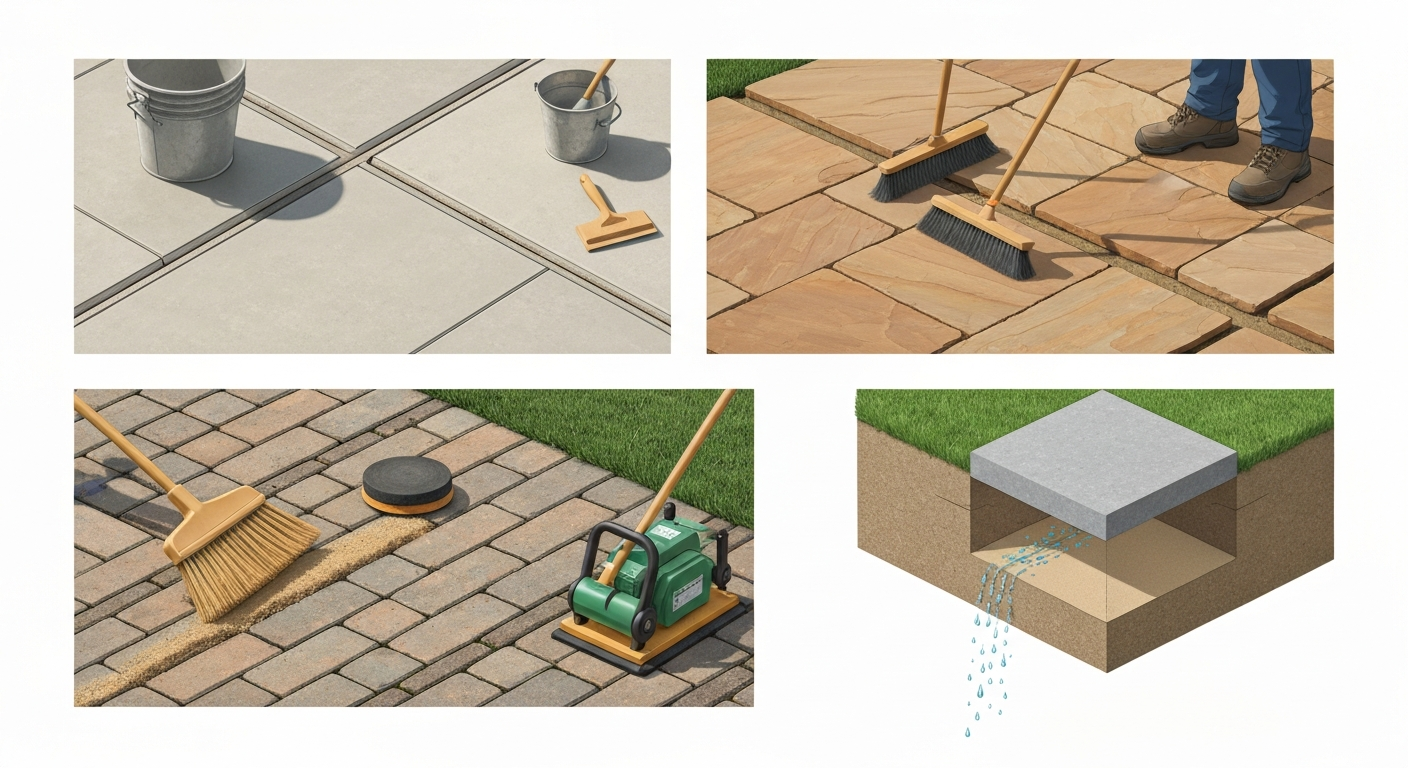
- Tools to have ready: stiff-bristled broom, pointing iron or grout float, sponge, bucket of clean water, rubber mallet (for polymeric sand compaction), plate compactor with rubber pad (for polymeric sand on pavers), mixing paddle and drill (for two-part epoxy).
Applying resin brush-in compounds (EasyJoint, Bostik All Weather)
- Confirm the surface is dry and joints are clean and open.
- Open the tub and apply the compound to the surface in sections of around 3-4 m² at a time, spreading it roughly across the area.
- Use a stiff broom to brush the compound firmly into the joints, working it diagonally across the joint direction to ensure full penetration. This is the step most DIYers under-do: keep brushing until you can see no voids.
- Remove excess material from the slab face using a squeegee or stiff brush, collecting it back into the tub. Don't leave excess on the surface to cure.
- For any residue on stone faces, wipe immediately with a damp cloth. Once cured, removal is extremely difficult.
- Allow to cure undisturbed: pedestrian traffic after 24-48 hours, full cure 3-4 weeks. Keep off the surface and protect from rain for the first 24 hours.
Applying polymeric sand (Techniseal SmartSand and equivalents)
- Confirm all joints are clean, dry, and the joint depth is at least 38 mm (1.5 inches). Recessed chamfer-to-joint top should be approximately 3 mm (1/8 inch) below the paver chamfer.
- Pour sand from the bag over the paver surface and spread it with a stiff broom, working it into joints in multiple passes. Fill joints to within 3 mm of the top (not flush).
- Use a leaf blower on a low setting to remove all excess sand from the paver surface before the next step. Any sand left on top will bond there permanently when activated.
- Compact the pavers with a plate compactor fitted with a rubber or foam pad. This forces the sand deeper into joints and re-levels any settled pavers.
- Repeat the fill and compact cycle 2-3 times until joints are consistently filled to the correct level.
- Mist the surface thoroughly with a fine water spray (do not jet wash or flood). This activates the polymer binders. Follow the manufacturer's misting instructions exactly: under-wetting and over-wetting are both common mistakes.
- Allow to cure without traffic for 24 hours and without rain for at least 24 hours after misting.
Applying two-part epoxy mortar (GftK vdw 850)
- Read the full TDS before starting. Mixing ratios are fixed and must be followed exactly: incorrect ratios prevent proper curing.
- Pre-seal all stone or sensitive paver faces as described in the prep section. This is especially important with epoxy: staining from improperly applied two-part mortars is very difficult to remove.
- Mix the epoxy component and aggregate component per the product instructions using a drill and paddle mixer. Mix only what you can place and finish within the stated pot life.
- Pour the mixed mortar over the paved area and work it into joints using a rubber squeegee or stiff broom, filling joints completely with no voids.
- Clean excess product from paver faces immediately using the specified tool or damp cloth. Once past the initial open time, clean-up becomes very difficult.
- Allow the product to self-compact into joints. Do not traffic until the stated cure time has elapsed. Protect from rain per the TDS.
Coverage calculations: how much product do you need?
Coverage depends on three variables: paving slab/paver size, joint width, and joint depth. No general figure is accurate without those inputs. Here are real-world reference points from manufacturer data to use as a starting point, then adjust for your actual dimensions.
| Product | Paving/joint scenario | Coverage |
|---|---|---|
| EasyJoint | 600×600 mm slabs, 30×5 mm joints | ~13-14 kg per m² |
| Sika FastFix-131 | 200×100 mm pavers, 10×60 mm joints | ~15 m² per 20 kg bag |
| Techniseal SmartSand | Narrow joints (1/16"-3/8") | 60-120 sq ft per 50 lb bag |
| Techniseal SmartSand | Wide joints (up to 1") | 25-40 sq ft per 50 lb bag |
| GftK vdw 850 | Variable (see product TDS) | Consult TDS for joint dimensions |
For a rough order calculation on brush-in compounds: multiply patio area (m²) by the kg/m² figure for your joint size. Always add 10-15% for wastage and joint variation. For polymeric sand, download the manufacturer's coverage chart (Techniseal provides one), input your paver size and joint dimensions, and it will give you bags required directly.
Maintenance and repair
Routine maintenance
The biggest favour you can do for any jointing product is to keep joints free of organic debris. Leaf litter trapped in joints decomposes into organic matter that supports moss and weed germination regardless of how good the jointing compound is. Brush the patio regularly and jet wash it at least once a year. For permeable SuDS patios, CIRIA C753 guidance recommends annual sweeping and occasional vacuum extraction of joint material to prevent silting. Applying a patio biocide in autumn before the growing season helps prevent moss and algae from establishing. Re-sealing natural stone every 2-3 years restores the protective barrier on slab faces and reduces staining risk.
Repairing failed joints
Partial top-ups of failed jointing material almost always fail again within a season. The correct repair is to remove all deteriorated material back to solid, clean substrate, confirm the joint depth meets the minimum for your chosen product, and fill completely. The practitioner rule of thumb backed by installer experience is that joint depth should be at least twice the joint width, and this is especially relevant when repointing: if the original joints were shallow, that's often why they failed in the first place. Use the same product family for the repair as the original jointing if possible, or remove everything and start fresh with a product that suits current joint dimensions.
Dealing with efflorescence and staining
Efflorescence (white salt deposits) is common in new cementitious and polymeric jointing in the first 6-12 months. It's usually self-resolving with weathering and regular washing. Persistent efflorescence can be treated with a dilute acid-based efflorescence remover (follow the stone-specific instructions carefully: acids damage some stones). Resin sheen or darkening from epoxy or resin contact is harder to address: a specialist stone reviver or colour enhancer can sometimes mitigate darkening, but prevention through pre-sealing is far more effective.
Sourcing and cost guidance
EasyJoint and Bostik All Weather are available at most builders' merchants, tile suppliers, and online. Sika FastFix-131 is stocked at Sika-approved distributors and online. GftK vdw 850 is primarily a trade product sold through specialist landscaping and paving distributors rather than general DIY outlets. Techniseal SmartSand is widely available in North America through paver suppliers and some home improvement retailers; availability in the UK is more limited, and similar EU-specification polymeric sands from Marshalls or Brett are the closer local equivalent.
As a rough cost comparison: polymeric sand runs at approximately £15-25 per 20 kg bag in the UK (covering around 10-15 m² on standard pavers). Resin brush-in compounds like EasyJoint typically cost £20-35 per 12.5-15 kg tub, giving roughly 1-1.5 m² coverage for medium joints. Two-part epoxy mortars like GftK vdw 850 cost £50-80+ per unit (coverage varies by joint size). Material cost should be viewed against expected service life: a £25 bag of polymeric sand that lasts 5 years is not better value than a £70 epoxy product that lasts 15-20 years in a freeze-thaw climate.
FAQ
Which types of patio jointing products should I consider and when (polymeric sand, brush‑in resin, 2‑part epoxy, permeable jointing)?
Choose by performance need: polymeric sand (single‑component, activated by moisture) for sand‑jointed pavers where moderate weed control and anti‑erosion are needed; brush‑in oxygen‑cured resin (ready‑to‑use) for narrow to medium joints on patios where faster installation and good washout resistance are required (suits porcelain, concrete, many natural stones if tested); 2‑part epoxy mortars for high strength, vehicle traffic, frost/de‑icing exposure, or where rapid waterproof, high‑compression joints are needed (best for heavy pedestrian/vehicle areas and some natural stone when pretested); permeable jointing products for SuDS/permeable paving where infiltration must be retained. Match product class to joint width/depth, drainage requirements and climate.
What are trusted brand picks for homeowners and which paving materials/climates do they suit?
Good, commonly recommended options: Techniseal SmartSand (polymeric sand) — ideal for typical concrete pavers, driveways/walkways in freeze–thaw and temperate climates (must be dry when installed); EASYJoint (brush‑in oxygen‑cured) — ready‑mix for porcelain, concrete and many natural stones (good for foot traffic, moderate climates; test on stone for sheen); Bostik All Weather Jointing Compound — all‑round brush‑in for diverse materials and variable weather windows; Sika FastFix‑131 — moisture‑curing compound for quick return to service and variable climates; GftK vdw 850 (two‑part epoxy) — high‑strength for vehicular loads, freeze–thaw and heavy use. For permeable needs look for specialist permeable joint products (tuffflow, SuDS‑rated mixes). Always follow TDS and pretest on natural stone for staining or darkening.
How do I pick the right product for my patio (decision checklist)?
Checklist: joint width & depth (check manufacturer min/max and rule of thumb: depth ≈ 2× width); drainage/permeability requirement (permeable vs impermeable joints); paving material sensitivity (porcelain, granite, sandstones — pretest for staining); climate stressors (freeze–thaw, de‑icing salts, hot UV exposure); load (pedestrian vs vehicular); aesthetics & texture (fine sand vs smooth resin); maintenance tolerance (easy top‑ups vs full repoint); budget (polymeric sand = lower cost, 2‑part epoxy = premium); local regulations (SuDS/permeable paving rules). Use this to narrow product class then pick brand/TDS that meets specs.
What are the core installation steps for brush‑in and polymeric jointing products (tools and timings)?
Core steps: 1) Prepare surface — remove old joint material, sweep and blow clean; ensure base and pavers are stable and properly drained. 2) Dry conditions — for polymeric sand, ensure surface and joints are dry; for some resins ensure recommended moisture windows. 3) Fill joints — pour product and brush into joints diagonally; use hand brush for brush‑in resins and plate compactor with rubber pad for polymeric sand compaction as required. 4) Remove excess — sweep off overfill promptly, then vacuum or blow fine dust. 5) Activation/curing — mist or allow moisture per TDS (polymeric sands often need light activation; oxygen‑cured resins cure in ambient air); respect temperature/rain windows and cure times (workable times and full cure vary — follow TDS: e.g., EASYJoint workable ~30–45 min at 20°C; Sika FastFix trafficable in 1–2 days). Tools: stiff and soft brushes, rubber‑pad plate compactor, garden blower/vacuum, tamper, mixing bucket for 2‑part systems, gloves, goggles, sponges and clean water for cleanup.
What special steps are required for two‑part epoxy joint mortars?
Key steps: accurately proportion and thoroughly mix components to avoid soft spots; follow working time/temperature limits; install into clean, dry joints to specified depth (manufacturers often require ≥25–30 mm); use squeegee or grout float to compact and smooth; remove residues immediately with recommended solvents/cleaners before curing; maintain manufacturer cure schedule (epoxies often reach trafficable strength faster but full chemical/mechanical properties take longer). Trial a small area on natural stone to check for sheen or color change.
How do I calculate coverage for jointing products?
Basic calculator inputs: area of patio (m² or ft²), paver/slab size, joint width (mm) and depth (mm). Formula (metric): volume of joints ≈ area × average joint width (m) × average joint depth (m). Convert volume to kg using product bulk density (check TDS), or use manufacturer coverage tables (preferred). Example: Techniseal SmartSand gives rough cover ranges (50 lb bag ≈ 22.7 kg covers ~60–120 ft² for narrow joints; actual coverage depends heavily on joint dimensions). Always allow 5–10% extra for waste and packing.