For most climates and most homeowners, porcelain tile is the more predictable, lower-maintenance choice, but natural stone patios are still worth choosing if you want a look that no manufactured tile can fully replicate and you're willing to seal and maintain the surface. The real decision comes down to your climate severity, your tolerance for ongoing upkeep, your budget, and whether you're hiring a contractor or doing it yourself. This guide walks through every factor so you can land on the right answer for your specific situation.
Natural Stone vs Porcelain Tile Patio: Key Differences
Nolan Ellison
30 Jun 2026
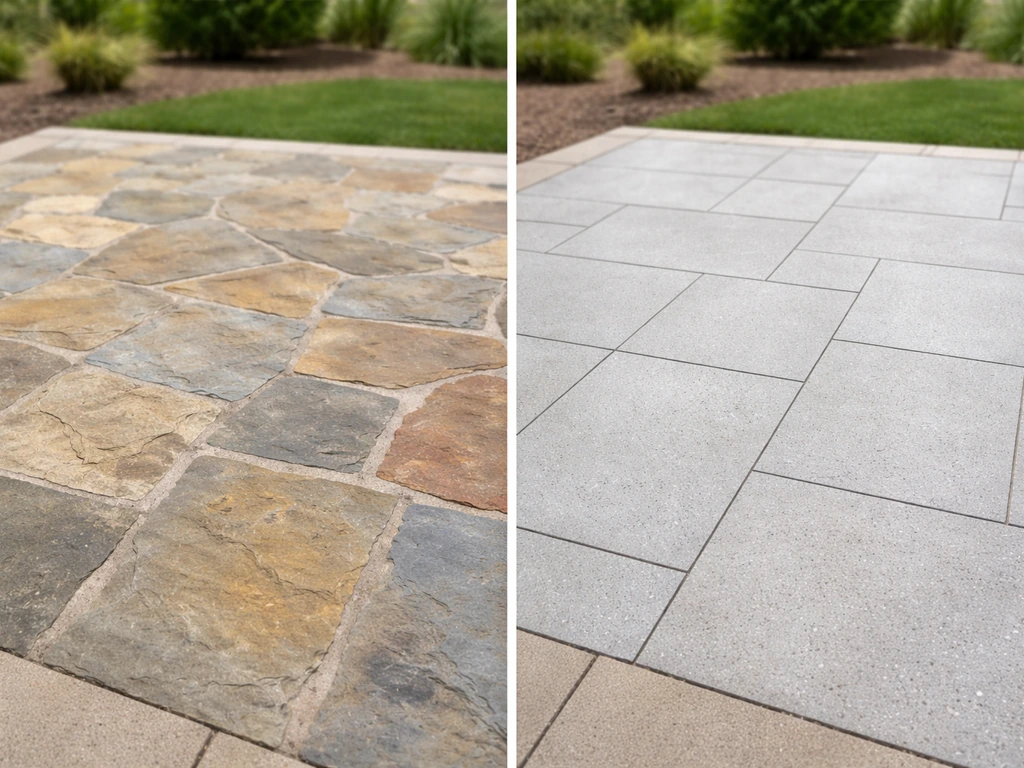
Core differences between porcelain and natural stone on a patio
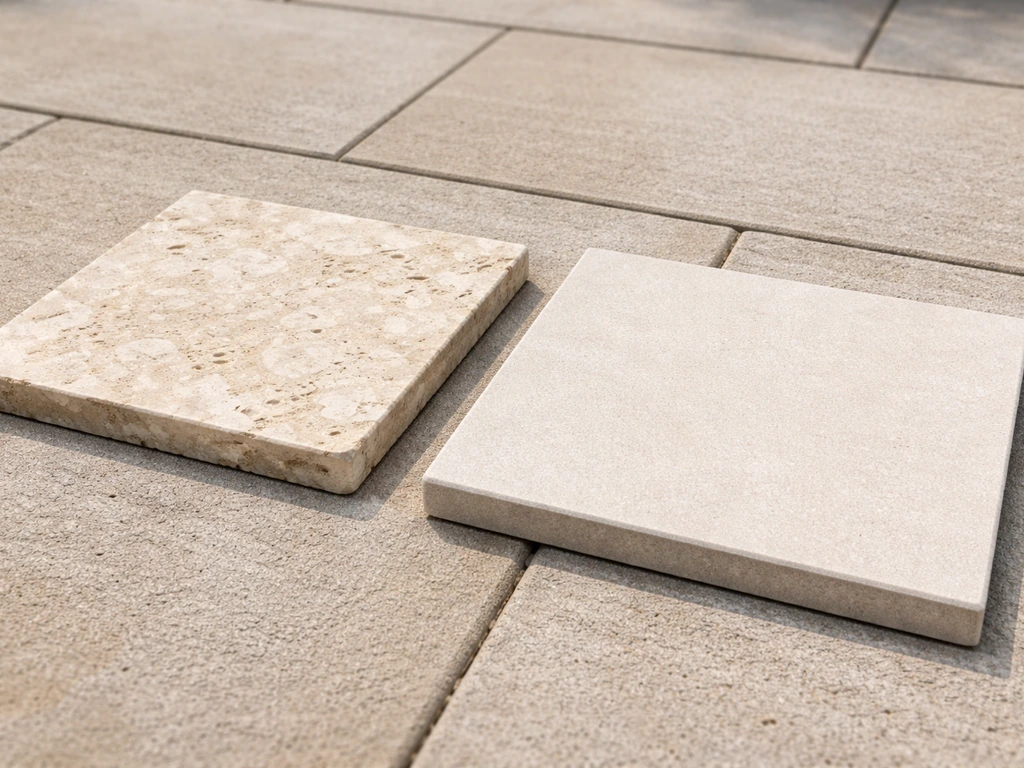
Porcelain tile is a fired ceramic product made from refined clay and other minerals, pressed under high pressure and fired at very high temperatures. The result is an extremely dense, low-porosity slab. Quality exterior porcelain hits a water absorption rate of 0.5% or less, which is the threshold that earns it the 'impervious' classification under ANSI A137.1 (tested via ASTM C373). That near-zero absorption is the single biggest practical advantage porcelain has over most natural stone outdoors.
Natural stone covers a wide range of materials: travertine, limestone, sandstone, slate, bluestone, granite, and quartzite, among others. Each has its own density, porosity, hardness, and surface character. Granite and quartzite are very dense and low-absorption. Travertine and limestone are much more porous and softer. Sandstone sits somewhere in between. This variation means that 'natural stone' is not one performance category. Choosing natural stone means choosing a specific stone type, and that choice matters enormously for weather performance, maintenance, and cost. Sandstone is also a common natural-stone option for patios, so the porcelain vs sandstone patio trade-off comes down to the specific stone grade and how much sealing upkeep you want.
Visually, porcelain has improved dramatically. Modern large-format porcelain tiles convincingly mimic travertine, slate, limestone, and even wood grain. But stand close, or look at the edge, and you can see the uniformity that gives away the manufactured origin. Natural stone has variation, depth, and character that comes from geology rather than a printing process. If authenticity of material matters to you, stone still wins that argument.
| Property | Porcelain Tile | Natural Stone (varies by type) |
|---|---|---|
| Water absorption | ≤0.5% (impervious) | 0.5%–15%+ depending on stone type |
| Surface consistency | Uniform, predictable | Varies piece to piece |
| Color fastness | Very stable, UV resistant | Some types fade or stain over time |
| Weight | Lighter per sq ft (varies) | Generally heavier, especially thick-cut flagstone |
| Edge finish options | Factory cut, precise | Natural cleft, sawn, or tumbled |
| Repairability | Difficult to match later | Easier to source matching stone in many cases |
| Feels underfoot | Hard, slightly cold | Similar, but more textural variety |
How each material handles weather: freeze/thaw, rain, heat, and UV
If you're in a climate that goes through hard freeze-thaw cycles every winter (think the Northeast, Midwest, or mountain states), water absorption is the most important spec you'll look at. Water that gets into a porous material expands when it freezes. Enough cycles and you get spalling, cracking, and surface flaking. Porcelain that meets ASTM C1026 freeze-thaw resistance testing (300 freeze-thaw cycles from 27°F to 40°F with no visible signs of damage required) is genuinely built for this.
Look for that spec on the product data sheet before you buy any porcelain for a freeze-thaw climate. Some manufacturer tender specifications also call out Freeze/Thaw Resistance per ASTM C1026 and water absorption per ASTM C373, with compliance to ANSI A137. 1 for porcelain performance [Look for that spec on the product data sheet before you buy any porcelain for a freeze-thaw climate. ](https://www.
panaria. us/downloads/7380/1523/PLAYLIST-tender-specifications. pdf).
Natural stone performance in freeze-thaw zones depends entirely on the specific stone. Granite and quartzite are very dense and handle freezing well. Slate performs reasonably well if it's a high-quality, low-cleft variety. Travertine and limestone are significantly more vulnerable because their natural porosity invites water infiltration. Sandstone varies widely by region and grade. The key step for any porous natural stone in a freeze-thaw climate is thorough penetrating sealer application before first winter exposure, and reapplication on schedule. Even with sealing, travertine and limestone are genuine risk in zones with consistent hard freezes.
For hot, sunny climates, both materials hold up well in terms of cracking, but color and surface behavior differ. Porcelain with a through-body color is very UV stable because the pigment is throughout the tile, not just a surface glaze. Natural stone color can shift over years of sun exposure depending on mineralogy. Some stones, like certain granites and bluestone, maintain color well. Others, like some sandstones, can bleach out. Heat retention is real for both materials in full sun. Dark-colored surfaces of either type will get hot enough underfoot in summer that bare feet aren't practical for a few hours midday.
In wet climates with standing rain, drainage design matters more than the tile material itself. Both porcelain and stone shed water fine when the surface is correctly sloped (minimum 1/8 inch per foot fall away from the structure). Where they differ is what happens in the gaps. Porcelain set with tight grout joints sheds water cleanly. Natural stone with wider irregular joints or dry-laid construction can trap moisture against the subbase, which leads to long-term heaving and weed growth in looser set applications.
Slip resistance and safety outdoors
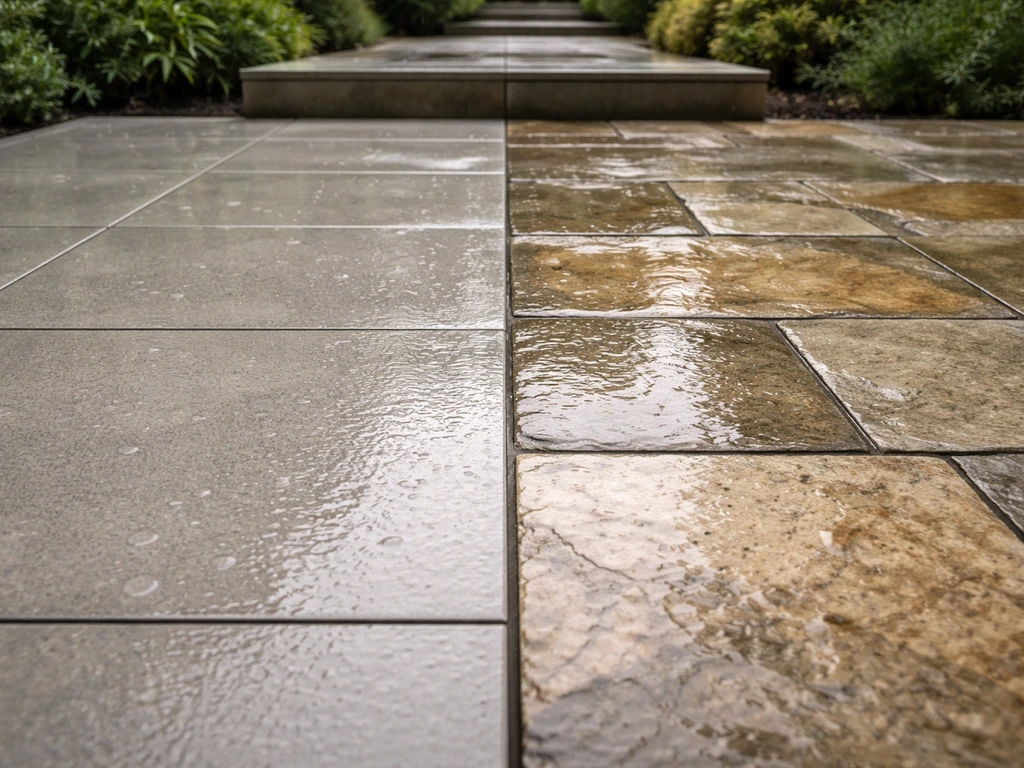
This is one area where the spec sheets actually tell you something useful. Slip resistance for tile is now governed by ANSI A326.3, which defines dynamic coefficient of friction (DCOF) thresholds for different use conditions. For “Interior, Wet Plus,” blank" rel="noopener noreferrer">ANSI A326.3-2021 sets a minimum referenced wet DCOF threshold of at least 0.50. For exterior wet use, you want a DCOF above 0.55, and you need to look at manufacturer-declared values specifically for the exterior wet classification. When you're shopping porcelain for a patio, ask for or look up the DCOF value in the product spec sheet. Smooth, polished, or glossy porcelain is not appropriate for an exterior patio. You want a textured, matte, or anti-slip surface finish.
Natural stone slip resistance depends on the surface treatment. Honed stone (smooth but not polished) can be slippery when wet. Natural cleft stone (split along its natural grain, like slate or certain sandstones) has built-in texture that performs much better. Sandblasted or bush-hammered stone surfaces are the most aggressive for traction. If you're buying pre-cut natural stone pavers with a polished or honed face, assume they'll be slippery when wet and either factor in surface treatment costs or switch to a cleft or textured option.
The area around a pool or any water feature deserves extra attention regardless of material. Both porcelain and stone can be ordered or specified in anti-slip grades. For porcelain, look for products marketed specifically as 'pool coping' or 'anti-slip exterior.' For stone, natural cleft slate, rough-sawn bluestone, or textured travertine are better poolside choices than honed travertine, which is genuinely dangerous when wet.
Installation and subbase: what each material actually needs
Porcelain tile is less forgiving of subbase imperfection than most natural stone, and this surprises people. Large-format porcelain (think 24x24 inches or larger, which is now very common) requires a very flat, stable base because the tile itself has almost no flex. The industry standard is no more than 1/8 inch variation in 10 feet for flatness. If the subbase moves unevenly, large porcelain cracks. This means a proper concrete slab with adequate reinforcement and expansion joints, or a very carefully prepared mortar bed. Installing large-format porcelain over a sandy or gravel-only base without a concrete slab is a path toward cracked tile within a year or two.
Natural stone, particularly thick-cut flagstone, has more tolerance for imperfection in the base because of its thickness and the fact that it's often set on a mortar bed that accommodates slight irregularities. Dry-laid flagstone over compacted gravel and sand is a legitimate installation method that accommodates ground movement better than a rigid mortar system. That said, dry-laid stone will shift and settle over time and requires periodic releveling. Mortar-set stone on a concrete slab requires the same base quality as porcelain, just with a little more tolerance for minor variation.
Drainage design is critical for both. A concrete slab under porcelain must be sloped correctly before the tile goes down. You cannot correct drainage slope at the tile layer alone. For dry-laid or mortar-set stone, the gravel and sand base layers handle drainage, and the surface slope needs to be built into the grading from day one. Get this wrong and you're dealing with water pooling against your house or saturating the base, which causes heaving, efflorescence, and joint failure.
Grout and joint behavior is another real difference. Porcelain is typically set with narrow grout joints (1/8 to 1/4 inch) using a polymer-modified grout designed for exterior use. Those joints are the weak point. Grout cracks from thermal movement and needs inspection and repointing over time. Large-format porcelain especially needs proper movement joints (expansion joints) where slabs meet walls, columns, and every 8 to 10 feet in large fields. Skipping movement joints is one of the most common reasons porcelain patios crack or tent. Natural stone joints are often wider and filled with mortar or polymeric sand, which handles slight movement better in many cases.
Setting methods at a glance
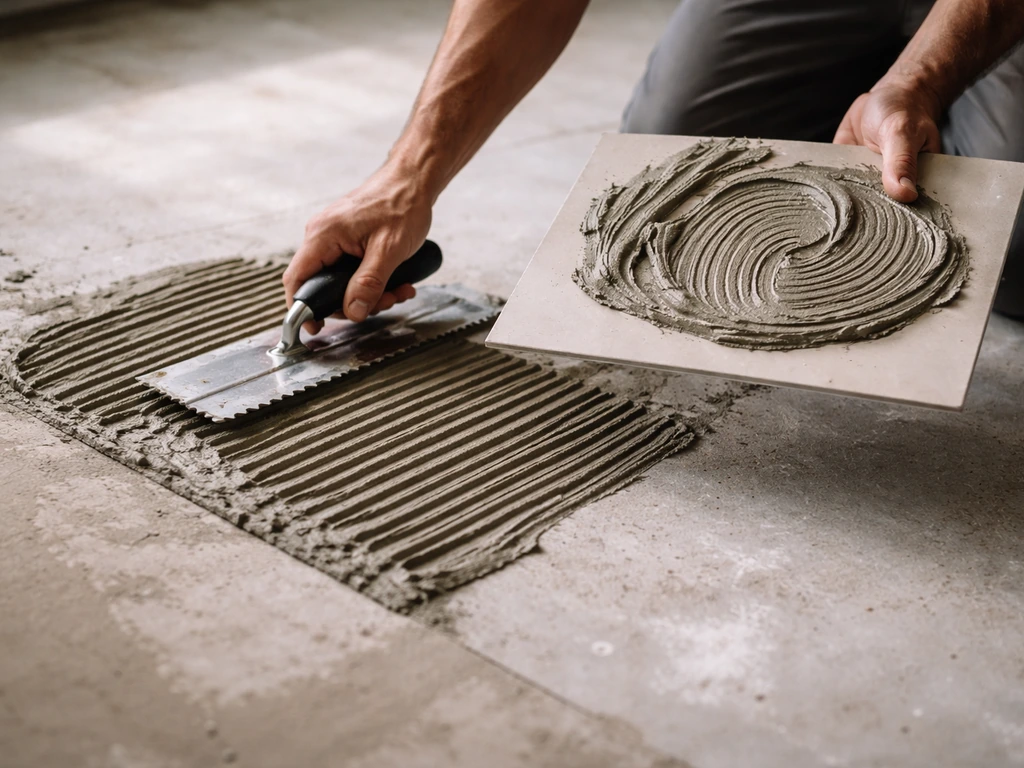
| Setting Method | Best For | Base Required | Movement Tolerance |
|---|---|---|---|
| Mortar bed on concrete slab | Porcelain, sawn stone | Reinforced concrete slab | Low — needs expansion joints |
| Thinset on concrete slab | Porcelain, smooth-cut stone | Flat, cured concrete slab | Low — needs expansion joints |
| Dry-laid on compacted gravel/sand | Thick flagstone, cobbles | 4"+ compacted gravel, sand layer | Good — accommodates settling |
| Pedestal/raised system | Porcelain on roof decks/raised patios | Structural slab or deck | Good — adjustable, drains below |
Cost comparison: materials, labor, and what you get long-term
Material costs for porcelain range from about $3 to $10 per square foot for mid-range outdoor tiles, and up to $20+ per square foot for premium large-format or imported Italian porcelain. Natural stone ranges similarly but more variably: basic sandstone or slate pavers can start under $4 per square foot, while premium bluestone, quartzite, or thick-cut travertine can reach $15 to $25 per square foot or more. Local stone quarries can significantly reduce stone costs depending on your region, which is a real advantage that porcelain doesn't have.
Labor costs often favor natural stone for dry-laid applications, where an experienced landscaper can lay flagstone without the precision requirements of porcelain installation. For mortar-set or thinset applications, porcelain can actually cost more in labor because of the flatness and expansion joint requirements, and because large tiles are less forgiving of errors. Budget $8 to $18 per square foot for professional porcelain installation on a concrete slab, and $6 to $14 per square foot for mortar-set natural stone, though regional rates vary considerably.
Long-term value is where the comparison gets interesting. Quality porcelain properly installed on a sound slab can genuinely last 30 to 50 years with minimal maintenance. Natural stone properly installed and maintained can last just as long or longer. The real difference is the 'properly maintained' part. Stone requires sealing on a schedule (typically every 1 to 5 years depending on the stone type and product). Porcelain does not require sealing. If you're the kind of homeowner who doesn't want to think about the patio for years at a time, porcelain is the lower-maintenance long game.
Repairs are worth thinking through before you commit. If a porcelain tile cracks or chips, replacing it years later is genuinely difficult because dye lots and production runs change. Matching an existing porcelain tile 5 years after installation is not guaranteed. Natural stone, especially common types like slate or bluestone, is often easier to source a matching piece of years later. This is a real advantage for stone that most people don't think about until they need a repair.
Maintenance and cleaning: what each material actually asks of you
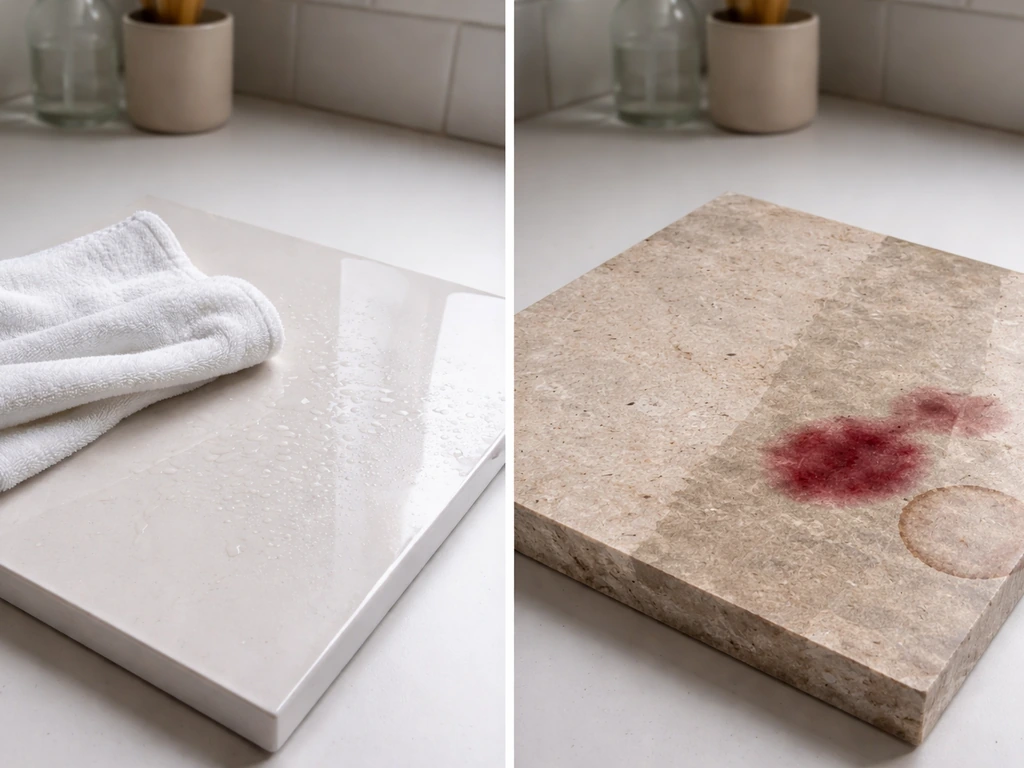
Porcelain's near-zero porosity means it doesn't absorb stains the way natural stone does. Spilled wine, grease from a grill, or leaf tannins that would permanently stain an unsealed limestone patio wipe off porcelain with soapy water or a mild cleaner. This is a genuine, meaningful advantage for anyone using their patio heavily. The cleaning routine for porcelain is mostly about keeping the grout joints clean and checking for cracked grout annually.
Natural stone requires a penetrating sealer to protect against staining. How often you reapply depends on the stone type, the sealer product, and how much wear the surface sees. Travertine and limestone typically need resealing every 1 to 3 years. Dense granite or quartzite might go 5 years between applications. The sealer doesn't make stone maintenance-free, it just slows stain penetration and gives you time to clean up spills. Unsealed porous stone outdoors will develop staining, biological growth, and in wet climates, efflorescence (those white mineral salt deposits that migrate to the surface) within a season or two.
Efflorescence is worth mentioning for both materials. It's caused by water carrying soluble salts through the setting bed to the surface. It's more common and more visible on natural stone, but it can appear in porcelain grout joints too. Good drainage design, using the right setting materials, and keeping joints well maintained are the best prevention. Efflorescence cleaners are widely available and effective, but preventing recurrence means addressing the underlying moisture issue.
Moss, algae, and biological growth happen on both surfaces in shaded, damp conditions. Porcelain is a little less hospitable because there's no porous surface for organic material to grip, but it still happens in joints and in shaded areas. For both materials, a diluted bleach solution or purpose-made patio cleaner, applied annually in spring, handles most biological buildup. A pressure washer (kept to moderate pressure, especially on softer stones) keeps both surfaces looking fresh.
Maintenance comparison summary
| Task | Porcelain | Natural Stone |
|---|---|---|
| Sealing required | No | Yes — every 1–5 years by stone type |
| Stain resistance | Excellent (no sealing needed) | Moderate — depends on sealer maintenance |
| Efflorescence risk | Low (joints only) | Moderate to high for porous stones |
| Biological growth | Low, but possible in joints | Moderate — surface texture holds growth |
| Grout/joint care | Annual inspection, repoint as needed | Annual inspection, repoint or re-sand |
| General cleaning | Soap and water, mild cleaner | PH-neutral cleaner only (acid damages stone) |
Sourcing, finishes, and how to pick the right product
When shopping for exterior porcelain, the first thing to verify is that the product is rated for outdoor use, specifically for freeze-thaw environments if you're in a cold climate. Look for water absorption of 0.5% or less (ASTM C373) and a freeze-thaw test result to ASTM C1026 with no visible damage after 300 cycles. Most reputable manufacturers publish these specs on their product data sheets. If a product listing doesn't show them, ask or move on. For slip resistance, look for a DCOF value above 0.55 for exterior wet use per ANSI A326.3.
Finish and texture for porcelain outdoors means: matte, textured, or anti-slip surface, not polished or glossy. Large-format tiles (24x24, 12x24, or the increasingly popular 24x48) look impressive and install quickly but demand a very flat, rigid subbase. If your slab isn't there yet, smaller format tiles (12x12 or 12x24) are more forgiving and still look great. Rectified tiles (precision-cut to exact dimensions) allow very tight grout joints and a cleaner look but require more subbase flatness.
Natural stone sourcing is regional. If you're in the Mid-Atlantic or Northeast, bluestone is widely available and cost-effective. In the South and West, local limestone, sandstone, or flagstone quarries can offer good value. Imported stone (travertine from Turkey, for example) is widely available through tile distributors and can be reasonably priced for cut-to-size pavers. When buying natural stone, buy more than your measured square footage. A 10% to 15% overage is standard for cut stone, and up to 20% for irregular flagstone to account for fitting and breakage. Saving several boxes or a few extra pieces from the original batch means you have matching material for future repairs.
If part of your attraction to natural stone is a specific look, like travertine or limestone, it's worth knowing that high-quality porcelain in those styles has gotten genuinely convincing. The comparison goes deeper in specific material matchups: if you're deciding between limestone and porcelain, or porcelain versus travertine specifically, those are different enough decisions that the specific stone type matters a lot to the outcome.
Finish options by surface type
| Finish Type | Available In | Wet Traction | Best Use Case |
|---|---|---|---|
| Natural cleft | Natural stone (slate, sandstone, bluestone) | Good to excellent | General patio, pool surrounds |
| Bush-hammered / textured | Natural stone, some porcelain | Excellent | High-traffic, poolside, sloped areas |
| Matte anti-slip | Porcelain | Good (verify DCOF) | General patio, any climate |
| Honed (smooth, matte) | Both stone and porcelain | Moderate — verify DCOF | Low-traffic areas only outdoors |
| Polished / glossy | Both stone and porcelain | Poor — avoid outdoors | Interior only |
| Tumbled | Natural stone (travertine, limestone) | Moderate | Low to moderate traffic |
How to make your decision: a practical framework
Run through these questions and the right answer will usually become obvious. If you want the quick takeaway on porcelain patio pros and cons, use the framework above to match the material to your climate, upkeep tolerance, and install details porcelain is the clear winner. If you're in a hard freeze-thaw climate and you want low maintenance, porcelain is the clear winner.
If you're in a mild climate, love the look of real stone, and are willing to seal it every couple of years, natural stone is a completely legitimate and beautiful choice. If budget is tight, compare local stone availability before assuming porcelain is cheaper. If you're DIY-ing, dry-laid flagstone is more forgiving than tiling a concrete slab with large-format porcelain.
- Hard freeze-thaw climate (Zone 5 and colder): lean toward porcelain with ASTM C1026 freeze-thaw rating, or dense stone like granite, bluestone, or quartzite. Avoid travertine and limestone unless sealed religiously.
- Mild climate with no freeze cycles: both materials work equally well for durability. Choose based on look, budget, and maintenance preference.
- Pool surrounds or water-adjacent areas: prioritize slip resistance above everything else. Choose textured porcelain with DCOF above 0.55, natural cleft stone, or bush-hammered stone.
- High-traffic, heavy-use patio: porcelain's stain resistance and no-seal requirement makes it easier to maintain over time.
- Prioritizing authentic look and character: natural stone. No porcelain print fully replaces the depth and variation of real material, especially up close.
- DIY installation: dry-laid flagstone is the most accessible DIY option. Large-format porcelain on a concrete slab is a job for an experienced tile setter.
- Repairs and future matching: natural stone is often easier to source a match for years later. Save extra porcelain tiles from your batch.
- Budget-conscious build: get quotes for local stone before defaulting to porcelain. Regional availability can make stone very competitive on total installed cost.
The bottom line is that both materials can give you a patio that lasts decades and looks great. Porcelain is more forgiving of neglect, more consistent in performance across climates, and easier to keep clean. Natural stone rewards the homeowner who chooses the right type for their climate and stays on top of sealing. Get the installation right either way, especially the subbase and drainage, and you won't regret either choice.
FAQ
Can I use regular interior porcelain tile on an outdoor patio?
You should not. Exterior use requires an outdoor-rated porcelain product, including proper freeze-thaw resistance in cold climates and an exterior slip rating (often via a DCOF value). Interior tiles may be more slippery when wet and may not be formulated or tested for repeated freezing and thawing, which can lead to cracking or joint failure.
How do I choose between sealed and unsealed natural stone for a patio that gets rain?
Treat it as an always-seal decision for porous stones. If you buy a stone that will be installed outdoors, plan for a penetrating sealer before first exposure to weather and then follow a re-seal schedule based on the stone type (more frequent for travertine and limestone). If you skip sealing, you are more likely to see staining, biological growth, and in some cases efflorescence within the first seasons.
What grout should I use with outdoor porcelain, and do grout lines really matter?
Use an exterior-rated polymer-modified grout and plan for maintenance of the grout joints. Grout joints are the area most prone to cracking from thermal movement, especially with large-format tiles. Expect periodic inspection and repointing, and make sure movement joints are installed where required by the patio layout.
Do I need movement or expansion joints with natural stone the same way as porcelain?
It depends on the installation system and patio size, but you should not assume natural stone eliminates the need. Even if wider joints and polymeric sand can tolerate movement better, you still need a design that accommodates expansion, slab movement, and changes near structures. If you dry-lay stone, shifting is normal and periodic releveling is part of the long-term plan.
Is honed travertine safe around a pool if I keep it clean?
Often no. Honed surfaces can be slippery when wet, especially in shaded or pool-splash zones where water film forms. For poolside areas, choose stone with built-in texture (for example cleft slate, textured travertine, or rough-sawn bluestone) or specify porcelain products intended for pool coping and anti-slip exterior use.
If I want the look of travertine, will porcelain always hide grout and show seams less?
Porcelain can look more uniform, but you still need to budget for grout visibility based on tile size and joint width. Rectified porcelain enables tighter joints, which can create a cleaner overall appearance, but it increases the demand for a very flat subbase. If your subbase is not ready, smaller format porcelain or traditional stone formats may be more forgiving.
How flat does the patio base need to be for large-format porcelain, practically?
Aim for very tight flatness before installation. A common target is no more than about 1/8 inch variation over 10 feet. Large tiles amplify the consequences of unevenness, leading to cracking if the base moves or is not properly supported and leveled.
Can I install porcelain or stone over existing pavers or a compacted gravel base?
Not as a default. Large-format porcelain generally requires a properly prepared rigid base, such as a correctly reinforced and sloped concrete slab, because it has minimal flex. Dry-laid stone can work over compacted gravel and sand, but it will shift and settle over time, so expect periodic releveling and potential joint upkeep.
What’s the fastest way to prevent efflorescence from coming back on my patio?
Fix the moisture pathway, not just the appearance. Efflorescence is driven by soluble salts carried to the surface by water. Ensure correct slope, address drainage, and maintain joints. If you repeatedly treat without correcting moisture, the white deposits are likely to return after wet cycles.
How much extra material should I buy for natural stone, and does it differ by stone type?
Yes, overage should be planned by how irregular the pieces are. A typical target is 10 to 15% for cut stone pavers, and up to about 20% for irregular flagstone because you will fit more pieces, trim edges, and replace breakage. Buying extra from the same batch helps with future repair matching.
What should I ask my contractor about sealing stone before the first winter?
Ask for the specific penetrating sealer they will use, the application timing, and whether they will apply it before first freeze exposure. Also confirm that they understand your stone type's reseal interval (travertine and limestone usually require more frequent resealing than dense stones). Don’t rely on cleanup or a single coat, sealing needs to be done correctly to be effective.
Are porcelain patios truly easier to repair long-term, or is matching a problem?
Matching can still be challenging, especially if the installation is old and products change. The difference is that stone is often easier to source in similar appearance for common types, while porcelain replacements may be difficult because dye lots and production runs vary. Before committing, ask about how replacements would be handled years later and consider keeping spare tiles from the original installation.