If you want a low-maintenance, freeze-thaw-proof surface that looks the same in ten years as it does on day one, go with porcelain pavers. If you want the warmth, character, and natural variation of real stone and you're willing to seal it every couple of years, limestone is genuinely beautiful and perfectly serviceable. The honest answer is that neither is universally better: porcelain wins on durability and ease of care, limestone wins on natural aesthetics and a softer feel underfoot.
Limestone vs Porcelain Patio: Which Surface Wins for You?
Nolan Ellison
6 May 2026
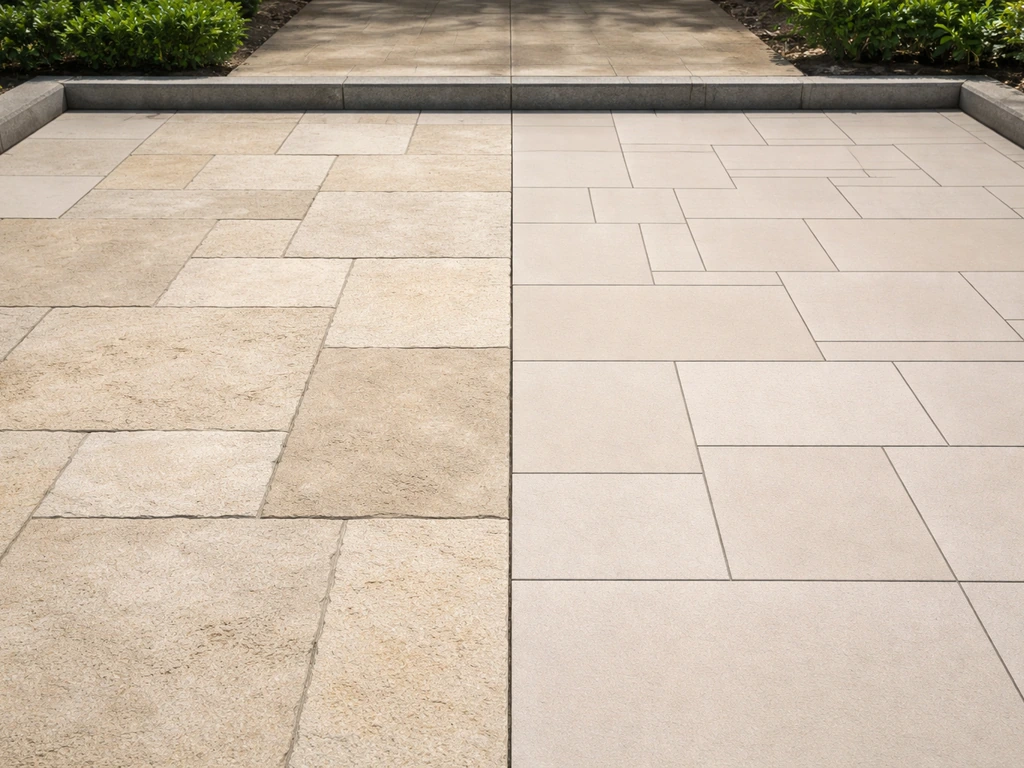
Porcelain patio pros and cons boil down to choosing between easier maintenance and long-term durability versus limestone’s natural look and softer feel. Most of the time, your climate and your maintenance tolerance will make the decision for you. If you're deciding between natural stone vs porcelain tile patio options, start by thinking about your climate, maintenance tolerance, and the slip risk on wet days.
How They Look: Natural Stone Character vs Porcelain Uniformity
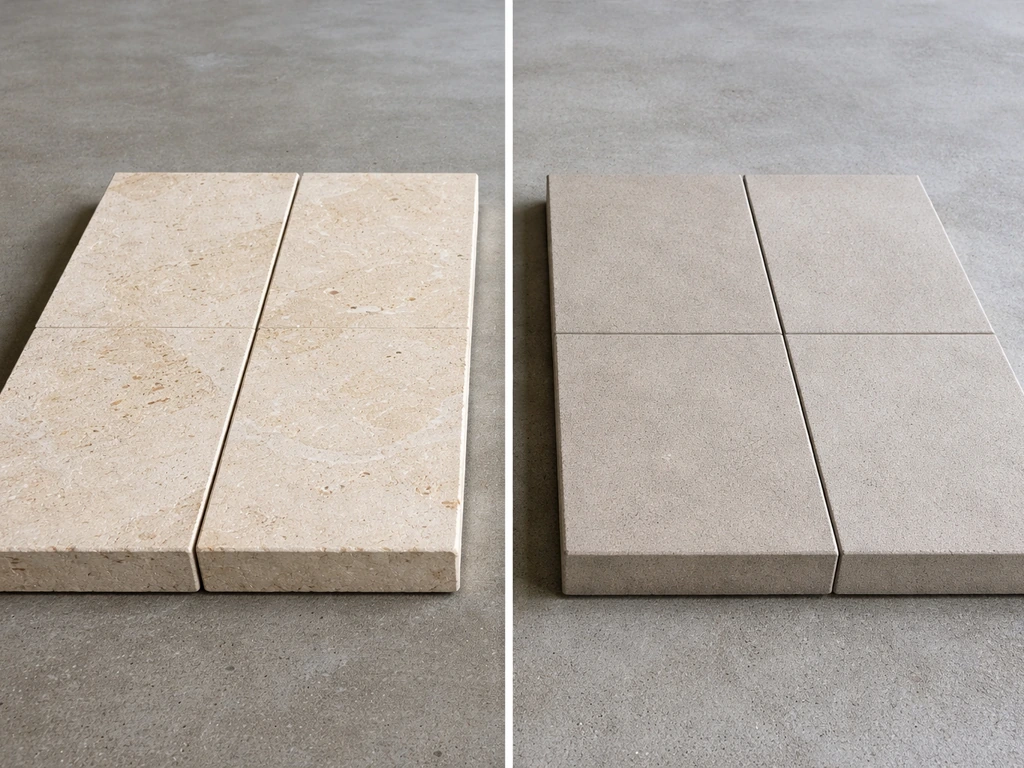
Limestone has a look that's hard to replicate. Each slab carries its own fossil marks, colour shifts, and texture variation. Depending on the quarry it comes from, you might get warm creams and buffs, cool blue-greys, or muted russets. That natural variation is exactly what most people love about it. The flip side is that variation means you don't always know what you're getting until the stone arrives. Batch differences between orders can show up, and that matters if you're extending a patio later.
Porcelain starts life as pressed ceramic clay fired at very high temperatures, and modern printing technology means manufacturers can produce it in finishes that convincingly mimic limestone, travertine, sandstone, or slate. The textures and veining look good, but if you stand two tiles side by side you'll notice the repeat pattern. For large patios that's rarely an issue, but purists who know their stone will spot the difference. What porcelain gives you in return is absolute colour consistency across an order and between top-up orders years later. If you tile in phases or need replacements, matching is easy.
Finish options differ meaningfully. Limestone is typically honed (matte), brushed, or sandblasted for outdoor use. Polished limestone exists but is a poor choice outside because it becomes dangerously slippery when wet. Porcelain comes in matte, structured (textured), grip-surface, and lappato (semi-polished) finishes. For patios, textured or structured finishes rated R11 under DIN 51130 are the standard recommendation and the right choice.
Durability, Weather Performance, and Freeze-Thaw Risk
This is where the gap between the two materials is most significant. Porcelain qualifies as a true porcelain tile when its water absorption is 0.5% or less, as defined by ANSI A137.1 using the ASTM C373 test method. That near-zero absorption is what makes it frost-resistant: water can't get into the tile deeply enough to expand, freeze, and crack it. Quality outdoor porcelain pavers are tested to ASTM C1026 for freeze-thaw cycling. Products that pass show no cracking after repeated freeze-thaw cycles. If you live anywhere that regularly drops below freezing, that test result matters enormously and is worth asking your supplier to confirm in writing.
Limestone is a carbonate rock and it is porous. Exactly how porous depends on the variety: dense, hard limestones like Jura Beige or Blue Limestone from Belgium absorb relatively little water, while softer, more granular varieties can drink up moisture quickly. That porosity creates two problems in cold climates. First, water absorbed into the stone expands when it freezes, which causes spalling and flaking on the surface over time.
Second, moisture moving through the stone carries soluble salts to the surface, which is the mechanism behind efflorescence, those white salt deposits that appear after rain or temperature changes. Somners explains efflorescence as mineral salt deposits left behind when water carrying dissolved salts migrates to the surface and evaporates [efflorescence, those white salt deposits that appear after rain or temperature changes. ](https://www. somners.
com/resources/efflorescence). In warm or dry climates these issues are largely irrelevant, but in freeze-thaw zones unsealed limestone on a patio is a long-term maintenance problem waiting to happen.
For scratch and impact resistance, porcelain's high firing temperature produces an extremely hard surface that holds up well under patio furniture, foot traffic, and dropped objects. Limestone is softer and can show scratching from metal chair legs or grit tracked across the surface. A honed finish hides minor scratches better than a smooth one, but over years of heavy use limestone will show wear in high-traffic zones in a way that porcelain generally won't.
| Factor | Limestone | Porcelain |
|---|---|---|
| Water absorption | Variable (moderate to high depending on variety) | ≤0.5% (ANSI A137.1 / ASTM C373) |
| Freeze-thaw performance | Risk of spalling and flaking; variety-dependent | Frost-resistant when tested to ASTM C1026 |
| Scratch resistance | Moderate; softer stone shows wear | High; very hard surface |
| Efflorescence risk | Higher due to porosity | Very low |
| Salt air / coastal exposure | Reactive to acidic conditions over time | Non-reactive; good for coastal use |
Traction, Slip Resistance, and Wet Safety
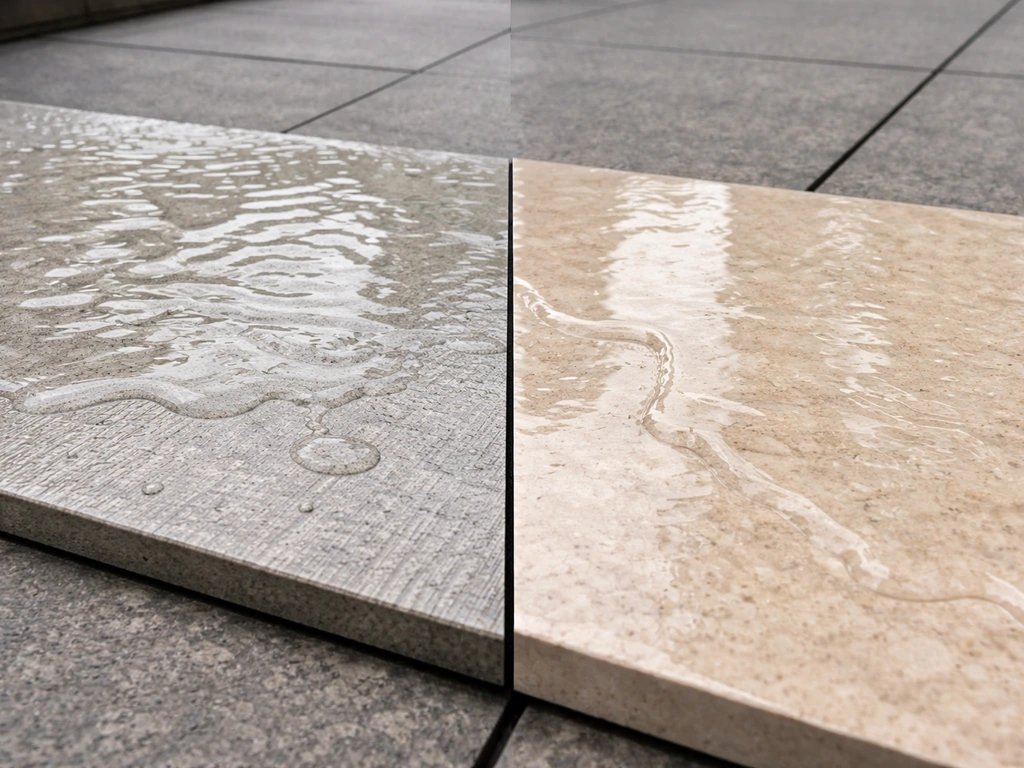
Both materials can be safe or dangerous outdoors depending on the finish you choose. The key number to look for is the slip resistance rating. In the US, ANSI A137.1 sets a minimum wet DCOF (Dynamic Coefficient of Friction) of 0.42 for tiles in wet interior conditions, measured using the BOT-3000E device under ANSI A326.3. For outdoor use, you generally want to exceed that threshold, not just meet it. In the UK and Europe, DIN 51130 (shod ramp test) classifies tiles from R9 to R13, with R11 considered good for most outdoor and wet-area applications, including balconies and light outdoor flooring. DIN 51097 covers barefoot and wet areas like pool surrounds.
Porcelain gives you precise, certified numbers. A structured or textured outdoor porcelain paver rated R11 is a known quantity. You can request the test certificate from the supplier and verify the rating before you buy. Some manufacturers go further with specific grip finishes designed explicitly for pool edges and wet outdoor areas. The point is: the data exists and you can ask for it.
Limestone's slip resistance depends on its finish and how clean the surface is kept. A brushed or sandblasted limestone has good natural texture and provides decent grip when dry. The problem comes when algae, lichen, moss, or a thin biofilm builds up on the surface, which happens faster on porous stone than on dense porcelain. A wet, algae-covered limestone patio becomes genuinely slippery. Regular cleaning and an appropriate sealer help, but they don't eliminate the issue. Households with children, elderly family members, or pets should factor this in seriously. If the patio gets a lot of shade and moisture, porcelain's easier-to-clean surface has a real safety advantage.
Maintenance, Sealing, and Cleaning
What limestone actually needs
Limestone needs to be sealed, full stop. The question is what kind of sealer and how often. Breathable penetrating sealers are the right choice for outdoor use: they reduce water absorption, protect against oil and organic staining, and allow moisture vapour to move through the stone (which prevents trapped moisture from causing problems). Because some limestones are highly porous, the first coat of sealer can disappear almost immediately as the stone absorbs it.
You may need two or three coats on the first application to reach effective coverage. After that, most exterior penetrating sealers need refreshing every two to three years depending on traffic, UV exposure, and the specific product. A simple water-bead test tells you when it's time to reseal: if water soaks in rather than beads up, you need to reapply.
For cleaning, use a pH-neutral stone cleaner and a stiff brush. Never use acid-based cleaners on limestone. Acids react with the carbonate in the stone and will etch the surface, leaving dull marks that can't be polished out without professional intervention. Avoid bleach too. For algae and organic growth, use a dedicated stone biocide cleaner, not a pressure washer on full power, which can lift the surface of softer limestones. Efflorescence is best managed by addressing the moisture source and keeping the sealer in good condition. Salt deposits will appear to disappear when the surface is wet and reappear when it dries, which makes it easy to underestimate how much is there.
What porcelain needs
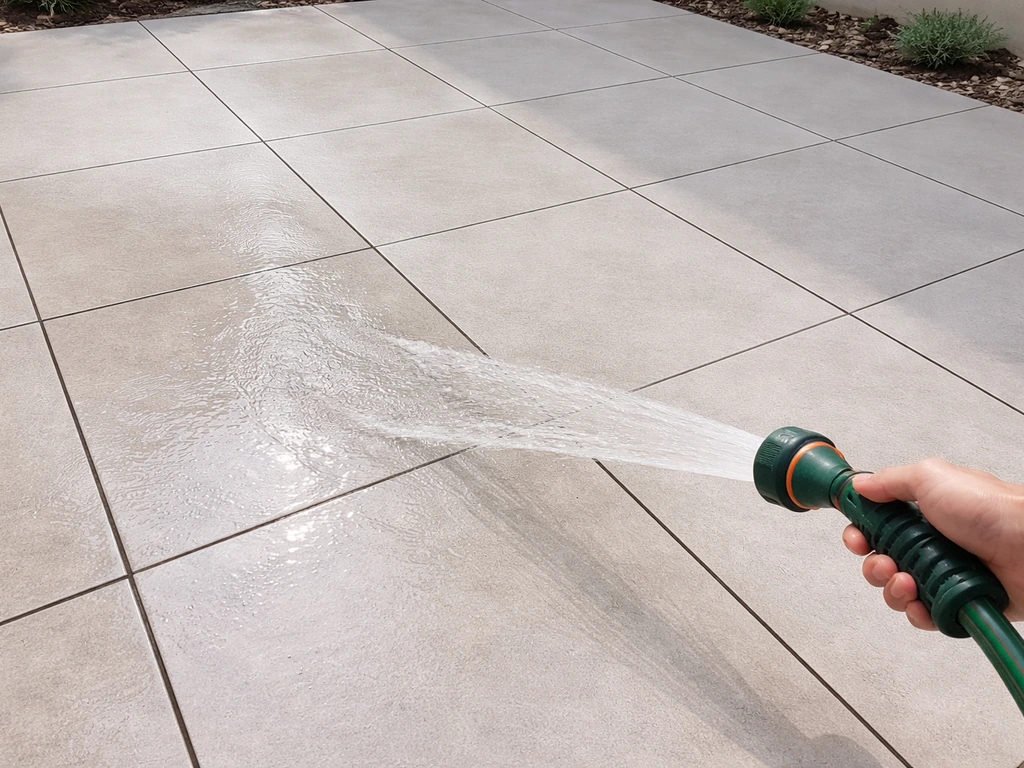
Porcelain's non-porous surface means it doesn't need sealing and doesn't absorb stains in the way stone does. Routine maintenance is genuinely simple: sweep off debris, then wash with a pH-neutral tile cleaner and water. Don't use ammonia-based cleaners, bleach, or anything acid-containing on porcelain. Acids can attack the grout joints and some surface treatments even on porcelain, and over time they'll cause grout erosion. A soft brush or mop is all you need. For tougher organic staining between the joints, a diluted specialist tile cleaner does the job. Pressure washing is safe on porcelain at moderate pressure, which is a practical advantage for large outdoor areas.
Installation Basics: Subbase, Setting, Grouting, and Complexity
Both materials require a solid, well-drained subbase, and this is the single area where most patio failures originate. Skimping on the base to save money is the most common and most expensive mistake I see. For foot traffic, a compacted aggregate base of around 4 to 6 inches is the starting point; if vehicles will park on the surface or you're in a freeze-thaw climate, go to 10 to 12 inches. Drainage matters too: the surface and base need to slope away from the house at roughly 1.5 to 2.0 percent (about a quarter inch per foot) so water doesn't pool.
Porcelain pavers are typically mortar-set onto a concrete or compacted base using exterior-rated adhesive or a sand-cement bed. Because porcelain has essentially no absorption, standard mortars don't bond to it the way they bond to porous stone: you need an approved flexible exterior adhesive, and the manufacturer's instructions about primer or slurry coats must be followed. Joint widths for porcelain are generally 3 to 5 mm, and you'll want a flexible polymeric joint compound or resin-based jointing mortar rather than rigid sand-cement pointing, which will crack with thermal movement. Cutting porcelain requires a wet-cut diamond blade rated for porcelain: a standard tile blade will chip the edges, and chipped edges on a patio are both unsightly and a trip hazard.
Edge restraint is non-negotiable for porcelain pavers. Without it, thermal expansion pushes the pavers apart at the perimeter and grout joints crack. Specify this explicitly when you're getting quotes. Also ask whether the installer plans to use L-shaped stainless or galvanised edge restraints or a mortar haunch: both work, but you want to know the plan.
Limestone is more forgiving to lay in some respects because its natural porosity means standard sand-cement beds and mortars bond well. Thick-format limestone flags (30 mm or more) are typical for patios and can be laid on a semi-dry mortar bed. Jointing is usually with a wet mortar pointing mix or flexible pointing compound. Limestone cuts well with a disc cutter or angle grinder but produces a lot of dust, so wet cutting is preferable where possible.
The bigger consideration with limestone is that any mortar or jointing compound that contacts the face of the stone should be cleaned off before it sets, as cement residue stains limestone and is very difficult to remove without acid (which you can't use on limestone).
Cost, Lifespan, and Long-Term Value
In the US, installed limestone paver costs typically run from about $16 to $32 per square foot including materials and labour, though premium imported varieties will push past that. In the UK, porcelain patio installation including materials and a proper subbase tends to come in around £100 to £150 per square metre at the mid-to-upper end, with budget porcelain options bringing the total closer to £70 to £100 per square metre. Material-only costs for porcelain slabs start around £30 to £70 per square metre for standard ranges, with premium large-format or specialist anti-slip grades higher.
Lifetime value is where the comparison gets interesting. Porcelain installed correctly over a proper base should last 25 to 40 years with essentially no material degradation. Its cost is mostly upfront. Limestone can also last decades but the ongoing costs add up: sealer every two to three years, occasional professional cleaning, and in freeze-thaw climates, potential repairs to spalled or cracked slabs over time. On a 20-year horizon, a well-installed porcelain patio often represents better value even if the initial installation cost is similar or slightly higher, specifically because of lower maintenance spend and fewer replacements.
Climate is the decisive factor here. In a warm, dry climate with no freeze-thaw risk, the gap narrows significantly. Limestone behaves well when it's not fighting repeated ice cycles, and the maintenance burden is manageable. In the UK, the US Northeast, the Midwest, Canada, or anywhere with genuine winter freezing, porcelain's frost-resistance advantage is substantial and the long-term cost equation tilts heavily in its favour.
| Climate / Use Case | Better Choice | Reason |
|---|---|---|
| Freeze-thaw climate (cold winters) | Porcelain | Frost-resistant (ASTM C1026); no spalling risk |
| Warm, dry climate (Mediterranean, arid) | Either | Limestone performs well without freeze risk |
| Coastal / salt air exposure | Porcelain | Non-reactive; limestone can degrade with acid-salt contact |
| High foot traffic / commercial feel | Porcelain | Harder surface; doesn't wear or scratch |
| Natural aesthetics / traditional garden | Limestone | Genuine stone character; ages naturally |
| Households with children / elderly users | Porcelain (R11 finish) | Certifiable slip resistance; easier to keep algae-free |
| Low-maintenance priority | Porcelain | No sealing; pH-neutral cleaning only |
| Budget-limited project | Compare quotes | Costs overlap; limestone material can be cheaper but maintenance adds up |
How to Choose: A Practical Decision Checklist
Before you call an installer or visit a stone yard, answer these questions honestly. They'll tell you which material actually suits your situation, not just which one looks best in a photo.
- Does your area experience temperatures below freezing in winter? If yes, lean strongly toward porcelain with confirmed ASTM C1026 freeze-thaw test results.
- How much ongoing maintenance are you genuinely willing to do? If re-sealing every two to three years sounds like a hassle, choose porcelain.
- Is this a shaded, north-facing, or damp area? Biofilm and algae will grow faster on porous limestone in these conditions, increasing slip risk.
- Do you have children, elderly family members, or pets using the patio regularly? Prioritise a certified R11 slip-rated surface.
- Is natural stone variation and character the main reason you want this patio? If the look of real stone is non-negotiable, limestone (properly installed and maintained) will satisfy you in a way porcelain won't.
- Are you near the coast? Salt air and occasional acid rain exposure make porcelain the safer long-term choice.
- What is your realistic project budget including ongoing costs over 10 years? Factor in sealing, cleaning products, and potential repairs for limestone.
What to tell your installer and ask before signing
A good installer should be able to answer all of these without hesitation. If they can't, or if they dismiss them, that's a red flag worth taking seriously.
- What is the subbase specification for my soil conditions and climate: depth, aggregate type, and compaction standard?
- What is the surface drainage slope, and where does water discharge to?
- For porcelain: what is the water absorption rating (should be ≤0.5% per ASTM C373) and has the product been tested to ASTM C1026 for freeze-thaw resistance?
- For porcelain: what slip resistance rating does the chosen product carry? Ask for R-value (DIN 51130) or DCOF figure and request the test certificate.
- What adhesive or bedding system will be used, and is it exterior-rated and manufacturer-approved for this specific tile?
- What jointing compound is specified? Flexible polymeric or resin jointing is preferable to rigid sand-cement for porcelain in temperature-variable climates.
- How will edges and perimeter restraint be handled?
- For limestone: what variety is being supplied, what is its density and water absorption, and has it been used successfully in this climate before?
- For limestone: what sealer do you recommend, and is the first sealing included in the quote?
- What is the warranty on workmanship, and what constitutes acceptable variation in a natural stone surface?
How to source the right material
For porcelain, specify outdoor-rated pavers with a minimum 20 mm thickness for patios (some products come in 10 mm for internal use and are not appropriate outside). Check that the product data sheet lists ASTM C373 water absorption at 0.5% or below and references ASTM C1026 freeze-thaw testing. For slip resistance, ask for a DIN 51130 R11 rating or a wet DCOF above 0.42 minimum, and higher if the patio will be frequently wet or used by vulnerable users. Large-format pavers (600 x 600 mm or 600 x 900 mm) reduce the number of joints and give a cleaner look, but make sure your installer has experience cutting them cleanly with a wet-cut porcelain blade.
For limestone, ask the supplier specifically about the variety's suitability for your climate. Dense, low-porosity varieties like Blue Limestone, Jura Beige, or similar hard limestones are significantly more frost-tolerant than soft, chalky types. Request slabs at 30 mm or 40 mm minimum thickness for outdoor use: thinner limestone is more prone to cracking under furniture loads and thermal movement. Check batch consistency in person if possible, especially if you're ordering a large area in phases.
Both materials are widely available from stone yards, specialist tile suppliers, and large building merchants. For porcelain, buying from a supplier who can provide full technical data sheets is worth paying a small premium over a budget source where the spec is unclear. For limestone, buying from a yard where you can see the actual batch you're purchasing, rather than ordering blind from a photo online, avoids the single biggest source of disappointment with natural stone projects.
If this is a large patio, the comparison between limestone and other natural stone options, or porcelain versus travertine or sandstone, is worth exploring in detail before you commit, since the same practical questions apply across all of those choices. If you're comparing porcelain versus sandstone for a patio, focus on slip resistance, freeze-thaw performance, and how much cleaning and sealing your climate will require.
FAQ
Which surface is safer if the patio gets wet often (shade, sprinklers, pool splash)?
For porcelain, start by confirming it is rated for outdoor use and has a wet slip figure (DIN 51130 R11 or better, or a wet DCOF above 0.42). For limestone, look for a finish you can keep clean (brushed or sandblasted), because algae and biofilm can quickly override the stone’s natural texture and make it dangerously slick.
Can I install limestone or porcelain on the same base type, or are there different rules?
Yes, but the details matter. Porcelain joints must be flexible (polymeric jointing or resin-based systems) and edges must have restraint to prevent pavers from pushing apart as temperatures change. Limestone can tolerate more typical sand-cement bedding, but any cement that smears on the face must be cleaned immediately to avoid permanent dark staining.
If one slab cracks later, which material is easier to match and repair?
Spot repairs are possible for porcelain because color consistency is the advantage, but you still need the exact same SKU, shade, and finish to avoid visible patching. For limestone, the stone’s batch variation can make repairs stand out, even if the type name matches, so plan to keep extra slabs from the original order.
I hate the idea of sealing, is limestone still realistic for an exterior patio?
If you want to skip sealing, porcelain is the practical choice. With limestone, sealing is not optional in outdoor freeze-thaw areas, and the first application often needs multiple coats until the stone stops absorbing. Also, choose a breathable penetrating sealer and re-test water beading every season or two to avoid discovering late-stage moisture issues.
What common cleaning products should I never use on limestone or porcelain?
Avoid acid cleaners on limestone, even for “stain removal,” because it etches the surface and makes the affected area dull and uneven. On porcelain, stick to pH-neutral products and avoid ammonia or bleach because they can degrade grout and some coatings over time, leaving joints looking tired even if the pavers look fine.
What’s the biggest installation mistake that ruins porcelain, even when the subbase looks good?
Many installers under-communicate this: porcelain typically needs an approved flexible exterior adhesive or manufacturer-specified bonding method because it bonds differently than porous stone. If someone plans to set porcelain on the same mortar used for limestone without checking the porcelain installation instructions, ask how they will achieve mechanical stability and long-term bond.
What documents or test info should I ask my supplier for before paying for either patio material?
If your supplier cannot provide the specific water absorption number (ANSI/ASTM context for porcelain, and freeze-thaw evidence) or slip classification for the finish you’re buying, treat it as a decision blocker. “It’s outdoor rated” is vague, especially for freeze-thaw climates where the wrong grade can fail after repeated winters.
If I add lighting or a cover, does it change the limestone vs porcelain recommendation?
Yes, and it changes the tradeoff. If you choose porcelain with a structured or grip-rated finish, it generally cleans easier and stays more consistently slip-resistant. If you choose limestone, plan maintenance around keeping biological growth under control, which often means more frequent washing in shaded or humid areas.
Does thicker limestone automatically make it as frost-proof as porcelain?
For freeze-thaw areas, thicker limestone (at least 30 to 40 mm outdoors, with the right variety) buys margin against furniture load and thermal movement, but it still won’t eliminate spalling risk if moisture cycles repeatedly. Porcelain’s advantage comes from low absorption and freeze-thaw testing, so thickness alone is not the same deciding factor for porcelain.
I want a seamless look with large slabs, what should I watch for when selecting size and layout?
Large format porcelain can look cleaner because it reduces joints, but it also increases the importance of installer skill when cutting and aligning panels. If your design needs many cuts around posts or borders, ask for a layout that minimizes small slivers and confirm they will use a wet-cut porcelain blade to prevent edge chipping.