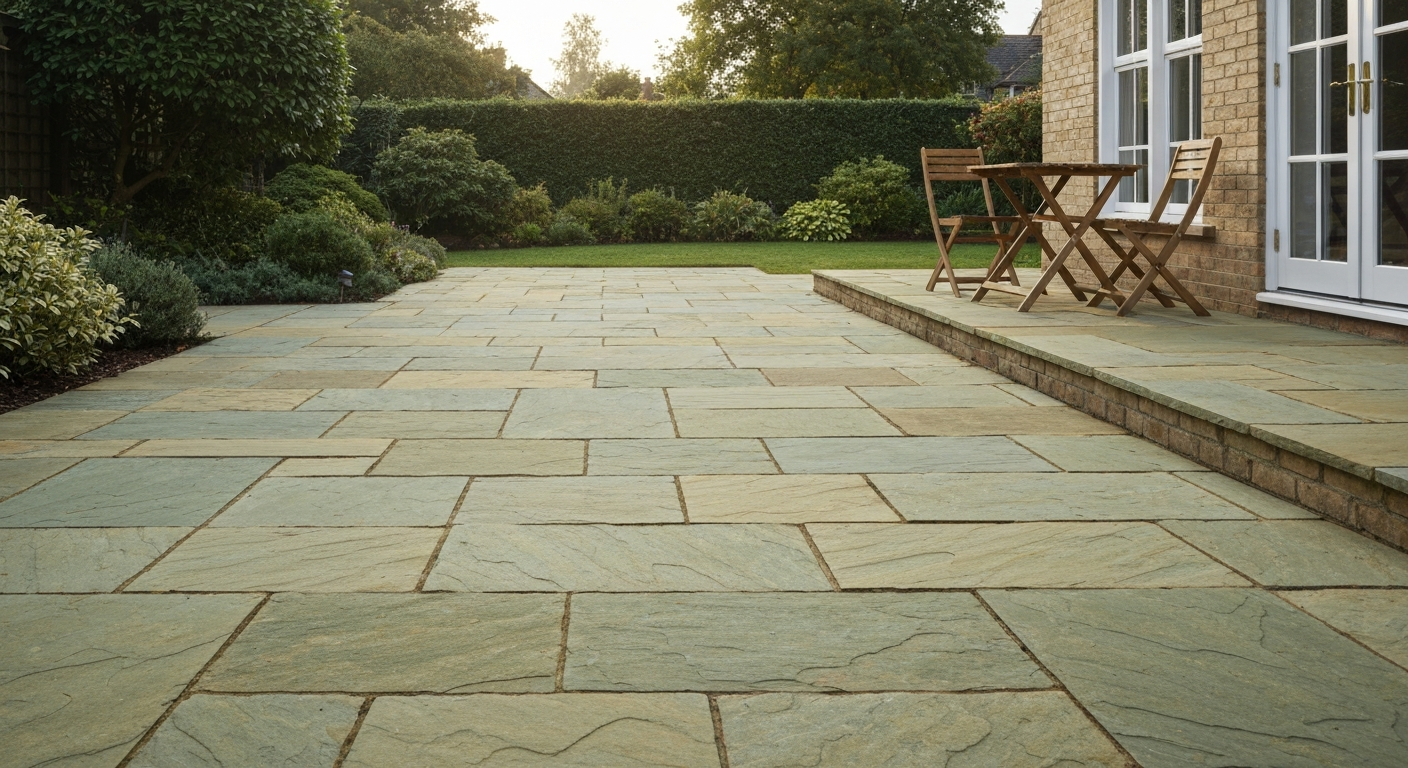
Sandstone is a genuinely good patio material for most homeowners, but only if you pick the right variety and install it correctly. A dense, low-absorption sandstone (water absorption below about 1%) laid on a solid subbase with proper drainage will give you 20 to 40 years of attractive, safe, low-maintenance service. A soft, porous sandstone laid flat without drainage will stain, scale, and deteriorate within a decade. The honest answer is that 'sandstone' covers an enormous range of stones, from near-quartzite hardness down to crumbly, clay-rich types, and the difference in real-world performance is huge. Get the spec right and it is one of the best-value natural stone options available.
Is Sandstone Good for Patios? Practical Guide for Homeowners
Nolan Ellison
14 Jul 2026
Quick verdict: is sandstone good for patios?
Yes, with caveats. Dense, quartz-cemented sandstones (Indian sandstone is the most widely available example) perform well on patios in most climates, are reasonably priced, and come in a wide range of natural colors. They are workable, relatively easy to cut and lay, and can be sourced in both irregular flagstone and sawn slab formats. They are a strong choice for homeowners who want the character of natural stone at a lower price than granite or premium limestone.
Sandstone is less ideal for: climates with frequent freeze-thaw cycles when a porous variety is chosen; pool edges where a smooth, sawn finish is specified (slip risk); heavy-traffic commercial settings; or anywhere deep, persistent shade encourages algae and organic staining on an unsealed surface. For those scenarios, you need to either upgrade to a denser grade of sandstone, specify a textured finish, commit to a sealing schedule, or consider an alternative material. I will walk through all of those trade-offs below.
Sandstone 101: what it is, the main varieties and finishes
Sandstone is a sedimentary rock formed from compacted and cemented sand grains. The key variable for patio performance is what those grains are made of and what cements them together. Quartz-dominated, silica-cemented sandstones are the hardest and most durable, behaving almost like quartzite. Carbonate-cemented or clay-rich sandstones are softer, more porous, and closer in performance to limestone or travertine. When you buy paving sandstone you are rarely told the cement type explicitly, which is why asking for water absorption figures from the supplier is the most practical proxy for durability.
Common sandstone types used in paving
- Indian sandstone (Raj Green, Autumn Brown, Kandla Grey, Fossil Mint): sourced mainly from Rajasthan, these are dense, quartz-rich stones with water absorption typically below 1% on good-grade product. They are the most widely used import sandstone globally and the best-value entry point for natural stone paving.
- Yorkstone / Pennine sandstone (UK): a classic British building stone, used in flagging for centuries. Water absorption varies by quarry but commonly sits around 2.5-3.5%. Strong and attractive, but noticeably more porous than good Indian sandstone.
- Buff/brown Australian and US sandstones: local sandstones vary enormously by region. Always request a technical datasheet before buying.
- Carboniferous/Old Red Sandstone (UK, Ireland): variable porosity, often more clay-rich; may be less suitable for exposed patios without sealing.
- Quartzitic sandstone: very high silica content and cementation, approaching quartzite; low absorption, high abrasion resistance. Rare in standard paving supply but excellent where available.
Finish options and what they affect
The finish controls both the look and the slip performance of your patio. Natural cleft (the stone split along its natural bedding plane) leaves a textured, undulating surface with very good wet grip. Sawn finishes are flat and precise but smoother, which reduces wet pendulum test (PTV) values significantly. Shot-blasted and bush-hammered finishes restore texture to sawn faces. Honed and polished finishes are only appropriate for indoor or covered outdoor use. For most residential patios, natural cleft or shot-blasted sawn sandstone is the right choice.
What sandstone does well on a patio
Having installed and reviewed a fair number of sandstone patios, these are the genuine advantages I come back to:
- Natural aesthetics: the warm golds, buffs, greens, and greys of sandstone are hard to replicate in porcelain or concrete. The subtle variation within each slab gives a patio a natural, relaxed character that many homeowners actively prefer over more uniform materials.
- Color range: Indian sandstone alone comes in Raj Green (silver-green-buff blend), Autumn Brown (warm rust and honey tones), Kandla Grey (cool grey-blue), and Fossil Mint (cream with fossilized detail). Yorkstone offers a consistent sandy-gold. Very few natural stones give you this breadth of palette.
- Workability: sandstone is easier to cut than granite and shapes well with standard angle grinders and diamond blades. For DIYers doing a flagstone-style layout, this matters a lot.
- Warm underfoot temperature: sandstone does not retain heat the way dark granite does, making it more comfortable barefoot in hot weather.
- Slip resistance on natural cleft surfaces: a natural cleft or rough-textured sandstone surface in wet conditions performs well for general pedestrian use, routinely returning pendulum test values (PTV) well above the 36 threshold that UK HSE guidance treats as low slip risk.
- Cost: good Indian sandstone paving typically costs less per square metre than equivalent granite or high-end porcelain, especially for mid-grade calibrated slabs.
- Repairability: individual slabs can be lifted and replaced without disturbing the whole patio, and color-matched replacement is generally easier than for highly veined or rare stone types.
The real disadvantages: what can go wrong
None of these are reasons to avoid sandstone outright, but each one can become a serious problem if you choose the wrong grade or skip important installation and maintenance steps.
- Porosity and staining: porous sandstones absorb oils, tannins from fallen leaves, red wine, rust from metal furniture legs, and organic matter readily. Stains can penetrate deeply and become permanent in untreated stone. This is the most common complaint from sandstone patio owners.
- Freeze-thaw vulnerability: water in open pore networks freezes and expands, causing grain dislodgement, scaling, and surface spalling. Stones with water absorption above roughly 2-3% are at meaningful risk in climates with repeated freeze-thaw cycles, especially where de-icing salt is used.
- Salt crystallization and efflorescence: salts dissolved in groundwater or from mortar migrate to the surface as moisture evaporates, depositing as white crystalline efflorescence. This is cosmetic initially but repeated cycles can cause subsurface damage by salt crystallization pressure in pores (tested per EN 12370).
- Wear and surface erosion: softer, clay-rich sandstones can erode under heavy foot traffic, losing their surface texture and becoming uneven over years. Dense, quartz-rich types are far more resistant.
- Biological growth: in shaded, damp, north-facing areas, sandstone can support moss, algae, and lichen growth, especially if unsealed. This both discolors the surface and increases slip risk.
- Inconsistency between batches: natural stone varies between quarry loads. Color and tone can shift noticeably between packs, which is worth knowing before ordering in stages rather than all at once.
- Requirement for ongoing maintenance: unlike porcelain or concrete, sandstone repays periodic sealing and cleaning attention. It is not a set-and-forget surface.
How sandstone actually performs: the technical picture
Understanding the numbers behind sandstone's performance helps you ask the right questions when buying. Here is what the key metrics mean in practice.
Compressive strength
Published laboratory data shows sandstone uniaxial compressive strength (UCS) ranges enormously: from around 6 MPa for very weak, friable types to over 200 MPa for dense quartzitic sandstones. Most building and paving sandstones cluster between 20 and 120 MPa. Raj Green Indian sandstone, one of the most commonly used patio stones, is datasheet-rated at approximately 117 MPa compressive strength (dry). Yorkstone from the Crosland Hill quarry comes in at around 79-97 MPa. For comparison, standard concrete paving is typically 30-50 MPa. These numbers mean that good sandstone is not fragile; it easily handles residential foot traffic, furniture, and occasional vehicle loads when correctly supported.
Porosity and water absorption
Water absorption (measured by EN 13755 or ASTM C97) is the single most important durability indicator for paving sandstone. Dense Indian sandstones can test as low as 0.15-1.0% by weight. Yorkstone-type sandstones typically test at 2.5-3.5%. More porous types can reach 5-10%. Higher absorption means faster capillary water intake (measured to EN 15801), which drives freeze-thaw damage, salt crystallization, and biological staining. Always ask your supplier for the water absorption figure for the specific quarry product before purchasing. If a supplier cannot provide this, treat that as a red flag.
Hardness and abrasion resistance
Quartz, the dominant mineral in most paving sandstones, sits at Mohs 7. Calcite (limestone, travertine, carbonate-cemented sandstones) sits at Mohs 3-4. This means quartz-rich sandstones are much more abrasion-resistant than carbonate stones, and well above the scratch threshold of everyday foot traffic. The practical implication: a quartzitic sandstone will hold its surface texture and finish far better over years of use than travertine or a soft limestone would.
Slip resistance
Slip performance is measured using the pendulum test (PTV values, per BS 7976 / EN 16165). UK HSE and UKSRG guidance treats wet PTV of 36 or above as low slip risk for pedestrian areas. For pool surrounds, Stone Federation GB recommends a minimum wet PTV of 40. Natural cleft and rough-textured sandstone surfaces typically comfortably exceed these thresholds. Sawn, diamond-sawn, or honed surfaces can fall below safe PTV values when wet. The key rule: always specify textured finishes for external paving and ask for tested wet PTV data from the supplier for any sawn or treated finish.
Staining and salt behavior
Oil stains penetrate porous sandstone quickly and are very difficult to remove fully without poultice treatment. Rust stains from ferrous metal furniture or fittings require chelation-based removers rather than acids; standard acid cleaners can etch the stone surface. Tannin staining from leaf debris responds to controlled reduction chemistry. Some stains are effectively permanent in untreated porous stone. Sealing significantly reduces penetration speed and makes most stains removable with normal cleaning. De-icing salts are particularly aggressive: they cycle through the stone pore structure as salt crystallization-dissolution repeats, gradually causing internal mechanical damage. If you live somewhere where de-icing salt is applied to adjacent surfaces, a penetrating silane/siloxane impregnator is practically mandatory.
Climate and use-case: where sandstone works and where it struggles
| Use-case / Climate | Suitability | Key conditions |
|---|---|---|
| Temperate climate, occasional frost | Good | Choose water absorption <2%; apply penetrating sealer; ensure positive drainage |
| Cold climate, regular freeze-thaw cycling | Moderate to poor for porous types; good for dense Indian sandstone | Use only absorption <1% stone; drainage is critical; avoid de-icing salt contact |
| Wet/coastal climate, salt air | Moderate | Dense stone required; salt-resistance sealer; annual inspection |
| Pool edge / wet surround | Good if correct finish | Specify natural cleft or shot-blasted; confirm wet PTV ≥40; avoid sawn/honed |
| Heavy residential foot traffic | Good for dense types | Quartz-rich sandstone; calibrated slab thickness ≥22 mm |
| Shaded/leafy area, north-facing | Moderate | Seal regularly; plan for annual pressure wash; consider anti-algae treatment |
| BBQ / cooking area | Moderate | High stain risk from grease; aggressive sealing schedule required |
| Vehicle overhang or light vehicle use | Poor for thin flags; good for thick slabs on commercial subbase | Minimum 40 mm thickness; full mortar bed; consult structural engineer for driveways |
I have seen Raj Green Indian sandstone patios in the north of England hold up very well through 15 winters with minimal surface deterioration, simply because the stone was dense and the drainage was right. The same type of patio using a lower-grade, higher-absorption Indian sandstone from a budget supplier started to scale and show efflorescence by year four. Climate is less the deciding factor than people assume: stone density and drainage are more important in most cases.
Installation: flagstone vs slabs, mortar-set vs dry-lay
Flagstone vs calibrated slabs
Sandstone paving comes in two main formats. Random or semi-random flagstone (natural cleft, varying thickness and dimensions) gives a more rustic, organic look and tends to have better natural slip resistance from the uneven surface. Calibrated slabs are sawn to a consistent thickness (typically 22 mm or 30 mm) and cut to regular dimensions (300x300 mm up to 900x600 mm). Calibrated slabs are easier to lay precisely, waste less material, and suit contemporary designs. Flagstone is more forgiving of slightly uneven subbase work but requires more skill to lay levelly.
Mortar-set installation
The preferred method for most residential patios is a full mortar bed on a compacted aggregate subbase. Use a 5:1 sharp sand to cement semi-dry mortar mix (some contractors prefer a proprietary paving bedding mortar for better adhesion to dense, low-absorption Indian sandstone). Full bed adhesion is critical: solid support prevents rocking, cracking under point loads, and water pooling beneath slabs. Bed depth is typically 30-50 mm over the compacted subbase. Joints are pointed with a matching mortar or proprietary flexible pointing compound; flexible pointing is recommended where temperature movement is a factor. Leave expansion gaps near walls and fixed structures.
Dry-lay and permeable joints
Dry-lay (sand-set) installation is possible with thicker sandstone flags (40 mm or more) on a compacted granular subbase, with open or brush-in jointing. This is a permeable construction method, which is increasingly required in many jurisdictions for front gardens and some patio areas. The trade-off is that flags can shift over time with tree root movement, frost heave, or inadequate compaction. Dry-lay suits informal, rustic flagstone layouts better than it suits precise calibrated slabs. A proprietary permeable jointing compound (polymeric sand or a resin-based permeable mortar) will stabilize the joints while maintaining drainage.
Cutting and edging
Sandstone cuts reasonably well with an angle grinder and diamond blade or a bench-mounted wet saw. The stone does not shatter unpredictably like some granites. For DIYers, cutting is probably the most achievable part of the installation. Always wear eye protection and a dust mask rated for silica (RPE with an assigned protection factor of at least 20 for silica-generating power tool work). Edge restraints (treated timber, concrete haunching, or proprietary metal edging) prevent lateral spread and keep the border slabs stable.
Subbase, drainage and structural best practices
Getting the structural preparation right is where most patio failures actually start. The stone itself is rarely the weak point; it is almost always the subbase or drainage that fails first.
- Excavate to the right depth: for a mortar-set patio, you typically need 150 mm of compacted Type 1 (MOT) crushed aggregate subbase plus a 30-50 mm mortar bed plus the slab thickness. For 22 mm calibrated slabs, total excavation depth is approximately 200-220 mm below finished patio level.
- Compact in layers: compact the aggregate subbase in layers no more than 100 mm deep using a plate compactor. Never compact the full depth in one pass; it leaves uncompacted material underneath.
- Get the fall right: a minimum fall of 1:60 away from the house (roughly 1 cm drop per 60 cm run) is required for surface drainage. Steeper falls (1:40) are preferable in higher-rainfall areas or where standing water is a concern. Insufficient fall is the number one cause of premature efflorescence and freeze-thaw damage.
- Account for slab thickness tolerances: calibrated slabs are marketed as a specific thickness but natural stone varies; allow for +/- 3 mm. Set your mortar bed generously enough to accommodate this without creating lipped joints.
- Install edge restraints before laying: haunched concrete edging or fixed restraints keep the layout stable during and after laying. Do not rely on adjacent soil alone to hold edge slabs.
- Pre-wet dense sandstone slabs before laying: low-absorption Indian sandstone can pull water from the mortar bed too quickly if it is hot and dry; a light pre-wetting of the underside reduces this risk.
- Point joints fully: gaps and voids in pointing allow water ingress under slabs and are the primary route for efflorescence salts and frost damage to develop.
Maintenance: cleaning, sealing and keeping it looking good
Sealing: which type and how often
There are two main sealer categories. Penetrating impregnators (silane, siloxane, fluoropolymer) soak into the stone and line pore walls without blocking them, reducing capillary water intake while remaining relatively vapour-permeable. These are the right choice for exterior paving because they do not trap moisture inside the stone, do not change the surface appearance significantly, and maintain or even slightly improve wet slip resistance. Film-forming sealers (acrylics, polyurethanes) coat the surface, change the appearance (often making it look 'wet' or shiny), can reduce breathability, and may alter slip performance. They are generally not recommended for exterior natural stone paving.
Apply a penetrating impregnator after installation (once the mortar has fully cured, typically after 28 days) and then test annually with a simple water-drop check: if water no longer beads and is absorbed within 30 seconds, reapplication is due. Many quality silane/siloxane products claim 5-15 year performance in protected conditions, but an outdoor patio in a wet climate or under a tree should be re-checked annually and re-treated every 3-5 years in practice. Manufacturer technical data and independent guidance show claimed multi‑year performance for silane/siloxane impregnators varies (commonly 3–15 years depending on exposure, solids content and abrasion), and recommend water‑drop checks with re‑application as performance declines rather than relying on a fixed long warranty for all exposures Sealer product practice notes / trade guidance summarising manufacturer claims and field re‑test strategies (SlabWise / trade summary). Always test any sealer on a hidden piece of the same stone before applying to the full patio.
Routine cleaning
Brush or blow leaves off promptly; tannins from decomposing leaves are one of the most common and persistent staining agents on sandstone. An annual pressure wash using a surface cleaner attachment (rather than a narrow-point lance, which can damage pointing and surface texture) removes algae, dirt, and organic buildup effectively. Use a pH-neutral stone cleaner; avoid bleach on a regular basis as it can affect stone color and damage mortar over time. Dedicated algae/biocide treatments are worthwhile for shaded areas after cleaning.
Stain removal
Act on spills quickly; the longer oil, grease, or organic matter sits in an unsealed or degraded-seal surface, the deeper it penetrates. For fresh oil, use an absorbent material (cat litter, diatomaceous earth) immediately, then a degreasing stone cleaner. For set oil or grease stains, a drawing poultice (absorbent material mixed with a solvent or alkaline cleaner, applied wet and left to dry and draw the stain out) is the most effective approach. Rust stains from metal furniture require a chelation-based iron remover, not an acid cleaner; acids can etch the stone. Tannin stains sometimes respond to controlled reduction treatments. Accept that some deep stains in unsealed, porous stone may not fully clear.
Replacing and repointing
Individual damaged slabs can be lifted with a bolster chisel and replaced without disturbing the surrounding patio, which is a real practical advantage over poured concrete. Crumbling or shrinking mortar joints should be repointed as soon as they are noticed; joint failure lets water in and is the start of most freeze-thaw and efflorescence problems. Proprietary flexible pointing compounds are more durable than standard mortar in exposed conditions and resist cracking better through seasonal temperature movement.
Realistic lifespan and what shortens it
A well-specified, correctly installed sandstone patio on a competent subbase with maintained sealing and pointing should last 25-40 years before any significant structural intervention is needed. The slabs themselves, in a dense Indian sandstone, are likely to outlast that estimate. What typically fails first is the mortar bed (freeze-thaw, inadequate mixing), the pointing joints (shrinkage, poor installation), or the subbase (tree root movement, inadequate compaction). Skipping the subbase preparation, using the wrong mortar, or buying low-grade porous stone can cut that lifespan to under 10 years.
Cost and sourcing: what to budget and what to watch for
Indian sandstone calibrated paving slabs in mid-grade (22 mm, standard sizes, Raj Green or Kandla Grey) typically retail in the UK at roughly £20-£35 per square metre for the stone alone, making it one of the most affordable natural stone options available. Premium grades, larger format slabs, or thicker calibrated slabs push toward £40-£60 per square metre. Yorkstone costs considerably more, often £80-£150+ per square metre, reflecting its local quarrying costs. In the US and Australia, locally quarried sandstones vary widely by region; always get at least two supplier quotes and request technical datasheets.
Grades matter. Indian sandstone is sold in a range of grades; first-quality (also called 'select' or 'premium') has tighter tolerances, better surface finish, and more consistent color. Trade or economy grades are cheaper but come with more thickness variation, more color inconsistency, and sometimes visibly lower quality surface finish. For a patio you plan to keep for 20 years, the premium grade is worth the extra cost. Ask specifically about water absorption test data from the quarry batch you are buying; reputable suppliers will have this.
Indian sandstone sourcing and sustainability are worth a mention. There have been genuine concerns about labor practices at some Indian quarrying operations. Look for suppliers who can provide evidence of responsible sourcing: membership of Ethical Trade Initiative (ETI) audited supply chains, or who reference the Ethical Stone Register. The environmental footprint of quarrying and shipping stone from India is also real; if sourcing locally quarried stone is possible, it is worth considering even at a higher cost.
How sandstone compares to the alternatives
If you are weighing up sandstone alongside other natural stone options, the table below gives a direct comparison across the factors that matter most for a patio. Sandstone vs limestone is a particularly common decision point, and worth its own detailed look, as the two stones share some characteristics but differ meaningfully in hardness, acid sensitivity, and maintenance needs. For a focused comparison, see Is limestone good for patios. Similarly, granite and sandstone occupy different ends of the durability and price spectrum.
| Property | Sandstone (dense Indian) | Limestone | Granite | Travertine |
|---|---|---|---|---|
| Compressive strength (MPa) | ~80-117 | ~40-100 | ~150-250+ | ~40-80 |
| Water absorption | Low: 0.15-1.0% | Low-moderate: 0.5-3% | Very low: <0.5% | Moderate-high: 2-8% (travertine often filled) |
| Mohs hardness (dominant mineral) | ~6-7 (quartz) | ~3-4 (calcite) | ~6-7 (feldspar/quartz) | ~3-4 (calcite) |
| Freeze-thaw risk | Low (dense types) | Low-moderate | Very low | Moderate-high (unfilled) |
| Acid/salt sensitivity | Low (siliceous types) | High (calcite dissolves in acid) | Very low | High (calcite) |
| Slip resistance (natural/textured finish) | Good | Good | Good | Good; honed versions poor when wet |
| Stain resistance (unsealed) | Moderate | Moderate | High | Low-moderate |
| Relative cost (mid-grade paving) | Low-medium | Medium | High | Medium |
| Workability / DIY cutting | Good | Good | Difficult | Moderate |
| Color/aesthetic range | Very wide | Moderate (creams, greys) | Limited (speckled) | Limited (cream-tan-walnut) |
Granite is the most technically durable of the group: very low porosity, high compressive strength, and the best long-term stain and frost resistance. But it costs significantly more, is harder to cut, and offers a limited aesthetic range. Limestone shares some of sandstone's character but is meaningfully more susceptible to acid etching (from rain, bird droppings, and cleaning products) and generally softer. Travertine is beautiful but has a naturally voided structure that traps dirt and water if not properly filled, and its calcite composition makes it vulnerable to acid-based cleaners and salt. For a focused comparison and guidance, see is travertine good for patios.
Decision checklist: is sandstone right for your patio?
Use this checklist before committing to sandstone. If you answer yes to the first group and no to the second group, sandstone is likely a strong choice. If you have multiple yeses in the second group, read the notes alongside each one before deciding.
Sandstone is well-suited if...
- You want natural stone character and warmth at a mid-range price point
- You can specify a dense, low-absorption stone (water absorption <1.5%) from a reputable supplier with technical data
- The patio will have good surface drainage (1: 60 fall or steeper away from the house) and a proper compacted subbase
- You are prepared to seal the stone after installation and re-seal every 3-5 years
- You want a DIY-friendly stone for cutting and handling
- You prefer a textured, natural finish over a perfectly smooth surface
- The patio is used for residential foot traffic, furniture, and occasional entertaining
Think carefully (or consider alternatives) if...
- You are in a climate with regular freeze-thaw cycling and cannot guarantee a dense (absorption <1%) stone (consider dense Indian sandstone specifically, or granite)
- The area is heavily shaded and you are not prepared for annual cleaning and biocide treatment (consider porcelain or granite for minimal maintenance)
- You need a pool surround and are considering a sawn or honed finish (specify cleft or shot-blasted with tested wet PTV ≥40 instead)
- You want genuinely zero-maintenance paving (porcelain is a more realistic choice)
- Budget is very tight and you are considering a low-grade, high-absorption import (the savings are not worth the shorter lifespan and maintenance costs)
- De-icing salt will be applied nearby and drainage away from the patio is poor (salt crystallization damage risk is significant)
FAQ
Is sandstone a good choice for a residential patio?
Yes — but 'good' depends on the specific sandstone type, finish and your climate/use. Quartz‑rich, dense sandstones (low water absorption, high compressive strength) perform very well for patios: they are attractive, slip‑manageable with the right finish, and can be durable for decades. Open, clay‑rich or carbonate‑cemented sandstones with higher porosity are more vulnerable to frost scaling, staining and salt damage. Select quarry‑specific technical data (absorption, capillary uptake, compressive strength and wet slip/PTV) and match those properties to your site before deciding.
What are the main advantages of sandstone for patios?
Advantages: attractive natural look and wide colour/texture range; many finishes (natural cleft, sawn, shot‑blasted) to control slip and appearance; good thermal and acoustic properties; available in flagstone or slab formats for dry‑lay or mortar set; when dense and properly installed, long service life and good load capacity for normal residential use.
What are sandstone’s main disadvantages and risks?
Disadvantages/risks: large variability in strength and porosity between types — some are susceptible to freeze–thaw damage, salt crystallization and staining; sawn/honed finishes can be slippery when wet; porous sandstones may absorb oils, rust and organic stains; some stones develop efflorescence or biological growth where drainage is poor.
How does climate affect sandstone suitability?
Cold/freeze–thaw climates: choose low‑absorption, frost‑resistant sandstones and ensure excellent drainage and fall; use penetrating repellents only as a supplementary measure. Coastal/ de‑icing salt exposure: prefer low‑capillarity stones and manage salts (wash, design drainage), as salt crystallization accelerates deterioration for porous stones. Hot/dry climates: most sandstones perform well but choose heat‑stable colour options if surface heating is a concern.
Is sandstone suitable for pool edges and wet areas?
It can be — only if you select stone with a tested wet pendulum slip resistance (PTV) above recommended thresholds and a textured finish (natural cleft, brushed, shot‑blasted or bush‑hammered). Industry guidance recommends higher wet PTVs for pool surrounds (Stone Federation GB suggests ≥40 for pool environs). Sawn or honed finishes often fail wet slip tests.
How do sandstone’s technical properties (compressive strength, porosity) affect performance?
Compressive strength affects load-bearing and wear: sandstone UCS ranges widely (~6 to >200 MPa) — typical paving sandstones commonly fall ~20–120 MPa. Porosity/water absorption determines vulnerability to freeze/thaw, salt and stains: low absorption (<~1–2%) and low capillary uptake improve durability. Always check supplier/lab data (ASTM/EN test results) for the specific product.