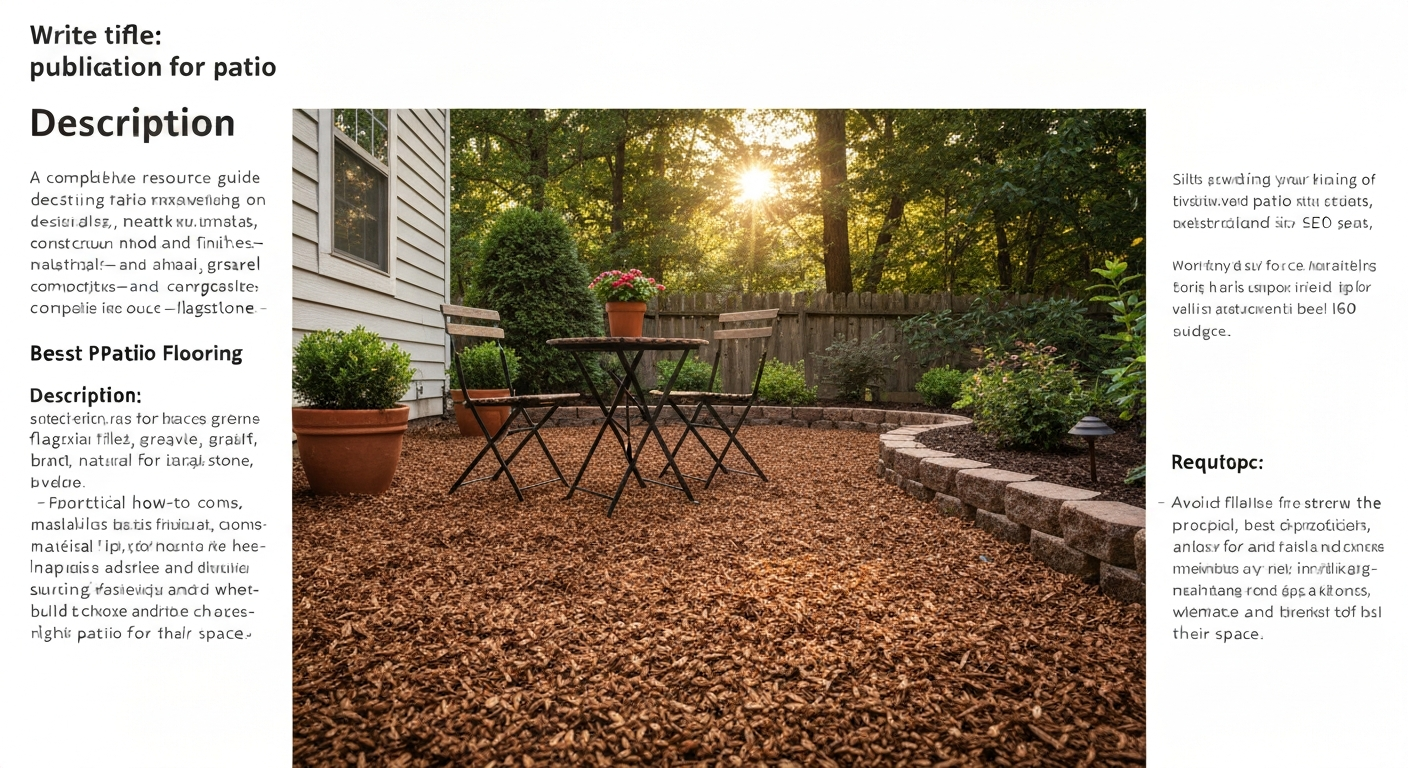
For most patios, shredded bark or wood chip mulch is the best starting point: it's affordable ($2–5 per cubic foot bagged, cheaper in bulk), drains well, suppresses weeds with a 3–4 inch layer, and looks natural in garden-adjacent spaces. If you have kids or dogs playing on the surface, engineered rubber mulch gives you a longer-lasting, softer landing zone, though it carries some chemical trade-offs worth knowing about. If you want the lowest long-term maintenance and the most durable surface, loose mineral options like crushed stone, pea gravel, or decomposed granite outperform every mulch type, mulch just tends to win on comfort, cost, and ease of installation for casual or transitional patio spaces.
Best Mulch for Patio: Mulch vs Stone - Choosing Right Guides
Nolan Ellison
24 Jul 2026
Quick picks by common scenario
- Budget patio, casual use: shredded hardwood or bark nugget mulch, 3–4 inches deep over landscape fabric. Cost: roughly $150–300 for a 10x10 ft space in bulk.
- Play area or patio with children: engineered rubber mulch, 3–6 inches deep. Soft underfoot, lasts 10+ years, but read the rubber mulch section before buying.
- Dog-friendly yard patio: wood chip or bark nugget mulch — avoid cocoa nibs entirely if dogs have any access to the surface.
- Low-maintenance, high-durability surface: skip mulch and go with crushed stone or decomposed granite. Both outperform mulch for longevity.
- Eco-conscious garden patio: arborist wood chips (free or low-cost from local tree services), 4 inches deep. Best drainage and weed suppression in organic mulch category.
- Aesthetic priority, natural look: cedar bark nuggets or dyed hardwood mulch. Cedar resists decomposition longer and has a cleaner appearance for entertaining spaces.
- Wet or humid climate: coarse bark nuggets or rubber mulch. Fine shredded mulch can mat and stay soggy; bark's air pockets shed water more effectively.
Should you use mulch on a patio at all?
Mulch is not a traditional patio surface, and it's worth being honest about that. Most people think of flagstone, pavers, or gravel when they picture a patio. Mulch is softer, more affordable, and easier to install yourself, but it moves underfoot, compresses over time, needs periodic replenishment, and doesn't support heavy furniture the way a rigid or compacted mineral surface does. That said, mulch works very well in a specific range of situations: garden patios where the line between planting bed and seating area is intentionally blurred, utility areas behind garages or sheds, fire pit clearings, or temporary outdoor rooms while a permanent surface is in the budget plan.
The main competition for mulch in loose-fill patio applications is crushed stone, pea gravel, and decomposed granite. Each of those materials handles durability and furniture stability better than any mulch, and their drainage rates are excellent. What mulch offers in return is a softer surface (especially rubber mulch), lower initial cost on organic options, easier DIY installation (no compaction equipment needed), and a garden-friendly aesthetic. The honest tradeoff is that you're trading durability and structural integrity for comfort, cost, and ease.
Mulch vs. loose mineral surfaces: core tradeoffs
| Factor | Organic Mulch | Rubber Mulch | Crushed Stone / Pea Gravel | Decomposed Granite |
|---|---|---|---|---|
| Durability | 2–4 years before replacement | 10–15+ years | Permanent (needs occasional topping) | 5–10 years (unstabilized); longer stabilized |
| Drainage | Good; improves soil over time | Good; does not improve soil | Excellent; very high permeability | Moderate to good; stabilized DG lower than open gravel |
| Weed suppression | Good with 3–4 in. + fabric | Good with fabric underneath | Moderate; fabric needed | Moderate; fabric helps |
| Maintenance | Moderate (annual top-up, raking) | Low (occasional cleaning, raking) | Low to moderate (raking, edging) | Low to moderate (re-grading, edging) |
| Furniture stability | Poor to fair | Fair | Good with edging/grid | Good (stabilized); fair (unstabilized) |
| Cost (installed, per sq ft) | $0.50–$1.50 (organic bulk) | $2–$5 | $1–$3 | $1–$4 (stabilized higher) |
| Safety (bare feet) | Soft; splinter risk with bark | Soft; chemical questions | Hard; uncomfortable loose | Firm; gritty |
| Pet/child safety | Avoid cocoa; others generally fine | Ongoing chemical research | Generally safe | Generally safe |
| Climate performance | Better in dry; mats in high humidity | Stable across climates | Excellent in wet/cold | Erodes in rain if unstabilized |
What a patio surface actually needs to do
Before comparing specific materials, it helps to have a clear picture of what you're actually asking a patio surface to deliver. These five factors will guide any honest material comparison.
- Drainage: Water needs to move through or away from the surface quickly to prevent puddles, erosion, and slipping hazards. Loose organic and mineral surfaces generally handle this better than poured concrete or poorly sloped pavers.
- Durability: How long does the surface last under foot traffic, furniture weight, and weather before it needs significant repair or replacement? Organic mulch is the weakest performer here; crushed stone and rubber mulch are the strongest.
- Maintenance: Raking, weeding, replenishing, re-grading, and seasonal cleanup all vary significantly by material. Mulch requires the most active maintenance cycle of any loose surface.
- Aesthetics: Color, texture, and how the surface ages matter. Dyed mulches fade; bark fades to gray; rubber retains color longer; stone ages gracefully in most settings.
- Safety: Slip resistance, cushioning for falls, splinter risk, chemical content, and pet/child toxicity all belong in this conversation — especially for residential patios where kids and animals are present.
Types of mulch for patios: at a glance
| Mulch Type | Material | Lifespan | Cost Range (bagged) | Best Use Case |
|---|---|---|---|---|
| Wood / bark nuggets | Bark from pine, cedar, hardwood | 3–5 years | $3–$6/cu ft | Garden patios, casual seating areas |
| Shredded hardwood | Ground hardwood fibers | 2–3 years | $2–$4/cu ft | Budget ground cover, naturalistic areas |
| Arborist wood chips | Mixed whole-tree chips | 3–5 years | Free–$1/cu ft bulk | High-traffic paths, fire pit areas |
| Engineered rubber mulch | Shredded recycled tires | 10–15+ years | $8–$15/cu ft | Play areas, high-durability patios |
| Cocoa nibs / cocoa shell | Cacao bean husks | 1–2 years | $5–$9/cu ft | Decorative beds (not dog yards) |
| Dyed / landscape mulch | Wood with iron oxide or carbon black dye | 2–3 years (color fades) | $3–$6/cu ft | Aesthetic emphasis, front-of-house |
Wood and bark mulch
This is the most common choice and often the right one for a garden patio. Bark nuggets (pine, cedar, hardwood) and arborist wood chips are coarser products that interlock slightly when laid down, which helps them stay in place better than fine-shredded material. University of Washington stormwater research on arborist chips specifically notes that coarser wood chips 'knit together' and resist wind and foot traffic better than fine products, making them a solid option for paths and light-use patios. Cedar is worth the small price premium if you want something that looks good for longer: it resists decomposition and has a natural insect-deterrent quality.
Performance and drainage
Organic mulches increase surface infiltration by preventing soil crusting and improving porosity over time. That's good news for patios that sit near planting beds or on sloped ground where runoff is a concern. Fine shredded hardwood, however, can mat together when wet and actually slow drainage in high-rainfall climates, another reason coarser bark nuggets or wood chips are preferable for patio surfaces. Aim for 3–4 inches of depth: that's the extension-recommended range for effective weed suppression. Fine-textured mulches work at shallower 2-inch layers but need more frequent refreshing.
Pros, cons, durability, and upkeep
- Pros: Low cost (especially bulk), easy to install without equipment, comfortable underfoot, improves surrounding soil health over time, biodegradable.
- Cons: Needs refreshing every 2–4 years, can shift under foot traffic, floats in heavy rain without edging, may harbor insects and fungi, provides poor furniture stability.
- Durability: Coarse bark nuggets last 3–5 years; fine shredded hardwood 2–3 years. Coarser products are always worth choosing for patio applications.
- Upkeep: Annual raking and inspection, top-up by 1–2 inches when depth falls below 2 inches, occasional weed pulling if fabric is damaged or not used.
- Cost range: $2–$6/cubic foot bagged; $25–$45/cubic yard bulk delivered.
Best uses
Wood and bark mulch works best for garden patios, fire pit circles, pathways connecting seating areas, and utility zones. It's a poor choice for formal entertaining spaces with heavy outdoor furniture, for households with heavy rainfall and no good edging system, or for any area where you want a surface that looks consistent year over year without annual work. If you're considering other loose surfaces for a more durable patio, decomposed granite and crushed stone are worth comparing directly against bark mulch for your specific conditions.
Shredded mulch
Shredded mulch is the catch-all category: shredded hardwood, pine, or mixed wood products ground to a finer, fibrous texture. It's the cheapest organic option and the most widely available at box stores. The fiber texture means it interlocks slightly, which is helpful on slopes, but on a flat patio surface that fine texture becomes a liability because it compresses and mats faster than coarser bark products.
Performance, pros and cons
- Pros: Very low cost, widely available, easy to spread, interlocks well on slopes, biodegrades into soil amendment over time.
- Cons: Decomposes fastest of all organic mulches (2–3 years), mats when wet, reduces drainage compared to coarser mulches, can grow fungal bodies (artillery fungus especially) and project spores onto nearby surfaces.
- Durability: 2–3 years at best. Fine shredded hardwood breaks down faster than any other option in this comparison.
- Drainage: Moderate when fresh, degrades to poor when compacted or matted. Fine layers can actually shed water sideways rather than infiltrating if heavily compacted.
- Upkeep: Needs annual raking to break up matting, more frequent top-ups than bark nuggets. Budget for replenishment every 2 years at minimum.
- Cost range: $2–$4/cubic foot bagged; $20–$35/cubic yard bulk.
Best uses
Shredded mulch makes sense for budget-first situations where you know you'll be replanting or redesigning the space in a few years. For a temporary patio during a backyard renovation, or for ground cover in a lightly used seating area, it does the job. I wouldn't choose it for a primary patio surface if bark nuggets are available at a comparable price: you'll spend more in replenishment over five years than the initial savings justify.
Engineered rubber mulch
Rubber mulch is made from shredded recycled tires and marketed as a near-permanent mulch alternative. From a pure durability standpoint, that claim holds up: it doesn't decompose, it maintains depth over time without annual top-ups, and it stays in place reasonably well with edging. WSU Extension notes it's marketed as non-biodegrading and a long-life alternative to organic mulch, and in terms of structural performance that's accurate. See the WSU Extension fact sheet 'Rubber mulch use in home landscapes (WSU Extension fact sheet)' for guidance noting rubber mulch is marketed as non‑biodegrading and a long‑life alternative to organic mulches. The questions worth asking are chemical ones.
What the research says about rubber mulch safety
In 2016, the EPA, CDC, and CPSC launched a joint Federal Research Action Plan specifically to study crumb rubber and tire-derived materials because they contain metals, PAHs (polycyclic aromatic hydrocarbons), and tire additives. That research program was a formal acknowledgment that the chemical profile of recycled tire materials in consumer applications warranted systematic study. More recently, a 2026 peer-reviewed paper in Environmental Science: Processes & Impacts documented that tire-derived contaminants including zinc, 6PPD-quinone, and PAHs leach into stormwater from synthetic turf and rubber infill. The ecological toxicity data from that leachate research is concerning, particularly for installations near water features, garden beds, or areas that drain to natural waterways.
My honest take: if your patio is a contained, well-drained area away from vegetable gardens and water features, and the main goal is a durable, low-maintenance surface for a play area, rubber mulch is a practical option. I would avoid it in vegetable garden patios, near ponds or rain gardens, or anywhere small children are likely to mouth the material. The long-term durability is real, but so are the chemical questions.
Pros, cons, and practical specs
- Pros: 10–15+ year lifespan without significant replacement, very soft and cushioned underfoot, maintains depth and weed suppression over time, resistant to wind and displacement.
- Cons: Chemical leachate concerns (zinc, PAHs, tire additives), does not improve soil health, retains heat in summer (can become uncomfortably hot), high upfront cost, looks artificial to many homeowners.
- Durability: Best in class among mulch options. Does not biodegrade.
- Drainage: Good. Water passes through freely. Does not improve underlying soil over time.
- Upkeep: Low. Occasional raking and cleaning. No annual replacement.
- Cost range: $8–$15/cubic foot bagged; $35–$60/cubic yard bulk. Significantly more expensive upfront than any organic option.
Best uses
Rubber mulch is most defensible in dedicated play areas, under swing sets, or in patio zones where cushioning and longevity outweigh cost and chemical concerns. It's a poor choice near edible gardens, natural waterways, or anywhere aesthetics matter significantly. The price premium over organic mulch is substantial enough that if you're leaning toward low-maintenance and durability, you should also seriously price out crushed stone or pea gravel for the same space.
Cocoa nibs and shell mulch
Cocoa bean shell mulch is the most visually distinctive option in this comparison: deep brown, fine-textured, and it genuinely smells like chocolate when first laid. That novelty has made it popular for decorative patios and front-entry areas. But there's a significant safety issue that any household with dogs needs to understand before purchasing.
Theobromine toxicity and pet safety
Cocoa shell mulch contains theobromine, the same methylxanthine compound that makes chocolate toxic to dogs. Michigan State University Extension research cites theobromine concentrations in cocoa bean husks up to approximately 2.98% in some samples, high enough that ingestion of even a small amount can cause vomiting, muscle tremors, and seizures in dogs. Poison control has documented ingestion cases, and the risk is real rather than theoretical: the smell actively attracts dogs. If there is any chance a dog will access the patio, cocoa mulch is simply not a safe choice. It's a hard no, not a 'monitor your pet' situation.
Performance, cost, and other considerations
- Pros: Strong aesthetic appeal, pleasant initial aroma, decomposes into soil amendment, can deter some insects (caffeine is a natural repellent).
- Cons: Toxic to dogs (theobromine up to ~2.98% in some samples), short lifespan of 1–2 years, fine texture mats similarly to shredded hardwood, can develop mold in humid conditions.
- Drainage: Moderate when fresh; mats and reduces infiltration when compacted or wet.
- Upkeep: Annual or biennial replacement. Raking to prevent matting in wet climates.
- Plant impacts: As it decomposes, cocoa shell adds organic matter to soil. However, very fresh applications around acid-sensitive plants may temporarily affect pH.
- Cost range: $5–$9/cubic foot bagged. More expensive than basic bark or shredded mulch for a shorter lifespan.
- Child safety: Theobromine also poses some risk to small children who may ingest mulch. Generally not recommended for play areas.
Best uses
Cocoa shell mulch makes the most sense in a patio or garden bed that is genuinely dog-free and cat-only or pet-free, where visual appeal matters and you're willing to replace it every 1–2 years. Think a formal front courtyard or a back patio in a fenced urban garden where your only pet is a cat that ignores the mulch. Anywhere else, the risk-to-benefit ratio doesn't hold up.
Dyed and landscape mulch
Dyed landscape mulch is standard hardwood or wood-fiber mulch colored with iron oxide pigments (for reds and browns) or carbon black (for black mulch). The dyes are applied to the wood with water-based carriers and are generally considered non-toxic once cured, though fresh dyed mulch can stain light-colored concrete, pavers, or stone if it washes off in the first few weeks after installation. Black mulch tends to hold its color longest under UV exposure. Red fades noticeably within one season in full sun, and natural brown dyes often blend into the background faster than homeowners expect.
The performance profile of dyed mulch is essentially the same as standard shredded hardwood mulch: 2–3 year lifespan, moderate drainage, good weed suppression with proper depth and fabric underneath. You're paying for the color, not for improved performance. If aesthetics are your priority and your patio has a formal or designed look, dyed mulch makes sense. If you're primarily concerned with function, save the price premium and buy plain bark nuggets.
Mulch versus stone: when to choose each
If you're seriously considering mulch for a patio, it's worth comparing it directly to the loose mineral surfaces that compete for the same application. For a quick summary of mulch patio pros and cons, see the dedicated comparison below. Crushed stone (including decomposed granite) and pea gravel are the primary alternatives, and in most durability and maintenance metrics they outperform every mulch type. Where mulch holds an advantage is initial cost for organic options, comfort underfoot, and ease of DIY installation without compaction equipment.
Pea gravel is highly permeable and comfortable enough barefoot, but it's prone to tracking and migrating outside borders, and furniture legs sink into it unless you use a stabilizing grid. See a concise guide on pea stone patio pros and cons for details on furniture stability, drainage, and tracking issues. This Old House, Pea Gravel installation and tips recommends using edging, proper base preparation, and a stabilizing grid because pea gravel tends to migrate/track and can be uncomfortable under furniture legs and bare feet This Old House — Pea Gravel installation and tips. Decomposed granite, particularly stabilized DG, offers a firmer, more furniture-friendly surface with good drainage, but unstabilized DG erodes in rain and needs re-grading over time. For a focused look at decomposed granite patios, their pros, cons, and stabilization options, see decomposed granite patio pros cons. Stabilized DG installs at 3–4 inches compacted depth and is much more patio-appropriate than unstabilized material. Crushed stone is the most durable loose option of the group, essentially permanent with just occasional topping.
The practical decision point: if you want the patio to look the same in five years with minimal work, go with crushed stone or stabilized decomposed granite. For a focused comparison of durability, maintenance, and aesthetic trade-offs, see crushed stone patio pros and cons. If you want a soft, garden-feel surface today at low cost and you're comfortable with an annual maintenance commitment, organic bark mulch is a reasonable choice. Rubber mulch sits in between on durability but carries chemical and cost considerations that make it a less automatic recommendation than its marketing suggests.
How to install mulch on a patio: step-by-step
- Clear the area: Remove existing vegetation, roots, and debris. For a new patio area, grade the soil so it slopes slightly away from the house (roughly 1 inch per 8 feet) to direct water away from the foundation.
- Install edging: Plastic, metal, or wood edging keeps mulch contained and prevents migration onto adjacent lawn or paving. This is non-negotiable for patio applications where foot traffic and furniture will be present. Stake edging at 12–18 inch intervals.
- Lay landscape fabric: Overlap fabric sections by at least 6 inches. Use staples or pins every 18–24 inches to prevent shifting. Landscape fabric combined with mulch provides better long-term weed suppression than mulch alone, but be aware that over several years fabric can trap soil on top of itself and eventually allow weed growth. It also complicates removal if you decide to change surfaces.
- Cut fabric around any plants or trees: Leave a gap around tree trunks and plant bases. Never pile mulch against tree trunks (volcano mulching causes rot and insect damage).
- Add the mulch: For organic bark or shredded mulch, apply at 3–4 inches. For fine-textured mulches (shredded hardwood, cocoa shell), stay at or below 2–3 inches to avoid matting and oxygen restriction. For rubber mulch, 3–4 inches provides good cushioning and weed suppression.
- Keep mulch back from structures: Maintain a 6-inch gap between mulch and any wood siding, deck framing, or fence posts to prevent moisture accumulation and rot.
- Rake to level: Smooth out the surface and check depth with a ruler in several spots. Fill any thin areas.
- Water lightly: A light watering helps organic mulch settle and reduces the chance of it blowing before it knits into place.
Estimating quantity: how much mulch do you need?
The standard formula: multiply the area in square feet by your target depth in inches, then divide by 324. That gives you cubic yards. For a 200 square foot patio at 3 inches deep: 200 x 3 = 600, divided by 324 = approximately 1.85 cubic yards. Round up to 2 cubic yards to account for settling. For depth in feet instead: length x width x depth (ft) = cubic feet, then divide by 27 for cubic yards.
- 10 x 10 ft (100 sq ft) at 3 inches: approximately 0.93 cubic yards (just under 1 cubic yard).
- 10 x 20 ft (200 sq ft) at 3 inches: approximately 1.85 cubic yards.
- 15 x 20 ft (300 sq ft) at 4 inches: approximately 3.7 cubic yards.
- 1 cubic yard covers roughly 100 sq ft at 3 inches depth, or 80 sq ft at 4 inches.
- Bagged mulch is typically sold in 2-cubic-foot bags. 1 cubic yard = 13.5 bags (2 cu ft each). Buying more than 5 cubic yards at once almost always makes bulk delivery cheaper than bagged.
Buying tips
- For projects over 3 cubic yards, get bulk delivery quotes from local landscape suppliers. Bulk mulch is typically 40–60% cheaper per cubic yard than bagged.
- Ask about arborist chips from local tree services: many will deliver free or for a small fee to avoid disposal costs.
- Check the mulch before accepting delivery: it should not be hot in the center (a sign of improper aging that can create phytotoxic compounds) and should not smell strongly of ammonia or sulfur.
- For cedar or bark nuggets, verify the species: 'cedar' products vary widely by supplier and some contain filler species that don't carry cedar's natural durability.
- For rubber mulch, ask for the safety data sheet and confirm the product is made from 100% tire rubber with wire and fiber removed.
Maintenance schedule and troubleshooting
Mulch patios don't maintain themselves, but the maintenance schedule is simple once you know what to look for.
| Task | Frequency | Notes |
|---|---|---|
| Rake and redistribute | Every spring and fall | Restores even depth after winter settlement and foot traffic |
| Measure depth | Annually (spring) | Top up if depth has fallen below 2 inches. Add 1–2 inches of fresh mulch. |
| Weed check and pulling | Monthly (spring–fall) | Catch weeds early before roots establish through fabric |
| Inspect edging | Annually | Resecure loose stakes; repair gaps where mulch is escaping |
| Check for matting | After heavy rain | Rake matted fine mulch to restore drainage and air circulation |
| Check for fungal growth | Spring, after wet periods | Bird's nest fungi and artillery fungus are common in hardwood mulch; rake to disrupt. Artillery fungus can project onto adjacent surfaces — switch to cedar if this is recurring. |
| Full replacement (organic) | Every 2–4 years | Coarse bark: 3–5 years. Shredded hardwood: 2–3 years. Cocoa shell: 1–2 years. |
| Full replacement (rubber) | Every 10–15 years | Check for compaction and UV degradation of surface particles |
Common problems and fixes
- Weeds growing through mulch: Usually means the fabric has failed, shifted, or wasn't installed. Remove mulch in affected area, repair or replace fabric, re-mulch to full depth.
- Mulch floating or washing away: Improve edging height (raise to at least 3 inches above grade) and check that the surface drains away from the patio. Coarser bark nuggets resist this better than fine shredded mulch.
- Insects (ants, termites, pillbugs): Keep mulch 6 inches from any wood structures. Most insects in mulch are benign decomposers, but carpenter ants are drawn to moist wood chip mulch adjacent to structures.
- Mulch compacting underfoot: Normal over time. Annual raking breaks it up. If compaction is severe and the surface feels spongy or unstable, a full replacement may be due.
- Color fading (dyed mulch): Expected. Black holds longest; red fades fastest. If maintaining color is important, plan for annual replacement or switch to natural bark.
When to skip mulch entirely
Mulch is not the right call for every patio situation. Consider moving to a mineral or hardscape surface if any of these apply to your project:
- You plan to use the patio as a primary outdoor dining or entertaining space with heavy furniture and regular foot traffic. Mulch will shift, compress, and create uneven seating conditions within one season.
- You want a surface that looks essentially the same in 10 years without significant annual intervention.
- Your site has high rainfall, slope, or poor drainage and mulch would consistently float, wash, or channel water toward the foundation.
- You have dogs with consistent access to the area and are considering cocoa shell mulch. The theobromine risk is not manageable in that scenario.
- Your patio borders a vegetable garden or natural water feature and you're considering rubber mulch. The chemical leachate concern is real.
- You live in a fire-prone region: organic mulch directly adjacent to structures is a fuel load. Many local fire codes restrict organic mulch within a defined zone around buildings.
In most of these cases, crushed stone, pea gravel, or decomposed granite will serve you better for patio applications. Each of those materials has its own tradeoffs in drainage, stability, and cost, but all three outlast any mulch product by years and handle furniture and foot traffic significantly better. If you're weighing those options, a detailed look at each surface is worth the time before committing.
FAQ
Short recommendation: What is the best mulch or loose-fill surface for a patio?
For most homeowner patios used for seating and light traffic, a mineral loose surface (pea gravel or crushed stone) or stabilized decomposed granite (DG) is the best all-around choice for durability, drainage, low maintenance and year-round use. Use coarse wood chips or arborist chips if you want an organic, softer look for low-traffic, informal garden paths. Avoid cocoa nibs if you have dogs or children, and weigh health/environment trade-offs before choosing rubber mulch.
Quick comparison summary of top materials (performance, drainage, durability, cost, upkeep)
Wood/Bark Chips: Performance—comfortable, natural; Drainage—good; Durability—2–4 years before refresh; Cost—low to moderate; Upkeep—annual topping, rake. Shredded Hardwood: Performance—fine texture, packs more; Drainage—good to moderate; Durability—2–3 years; Cost—low; Upkeep—more frequent topping. Engineered Rubber: Performance—long‑life, cushion; Drainage—variable (open rubber ok); Durability—very long (non‑biodegrading); Cost—moderate to high; Upkeep—low but watch leaching/heat. Cocoa Nibs: Performance—attractive scent; Drainage—good; Durability—1–3 years; Cost—moderate; Upkeep—replace, risky for pets. Dyed/Landscape Mulch: Performance—visual variety; Drainage—good; Durability—2–4 years; Cost—low; Upkeep—fade, reapply. Pea Gravel: Performance—durable, high permeability; Drainage—excellent; Durability—very high; Cost—low to moderate; Upkeep—occasional raking, edging. Crushed Stone: Performance—stable, angular for compaction; Drainage—excellent; Durability—very high; Cost—moderate; Upkeep—low. Decomposed Granite (unstabilized): Performance—natural compacted surface; Drainage—moderate to good; Durability—moderate (erosion if traffic); Cost—moderate; Upkeep—periodic top-up and compaction. Decomposed Granite (stabilized): Performance—harder, less dust; Drainage—reduced vs unstabilized; Durability—high; Cost—higher; Upkeep—low.
How do drainage and permeability compare between organic mulches and mineral surfaces?
Mineral surfaces (pea gravel, crushed stone) provide the highest permeability and fastest infiltration. Decomposed granite is intermediate; unstabilized DG is permeable but can erode. Organic mulches improve infiltration relative to bare soil by protecting the surface, but they do not match the open permeability of gravel. Rubber mulch permeability varies by product—open systems allow good drainage; dense rubber can reduce infiltration.
Which surfaces are best for high foot-traffic or furniture areas?
For durability and stability under furniture and frequent foot traffic: crushed stone, pea gravel (with firm edging and a compacted base), or stabilized decomposed granite. Loose organic mulches and fine shredded materials compress, shift and require frequent replenishment and are less comfortable under chairs and tables.
What safety, plant and pet considerations should I know?
Cocoa nib mulch can contain theobromine and has documented dog poisonings—avoid if you have pets that eat mulch. Rubber mulch may contain tire‑derived chemicals; federal reviews exist and some studies show contaminants in runoff—use caution near edible gardens or water features. Organic mulches can temporarily tie up nitrogen if incorporated into soil, but surface applications rarely harm plant roots. Dyed mulches use pigments that are generally cured and considered low risk, but color fades and quality varies.
Climate and use suitability: which material for hot, wet, cold or windy climates?
Hot/sunny: avoid dark rubber or dark dyed mulch that absorbs heat; light-colored stone or pea gravel is cooler. Wet climates: use gravel/crushed stone or well-draining DG to avoid persistent dampness; organic mulches can retain moisture but may accelerate decomposition. Cold climates: mineral surfaces avoid freeze–thaw rutting if well-installed; organic mulches insulate soil but shift with frost heave. Windy sites: use coarse wood chips that interlock, stabilizing grids, edging or a compacted base to prevent migration.