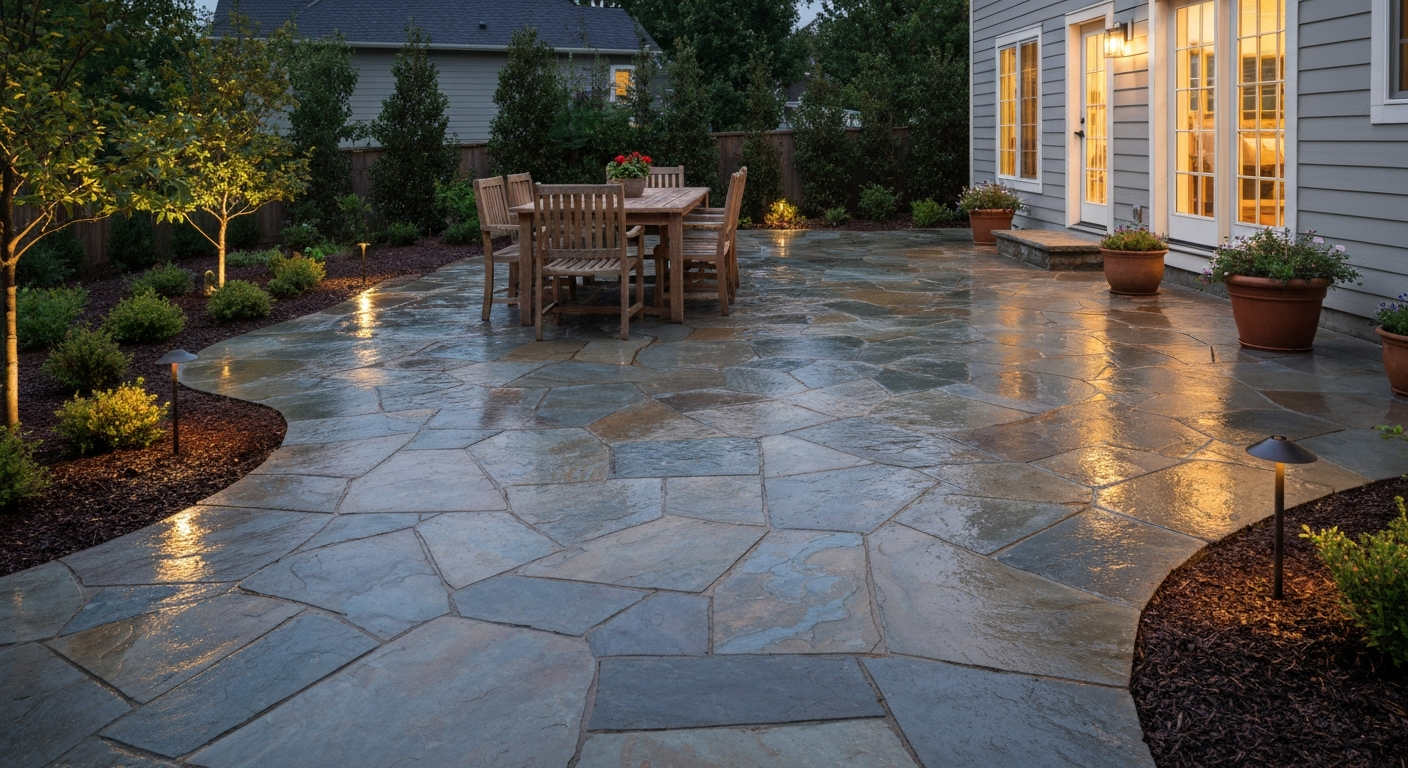
Flagstone patios are more expensive than poured concrete or gravel but sit in a middle-to-upper range among outdoor paving options. Expect to pay roughly $15–$32 per square foot installed for dry-laid flagstone on a compacted gravel base, and $19–$45 per square foot for mortar- or concrete-set (wet-set) work. A typical 300 sq ft patio runs somewhere between $4,500 and $13,500 depending on the installation method, stone type, and your local labor market. That's meaningfully more than a basic concrete slab (often $6–$12/sq ft installed) but less than high-end porcelain or premium cut-stone work. Whether that cost is worth it comes down to what you want from your patio and how long you plan to keep it.
Are Flagstone Patios Expensive? Costs, Budgets & Savings
Nolan Ellison
30 Jul 2026
How to use this guide
This article is built to help you make two practical decisions: first, whether flagstone fits your budget; and second, where you can control costs once you decide to go ahead. I'll walk through every line item that drives the final number, from stone selection and base materials to labor versus DIY tradeoffs. Along the way, I'll compare the three main installation methods (dry-laid on gravel, mortar-set on a concrete slab, and stepping-stone style), give you realistic sample budgets, and flag the spots where cutting corners actually costs you more over time. By the end, you'll have a clear picture of what a flagstone patio will actually cost for your specific situation and what questions to ask a contractor before you sign anything.
National averages and what actually drives the cost
The installed price range for flagstone patios is wide, and that's not a dodge. It's genuinely wide because the method of installation changes the cost structure entirely. Dry-laid flagstone on a gravel base is the most common DIY-friendly approach and typically the least expensive. Wet-set flagstone on a poured concrete slab is the most durable and the most expensive. Mortar-set directly on compacted ground sits in between but is less forgiving long-term in freeze-thaw climates. Here's a quick snapshot of how those methods stack up nationally.
| Installation Method | Typical Installed Cost (per sq ft) | 300 sq ft Project Estimate | Best For |
|---|---|---|---|
| Dry-laid on gravel base | $15–$32 | $4,500–$9,600 | DIY-friendly, cold climates, budget-conscious |
| Mortar-set on compacted base | $18–$35 | $5,400–$10,500 | Stable soils, moderate climates |
| Wet-set on concrete slab | $19–$45 | $5,700–$13,500 | Maximum durability, high-traffic areas |
Several cost drivers sit underneath those ranges. Stone type and origin, slab thickness, total square footage, site conditions (slope, drainage, soil type), base assembly, joint method, pattern complexity, and local labor rates all move the number up or down. Most projects that come in at the low end of the range are small, flat, and use local or regionally available stone on a straightforward gravel base. Projects that land near the top involve premium imported stone, complex patterns, significant excavation, drainage work, and skilled mason labor in a high-cost metro area.
Stone type, thickness, and square footage
The stone itself is usually the single biggest line item in a flagstone project, and the price range is enormous. For recommendations on selecting the best flagstones for patio, see our guide to the best flagstones for patio. Bluestone, which is one of the most popular choices in the Northeast, typically runs $375–$450 per ton at retail or wholesale. Sandstone is generally cheaper at $200–$350 per ton and works well in drier climates. Travertine and slate push toward the higher end on both material cost and cutting difficulty. If you're buying locally quarried material, you can sometimes undercut those national prices significantly. Stone shipped across the country adds hauling cost that can push material prices up by 20–40%.
Thickness matters for two reasons: durability and price per square foot. For pedestrian patios, most installers use 1. Typical guidance from installers and stone suppliers is to use 1–2 in flagstone for light pedestrian patios/paths and 2–3 in (or thicker) pieces when durability and reduced breakage are priorities Industry guidance and stone suppliers commonly recommend 1–2 in pieces for light pedestrian patios/paths and 2–3 in (or thicker) pieces for durable patio installations.. 5 to 2 inch irregular flagstone as a minimum, with 2 to 3 inch pieces being the preferred range for a long-lasting installation. Thicker stone resists cracking under point loads, handles freeze-thaw cycling better, and gives you more material to work with when leveling on an uneven base. The downside is weight. A 2.5 inch bluestone slab weighs roughly 30 pounds per square foot, which means a 300 sq ft patio requires moving and placing around 9,000 pounds of stone. That's real labor, and it adds to the installed cost.
Square footage affects cost in two ways beyond the obvious material volume. Larger projects benefit from economies of scale (less setup time per square foot, better bulk pricing on stone) but also require more base material, more labor hours, and often trigger permit thresholds. Most municipalities waive building permits for patios under roughly 200 sq ft, but anything larger or attached to the house may require a permit and inspection, adding $50–$500 or more depending on your jurisdiction. Permits: many municipalities waive building permits for small patios (common threshold cited is under ~200 sq ft) while larger/specific structural work or electrical/gas rough‑ins will usually require permits and inspections; consumer cost guides remind homeowners to check local rules as permit cost/requirements vary widely Many municipalities waive building permits for patios under about 200 sq ft, while larger patios or those involving structural, electrical, or gas work usually require permits and inspections; check local rules as requirements and permit costs vary widely.. It's worth checking your local rules before you finalize the design.
Site prep, grading, drainage, and permits
Site preparation is the part of flagstone projects that most cost estimates undersell. If your yard is flat, well-drained, and easy to access, excavation is a manageable cost. If it's sloped, compacted clay, or has drainage problems, you can easily spend $1,000–$3,000 just getting the site ready before a single flagstone is placed. Excavation for a standard dry-laid patio typically means removing 6–8 inches of soil (4–6 inches for the gravel base plus 1 inch of bedding sand plus stone thickness). On a 300 sq ft patio that's roughly 20–25 cubic yards of spoil to haul away, which is its own line item.
Proper grading is non-negotiable. The patio surface needs to slope away from the house at a minimum of 1/8 inch per foot (1% slope), and the base layers need to maintain that slope throughout. This sounds simple but takes time and skill to execute correctly, especially with irregular flagstone pieces that vary in thickness. I've seen DIY projects where the homeowner skipped precise grading and ended up with a surface that pooled water against the foundation. Getting grading right at the start is far cheaper than fixing drainage problems after the fact.
If your site has poor natural drainage, a French drain or underdrain along the patio perimeter will likely be necessary. Professional French drain installation runs roughly $10–$65 per linear foot depending on depth, access, and how far the outlet needs to run. A simple 40-foot perimeter drain on a flat site might cost $600–$1,200. A deep trench drain on a sloped property with a difficult outlet could run $3,000–$6,000. Factor this in early because drainage problems that show up after installation are expensive to fix.
Base materials: gravel, sand, and concrete
The base assembly is what determines how long your patio lasts, and it's where I've seen the most corners cut on budget installs. For dry-laid flagstone, the standard recommendation is 4–6 inches of compacted crushed stone (typically 3/4 inch clean crushed or 21A/crusher run) topped with a 1-inch bedding layer of coarse concrete sand. For guidance on selecting the best gravel for flagstone patio bases, see our detailed guide on best gravel for flagstone patio. The crushed stone base provides drainage and load distribution; the bedding sand allows you to fine-tune the level of each stone. Skimping on base depth, particularly in climates with hard freeze-thaw cycles, is the number one reason flagstone patios develop heaving and cracking within a few years.
Crushed stone for a 300 sq ft patio with a 5-inch base requires roughly 4–5 tons of material. At $25–$45 per ton delivered, that's $100–$225 in material, but factor in the cost of a plate compactor rental ($75–$150 per day) and the labor to spread and compact in lifts. If you're pouring a concrete slab for wet-set flagstone, add the cost of forming, a 4-inch concrete slab (typically $4–$8/sq ft for the concrete and forming alone), and then the mortar bed or thinset on top. The slab approach is the most material-intensive and labor-intensive method, but it produces the most stable and durable result, particularly on expansive soils.
One material upgrade worth mentioning here: polymeric sand for the joints between flagstones. Standard mason's sand washes out over time, invites weeds, and needs regular replenishment. Polymeric sand, which hardens when wetted and cured, dramatically reduces both weed growth and joint erosion. For help choosing the best sand for a flagstone patio, see our guide to selecting joint and bedding sands. It costs more upfront but saves meaningful maintenance time over the first several years. The type of joint sand you choose also affects which base setup makes sense, so it's a decision worth making before you start the project rather than at the end.
Joints, pattern complexity, cutting, and waste
Joint method and pattern are cost levers that many homeowners don't think about until they're shopping for stone, but they have a meaningful effect on both material cost and labor hours. Irregular random flagstone with wide joints and a natural random pattern is the most forgiving to install but generates the most waste and requires the most cutting time. Expect a waste factor of 15–20% on a random flagstone installation. That means for a 300 sq ft patio you should order 345–360 sq ft of material. For a tighter, more geometric cut pattern (like ashlar coursing), waste drops to 8–13% and installation is faster, but you need more precise cuts and the stone must be consistent enough in thickness to allow it.
Cutting flagstone requires either an angle grinder with a diamond blade or, for cleaner cuts, a wet-cut masonry saw. Saw rental is $75–$150 per day, and blade wear on natural stone can be significant. Labor time for fitting and cutting irregular flagstone is considerably higher than for modular pavers because each piece is unique and fitting them together is a puzzle with no preset answer. Contractors typically factor cutting time into their per-square-foot price, but it's worth asking how they handle it if you're getting itemized quotes.
If you want the look of flagstone with tighter tolerances and less cutting waste, manufactured flagstone-look concrete slabs (like large-format Belgard Mega-Arbel style products) are worth considering. These run roughly $4–$8 per sq ft in material cost, significantly less than natural stone, with waste factors of 5–10% and consistent thickness that speeds installation. They won't have the same natural variation and feel as real flagstone, but they're a practical option if budget is the primary constraint and you still want a flag-style aesthetic. This is a trade-off worth comparing honestly.
Labor vs DIY: rates, time, and what skill level actually means here
Labor typically accounts for 30–45% of the total installed cost of a flagstone patio, depending on the complexity of the job. Specialty stonemasons and brickmasons have a national median hourly wage around $29–$30 per hour, but contractor billing rates (which include overhead, insurance, equipment, and profit) commonly run $50–$90 per hour in most markets and higher in coastal metros. A skilled mason and a helper can typically install 150–250 sq ft of dry-laid irregular flagstone per day on a prepared base, so a 300 sq ft project often takes 2–3 crew days for the stone-setting phase alone, not counting excavation and base prep.
DIY is genuinely viable for dry-laid flagstone on a gravel base, and it's where most motivated homeowners can save the most money. The skill level required is moderate rather than expert: you need to be comfortable with a plate compactor, a level, basic grading work, and the physical demands of moving heavy stone. The key is patience. Fitting irregular flagstone well takes time, and rushing the base preparation almost always causes problems later. I've done dry-laid flagstone DIY projects that came out beautifully, and I've seen rushed ones fail within two winters. Budget realistically for tool rentals, and don't underestimate the physical effort for a 300+ sq ft project.
Wet-set and mortar work on a concrete slab is a different story. Pouring a concrete slab, even a simple residential patio slab, requires formwork experience, knowledge of reinforcement placement, and proper curing management. Setting flagstone in a mortar bed or thinset requires consistent technique to avoid hollow spots, which cause cracking and spalling over time. Unless you have concrete and masonry experience, I'd strongly recommend hiring a professional for wet-set installations. The cost savings from DIY are real but so is the cost of redoing a failed mortar-set installation.
| Task | DIY Feasibility | Key Skills Needed | Estimated DIY Savings (300 sq ft) |
|---|---|---|---|
| Excavation and haul-out | High | Equipment operation or hand tools, loading | $400–$900 |
| Gravel base and compaction | High | Plate compactor use, grading | $300–$700 |
| Dry-laid stone setting | Moderate | Leveling, fitting, cutting, patience | $1,500–$3,500 |
| Mortar-set on existing slab | Low-Moderate | Trowel technique, consistent mortar bed | $800–$2,000 |
| Concrete slab pour | Low | Formwork, concrete placement, finishing | $1,200–$3,000 |
| Jointing with polymeric sand | High | Basic technique, compaction, watering | $150–$400 |
DIY feasibility checklist
- Is your site relatively flat (less than 3–4% natural slope)? Steeper sites need grading work that's harder to DIY accurately.
- Do you have or can you rent a plate compactor and a masonry saw? Trying to skip either on a real patio is a mistake.
- Can you physically handle moving heavy stone (often 40–80 lbs per piece) over several days?
- Are you comfortable with basic leveling and grading using string lines and a long level?
- Is your installation dry-laid or wet-set? Dry-laid is a realistic DIY; wet-set is better left to professionals unless you have concrete experience.
- Do you have at least one experienced helper for stone-moving days?
- Have you checked whether your project requires a permit or HOA approval before breaking ground?
How flagstone compares to other patio materials on cost
Flagstone sits in the mid-to-upper range of patio material costs when you compare it to the full field of options available to homeowners. It's more expensive than gravel, plain concrete, and standard brick, roughly comparable to quality concrete pavers, and generally less expensive than premium porcelain tile or high-end cut stone. Here's a straightforward comparison to put the numbers in context.
| Patio Material | Typical Installed Cost (per sq ft) | Durability | DIY-Friendly? | Long-Term Maintenance |
|---|---|---|---|---|
| Poured concrete (plain) | $6–$12 | Good | Low (requires forms, finishing) | Low (seal every 3–5 yrs) |
| Concrete pavers (standard) | $10–$20 | Very good | Moderate | Low-moderate |
| Gravel/crushed stone | $2–$8 | Moderate | High | Low (top-up annually) |
| Brick | $10–$20 | Very good | Moderate | Low-moderate |
| Natural flagstone (dry-laid) | $15–$32 | Very good | Moderate | Moderate (weeds, reseating) |
| Natural flagstone (wet-set) | $19–$45 | Excellent | Low | Low-moderate (repoint joints) |
| Manufactured flagstone-look pavers | $12–$22 | Good | Moderate | Low |
| Porcelain tile (outdoor) | $20–$50+ | Excellent | Low | Low (reseal grout) |
| Composite/composite decking | $15–$35 | Good | Moderate-High | Low (clean annually) |
The honest takeaway from that table is that flagstone's cost premium over concrete or pavers buys you a specific thing: natural aesthetic variation and a material that actually improves in appearance as it weathers. If that visual quality matters to you and your budget supports it, flagstone is hard to beat. For a plain answer and guidance on when flagstone is the right choice, see our guide: Is flagstone good for a patio Is flagstone good for a patio?. If you're primarily optimizing for lowest cost or easiest installation, concrete pavers or a simple concrete slab deliver very good results at a lower price. If you want zero maintenance and maximum durability, wet-set porcelain tile is worth the price comparison, though installation is even more demanding.
Sample budgets by installation method
To make the per-square-foot numbers more concrete, here are three sample project budgets for a 300 sq ft patio in a mid-cost market (not a coastal metro, not a rural Plains market). These are realistic estimates, not minimums.
| Line Item | Dry-Laid on Gravel (DIY) | Dry-Laid on Gravel (Pro) | Wet-Set on Concrete Slab (Pro) |
|---|---|---|---|
| Flagstone material (300 sq ft + 15% waste) | $900–$1,800 | $900–$1,800 | $1,200–$2,400 |
| Excavation and haul-out | $0 (DIY) | $400–$900 | $600–$1,200 |
| Crushed stone base (5 in) | $150–$250 | $150–$250 | $150–$250 |
| Concrete slab (4 in, formed) | N/A | N/A | $1,200–$2,400 |
| Bedding sand or mortar/thinset | $50–$100 | $50–$100 | $200–$600 |
| Joint sand (polymeric) | $80–$150 | $80–$150 | $80–$150 (or grout) |
| Edge restraint/edging | $80–$150 | $80–$150 | $100–$200 |
| Tool rental (compactor, saw) | $200–$400 | N/A | N/A |
| Labor (stone setting) | $0 (DIY) | $1,500–$3,500 | $2,500–$5,000 |
| Permit (if required) | $50–$300 | $50–$300 | $100–$500 |
| TOTAL ESTIMATE | $1,510–$3,150 | $3,210–$7,150 | $6,130–$12,700 |
A few notes on those numbers. The DIY dry-laid budget assumes you already own or can borrow basic tools like a wheelbarrow, tamper, and hand tools, and only need to rent the plate compactor and saw. The professional dry-laid budget assumes a two-person crew in a mid-cost market; add 20–40% in high-cost metros. The wet-set professional budget is the most variable because concrete costs and mason rates differ significantly by region. Always get at least three itemized quotes before committing.
Long-term costs and maintenance reality
Flagstone's long-term maintenance costs are moderate and manageable, especially on a dry-laid installation. The main recurring tasks are reseating stones that have shifted or heaved (particularly in freeze-thaw climates), replenishing or replacing joint sand, managing weed growth in joints, and occasional sealing. Joint sand is the most frequent task; on a dry-laid installation with standard sand, you may need to add sand and pull weeds seasonally. Polymeric sand reduces but doesn't eliminate this task. Sealing is optional for many flagstones but recommended for porous stones like sandstone and travertine; expect to reseal every 2–5 years depending on the product and use.
Wet-set installations on concrete require less routine maintenance because the stone is fixed, but they have a different failure mode. When mortar joints crack or spall (which happens eventually, especially in climates with temperature swings), repointing is required. A professional repointing job for a 300 sq ft patio might run $300–$800 depending on how much joint area needs work. It's not a frequent cost but it's real. One thing to keep in mind: if a stone cracks or breaks on a dry-laid installation, you can typically replace it in an afternoon. On a mortar-set installation, replacing a single stone requires carefully chiseling out the mortar, which is more involved.
Cost-saving strategies that actually work
- Source stone locally. Regional flagstone (whatever is quarried or distributed near you) is almost always cheaper than stone shipped from across the country. Ask local stone yards what they stock rather than specifying a stone type first.
- Buy direct from a stone yard rather than a big-box home improvement store. Stone yards often sell by the ton with bulk pricing, and staff can advise on thickness and quality for your specific use.
- Choose a simpler pattern. Random irregular flagstone with wide joints requires less cutting precision but does take longer to puzzle-fit. Tight-cut geometric patterns look sharp but add labor time.
- Do your own excavation and haul-out. This is the part of the job that requires the least specialized skill and benefits most from renting an excavator for a day (typically $300–$600) versus paying contractor rates.
- Do your own base prep and compaction on a flat site. If you're comfortable renting a plate compactor and following the 4–6 inch base spec, this is straightforward work that saves real money.
- Skip the concrete slab if your soil is stable. Dry-laid on a properly prepared gravel base performs extremely well in many climates and is significantly cheaper than a slab-set installation.
- Order 15% more material than your measured square footage and keep spare pieces. Matching stone later is difficult and expensive; off-cuts now become repair stock for years.
- Consider manufactured flagstone-look pavers for secondary spaces (side yard, utility path) and reserve natural flagstone for the primary patio area where the aesthetic most matters.
What to ask contractors before you hire
Getting accurate quotes for a flagstone project requires asking the right questions. Vague quotes for 'flagstone patio installation' are nearly useless for comparison because two contractors may be pricing completely different base assemblies, stone grades, and joint methods. Ask each contractor to give you an itemized breakdown with separate line items for excavation, base material, stone material (by the ton or sq ft with species and thickness specified), labor, jointing, and any drainage or edging work. That's the only way to compare quotes honestly.
- What base assembly are you proposing: depth of gravel, type of gravel, bedding material, and compaction method?
- What stone type, thickness, and grade are you pricing? Will you provide samples?
- How do you handle drainage? Does the quote include sloping the base away from the house, and is any drainage pipe included?
- What joint method are you using and what product specifically (polymeric sand brand, mortar type)?
- How do you handle waste and off-cuts? Is disposal included in the price?
- What warranty or correction policy do you offer if stones shift or settle in the first year?
- Are permits included, and will you pull them, or is that my responsibility?
- Can I see a recent similar project and speak with the homeowner?
One last practical note: flagstone costs and the stones that make the most sense for your project are closely tied to what's available in your region. The questions around which flagstone type to specify, what base gravel works best in your soil type, and whether to use polymeric sand or standard joint sand are all decisions that benefit from more detailed guidance. Those topics each deserve their own deep dive, and the answers often determine whether your patio performs well for 20 years or starts showing problems in three.
FAQ
Short answer: Are flagstone patios expensive?
Short answer: It depends. Natural flagstone patios are typically mid-to-high in cost compared with common patio options. National installed price ranges commonly fall about $15–$32 per sq ft for dry‑laid installations and roughly $19–$45 per sq ft for mortar/wet‑set or slab‑on‑grade methods. Final cost depends on stone type, installation method, site prep, labor rates and local market conditions.
What main factors drive the cost of a flagstone patio?
Primary cost drivers: stone type/grade (bluestone, sandstone, slate, travertine differ by $/ton), stone thickness and waste/cutting, patio square footage, installation method (dry‑laid, mortar/wet‑set, slab‑on‑grade), subbase requirements (excavation depth, crushed stone & bedding), drainage work, edging and restraints, pattern complexity, jointing method (sand, polymeric sand, mortar), hauling/disposal, permits, and labor (can be 30–45%+ of installed cost). Regional labor and delivery premiums also materially affect final price.
Typical price ranges and example budgets by installation method
Typical installed ranges (national examples): - Dry‑laid on compacted gravel: $15–$32 per sq ft. Example 200 sq ft patio: $3,000–$6,400. - Mortar/wet‑set or stone set on concrete slab: $19–$45 per sq ft. Example 200 sq ft patio: $3,800–$9,000. - Slab‑on‑grade poured concrete with stone set: closer to the high end due to concrete, forms and finishing. Add 10–20% for complex patterns, high waste or premium stone. Expect regional variation ±$5–$15/sq ft.
How does stone type affect cost?
Natural stone price varies by species and local availability. Typical relative costs: sandstone (lower–mid), flagstone mixes (mid), slate and travertine (mid–high), bluestone (premium). Suppliers price by ton or per pallet; bluestone commonly costs more per ton than sandstone. Manufactured concrete 'flagstone-look' slabs are materially cheaper (material-only often ~$4–$8/sq ft) and reduce waste and thickness variability.
How thick should flagstone be and how does thickness affect price?
Common thickness choices: 1–2 in for light pedestrian traffic; 2–3+ in for durable patios and furniture loads. Thicker stone costs more per piece and may increase freight and waste handling. Thicker pieces also reduce risk of breakage and can lower long‑term replacement costs, so weigh upfront material price vs durability.
How much base and bedding do I need for a dry‑laid flagstone patio?
Standard guidance: excavate to allow for 4–6 in compacted crushed‑stone base plus about 1 in coarse bedding sand (or stone dust) under the flagstones. Compact the crushed stone in layers. On poor soils or where vehicle loads occur, increase base depth. Proper base and compaction are essential to avoid settling and repair costs later.